
How Much Does It Cost to Hire Your First Employee in the U.S.?
Published on | Written by Alec Pow
This article was researched using 14 sources. See our methodology and corrections policy.
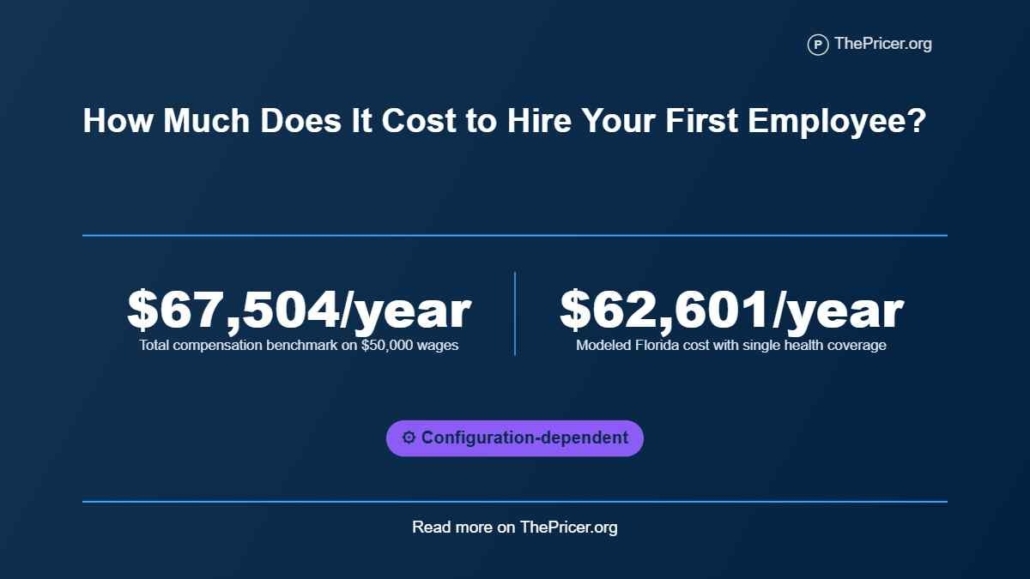
For a U.S. small business hiring its first W-2 employee, salary is only the starting point. A broad current benchmark puts total compensation about 35% above wages, based on compensation data for small establishments with 1 to 49 workers. Those employers reported $37.64 per hour in total compensation against $27.88 in wages. The ratio is 1.3501, so $50,000 of wages normalizes to about $67,504 in total compensation.
The cost stack for a first employee can include IRS-governed Social Security, Medicare, and FUTA taxes, state unemployment insurance, workers’ compensation, payroll administration, health insurance, retirement contributions, recruiting, background screening, equipment, and job-specific software.
FICA and FUTA are federal employer costs, SUTA depends on the employee’s work state, and benefit choices can move the annual budget far more than a simple payroll-tax estimate. These components belong in one hiring budget, but they should not be counted twice.
The $67,504 figure is a compensation benchmark, not a first-hire invoice. A cash budget can be lower or higher because the BLS measure already contains categories such as paid leave, insurance, retirement, and legally required benefits, while a new employer can also face one-time recruiting, screening, equipment, and setup expenses. The itemized cases below separate those layers instead of applying one salary multiplier to every business.
Article Highlights
Jump to sections
- A $50,000 (at $30 per hour, earning that amount would take about 9.6 months of full-time work, before taxes) salary creates about $3,825 of employer Social Security and Medicare tax when all wages are below the 2026 Social Security wage base.
- Normal-credit FUTA on one employee reaches $42 after the maximum state unemployment credit.
- A modeled Florida recurring cash cost reaches about $62,601 with payroll software and average employer-paid single health coverage.
- BLS data for 1 to 49-worker private establishments implies a 1.350 compensation-to-wage ratio.
- State unemployment tax can change sharply even when salary stays fixed.
- Recruiting, screening, equipment, workers’ compensation, and local requirements can push first-year spending above the recurring model.
How Much Does It Cost to Hire Your First Employee in the U.S.?
For most ordinary W-2 wages, the employer side starts with Social Security, Medicare, and FUTA. The IRS sets the 2026 employer rates for Social Security at 6.2% on wages up to $184,500 (about 3 years of full-time work at $30 per hour), employer Medicare at 1.45% with no wage cap, and FUTA at 6.0% on the first $7,000 of wages with a maximum 5.4% state unemployment credit when the employer meets the credit conditions.
A $50,000 salary stays below the Social Security ceiling, so Social Security and Medicare total 7.65%, or $3,825. With the full FUTA credit, 0.6% of the $7,000 federal wage base adds $42. The combined federal employer tax in this case is $3,867, equal to 7.734% of salary.
The $42 FUTA figure is a normal-credit case rather than a universal bill. Credit-reduction rules or failure to meet the full-credit conditions can raise it. Published federal rates make this layer straightforward to model accurately, while state unemployment insurance, workers’ compensation, payroll administration, health coverage, and elective benefits create more variation. Salary also matters because Social Security stops at its wage base while Medicare continues on covered wages above that point.
What Counts as Hiring Cost?
The cleanest first-hire budget separates three buckets. Acquisition covers job advertising, recruiter fees, screening, interview time, and other costs incurred before the employee starts. Payroll cash covers wages, employer payroll taxes, state unemployment charges, payroll administration, insurance, and chosen benefits. Total compensation is the wider statistical measure that can include paid leave, supplemental pay, insurance, retirement, and legally required benefits.
Mixing those buckets can create a false total. A salaried employee who receives paid vacation does not automatically require the employer to add another cash payment for each vacation hour on top of the annual salary. BLS compensation data still assign an hourly value to paid leave because the measure describes compensation for hours worked. That is why a broad benefits ratio belongs in planning, not on an invoice.
Using the June 2026 BLS figures cited above, private establishments with 1 to 49 workers had $37.64 (about 1.3 hours of work at $30 per hour) per hour of total compensation and $27.88 in wages. Dividing those figures gives 1.3501. Applied conditionally to $50,000 of wages, that ratio produces about $67,504 of total compensation. It is a benchmark, not a quote for a new employer.
State Costs
State unemployment insurance can make identical salaries produce different employer bills. Florida assigns new employers a 2.7% rate on the first $7,000 of wages. That produces $189 for a new employer once the worker earns at least the taxable wage base.
Washington shows why a national SUTA percentage is weak budgeting. The state sets new-employer UI rates at 115% of the industry’s average rate, subject to a 1% minimum, and the taxable wage base is $78,200. A $50,000 employee creates at least $500 of UI tax before the Employment Administration Fund component. The actual new-employer rate can be higher.
That floor is $311 above the Florida new-employer charge on the same salary. The gap comes from the taxable wage base and rate structure, not from higher pay. Workers’ compensation adds another location-sensitive layer. Federal labor guidance directs employers to state programs, reflecting state-level administration, so a national article cannot responsibly assign one premium to every occupation. The premium is left outside the national model because no occupation or state has been fixed.
Benefits Can Overtake Taxes
Federal small-business rules do not require health insurance from employers with 1 to 50 full-time-equivalent employees and impose no federal penalty for declining it. Eligible businesses can still choose SHOP or another source of coverage. Health insurance is a budget choice for this modeled employer, not a mandatory line item.
Once coverage is offered, the dollar effect can exceed federal employer payroll taxes. KFF’s 2025 survey reported average annual premiums of $9,325 for single coverage and $26,993 for family coverage. Average worker contributions were $1,440 and $6,850. Subtracting those contributions gives implied average employer shares of $7,885 for single coverage and $20,143 for family coverage.
Compare those figures with the $3,867 federal employer FICA-plus-FUTA case at a $50,000 salary. The single-coverage contribution is about 2.04 times that federal tax bill. The family contribution is about 5.21 times as large. This comparison does not predict a quote for a one-person firm because KFF surveys employers with ten or more workers. It does show why health coverage can move a hiring budget farther than payroll-tax estimates suggest. Readers comparing individual coverage can also review current ACA health insurance costs.
Recruiting and Payroll Setup
Small employers can start with modest published service prices, but hiring acquisition costs vary widely by role. Gusto lists its Simple payroll price at $49 per month plus $6 per person for single-state payroll and includes payroll tax filing and payments. One employee makes the published arithmetic $55 per month, or $660 for 12 months, before add-ons. An employer comparing platforms can also check current ADP payroll costs.
Job advertising can start at no charge or become a recurring campaign. The platform says many jobs can be posted free, subject to its rules, while its published sponsored-job budget floor begins at $5 per day or $150 per month and can be higher by role and market. That makes $150 a usable low-end monthly scenario, not an average. More detail on the platform sits in the related job posting cost article.
Screening creates another per-hire charge when the employer chooses or needs it. Checkr lists three screening package levels, with Basic at $29.99, Essential at $59.99, and Complete at $94.99 per report, with possible pass-through fees. A separate background check cost comparison covers other screening scopes. A broad cost-per-hire benchmark should not be stacked onto the itemized advertising and screening scenario because an organization-level recruiting measure can overlap with spending already counted.
Three First-Hire Budgets
Three views answer three different questions. The lean cash case asks how much a $50,000 Florida employee costs after the major federal payroll taxes, Florida reemployment tax, and one year of basic payroll software. The health case adds KFF’s implied average employer share for single coverage. The compensation benchmark applies the BLS small-establishment ratio to wages and captures a much wider package of benefits.
| Budget view | Modeled annual amount | What it contains |
|---|---|---|
| Lean recurring cash | $54,716 | $50,000 salary, $3,825 employer FICA, $42 FUTA, $189 Florida UI, $660 payroll software |
| Cash with single health coverage | $62,601 | Lean case plus $7,885 modeled employer health contribution |
| Washington minimum-UI cash case | At least $55,027 | $50,000 salary, $3,825 employer FICA, $42 FUTA, at least $500 Washington UI, $660 payroll software, before EAF |
These totals are not competing estimates of one invoice. The first two are constructed cash budgets with named assumptions. The Washington row isolates location risk by holding salary and the payroll service constant while changing the state UI structure. The BLS figure remains a separate broad normalization that contains paid leave, insurance, retirement, supplemental pay, and legally required benefits. Adding that BLS result to the itemized health and tax model would count some categories twice.
The useful planning range is built by choosing the view that matches the decision. A founder checking bank runway should start from the recurring cash model and add actual quotes for workers’ compensation, equipment, software, and benefits. A founder comparing compensation against a wider labor-market benchmark can use the BLS normalization as a reference point, not as a payable total.
Worked First-Hire Model
 Consider an illustrative Florida employer hiring one full-time worker at $50,000 a year. Salary contributes $50,000. Employer FICA adds $3,825. Normal-credit FUTA adds $42. Florida reemployment tax adds $189. Gusto Simple adds $660 across 12 months. The KFF-derived employer share for average single coverage adds $7,885. One month at the sponsored-job floor adds $150, and one Checkr Basic report adds $29.99.
The arithmetic is $50,000 + $3,825 + $42 + $189 + $660 + $7,885 + $150 + $29.99 = $62,780.99. Remove the modeled one-time advertising and screening charges and the recurring annual case is about $62,601. The first-year acquisition increment in this narrow example is only $179.99 because it uses the published minimum sponsored-job monthly budget and one basic Checkr report.
That total still excludes workers’ compensation, a laptop, furniture, occupation-specific software, retirement contributions, bonuses, local payroll taxes, paid recruiter services, and any additional advertising. Those omissions are deliberate. They cannot be priced nationally without inventing a role, location, plan, or vendor. The model is reproducible because every included rate has a defined source and every excluded category is named.
The hardest comparison is not salary versus salary. It is a fully scoped first-year cash requirement versus the business’s available cash. A company that needs a $2,000 laptop, a role-specific software seat, and an insurance quote should add those actual amounts to $62,780.99 instead of applying a generic salary multiplier.
Employee or Contractor?
A contractor can look cheaper because the business usually does not withhold employment taxes or pay the matching employer FICA on contractor payments. That does not make contractor status an elective discount. The IRS says classification depends on the facts showing control and independence, grouped around behavioral control, financial control, and the type of relationship. The IRS uses multiple classification factors, and no single factor decides every case.
A fair cost comparison starts after classification. If the relationship is genuinely independent, compare the contractor’s quoted fee with the employee’s salary, employer taxes, benefits, insurance, payroll administration, equipment, and management needs. If the facts point to employee status, a lower contractor invoice does not erase the employer obligations tied to that relationship.
Makes sense if
- The business needs continuing work that fits an employee relationship.
- The recurring cash model leaves room for state insurance and role-specific costs.
- The company wants tighter direction over how and when the work is performed.
- Benefits or long-term retention matter to the role.
Does not make sense if
- The business cannot fund payroll and employer taxes through a realistic revenue dip.
- The work is short, independent, project-based, and the facts support contractor treatment.
- Required equipment, insurance, or software pushes the real first-year total beyond available cash.
- The owner has budgeted only salary and has not priced state-specific obligations.
Answers to Common Questions
How much should a business budget above a new employee’s salary?
There is no single national percentage. A $50,000 Florida case modeled here reaches about $54,716 before health coverage and about $62,601 after adding the KFF-derived single-coverage employer contribution. Workers’ compensation, equipment, retirement, and role-specific costs still sit outside that figure.
What federal payroll taxes does an employer pay?
For the modeled $50,000 worker, employer Social Security and Medicare total $3,825. Normal-credit FUTA adds $42. Higher wages, FUTA credit reductions, and special worker categories can change the calculation.
Does a first employee have to receive health insurance?
A business with 1 to 50 full-time-equivalent employees is not subject to a federal penalty for declining to offer employee health insurance. A small employer can still choose group coverage if eligible.
Is a contractor always cheaper than an employee?
No. Contractor pricing can avoid some employer payroll costs, but worker status depends on the actual relationship. A valid comparison uses the contractor’s fee against the employee’s full recurring cost only after classification is resolved.
Disclosure: Educational content, not financial advice. Prices reflect public information as of the dates cited and can change. Confirm current rates, fees, taxes, and terms with official sources before purchasing. See our methodology and corrections policy.