
How Much Does It Cost to Increase a Nuclear Plant’s Power Output?
Published on | Written by Alec Pow
This article was researched using 13 sources. See our methodology and corrections policy.
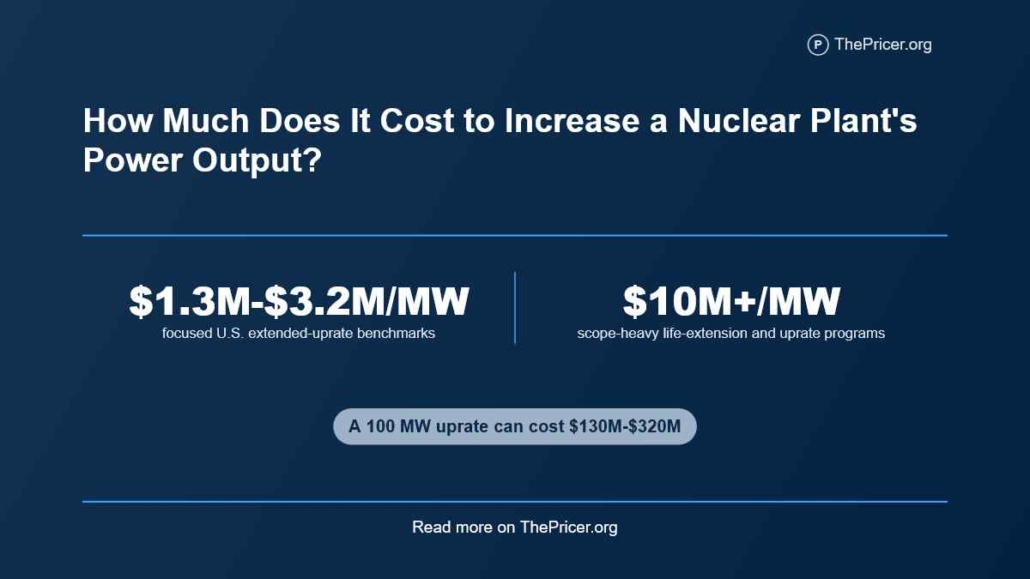
Increasing the power output of an existing U.S. nuclear plant can cost roughly $1.3 million to $3.2 million per added megawatt in relatively focused extended power uprate projects documented in public records. A 100 MW increase at that scale points to roughly $130 million to $320 million. Projects that combine the uprate with life extension, major refurbishment, financing and sitewide upgrades can climb above $10 million per added MW.
The range is wide because a nuclear uprate is not one standard construction package. A small increase may come from more accurate instrumentation and revised operating limits. A major extended uprate can require turbines, pumps, generators, transformers, fuel changes, engineering, licensing, testing and work during several refueling outages.
The question is newly relevant. Reuters reported on October 3, 2026 that the federal government plans roughly $4.2 billion in financing for Vistra as the company pursues nuclear output increases. That financing headline should not be mistaken for the direct construction cost of the added megawatts.
Article Highlights
Jump to sections
- TVA’s Browns Ferry extended uprate finished at about $457 million (at $30 per hour, earning that amount would take about 7.3 thousand years of full-time work, before taxes) and added roughly 353 MW of validated summer capacity, about $1.29 million per added MW.
- Exelon approved $419 million for its share of a Peach Bottom extended uprate expected to add about 130 MW to that ownership share, roughly $3.22 million per MW.
- Monticello’s combined life-extension and uprate program reached about $748 million for a 71 MW capacity increase, or about $10.5 million per MW.
- The NRC classifies uprates as measurement uncertainty recapture, stretch, or extended power uprates, with extended increases approved as high as 20%.
- NRC expects 31 uprate applications from 2026 through 2032 representing about 2,421 MW of additional electric capacity.
- A federal loan, power purchase agreement or plantwide refurbishment budget should not be divided by added MW and presented as a pure uprate construction price.
How Much Does an Uprate Cost?
There is no national fixed price per reactor. The best way to price an uprate is to separate focused capacity work from projects carrying other capital needs.
| Project | Published cost | Added capacity | Calculated cost per added MW | Scope warning |
|---|---|---|---|---|
| Browns Ferry | $457 million (about 7.3 thousand years of full-time work at $30 per hour) | 353 MW validated | $1.29 million/MW | Focused three-unit extended power uprate |
| Peach Bottom | $419 million | 130 MW ownership share | $3.22 million/MW | Approved Exelon share of the EPU |
| Monticello | $748 million | 71 MW | $10.54 million/MW | Combined life-cycle management and uprate program |
| Calvert Cliffs current investment | More than $3 billion | About 190 MW planned | More than $15.8 million/MW if divided directly | Includes plantwide improvements and license-life investment, not a pure uprate budget |
Browns Ferry is the cleanest completed cost benchmark in this group. TVA’s final filing says the extended power uprate cost $457 million and raised summer net capability by about 353 MW. That works out to roughly $1.29 million per added MW.
The Peach Bottom number sits higher. A public SEC filing says Exelon approved $419 million for its uprate share, expected to add roughly 130 MW to its ownership share. The quotient is about $3.22 million per MW.
Those examples support a practical planning band near $1 million to $4 million per added MW for major uprates with relatively clean scope. They do not create a guaranteed industry price.
What an Uprate Actually Changes
A power uprate raises the maximum licensed thermal power of an operating reactor so it can produce more electricity. The reactor does not simply turn a dial past its old setting.
More reactor heat produces more steam. Pipes, valves, pumps, heat exchangers, turbines, electrical equipment and cooling systems must be able to handle the higher flows and loads. Fuel loading may change too. The NRC’s uprate description notes that plants may use more fresh fuel or higher enrichment and may have to replace major components when existing equipment lacks enough margin.
The final capacity gain is electric output, but licensing begins with reactor thermal power. Plant efficiency, generator performance, cooling conditions and other equipment determine how much of the added reactor heat becomes usable megawatts on the grid.
Three Uprate Types
The NRC divides reactor uprates into three main classes. The type determines how extensive the engineering and equipment work may become.
Measurement uncertainty recapture uprates are below 2%. They rely on more accurate methods for measuring reactor power, including improved feedwater-flow measurement. They can recover operating margin without the equipment replacement associated with a large extended uprate.
Stretch uprates are commonly up to about 7%. They stay within plant-specific design margins and often involve instrumentation or operating-setpoint changes rather than large modifications.
Extended power uprates go beyond the stretch range and have been approved for increases as high as 20%. These can require changes to high-pressure turbines, condensate pumps and motors, generators, transformers and other balance-of-plant equipment.
The pricing implication is straightforward. A 1% measurement recapture and a 15% extended uprate are not comparable products. One is largely a measurement, analysis and licensing exercise. The other can become a multiyear heavy-equipment project.
Real Project Costs
TVA initially expected the Browns Ferry project to cost about $475 million (about 7.6 thousand years of full-time work at $30 per hour) and add around 465 MW. The completed project eventually cost $457 million, but the validated summer-capability increase was about 353 MW.
That changes the cost ratio. Using the early estimate gives about $1.02 million per expected MW. Using the final validated capacity gives $1.29 million per MW. The project’s dollar cost fell slightly while its realized capacity metric made the cost per added MW about 27% higher than the early headline ratio.
Monticello shows the opposite end of the spectrum. Xcel’s combined life-cycle management and extended power uprate project increased the plant from 600 MW to 671 MW. The company reported approximately $665 million in project expenditures and about $748 million in total capitalized costs including allowance for funds used during construction.
The project had originally been estimated near $320 million before financing costs. Comparing $748 million with $320 million shows a final capitalized total about 134% above that early estimate.
Dividing $748 million by the 71 MW increase produces roughly $10.54 million per MW. That does not mean a normal nuclear uprate costs $10.5 million per MW. The Monticello program also carried life-extension and broader plant work, which is precisely why scope labels matter.
New Deals Look Like Billions
Current announcements can make uprates appear much more expensive than the older focused projects.
Vistra’s January 2026 agreement with Meta covers 433 MW of planned added nuclear capacity across Perry, Davis-Besse and Beaver Valley. Vistra identifies the split as 213 MW at Perry, 80 MW at Davis-Besse and 140 MW at Beaver Valley.
Dividing the reported $4.2 billion federal financing plan by 433 MW produces about $9.7 million per MW. That is not a valid construction-cost conclusion. A loan is a financing vehicle, and the final project scope and eligible uses have not yet been published as a clean three-plant uprate invoice.
Calvert Cliffs creates the same trap. Constellation says its new Amazon agreement will support more than $3 billion in infrastructure investment and about 190 MW of added nuclear capacity between 2030 and 2032.
A direct division gives more than $15.8 million per added MW. The company says the investment also covers improvements across the 1,790 MW plant and supports another 20 years of operation. It is not evidence that the 190 MW uprate itself costs more than $3 billion.
The same warning applies to DOE’s $26.5 billion Southern Company loan package. It supports more than 200 energy projects spanning gas generation, nuclear license renewals and uprates, hydropower, batteries and transmission. It cannot be divided by the planned nuclear uprate megawatts to manufacture a reactor-upgrade price.
The Hidden Cost Layers
 The equipment contract is only one part of a major uprate budget. Engineering teams must rerun safety analyses for the higher reactor power, evaluate equipment margins and prepare the license amendment. Large projects also need procurement, fabrication, installation, testing and power-ascension work.
The NRC currently targets reviews of roughly six months for a measurement uncertainty recapture application, nine months for a stretch uprate and 12 months for an extended uprate. Those are review targets rather than guarantees.
The regulatory fee is not a small flat permit. NRC regulations set the professional staff-hour rate at $318 per hour for most reactor licensing work. The utility also pays its own engineers, vendors, consultants and legal staff to build and defend the application.
Extended uprates are commonly installed during scheduled refueling outages. That reduces the need for a separate shutdown, but heavy work can still affect outage duration. Every extra day a reactor remains offline represents lost generation as well as labor and contractor expense.
Fuel can become another recurring cost. Higher power can require more fresh fuel, higher enrichment, different batch fractions or advanced fuel designs. Idaho National Laboratory notes that pushing reactor output higher without better fuel can shorten operating cycles or increase fuel reload requirements, which can erode the economics of the extra megawatts.
What One Added Megawatt Produces
An added nuclear megawatt is more valuable than nameplate capacity alone suggests because U.S. reactors run at high utilization. EIA reports that the U.S. nuclear fleet averaged a 91% capacity factor in 2025.
At that utilization, each added 1 MW can produce about 7,972 MWh in a year. A 100 MW uprate can produce roughly 797,000 MWh annually before plant-specific losses or operating constraints.
Browns Ferry’s 353 MW validated increase translates to about 2.81 million MWh per year at a 91% capacity factor. If the $457 million capital cost is divided across 20 years of that modeled incremental production, the simple capital burden is about $8.12 per MWh.
That $8.12 is not a levelized cost of electricity. It excludes financing, fuel, operation, maintenance, taxes and the time value of money. It does show why a successful uprate can be economically attractive when the plant already exists.
Idaho National Laboratory places new large light-water-reactor construction near $10 million per MW as a broad planning figure. Browns Ferry’s $1.29 million per added MW is roughly 7.7 times lower, although the figures come from different years and measure different construction scopes.
When the Economics Work
An uprate is most attractive when the reactor has unused design margin, major equipment can tolerate the added load, the work fits inside planned outages and the plant has enough remaining licensed life to earn back the investment.
The U.S. is moving back toward this strategy. NRC’s current expected-application list shows 31 anticipated uprates through 2032, including 19 extended uprates. Together, they represent about 2,421 MW of potential added electric capacity.
DOE’s UPRISE initiative is pushing in the same direction, targeting existing plants as a faster source of additional generation. That matters as large new loads increase grid demand. The economics connect directly with the cost pressure from AI data centers, where dependable new capacity can require large transmission and generation investment.
A utility should not chase added MW at any price. Monticello shows how a combined modernization program can become far more expensive than its early estimate. Calvert Cliffs shows why a plantwide life-extension package should not be judged solely on uprate MW. Vistra shows why financing size and construction cost are different numbers.
Makes sense if
- The plant has real thermal and equipment margin available.
- The project can be installed during scheduled refueling outages.
- The reactor has decades of operating life remaining or a credible license-extension path.
- The local grid and power market need dependable incremental capacity.
Does not make sense if
- Major cooling, turbine, generator and transmission systems all need replacement solely to gain a small number of MW.
- The plant is near retirement with no long-term operating plan.
- A published financing package is being mistaken for the physical uprate budget.
- The project bundles so much unrelated refurbishment that the added MW no longer explain the capital decision.
For comparison with another high-capacity-factor generation option, a new geothermal power plant commonly requires several million dollars per installed MW before resource and site risk are resolved. Nuclear uprates have the advantage of using an operating site, existing staff and much of the existing grid connection.
The demand side also matters. Cooling a large computing campus can itself cost tens of millions per year, as shown in the AI data-center cooling cost. Long-term technology-company power deals are one reason existing nuclear plants are again considering large uprates.
Answers to Common Questions
How much does a 100 MW nuclear uprate cost?
Using focused public U.S. extended-uprate benchmarks, a 100 MW project can land near $130 million to $320 million. The plant’s equipment, cooling system, fuel plan and required replacements can move the total well outside that range.
What is the cheapest type of nuclear power uprate?
Measurement uncertainty recapture uprates are usually the least equipment-intensive because they raise licensed output by less than 2% through more precise power measurement and supporting analyses.
How large can a nuclear uprate be?
NRC says extended power uprates have been approved for increases as high as 20% of licensed reactor power.
Does a nuclear plant need a new operating license to uprate?
No new reactor license is normally issued. The operator requests amendments to its existing operating license and technical specifications, and the NRC must approve the higher licensed power level before operation at that level.
Is an uprate cheaper than building a new nuclear reactor?
It can be much cheaper when the existing plant has usable design margin. Browns Ferry’s completed uprate cost about $1.29 million per added MW, while a recent INL planning document places a new large light-water reactor near $10 million per MW. The comparison is directional because the figures come from different periods and project scopes.
Disclosure: Educational content, not financial advice. Prices reflect public information as of the dates cited and can change. Confirm current rates, fees, taxes, and terms with official sources before purchasing. See our methodology and corrections policy.