
How Much Does It Cost to Install a 50-Gallon Water Heater?
Updated on | Researched and reviewed by Alec Pow, Founder & Pricing Investigator
Prices, claims, and calculations checked against 14 cited sources. See our research methodology and corrections policy.
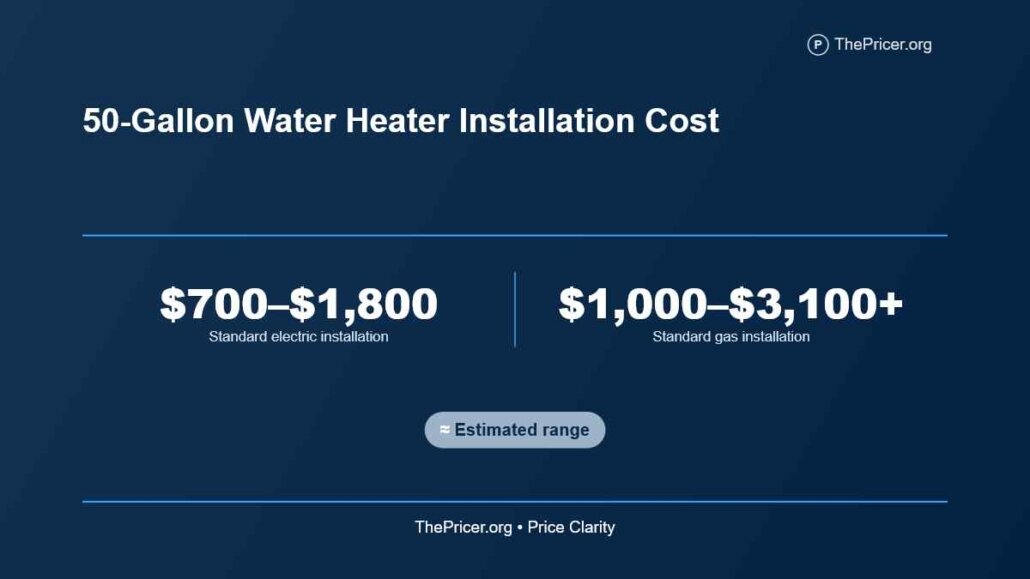
Installing or replacing a 50-gallon water heater in the United States can cost about $700 to $1,800 for a standard electric model, $1,000 to $3,100+ for a gas model, and roughly $2,300 to $4,400 for a 50-gallon hybrid heat-pump model.
Current 50-gallon replacement pricing shows that the tank itself may be only part of the invoice. Labor, venting, electrical work, permits, disposal, an expansion tank, drain work, and code-related changes can add hundreds or thousands of dollars. A direct swap in an open utility area sits near the lower end. Fuel conversion, difficult access, new venting, or electrical upgrades can move the project much higher.
Article Highlights
Jump to sections
- Standard 50-gallon electric replacements commonly cost about $700 to $1,800 installed.
- Gas 50-gallon replacements can run about $1,000 to $3,100+ installed.
- Current 50-gallon Rheem equipment examples start around $539 for standard electric and $729 for standard gas.
- A 50-gallon hybrid heat-pump unit can cost about $1,699 before installation.
- Venting, permits, disposal, and expansion-tank work can materially change a quote.
- Tank capacity alone does not tell you how much hot water the unit can deliver during the busiest hour.
\How Much Does It Cost to Install a 50-Gallon Water Heater?
Installed price changes sharply by fuel type. HomeGuide currently places a 50-gallon electric replacement at $700 to $1,800, gas at $1,000 to $3,100+, and a 50-gallon heat-pump system at $2,300 to $4,400. Those totals include labor but can still move when the home needs new venting, wiring, plumbing, or code-related work.
Current retail listings also show why equipment price alone is not the project price. A January 2026 installation-cost dataset places electric 50-gallon jobs at $700 to $1,900, gas or propane at $900 to $2,500, and hybrid heat-pump installations at $2,000 to $5,500. Home Depot’s current basic 50-gallon electric listings, 50-gallon gas listings, and 50-gallon heat-pump listings support the unit examples in the table. The installed bands and retail prices come from different datasets and should not be blended into one false national average.
| 50-gallon type | Current unit example | Current installed estimate |
|---|---|---|
| Standard electric | Basic six-year electric model $539 |
$700 to $1,900 |
| Standard natural gas | Standard gas retail range $729 to $929 |
$900 to $2,500 |
| Gas power vent | Current 50-gallon retail example $1,429 |
Varies with vent work |
| Hybrid heat pump | Current heat-pump models $1,529 to $2,119 |
$2,000 to $5,500 |
The ranges should be read by configuration, not as quality grades. A standard gas tank, a power-vent gas heater, and a heat-pump unit solve the same basic hot-water problem through different equipment and installation requirements.
What 50 Gallons Means
A 50-gallon water heater is a storage-tank system with a nominal tank capacity near 50 gallons. It can use electric resistance elements, a gas burner, propane, or a heat-pump system. The tank stores heated water so showers, sinks, a dishwasher, and laundry can draw from the same supply. The purchase is not comparable with a tankless unit, which heats water as it flows rather than keeping a large reserve hot.
Capacity is only one performance measure. A storage heater also has a First Hour Rating, which estimates how much hot water the unit can supply during a busy hour after starting with a fully heated tank. Two 50-gallon models can deliver different first-hour amounts because burner input, element wattage, and recovery performance differ. Tank volume tells you how much water is stored, while First Hour Rating gives a better picture of short-period delivery.
That distinction matters. A family that uses several showers and an appliance close together may need a higher First Hour Rating even if a 50-gallon tank seems large enough on paper. A lower-demand household may be fully served by the same nominal tank size with no need to pay for a larger unit.
Electric, Gas, or Heat Pump
Standard electric resistance tanks usually have the lowest equipment and installation entry point. They need the correct electrical circuit but no combustion vent. Gas models may require venting, a gas connection, combustion-air provisions, and more labor. They can also recover hot water faster than many standard electric tanks, but the actual first-hour performance depends on the burner input and model rather than fuel name alone.
Heat-pump water heaters are electric but use a compressor to move heat from surrounding air into the tank. These units also need condensate drainage and suitable installation conditions, and some projects require electrical changes. Their higher equipment cost buys a different efficiency technology rather than a larger nominal tank. This is why a heat-pump quote should be compared with a standard electric quote on installed scope and future energy use, not shelf price alone.
Fuel conversion deserves its own quote. Moving from gas to electric can require circuit work and may leave old venting to be addressed. Moving from electric to gas can require a gas line and vent system. A same-fuel replacement is usually the cleaner comparison. The gas examples also show a $200 spread between the current six-year and 12-year standard models before labor, giving buyers a concrete warranty-price tradeoff to compare.
Labor and Code Add-Ons
The hidden-price section of a 50-gallon replacement is the work around the tank. Current water-heater labor data puts standard 40- to 50-gallon electric labor at $200 to $600 and gas labor at $400 to $1,000. A 50-gallon project can also require plumbing changes, electrical work, vent changes, drain-pan work, a temperature-and-pressure discharge route, or an expansion tank.
The same current source puts applicable permit costs around $50 to $200+, old-unit disposal around $75 to $500, and basic installation materials around $150 to $500. A new dedicated electrical circuit can add $250 to $900 when needed. Disposal may already be bundled, so it should not be added twice. Gas venting and expansion control can create more work even when they are not separate line items on the quote.
Local code controls the actual requirements. The old claim that most U.S. areas do not require a permit is too broad. The installer should identify the permit, inspection, expansion-control, drain, vent, electrical, and seismic requirements that apply at the property. A quote that includes these items should not be compared directly with a unit-only store price. Readers comparing contractor charges can also use current plumber pricing to understand labor rates outside the heater itself.
A Direct-Replacement Example
Consider an illustrative 50-gallon electric replacement using the current inputs established above. Start with a basic Rheem electric tank at $539. Add electric installation labor of $200 to $600, a separately billed permit of $50 to $200, old-unit disposal of $75 to $500, and basic installation materials of $150 to $500. This scenario assumes each item is billed separately, which will not be true for every contractor.
The low side is $539 + $200 + $50 + $75 + $150 = $1,014. The high side is $539 + $600 + $200 + $500 + $500 = $2,339. That produces a modeled installed total of $1,014 to $2,339 before sales tax or any unexpected wiring, piping, venting, or structural work.
This calculation shows why a shelf price near $539 can turn into a four-figure invoice without the tank itself becoming more expensive. At the low side, non-unit charges add $475. At the high side, they add $1,800, more than three times the equipment price.
For retailer-specific installation planning, the separate guide to Home Depot water heater installation covers the purchase-plus-install model rather than a general contractor replacement.
Operating Cost and Payback
Electric operating cost should be based on energy use, not by multiplying element wattage by an assumed number of full-power hours. The U.S. Energy Information Administration reports a June 2026 residential electricity average of 18.34 cents per kWh. Actual water-heating cost still depends on hot-water demand, incoming-water temperature, thermostat setting, standby losses, and the heater’s efficiency.
Heat-pump models can change that operating-cost picture. ENERGY STAR says a certified heat-pump water heater can save a four-person household about $550 per year compared with standard electric resistance heating under its stated assumptions. Compare the current $1,699 Rheem heat-pump example with the $539 basic electric model. The equipment premium is $1,160.
If the household achieved the ENERGY STAR savings estimate, $1,160 ÷ $550 gives an equipment-price payback of about 2.1 years. That is not an installed-project payback because electrical work, condensate routing, rebates, and local rates can change both sides. ENERGY STAR’s published savings model uses an electricity rate below the current June 2026 U.S. residential average, so the $550 figure should be treated as a modeled comparison rather than a household-specific forecast. It does show why the higher shelf price cannot be judged without operating cost.
Sizing and Recovery
A 50-gallon tank can suit many medium-demand households, but the better test is the home’s busiest hot-water hour. Rheem’s current sizing example combines two showers, one laundry load, and kitchen use into 55 gallons of peak-hour demand. In that case, the buyer should seek a heater with a First Hour Rating of at least 55 gallons rather than relying on tank capacity alone.
Recovery also explains why the old shower-count formula should be removed. A 50-gallon tank does not simply supply 50 gallons and stop. Cold water enters as hot water leaves, the heater begins reheating, and the water at the shower is mixed to a lower temperature. Rheem’s standard electric specifications include 50-gallon models in a line with First Hour Ratings from 33 to 62 gallons and recovery up to 21 gallons per hour at a 90°F rise, depending on model.
Tank size is not output. A family with simultaneous showers, a large soaking tub, or heavy laundry use should compare peak-hour demand with the specific model’s First Hour Rating. A household with staggered use may not need a larger tank at all.
Replacement Timing
Replacement timing depends on tank condition, water chemistry, maintenance, and installation quality. Current replacement guidance puts tank water-heater life around 8 to 12 years on average, with longer service possible under good maintenance. A leaking tank usually points toward replacement, while a failed heating element, thermostat, valve, or burner component may be repairable. The separate water-heater replacement cost guide is useful when the decision is broader than one 50-gallon configuration.
Warranty length can also change the equipment choice. Current retail lines offer different warranty periods across otherwise similar tank sizes, while heat-pump models often carry different coverage from standard resistance or atmospheric gas tanks. A longer warranty does not mean every installation will last that many years. Read the tank, parts, and labor terms separately because they may have different durations.
Makes sense if
- Your peak-hour demand matches the chosen model’s First Hour Rating.
- A same-fuel replacement avoids expensive conversion work.
- The quote separates the tank, labor, permits, disposal, and required code work.
- A higher-efficiency model produces enough projected savings to justify its added installed cost.
Does not make sense if
- You choose 50 gallons only from household headcount without checking peak demand.
- You compare a shelf price with a contractor’s complete installed quote.
- A fuel conversion adds wiring, gas-line, or vent work that was not priced.
- You assume a larger tank automatically delivers better first-hour performance.
For water-use issues around the home, current water meter costs provide a separate plumbing-cost reference.
Answers to Common Questions
How much does it cost to install a 50-gallon water heater?
A standard electric 50-gallon replacement commonly costs about $700 to $1,800 installed, while gas can cost about $1,000 to $3,100+. Hybrid heat-pump installations can run around $2,300 to $4,400.
How much does a 50-gallon water heater cost without installation?
Current basic Rheem examples start around $539 for standard electric and $729 for standard gas. Heat-pump models cost much more, with one current example at $1,699.
Is a 50-gallon water heater enough for four people?
It can be, but household count is only a screening tool. Compare the home’s busiest-hour demand with the model’s First Hour Rating before choosing the tank.
How long does a 50-gallon water heater last?
Tank water heaters commonly last around 8 to 12 years on average, while good maintenance and favorable operating conditions can extend service life.
How long does a 50-gallon water heater take to recover?
Recovery varies by model, fuel, input rating, and temperature rise. One current Rheem electric product line lists recovery up to 21 gallons per hour at a 90°F temperature rise.
Disclosure: Educational content, not financial advice. Prices reflect public information as of the dates cited and can change. Confirm current rates, fees, taxes, and terms with official sources before purchasing. See our methodology and corrections policy.