
How Much Does It Cost to Live Alone vs. With a Roommate?
Published on | Written by Alec Pow
This article was researched using 11 sources. See our methodology and corrections policy.
Living alone in the U.S. usually costs hundreds of dollars more each month than sharing a two-bedroom apartment with one roommate. In July 2026, the median one-bedroom asking rent across the 50 largest U.S. metros was $1,581 per month, while the median two-bedroom was $1,893 per month. Splitting that two-bedroom equally produces a rent share of $946.50 per person, a rent-only difference of $634.50 per month or $7,614 per year. Utilities, internet, deposits, local rent patterns, and personal spending determine how much of that advantage survives in a real household budget.
This comparison follows a U.S. renter choosing between a one-bedroom alone and an equal share of a two-bedroom with one roommate. Realtor.com and Zumper provide current asking-rent benchmarks, SmartAsset supplies city-level roommate comparisons, BLS consumer-unit data helps model shared household services, and HUD provides the housing-cost-burden reference used for the income comparison. Each source covers a different pricing input, so rent, shared services, move-in cash, and affordability are kept distinct rather than blended into a single unsupported national average.
Article Highlights
Jump to sections
- A current national metro comparison puts the rent-only roommate saving at $634.50 (at $30 per hour, earning that amount would take about 2.6 full-time workdays, before taxes) per month.
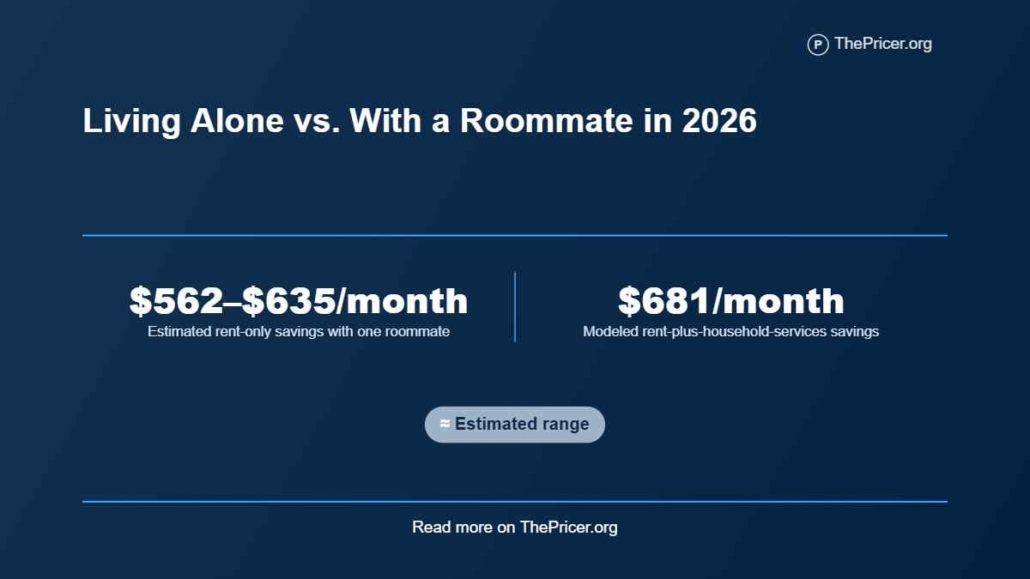
- An independent August 2026 rent index produces a lower rent-only saving of $561.50 per month.
- A modeled rent-plus-household-services comparison produces a gap of about $681 per month.
- Current city examples range from $250 per month saved in El Paso to $1,730 per month in New York City.
- The solo one-bedroom rent used here requires about $63,240 in annual gross income to equal 30% of income.
How Much Does It Cost to Live Alone?
The cleanest starting point is housing scope. Living alone means one renter pays the entire rent on a one-bedroom unit. The roommate case means two adults split a two-bedroom unit evenly. It does not assume that either person shares groceries, transportation, healthcare, phone costs, debt payments, or personal subscriptions. Those expenses depend on individual behavior and can remain almost unchanged after a roommate moves in.
A one-bedroom also is not simply half of a two-bedroom. The kitchen, living room, entry area, heating system, and many building amenities are shared spaces. That is why the second bedroom often raises the total apartment rent by much less than 100%. The pricing structure creates the economic opening for roommates. One person gives up exclusive use of the home, yet both renters divide a property whose total rent may be only modestly higher than the smaller unit.
Readers comparing leases can use the broader apartment rental cost guide for deposits, rent drivers, and leasing expenses. For this comparison, the useful unit is each renter’s monthly cash outflow. That keeps a $1,893 (about 1.6 full-time workweeks at $30 per hour) two-bedroom from being mistaken for a more expensive choice when one person’s equal share is only $946.50.
The Rent Gap
The current rent gap is large under more than one rental dataset, but its exact size changes with the source. Zumper’s August 2026 national index reports a median one-bedroom rent of $1,515 (about 1.3 full-time workweeks at $30 per hour) per month and a two-bedroom rent of $1,907 per month. Half of that two-bedroom is $953.50, leaving a rent-only saving of $561.50 per month compared with the one-bedroom.
Realtor.com’s July figures produce the larger $634.50 monthly difference used in the lead. The two results are not contradictory. They rely on different rental inventories and market methods. Together they create a useful current band of roughly $562 to $635 per month for this one-bedroom versus half-a-two-bedroom calculation. That equals about $6,738 to $7,614 per year in rent alone.
The key comparison is not the full two-bedroom rent against the one-bedroom rent. It is one renter’s share of the two-bedroom against the full cost of the one-bedroom. A renter who skips that division can conclude that adding a bedroom makes housing more expensive, even when the per-person cost drops sharply. The source choice also changes the measured gap before utilities enter the budget.
Bills You Can Split
Rent is only one shared expense. Home internet is a useful case because one connection can serve both roommates. BroadbandNow’s April 2026 research put the national average home internet plan at $81.16 per month, based on active residential plans and a consumer survey. An equal split turns that bill into $40.58 per person, saving one roommate $40.58 per month versus paying the same average plan alone.
Utilities do not divide as neatly. The one-person consumer-unit spending figure for utilities, fuels, and public services was $2,978 per year, or about $248.17 per month, in 2024. The comparable two-person consumer-unit spending figure was $4,837 per year, or about $403.08 per month.
Half of the two-person figure is about $201.54 per person per month. That is below the one-person figure by roughly $46.63 per month. This is a modeling proxy, not a measured roommate bill. BLS consumer units can include related households and people making joint spending decisions. It still shows why electricity, water, broadband, and other household services should not be assumed to double when a second person shares the dwelling. A separate monthly utilities cost guide gives more detail on bill categories.
Bills That Stay Personal
A roommate does not automatically reduce every line of a monthly budget. Food can fall if two people deliberately buy shared staples, yet separate diets, work schedules, and preferences can leave grocery spending mostly personal. The same is true for cell service, car costs, transit passes, medical spending, debt payments, clothing, entertainment, and many subscriptions. Counting those categories as a 50% roommate saving would inflate the benefit.
Renters insurance also needs careful treatment. Each person may have separate coverage, or the insurer and lease may set rules about who is named on a policy. The comparison here does not assign a dollar saving to insurance because the arrangement is not uniform. Furniture and household supplies sit between personal and shared costs. A sofa, cookware set, vacuum, cleaning supplies, or streaming device may be divided, provided both roommates agree on ownership and replacement rules.
This boundary matters for budgeting. A roommate usually attacks housing and household-level fixed costs most directly. The renter should start with the rent difference, add only bills that will actually be divided, then leave personal spending untouched unless there is a concrete sharing agreement. That produces a more credible estimate than cutting an entire living-cost budget in half. An affordability comparison that mixes rent with food and transport can be useful for a broader household plan, while the roommate decision needs a narrower shared-cost lens.
Move-In Cash
 The monthly saving can be attractive while the move-in bill still feels heavy. Zillow’s 2025 survey of renter costs found a median application fee of $50 among recent renters as a whole. For renters who paid a security deposit, the typical reported deposit was $795. In the same survey, 73% said first month’s rent was required to secure the rental and 24% said last month’s rent was required.
Those figures should not be added into one universal move-in total. A property can charge a different deposit, waive it, set an application fee per applicant, or use rules controlled by state and local law. A roommate may reduce a property-level deposit if the two renters divide it, yet each applicant can still face individual screening or application charges. The lease decides who owes the landlord, while any private split between roommates decides who reimburses whom.
For cash planning, use the actual listing and lease. Add the first rent payment, required deposit, application charges, moving costs, utility setup charges, and any last-month requirement. Then divide only the items the roommates have agreed to share. A cheaper monthly arrangement can still require substantial cash before move-in, so the first-year comparison should keep recurring savings separate from one-time entry costs.
Where Savings Change Most
Location can change the roommate payoff by more than $1,000 per month. SmartAsset’s April 2026 comparison across 100 cities measured one-bedroom rent against half of a two-bedroom. It found an average roommate saving of about $541 per month, with much wider results in individual markets.
New York City had the largest raw-dollar example cited in the study. Average one-bedroom rent was $4,380 per month, while half of the $5,300 two-bedroom was $2,650. The implied saving was $1,730 per month. Cleveland produced a different pattern. A $1,150 one-bedroom sat close to a $1,200 two-bedroom, so half of the larger unit was only $600. That yielded a $550 monthly saving, close to 48%.
El Paso shows why a national average cannot answer every local decision. Its one-bedroom figure was $850 and its two-bedroom was $1,200. A roommate’s half was $600, leaving only $250 per month in rent savings. The local relationship between one-bedroom and two-bedroom rents matters more than either rent viewed alone. Price both unit sizes in the same neighborhood and lease period before applying a citywide ratio.
The Full Monthly Comparison
A useful worked example combines rent with a household-services proxy without counting personal spending. Start with Realtor.com’s current $1,581 one-bedroom and $1,893 two-bedroom rents. Use the BLS figures already cited for utilities, fuels, and public services. The solo model becomes $1,581 plus $248.17, or $1,829.17 per month. The roommate model becomes $946.50 in rent plus $201.54 as one-half of the two-person services figure, or $1,148.04 per person per month.
| Cost item | Living alone | With one roommate |
|---|---|---|
| Rent | $1,581.00 per month | $946.50 per person per month |
| Utilities, fuels, public services proxy | $248.17 per month | $201.54 per person per month |
| Modeled recurring total | $1,829.17 per month | $1,148.04 per month |
| Modeled difference | $681.13 per month, about $8,173.50 per year | |
The $681.13 monthly result is an illustrative estimate, not a national measured roommate average. Its rent inputs come from a current asking-rent dataset, while its service inputs come from 2024 consumer-unit spending. It excludes food, transport, renter insurance, move-in charges, furniture, and other personal costs. The separate $81.16 broadband average is kept outside this model because the worked total already uses a bundled BLS household-services proxy rather than itemized utility bills.
A second sensitivity check uses Zumper rent instead. Its rent-only gap is $561.50 per month, which is $73.00 below the Realtor.com rent-only result. That spread is a reminder to run the same arithmetic with the actual one-bedroom and two-bedroom listings in the neighborhood where the renter plans to live.
When Living Alone Fits the Budget
One way to frame the privacy premium is to convert rent into an income threshold. HUD defines housing cost burden as monthly housing costs, including utilities, above 30% of monthly income. Using 30% as a reference point for rent alone, a $1,581 monthly one-bedroom corresponds to $63,240 in annual gross income. The $946.50 roommate rent share corresponds to $37,860.
The difference is $25,380 in annual gross income. That number does not mean someone below the threshold cannot live alone, and it is not a lease-approval rule. It shows how much more gross income is associated with keeping the same 30% rent share under these two current rent figures. Since HUD’s definition includes utilities, a complete housing-cost calculation would require income above the rent-only figures shown here.
Makes sense if
- The solo premium still leaves room for savings and irregular expenses.
- Privacy or working from home has enough personal value to justify the extra rent.
- The renter can cover the larger move-in cash requirement without relying on high-cost debt.
- Local one-bedroom pricing is relatively close to one person’s share of a two-bedroom.
Does not make sense if
- The rent gap would consume money needed for emergency savings or required debt payments.
- The local roommate saving is several hundred dollars each month and that cash has a higher priority.
- Solo housing would push recurring housing costs well past the renter’s own affordability limit.
- A compatible roommate is available and both renters know which shared bills they will pay.
The decision is not purely a percentage exercise. A renter choosing between the two arrangements can compare the annual roommate saving with the personal value placed on privacy, control of shared space, and lower interpersonal risk. The work-hours affordability research offers another way to express housing pressure by converting essential costs into work time.
Answers to Common Questions
How much can you save by having a roommate?
Current national datasets put the rent-only saving in this one-bedroom versus half-a-two-bedroom comparison at about $562 to $635 per month. Local results can be much lower or higher.
Is living alone twice as expensive?
No. A two-bedroom often costs less than twice a one-bedroom, which is why splitting the larger unit can reduce each person’s rent sharply. Personal costs also do not automatically change when a roommate moves in.
Should utilities be split 50-50?
An equal split is simple when both people use the home in similar ways, but roommates can choose another method. Put the split and reimbursement schedule in writing, then check the lease and account terms before assigning each bill.
How much income do you need to live alone?
Using the current $1,581 monthly one-bedroom figure and a 30% rent-to-income reference produces about $63,240 in annual gross income. A complete housing-cost test should also include utilities and the renter’s actual local rent.
Disclosure: Educational content, not financial advice. Prices reflect public information as of the dates cited and can change. Confirm current rates, fees, taxes, and terms with official sources before purchasing. See our methodology and corrections policy.