
How Much Does It Cost to Overhaul a U.S. Aircraft Carrier?
Updated on | Written by Alec Pow
This article was researched using 10 sources. See our methodology and corrections policy.
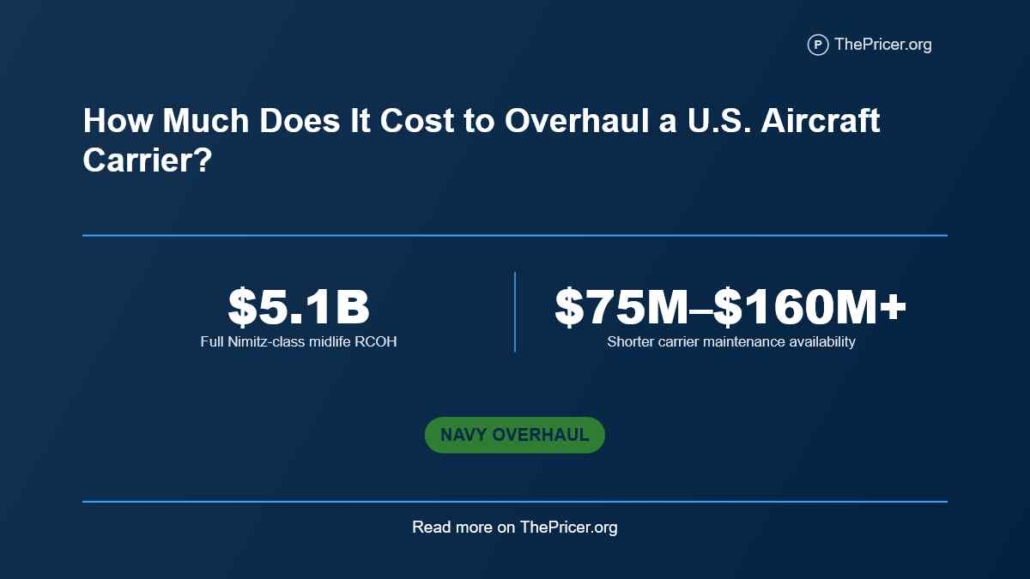
A full midlife overhaul of a U.S. nuclear aircraft carrier now costs about $5.1 billion. On September 29, 2026, Huntington Ingalls Industries received a $5,099,973,132 contract to perform the Refueling and Complex Overhaul, or RCOH, of USS Harry S. Truman (CVN 75). Contract options could raise the value to $5,183,380,744.
That is the closest thing to a current price for completely overhauling a Nimitz-class carrier. It includes far more than repairs. The ship’s nuclear reactors are refueled, aging systems are replaced, corrosion is repaired, propulsion and combat systems are modernized, and thousands of compartments and tanks are worked on so the carrier can serve for roughly another 25 years.
Not every carrier “overhaul” costs $5 billion. Shorter Planned Incremental Availabilities and Docking Planned Incremental Availabilities can cost tens or hundreds of millions of dollars. The multibillion-dollar RCOH happens only around the midpoint of a Nimitz-class carrier’s roughly 50-year life.
Article Highlights
Jump to sections
- A current full nuclear carrier RCOH costs about $5.1 billion (at $30 per hour, earning that amount would take about 82 thousand years of full-time work, before taxes), based on the September 2026 USS Harry S. Truman contract.
- Options could lift Truman’s execution contract to about $5.18 billion.
- Earlier execution contracts were approximately $2.8 billion for USS George Washington and $2.994 billion for USS John C. Stennis.
- An RCOH refuels the reactors and effectively rebuilds and modernizes large portions of the ship for another 25-plus years of service.
- RCOH represents roughly 35% of all depot-level maintenance performed during a Nimitz-class carrier’s life.
- Shorter carrier maintenance periods are dramatically cheaper. A recent USS Ronald Reagan DPIA contract started at about $74.9 million, while a USS Abraham Lincoln PIA completed in 2021 cost about $160 million.
How Much Does It Cost to Overhaul a U.S. Aircraft Carrier?
The answer depends on what the Navy means by overhaul. The largest scheduled maintenance event is the Refueling and Complex Overhaul. For that job, today’s strongest price benchmark is approximately $5.1 billion to $5.18 billion (about 82 to 83 thousand years of full-time work at $30 per hour).
| Carrier work | Public cost | Scope |
|---|---|---|
| USS Harry S. Truman RCOH, 2026 | $5.10B, up to $5.18B | Full midlife refueling and overhaul execution |
| USS John C. Stennis RCOH, 2021 | $2.994B initial contract | Full midlife refueling and modernization |
| USS George Washington RCOH, 2017 | $2.8B initial contract | Full midlife refueling and overhaul |
| USS Abraham Lincoln RCOH, 2013 | $2.6B execution contract | Full midlife refueling and overhaul |
| USS Abraham Lincoln PIA, 2020-2021 | About $160M | Shorter planned maintenance availability |
| USS Ronald Reagan DPIA, 2025 award | $74.9M initial order | Dry-docking repairs, maintenance and alterations |
The wide spread is not a contradiction. An RCOH and a routine carrier availability are fundamentally different jobs. Navy maintenance definitions describe a Docking Planned Incremental Availability as a labor-intensive dry-docking period generally lasting 16 months or less. An RCOH is the carrier’s one major midlife nuclear refueling and recapitalization event.
The Navy’s aircraft carrier cost therefore cannot be understood from the purchase price alone. A carrier that costs well over $10 billion to build can later require another multibillion-dollar industrial project simply to reach the second half of its intended service life.
What $5.1 Billion Buys
USS Harry S. Truman provides the newest example. HII announced on September 29, 2026 that Newport News Shipbuilding had received a $5.09997 billion RCOH execution contract. With options, the contract can reach $5.18338 billion.
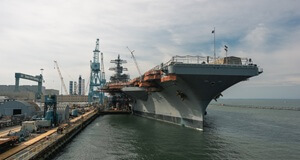
The carrier arrived at Newport News Shipbuilding on September 30, 2026, to begin the overhaul following years of advance planning. The work includes refueling the ship’s nuclear reactors plus extensive modernization in thousands of compartments and tanks. Propulsion equipment, combat systems and many other ship systems will also be upgraded or restored.
This is why “refueling” seriously understates the scope. Nuclear fuel is one part of a project that touches a large share of a roughly 100,000-ton warship.
The Navy says an RCOH is performed around the midpoint of a Nimitz-class carrier’s approximately 50-year lifespan. Its purpose is to leave the ship capable of completing another 25-plus years using the normal maintenance cycle.
The Price Has Jumped
The progression of recent contracts is striking.
USS George Washington received a $2.8 billion (about 45 thousand years of full-time work at $30 per hour) RCOH execution contract in 2017. USS John C. Stennis followed with a $2.994 billion contract in February 2021. Truman’s new award is approximately $5.10 billion.
Measured only against those initial execution awards, Truman is about $2.11 billion more expensive than Stennis. That is an increase of roughly 70% in nominal contract dollars in a little more than five years.
Against George Washington’s $2.8 billion award, the increase is approximately $2.30 billion, or 82%.
Those percentages do not mean the underlying cost of performing identical work rose by 70% to 82%. Inflation, ship condition, contract scope, modernization requirements, labor, material prices and work included outside the initial contract all differ. The comparison does show how far the nominal price of a new RCOH execution award has moved.
Delays Get Expensive
The USS John C. Stennis project demonstrates why the original contract is not necessarily the final taxpayer cost.
The Navy initially awarded $2.994 billion for Stennis in 2021, with completion then expected in August 2025. The schedule subsequently slipped as the shipyard encountered growth work and supply-chain difficulties.
By the FY2025 budget cycle, the Navy was seeking an additional $731.7 million associated with overhaul costs and the delayed redelivery. FY2026 documents subsequently included $483.1 million in cost-to-complete funding tied to cost growth, schedule effects, contract changes and equipment modifications. These evolving budget figures should not simply be added together because later requests can reflect updated treatment of previous requirements.
A separate 2024 contract modification added another $80 million for emergent supplemental work, and later modifications followed.
This creates one of the most important lessons in carrier pricing. The original RCOH award is a strong headline number, but discovered work and schedule delays can add hundreds of millions of dollars before the ship returns to the fleet.
Planning Costs Too
Another easily missed expense occurs before the carrier even enters the main overhaul.
In January 2024, the Defense Department awarded HII a separate $913.15 million contract for advanced planning and long-lead materials needed for Truman’s RCOH. The work covered engineering, material procurement and preparations necessary to make the ship ready for its eventual overhaul.
That planning contract later received additional modifications for long-lead materials and other preparation.
Consequently, the newly announced $5.1 billion execution award should not automatically be interpreted as every dollar ever spent preparing for and conducting Truman’s midlife overhaul. Substantial planning and material spending was already underway under another contract.
This is the hidden accounting issue that makes a carrier overhaul more expensive than the number most readers see in a headline.
Cost Per Added Year
There is another useful way to evaluate a $5.1 billion overhaul.
The RCOH is intended to prepare a carrier for roughly another 25-plus years of service. Using only Truman’s $5.09997 billion execution contract:
$5.09997 billion ÷ 25 years = about $204 million per additional year of carrier service.
If every option were exercised and the contract reached $5.18338 billion, the equivalent would be approximately $207 million per year.
That calculation does not include normal operating expenses or subsequent maintenance. It simply spreads the one-time midlife recapitalization across the second half of the ship’s planned life.
There is an even more revealing comparison. The final procurement cost of USS Gerald R. Ford was approximately $13.3 billion in nominal dollars, according to the Congressional Budget Office. Truman’s $5.1 billion execution contract equals about 38% of that amount.
In raw dollars, the difference is roughly $8.2 billion. This is not a claim that the Navy could substitute a new Ford-class carrier for an RCOH at those exact prices. The ships have different capabilities, procurement dates and remaining service lives. It does illustrate why spending several billion dollars to extract another quarter-century from an existing hull can still be economically significant compared with building another nuclear supercarrier.
RCOH Versus Replacement
The latest Ford-class ships reinforce that comparison. Current Navy estimates put individual Ford-class procurement in roughly the $13 billion to $15 billion range depending on the ship. CVN-80 Enterprise is estimated at about $14.2 billion and CVN-81 Doris Miller at roughly $15.2 billion in the FY2026 budget baseline.
CBO calculated that the first ship, USS Gerald R. Ford, cost $13.3 billion in nominal appropriations but approximately $19.6 billion in 2024 dollars when adjusted using the Navy’s shipbuilding inflation index. That excludes about $6 billion in class-wide research and development.
Our broader article on USS Abraham Lincoln’s cost shows the same lifetime pattern on an individual Nimitz-class ship. Construction, midlife refueling and replacement-era value are distinct cost buckets rather than one simple purchase price.
Shorter Overhauls
A carrier does not spend 25 years sailing between its original construction and RCOH without major maintenance.
The Navy uses Planned Incremental Availabilities, Docking Planned Incremental Availabilities and other scheduled maintenance periods to repair and modernize carriers throughout their lives.
Puget Sound Naval Shipyard reported that an USS Abraham Lincoln Planned Incremental Availability completed in April 2021 involved about 230,000 man-days of work and cost approximately $160 million.
In February 2025, General Dynamics NASSCO-Bremerton received an initial $74.87 million delivery order for USS Ronald Reagan‘s Docking Planned Incremental Availability, covering necessary repairs, alterations and maintenance.
Those figures explain why someone can correctly describe one carrier overhaul as a $100 million-scale project while another costs more than $5 billion. The work packages are completely different.
The Hidden Cost
The execution contract does not capture every consequence of removing an aircraft carrier from operational service for years.
Truman requires advance engineering and long-lead material purchases before the main job. Shipyard facilities must be maintained and modernized. Thousands of sailors remain attached to the program, even though the Navy is shifting some traditional sailor work to commercial contractors. In June 2026, the Navy said this approach could return up to one million sailor man-hours to Truman’s crew during RCOH.
Extended deployments create another maintenance risk. USS Abraham Lincoln returned to San Diego on October 8, 2026, after 321 days deployed, including 265 consecutive days at sea, according to USNI’s deployment reporting. When a carrier remains deployed beyond its planned rotation, repairs requiring shipyard facilities may have to wait, while subsequent maintenance windows face additional pressure.
The Government Accountability Office has documented these risks. Its ship maintenance backlog investigation found that an earlier Truman availability deferred 15.3% of planned labor because of shipyard capacity constraints, operational demand and competition for regional resources. A later military readiness assessment found that only 20% of carrier strike group maintenance phases finished on time in FY2021 and 39% in FY2022. These figures cover the wider strike group, not just aircraft carriers.
Delayed work can increase repair complexity, compete for shipyard capacity and reduce fleet availability. No verified public estimate establishes how much Lincoln’s latest deployment will add to its maintenance bill. An extended deployment is also not the same expense as a scheduled nuclear RCOH.
A carrier undergoing a multi-year overhaul cannot deploy. Keeping other carriers at sea longer to cover that absence can create further scheduling pressure. The separate cost of sustaining naval forces around the Strait of Hormuz illustrates the operating-expense side of carrier deployments, which should not be added directly to a shipyard overhaul contract.
The carrier air wing is another separate bucket. Aircraft, missiles and aviation modernization are generally funded through other programs. Even equipment installed on the ship can appear in different procurement and modernization accounts. The Navy’s EMALS catapult cost shows how an individual carrier subsystem can itself represent hundreds of millions of dollars.
What We Verified
We checked the newest HII contract announcement against Navy and Defense Department maintenance records rather than carrying forward the older $2.8 billion to $3 billion figure as though it were still current.
- Verified: HII’s September 29, 2026 Truman RCOH execution contract is $5,099,973,132, with options that can raise it to $5,183,380,744.
- Verified: Truman arrived at Newport News Shipbuilding on September 30 to begin its RCOH.
- Verified: the initial Stennis execution contract was $2,994,237,224 in February 2021.
- Verified: George Washington received a $2.8 billion RCOH execution contract in 2017.
- Verified: RCOH takes place around the midpoint of a Nimitz-class carrier’s 50-year service life and supports another 25-plus years of operation.
- Verified: USS Abraham Lincoln’s October 8 return ended a 321-day deployment, including 265 consecutive days at sea.
- Checked: GAO evidence of deferred carrier maintenance, shipyard capacity constraints and delayed strike group maintenance.
- Important distinction: shorter PIA and DPIA maintenance periods are not equivalent to a nuclear RCOH. Nor is a ship’s extended deployment a documented increase in its overhaul contract cost.
Answers to Common Questions
How much does it currently cost to completely overhaul a U.S. aircraft carrier?
The best current benchmark is about $5.1 billion. USS Harry S. Truman‘s September 2026 RCOH execution contract is $5.09997 billion and can reach approximately $5.18338 billion with options.
Why does an aircraft carrier overhaul cost billions?
A Nimitz-class RCOH is both a nuclear refueling and a massive modernization project. Workers service the reactors, propulsion plant, combat systems, hull, tanks, piping, aviation systems, electrical equipment and thousands of compartments so the carrier can operate for another 25-plus years.
How often is a nuclear aircraft carrier completely overhauled?
A Nimitz-class carrier undergoes one RCOH at approximately the midpoint of its planned 50-year life. Smaller maintenance availabilities occur much more frequently.
Do extended carrier deployments increase maintenance costs?
They can. Longer deployments may defer shipyard repairs, increase equipment wear and put pressure on later maintenance schedules. Actual cost growth depends on ship condition, operating intensity, inspections and discovered work. No reliable additional maintenance cost has yet been established for USS Abraham Lincoln‘s 321-day deployment ending October 8, 2026.
Is it cheaper to overhaul a carrier than build a new one?
On the headline figures, yes. Truman’s $5.1 billion RCOH execution contract is roughly 38% of USS Gerald R. Ford‘s $13.3 billion nominal procurement cost. The comparison is not perfectly equivalent because a new carrier provides an entirely new 50-year hull and different capabilities.
Does the $5.1 billion Truman contract include everything?
No. Truman already had a separate $913.15 million advanced-planning and long-lead-material contract that subsequently received modifications. Other Navy expenses can also sit outside the main shipyard execution contract, so $5.1 billion should be described as the RCOH execution-contract value rather than a guaranteed final all-in lifetime invoice.
Disclosure: Educational content, not financial advice. Prices reflect public information as of the dates cited and can change. Confirm current rates, fees, taxes, and terms with official sources before purchasing. See our methodology and corrections policy.