
How Much Does It Cost to Own a Parrot Per Year?
Published on | Written by Alec Pow
This article was researched using 10 sources. See our methodology and corrections policy.
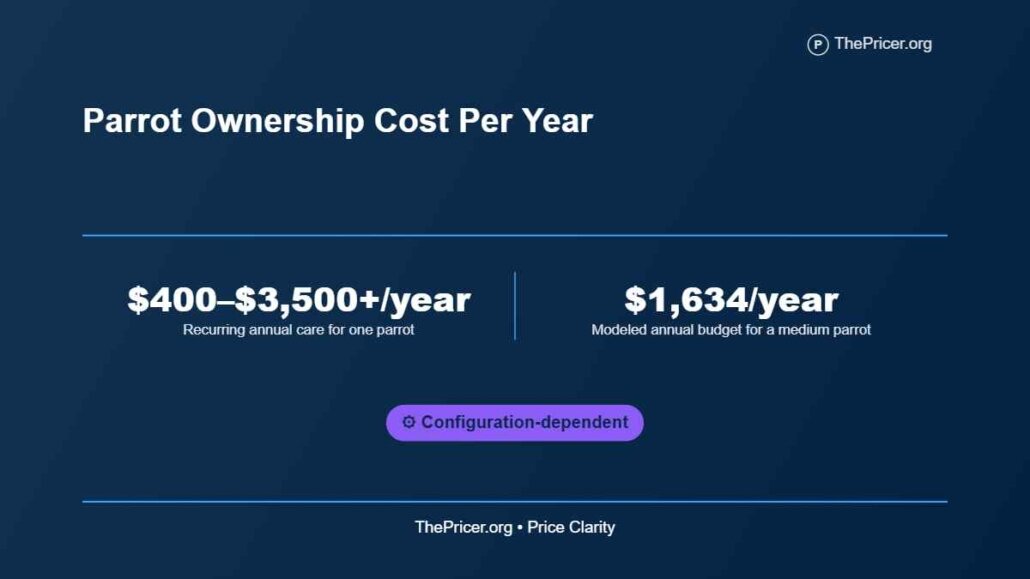
Owning one parrot in the United States costs about $400 to $3,500+ per year for recurring care, although giant parrots and birds with unusually expensive care needs can cost considerably more. A budgie may need roughly $400 to $900 a year, while an African grey, Amazon, cockatoo, or large macaw can require $1,500 to $3,500+.
The bird’s purchase or adoption price is separate. The same is true for the main cage, carrier, play stand, and other first-year equipment. For a useful annual budget, owners should focus on expenses that continue after setup, including food, enrichment, veterinary care, cleaning supplies, replacement equipment, and boarding.
Recurring cost should also be separated from emergency savings. Money reserved for an unexpected veterinary bill remains the owner’s asset until it is spent, so adding an entire emergency fund to every year’s ownership total would exaggerate normal spending. A better comparison uses ordinary annual expenses first, then shows first-year setup and emergency reserves as separate financial commitments.
Article Highlights
Jump to sections
- Recurring parrot ownership generally requires about $400 to $3,500+ per year, with some giant parrots costing substantially more.
- A typical budgie can cost about $400 to $900 per year after the initial setup.
- Food can reasonably consume about $180 to $1,200+ per year depending on species, diet, waste, and fresh-food purchases.
- Parrots need recurring toys, chewable materials, perches, cage supplies, and cleaning products in addition to food.
- Veterinary guidance calls for at least an annual examination for pet birds.
- A $200 large-parrot adoption fee can be tiny compared with several thousand dollars of subsequent care.
- A separate emergency reserve of roughly $1,000 to $3,000+ is a useful ThePricer planning target, rather than part of ordinary annual spending.
How Much Does It Cost to Own a Parrot Per Year?
The word parrot covers animals with radically different ownership costs. Budgies, parrotlets, lovebirds, cockatiels, conures, caiques, African greys, Amazons, eclectus parrots, cockatoos, and macaws differ in body size, food consumption, enclosure needs, toy destruction, veterinary handling, and boarding requirements. That makes one annual average less useful than a species-size budget.
A practical ThePricer planning range is $400 to $900 per year for a budgie, parrotlet, or lovebird, roughly $500 to $1,200 for a cockatiel or small conure, and around $900 to $1,800 for many medium parrots. African greys, Amazons, and similar large birds can move toward $1,400 to $2,500+, while cockatoos and large macaws can require around $2,000 to $4,500+. These are budgeting ranges synthesized from current food, enrichment, veterinary, and care costs rather than published veterinary standards.
The extremes are wide. ThePricer’s current budgie ownership estimate puts recurring care around $400 to $900 annually. At the opposite end, its hyacinth macaw cost analysis models one travel-heavy ownership case at $9,700 per year before emergencies.
Size is not the only driver. A small bird with chronic medical problems can cost more than a healthy larger bird in a quiet year. The ranges work best as planning bands rather than spending guarantees.
Small Parrots
Budgies, parrotlets, and lovebirds consume smaller quantities of food and can use smaller cages, carriers, perches, and toys than macaws or cockatoos. Their recurring costs can therefore remain near the lower end of the ownership range when the bird is healthy and the owner does not need frequent paid boarding.
A small-parrot budget might allocate roughly $15 to $30 per month to pellets, seed where appropriate, vegetables, fruit, treats, and ordinary food waste. That produces $180 to $360 per year. Another $60 to $180 can be reserved for toys and chewable enrichment, with additional money for liners, cleaning supplies, replacement perches, and veterinary care. These are ThePricer budgeting allowances rather than fixed retail packages.
Current retail prices show why a modest food allowance can work for a small bird. A 2-pound bag of parakeet food was recently listed at $8.79 for one purchase. Owners feeding another product, buying more fresh produce, or discarding more uneaten food can spend more.
Small does not mean disposable. Veterinary diagnostics and emergency treatment do not shrink in proportion to the bird’s purchase price. A budgie bought inexpensively can still need an avian veterinarian, laboratory testing, medication, imaging, or hospitalization.
Large Parrots
Large parrots increase several cost categories at once. African greys, Amazons, cockatoos, eclectus parrots, and macaws eat more, require larger enclosures and carriers, use thicker perches, and can destroy substantial toys quickly. Large birds can also require stronger hardware because a powerful beak can dismantle products that last much longer with a small parrot.
A recurring budget around $1,500 to $3,500+ is reasonable for many large-parrot households once food, enrichment, routine veterinary care, supplies, and some boarding or replacement equipment are included. A large macaw or highly destructive cockatoo can exceed that band. The amount does not include buying the bird or a major new enclosure every year.
Hyacinth macaws show the upper edge rather than the ordinary case. ThePricer’s documented ownership scenario uses $3,000 for annual food, $2,400 for toys, $700 for routine veterinary care, $2,100 for two weeks of boarding, and $1,500 for repairs and supplies. The resulting $9,700 total is deliberately not a general macaw average.
That distinction matters. Applying a hyacinth macaw budget to a cockatiel would exaggerate ordinary ownership, while using a budgie budget for a large cockatoo could leave major recurring costs unfunded.
Food
 Parrot food is broader than a bag of seed. Current avian guidance discusses combining pellets with fresh vegetables and using seeds more sparingly rather than relying on a seed-heavy diet. The exact mix still depends on species and the individual bird.
Retail pellet prices vary substantially. Current parrot listings include a 3.5-pound product around $24.29, a 10-pound product around $37.23, a 20-pound large-parrot product around $54.99, and a 5-pound premium product priced around $63.59. Product choice can therefore change the pellet portion even before fresh food enters the cart.
A useful planning allowance is roughly $180 to $360 annually for a small parrot, $360 to $720 for many medium birds, and $600 to $1,200+ for a large parrot. Those bands include a modeled mix of formulated food, fresh produce, treats, and waste. They are not claims that every bird consumes the same quantity.
Food waste matters too. Parrots scatter, shred, dunk, and discard food. The amount purchased can be materially higher than the amount actually eaten, especially when fresh produce is offered daily.
Annual Avian Care
Veterinary care should not be treated as something purchased only after a bird becomes visibly sick. Current veterinary guidance says birds should receive annual examinations, with a veterinarian setting a different schedule when the individual bird needs it. The examination can be accompanied by diagnostic or wellness testing based on age, species, size, history, and physical findings.
New birds create an extra first-year expense. Veterinary guidance recommends an initial visit shortly after acquisition, and the veterinarian may recommend baseline diagnostic tests. That initial work should be separated from the ordinary later-year budget when comparing first-year and recurring costs.
Owners also need a plan for illness. Birds can conceal outward signs of disease, and diagnostic work may include blood testing, fecal testing, radiographs, cultures, or other procedures. Current clinical guidance explains how testing can investigate hidden disease in sick and apparently healthy birds.
A separate emergency reserve around $1,000 to $3,000+ is a useful ThePricer planning target. It is savings, not automatic annual consumption. Large birds, birds with medical histories, and households far from avian specialists may prefer a larger reserve.
Toys and Perches
Parrot enrichment is a recurring supply category because many items are designed to be manipulated, shredded, chewed, or dismantled. Avian-care guidance describes several forms of companion-bird enrichment, including sensory, nutritional, manipulative, environmental, and behavioral activities. A household budget therefore needs more than one permanent toy set purchased with the cage.
A small parrot might use a modeled $5 to $15 per month in replacement enrichment, or $60 to $180 per year. A medium bird can reasonably justify around $15 to $35 per month, equal to $180 to $420 annually. A large, destructive parrot can push the allowance toward $25 to $60 per month or more, producing $300 to $720+ each year.
Perches add another replacement cycle. Natural wood can wear, become heavily soiled, or be chewed apart. Rope products and hardware also need inspection and replacement when damaged. Owners may need more than one size and texture to furnish a large enclosure and play area.
This spending is easy to underestimate because no single toy looks expensive enough to reshape the annual budget. Repeated purchases do. At $30 per month, enrichment becomes $360 per year, which can rival a smaller parrot’s food budget.
Boarding and Cleaning
Daily care produces smaller purchases that accumulate across 12 months. Cage liners or paper, bird-safe cleaning products, food bowls, damaged hardware, bathing supplies, replacement perches, storage containers, and occasional carrier replacements can add hundreds of dollars to a large-parrot household even when no single purchase is memorable.
Boarding can create a much larger spike. Parrots may require a bird-experienced sitter, avian boarding facility, or veterinary boarding arrangement when the owner travels. Price depends on species, location, number of birds, medication needs, length of stay, and whether the caregiver provides food or expects the owner to supply it. A household that rarely travels can keep this category near zero in an ordinary year. Frequent travelers need a dedicated allowance.
Housing also creates occasional capital expenses. A main cage can last for years, so charging the entire cage price to every annual budget would overstate recurring ownership. Damaged trays, bowls, locks, wheels, stands, and perches are different because they may need replacement between cage purchases.
One way to budget for irregular equipment is to create a replacement allowance. Setting aside $10 per month produces $120 per year. A large-parrot household using $25 per month accumulates $300 toward repairs or future equipment without pretending that a new cage is purchased annually.
A Cheap Adoption
The price paid to acquire a parrot says surprisingly little about its later ownership cost. Current rescue fees include $25 for budgerigars, $50 for lovebirds and cockatiels, $300 for conures and several other medium parrots, $400 for cockatoos and eclectus parrots, and $500 for African greys and large macaws.
Another rescue example makes the mismatch even sharper. Current adoption pricing includes $100 for a small parrot and $200 for a large parrot such as a macaw or cockatoo. The adoption fee is an acquisition charge, not an estimate of what the animal will cost to feed, house, enrich, board, and treat medically.
Suppose an adopted large parrot costs $200 and the household later spends a modeled $2,400 per year on recurring care. The calculation is $2,400 ÷ $200 = 12. One year of care equals 12 times the adoption fee.
Over five years, the same simplified annual budget becomes $2,400 × 5 = $12,000, excluding inflation, the initial cage, emergencies, and replacement of major equipment. That comparison is a better affordability test than asking whether the bird itself is inexpensive.
The First Year
First-year ownership adds expenses that should not be repeated mechanically in every later-year total. The bird or adoption fee, primary enclosure, travel carrier, initial perches, bowls, play stand, scale, first set of toys, and initial veterinary visit can make year one substantially more expensive than year two.
Cage requirements also vary with species. A budgie setup is not an acceptable price comparison for a macaw enclosure. Larger birds need more physical space and stronger construction, while the spacing and design must suit the particular species. Current companion-bird guidance covers housing, diet, and basic bird care, including the need to match care to the bird rather than treating all parrots alike.
A first-year calculation should therefore use two layers. Start with the recurring annual budget that will continue after setup. Then add the bird, cage, carrier, and other one-time or long-lived equipment. A rescue bird with an inexpensive adoption fee may still have a costly first year if the household has to buy a large enclosure from scratch.
Used equipment can reduce acquisition cost, but condition and suitability matter. Rust, unsafe coatings, inappropriate bar spacing, broken locks, damaged welds, and difficult-to-sanitize surfaces can make a cheap enclosure a poor purchase. The budget should prioritize a suitable living space rather than the lowest listing price.
A Medium Parrot
A worked budget shows how ordinary recurring categories combine. Consider an illustrative medium parrot with no major illness during the year. Assume $45 per month for food, $25 per month for toys, $12 per month for cleaning and liners, a $250 routine veterinary allowance, $150 for replacement perches and accessories, and $250 for occasional boarding or pet care.
| Annual expense | Modeled amount |
|---|---|
| Food and fresh produce | $540 |
| Toys and enrichment | $300 |
| Cleaning supplies and liners | $144 |
| Routine veterinary allowance | $250 |
| Replacement perches and accessories | $150 |
| Boarding or pet care | $250 |
| Modeled annual total | $1,634 |
The arithmetic is $540 + $300 + $144 + $250 + $150 + $250 = $1,634. These are explicit budgeting assumptions, not a documented customer invoice. Changing the bird, diet, local veterinarian, travel schedule, or rate of toy destruction changes the result.
The toy line also reveals a less obvious cost relationship. $300 ÷ $540 = 55.6%, so enrichment equals about 56% of the modeled food expense. A household that budgets carefully for pellets but ignores toy replacement can therefore miss a meaningful share of annual spending.
Match the Budget to the Bird
A workable parrot budget starts with the species rather than a generic pet allowance. Estimate normal food consumption, fresh produce, enrichment replacement, routine avian care, cleaning supplies, boarding needs, and an annual allowance for damaged accessories. Keep first-year equipment and emergency savings outside that recurring total so the numbers retain clear meanings.
Access to veterinary care also belongs in the decision. Birds can hide outward illness, and visible symptoms may appear only after a bird has been ill for some time. Owners should have a plan for reaching an avian veterinarian rather than assuming an ordinary dog-and-cat clinic will provide every bird service. Current veterinary guidance notes that subtle changes can signal illness, which makes both routine care and emergency liquidity relevant to the ownership budget.
Makes sense if
- You can support the recurring budget for the specific species.
- You have access to appropriate avian veterinary care.
- You can replace enrichment as the bird destroys it.
- You have a separate plan for emergency veterinary bills.
Does not make sense if
- The purchase price is the main affordability test.
- A large cage would consume the entire pet budget.
- Routine veterinary care has no place in the plan.
- Travel would regularly leave the bird without suitable care.
The bird can live for years. That makes recurring affordability more important than finding the lowest acquisition price.
Answers to Common Questions
How much does a parrot cost per month?
A recurring annual budget of $400 to $3,500+ works out to roughly $33 to $292+ per month. Actual spending is uneven because veterinary visits, boarding, and equipment replacement do not occur in equal monthly installments.
How much does a budgie cost per year?
A practical recurring budget is about $400 to $900 per year after the initial setup. Food, toys, cleaning supplies, replacement perches, and veterinary care make up most of that later-year budget.
How much does a large parrot cost per year?
Many large parrots can require roughly $1,500 to $3,500+ annually. Large macaws, highly destructive cockatoos, birds needing frequent boarding, and unusually demanding species can exceed that range.
Is the cage included in the annual cost?
Not as a full purchase every year. The main enclosure is primarily a first-year or occasional replacement expense. Annual budgets can include smaller allowances for damaged perches, bowls, locks, hardware, and other cage accessories.
How much should I save for parrot emergencies?
About $1,000 to $3,000+ is a useful ThePricer planning target for a separate veterinary emergency reserve. That money is savings rather than annual spending unless the bird needs treatment.
Disclosure: Educational content, not medical advice. Pricing varies by provider, location, and insurance. Confirm eligibility, coverage, and out-of-pocket costs with a licensed clinician and your insurer. See our methodology and corrections policy.