
How Much Does It Cost to Own a Private Island Per Year?
Published on | Written by Alec Pow
This article was researched using 7 sources. See our methodology and corrections policy.
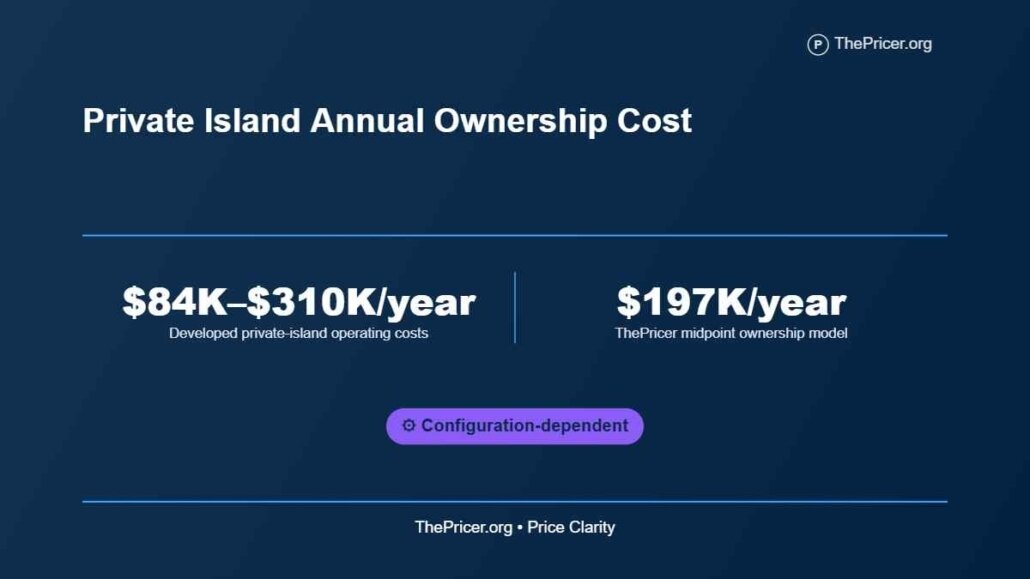
Owning a developed private island can cost roughly $84,000 to $310,000 per year in recurring expenses, with a current specialist ownership model placing a staffed Bahamas retreat at about $177,000 per year.
A simpler seasonal island with limited infrastructure can cost much less, while a heavily staffed tropical property can exceed $400,000 per year. Those figures cover annual ownership rather than the purchase itself. Major construction, financing, new infrastructure, and uninsured catastrophe losses sit outside the recurring budget.
For a developed personal retreat, ThePricer’s midpoint model using published specialist cost ranges comes to $197,000 per year, or about $16,417 per month. That is roughly $540 per calendar day, including days when the owner is not there.
Property tax represents only about 14% of this model. Maintenance, insurance, caretaking, transportation, and utility systems account for most of the annual spending, which is why a low purchase price or modest tax bill does not necessarily translate into inexpensive island ownership.
Article Highlights
Jump to sections
- Published specialist estimates put recurring costs for a developed private island around $84,000 to $310,000 per year, depending on property and operating scope.
- ThePricer’s midpoint model produces an annual operating budget of $197,000, or about $16,417 per month.
- At that modeled spending level, the island costs about $540 per day to carry throughout the year.
- Current specialist staffing estimates range from roughly $12,000 to $24,000 per year for part-time local caretaking to $72,000 to $120,000 for a small multi-person staff.
- Insurance can become one of the largest expenses on hurricane-exposed islands, particularly where ordinary coverage is difficult to obtain.
- Owners also need reserves for irregular capital expenses such as docks, boats, batteries, generators, water equipment, and storm repairs.
How Much Does It Cost to Own a Private Island Per Year?
A developed private island has many of the same bills as a waterfront home, plus the costs created by isolation. Current specialist estimates put property tax around $5,000 to $50,000, insurance around $10,000 to $50,000, maintenance around $30,000 to $100,000, caretaking around $24,000 to $60,000, transportation around $10,000 to $30,000, and utility-system maintenance around $5,000 to $20,000 per year.
Adding the low ends of those categories produces $84,000. Adding the high ends produces $310,000. That calculation provides a useful developed-island planning band, but it is not a quote or a national average. Individual islands can sit outside it.
| Annual expense | Published planning range |
|---|---|
| Property tax | $5,000 to $50,000 |
| Insurance | $10,000 to $50,000 |
| Maintenance and repairs | $30,000 to $100,000 |
| Caretaking | $24,000 to $60,000 |
| Boat and transportation | $10,000 to $30,000 |
| Utility-system maintenance | $5,000 to $20,000 |
| Total of category ranges | $84,000 to $310,000 |
A minimally developed seasonal island can avoid some of these expenses. There may be no full-time staff, desalination plant, large residence, elaborate landscaping, or permanent power system. The tradeoff is that the owner may need to bring water, fuel, food, tools, and other supplies by boat while accepting fewer amenities.
At the other end, a large tropical retreat can require several employees, multiple boats, extensive grounds, substantial power generation, air conditioning, docks, guest accommodations, and continuous storm preparation. Those properties can move beyond the range in the table.
Taxes and Insurance
Private islands do not have one special universal tax rate. The owner pays according to the jurisdiction, assessed property value, property classification, residency rules, exemptions, and local tax system. Even two islands with similar sale prices can produce very different annual tax bills.
A real U.S. listing shows how modest the tax component can look on an undeveloped island. A 3.7-acre island listing in Beals, Maine reports annual property taxes of $4,097 while also listing no electricity, sewer, or water service. That tax figure should not be interpreted as the annual cost of owning a developed island. The missing infrastructure is part of what makes the property fundamentally different.
Insurance can create a much larger variable. A remote coastal property can need building coverage, liability protection, marine coverage, boat insurance, and protection for docks or other waterfront infrastructure. Hurricane exposure can sharply affect premiums and deductibles, and some island properties can be difficult to insure through ordinary markets.
Current specialist guidance estimates that property coverage can fall around 0.5% to 2.5% of insured value in some private-island scenarios, with marine infrastructure, vessels, and liability potentially requiring additional coverage. This percentage should not simply be multiplied by the island’s purchase price because insured replacement value and market value are different measures.
Storm-zone ownership deserves extra caution. A low-tax island is not necessarily inexpensive if wind coverage, high deductibles, storm preparation, and post-storm logistics consume the tax saving.
Caretakers and Island Staff
 Remote property deteriorates even when nobody is vacationing there. A caretaker can inspect buildings after storms, run generators and pumps, monitor solar and battery systems, clear vegetation, check docks and boats, receive contractors, handle deliveries, prepare the residence for arrivals, and identify leaks or corrosion before they become larger repairs.
Current specialist estimates put part-time local caretaking around $12,000 to $24,000 per year, a live-on caretaker around $30,000 to $48,000, a caretaker couple around $48,000 to $72,000, and a small staff around $72,000 to $120,000. Staffing needs rise with the number of buildings, boats, guests, landscaped areas, and mechanical systems.
Current U.S. salary data provides another reference point. Reported private-island caretaker pay averages about $39,697 per year, with much of the reported salary range around $31,000 to $45,500. Salary is not the employer’s complete staffing cost. Payroll taxes, benefits, housing, food, transportation, insurance, permits, and relief coverage can increase the real expense.
A staffed luxury retreat can go far beyond one caretaker. Groundskeepers, housekeepers, chefs, boat captains, security personnel, property managers, and maintenance technicians can turn staffing into the largest annual category. Owners who occupy the island only occasionally may still need year-round property coverage because weather and mechanical systems do not follow the vacation calendar.
Boats Make Access a Bill
An island without a bridge or public ferry makes transportation part of property ownership. The owner may need one or more boats, fuel, insurance, engine service, haul-outs, antifouling, marina space, dock maintenance, safety equipment, and storage. Supplies and contractors may also arrive by boat, adding freight or travel costs to otherwise ordinary repairs.
Specialist private-island estimates place routine boat transportation around $10,000 to $30,000 per year for a developed property. A larger vessel, long mainland run, frequent guest transfers, or full-time captain can move the cost much higher. A detailed Bahamas ownership model estimates annual boat maintenance at $60,000, alongside fuel, staffing, facilities maintenance, and property tax.
ThePricer’s boat ownership cost guide provides more detail on the separate purchase, fuel, maintenance, storage, insurance, and repair costs that can sit inside an island-access budget. The boat should not be treated as free infrastructure simply because the owner already owns it.
Freight deserves attention too. A replacement refrigerator, generator part, construction material, propane delivery, or contractor crew may be inexpensive to move across a mainland town but costly to transfer across open water. Bad weather can delay both people and materials.
Access distance matters. An island five minutes from a marina creates a different transportation budget from a remote cay requiring a long high-speed boat run. The property price alone does not reveal that operating difference.
Power and Water Off the Grid
Many private islands function as small independent utility systems. Depending on location, an owner may need solar generation, batteries, backup generators, fuel storage, wells, rainwater collection, reverse-osmosis desalination, septic treatment, pumps, satellite communications, and spare components.
Current development estimates place a 10 to 20 kW solar installation around $50,000 to $120,000, desalination around $200,000 to $850,000, septic or wastewater systems around $50,000 to $180,000, communications around $5,000 to $30,000, and dock construction around $150,000 to $650,000. These are capital figures rather than annual bills, but the systems create maintenance and eventual replacement expenses.
Generators illustrate the distinction. Buying a generator is a capital expense, while oil changes, filters, inspections, fuel, batteries, repairs, and eventual replacement belong to the ownership cycle. ThePricer’s standby generator cost guide puts routine annual maintenance around $200 to $600 for typical equipment, although a large island installation can differ substantially in size and duty cycle.
Water can be even more consequential. A desalination system requires pumps, membranes, filters, power, controls, and skilled servicing. Saltwater conditions accelerate wear on equipment, fasteners, electrical connections, and metal components.
Redundancy also costs money. A remote owner may reasonably keep a generator behind a solar-and-battery system or store spare pumps and filters because waiting several days for a critical component can leave a house without power or water.
Maintenance Never Stops
Private-island maintenance includes the residence, guest structures, staff housing, docks, paths, landscaping, drainage, generators, pumps, water systems, boats, communications, and shoreline infrastructure. Salt air, humidity, intense sun, vegetation, insects, wind, and wave exposure can accelerate deterioration compared with a sheltered inland home.
Specialist annual planning figures put routine maintenance and repairs around $30,000 to $100,000 for developed islands. That range can include ordinary upkeep, but it should not be mistaken for a guarantee that major storm reconstruction or complete infrastructure replacement fits inside the annual amount.
Docks are a good example. Current island-development estimates put new dock construction around $150,000 to $650,000 depending on site and specification. An owner may spend relatively little on the dock during a calm year and then face a major repair after a storm. Annual budgeting should include both routine maintenance and a reserve for irregular work.
Grounds create another recurring burden. Tropical vegetation can grow rapidly, while fallen trees, invasive plants, pests, drainage problems, and erosion can require continuing attention. Leaving the island vacant does not stop these processes.
Storm preparation can involve securing boats, removing outdoor equipment, protecting windows, checking fuel, testing generators, and arranging post-storm inspections. A severe event can then generate emergency transportation, debris removal, dock work, roof repairs, and insurance deductibles. Those expenses explain why a normal-year maintenance budget and a catastrophe reserve serve different purposes.
A $197,000 Annual Budget
ThePricer can turn the published developed-island ranges into a reproducible midpoint scenario. This is not a claimed national average. It takes the midpoint of each researched annual category to show what a substantial personal retreat could cost when none of the categories sits at either extreme.
| Expense | Modeled annual amount |
|---|---|
| Property tax | $27,500 |
| Insurance | $30,000 |
| Maintenance and repairs | $65,000 |
| Caretaker | $42,000 |
| Boat and transportation | $20,000 |
| Utility-system maintenance | $12,500 |
| Modeled annual operating total | $197,000 |
The calculation is straightforward:
$27,500 + $30,000 + $65,000 + $42,000 + $20,000 + $12,500 = $197,000 per year
Dividing that total by 12 produces about $16,417 per month. Dividing it by 365 produces about $540 per day. That daily figure applies across the calendar rather than only to days spent on the island. If the owner uses the property for 60 days in a year, the same annual operating budget equates to about $3,283 per occupied day, although that figure should not be confused with a rental rate.
Property tax accounts for roughly 14% of the modeled total. Maintenance alone is about 33%. Caretaking contributes about 21%. This shows why buying in a low-tax jurisdiction does not automatically make private-island ownership inexpensive.
The model excludes financing, purchase costs, major renovations, replacement boats, new docks, major storm reconstruction, owner travel, and initial development. Adding those items can increase annual cash requirements sharply.
Build a Replacement Reserve
An annual operating budget can look artificially low if it includes only bills that happen to arrive that year. Docks, batteries, boats, generators, roofs, pumps, desalination equipment, septic systems, and solar hardware eventually need major repair or replacement. Reserve funding spreads some of that future burden across the years benefiting from the equipment.
Consider an illustrative $250,000 dock with an assumed 25-year replacement horizon. Straight-line reserve funding would be:
$250,000 ÷ 25 = $10,000 per year
Now assume a $30,000 battery bank with a 12-year planning horizon:
$30,000 ÷ 12 = $2,500 per year
Those two items alone would add $12,500 per year to a simple replacement reserve. The installed costs and useful-life assumptions are illustrative. A real owner should substitute actual equipment costs, engineering expectations, climate exposure, warranties, and replacement schedules.
The method matters more than those sample numbers. A dock that survives another year did not become economically free that year. Part of its useful life was consumed. The same reasoning applies to batteries, roofs, boats, generators, pumps, and water equipment.
A storm reserve may need separate treatment because hurricane damage is not a predictable straight-line replacement. Owners should examine insurance deductibles, exclusions, emergency access, debris removal, temporary accommodations, and the possibility that docks or marine structures have different coverage from the residence.
Makes sense if
- The owner can carry substantial fixed expenses even during years with little personal use.
- Boat access and off-grid systems are part of the desired lifestyle rather than unwanted complications.
- The annual budget includes staff, preventive maintenance, and reserves instead of only tax and insurance.
- Large irregular repairs can be absorbed without depending on an immediate sale of the property.
Does not make sense if
- The purchase budget leaves little cash for recurring maintenance and infrastructure replacement.
- The owner expects a remote island to cost about the same as a similarly priced mainland home.
- Boat transportation, storms, corrosion, or independent utilities would make routine property management burdensome.
- The financial plan depends on every year being free of major repairs.
Answers to Common Questions
How much does it cost to maintain a private island each year?
Published specialist categories support roughly $84,000 to $310,000 per year for a developed island when property tax, insurance, maintenance, caretaking, transportation, and utility-system upkeep are combined. Simpler properties can cost less, while heavily staffed tropical islands can exceed that range.
Do you pay property taxes on a private island?
Usually the applicable jurisdiction’s property-tax rules still apply, although rates, classifications, assessments, exemptions, and residency treatment differ. A private island is not automatically tax-free merely because it is separated from the mainland.
What is the biggest annual private-island expense?
It depends on the property. Maintenance, staffing, and insurance can each become dominant categories. On a hurricane-exposed luxury island with several employees, insurance and payroll can be far larger than the tax bill.
Do you need a full-time caretaker for a private island?
Not always. A small seasonal island close to the mainland may use periodic local caretaking. A developed remote property with boats, generators, water systems, landscaping, and several buildings has a stronger case for continuous oversight.
Does an undeveloped private island cost less per year?
It can have lower recurring bills because there are fewer buildings and mechanical systems to maintain. The tradeoff is that adding a dock, residence, power, water, wastewater treatment, communications, and access infrastructure can require substantial capital spending.
Disclosure: Educational content, not financial advice. Prices reflect public information as of the dates cited and can change. Confirm current rates, fees, taxes, and terms with official sources before purchasing. See our methodology and corrections policy.