
How Much Does It Cost to Paint a House Exterior?
Published on | Written by Alec Pow
This article was researched using 14 sources. See our methodology and corrections policy.
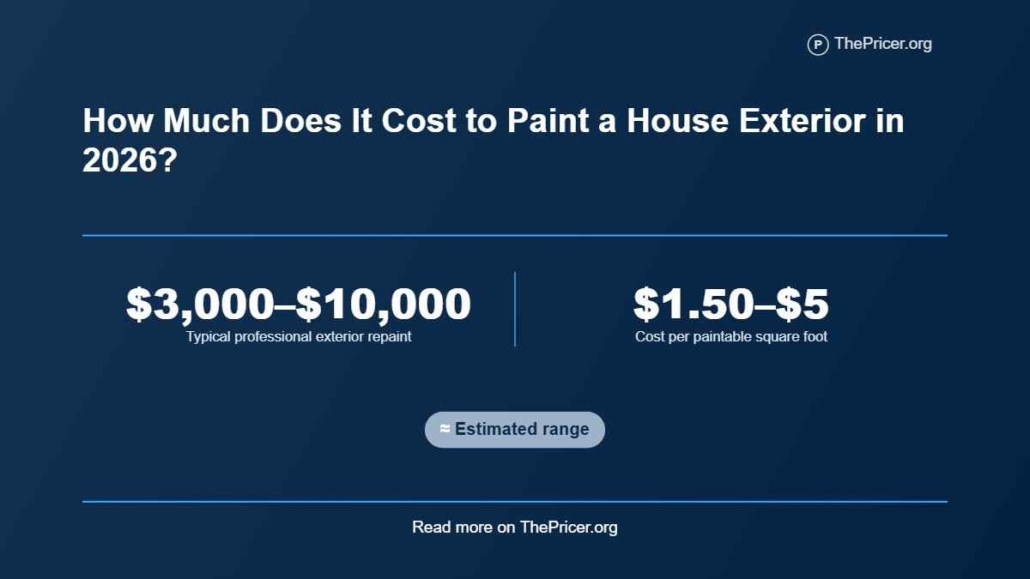
Exterior house painting typically costs about $3,000 to $10,000 for a professional repaint of a typical 2,000-square-foot U.S. home, according to a current 2,000-square-foot cost model. That is a planning range rather than a universal quote. Paintable wall area, siding material, stories, surface condition, prep, trim, access, coating system, and local labor can move the bill sharply. The useful measurement is the exterior surface being coated, not the home’s interior floor area.
Exterior house painting connects several price-setting entities and quantities. Painting contractors such as CertaPro price labor, preparation, access, and scope. Coating makers such as Behr, Benjamin Moore, and Sherwin-Williams publish coverage specifications.
The EPA governs applicable lead-safe work on many pre-1978 homes, while PaintCare adds container fees in participating states. Homeowners also need to separate siding or wall-body painting from trim, fascia, soffits, doors, garage doors, repairs, primer, extra coats, and surface stripping because those items can change what a quoted total buys.
Article Highlights
Jump to sections
- A practical planning band for many full professional repaints is $3,000 to $10,000 (at $30 per hour, earning that amount would take about 2.5 to 8.3 full-time workweeks, before taxes), but current national sources publish materially different ranges.
- A 2,000-square-foot home can have about 1,700 square feet of paintable exterior in one published reference model.
- Using floor area instead of that wall area would overstate the measured quantity by about 17.6% in that model.
- Current prep pricing can add $0.50 to $2 per square foot for stripping where old coating must be removed.
- On a two-coat 1,700-square-foot scenario, published paint coverage can move the purchase from two five-gallon pails to three.
How Much Does It Cost to Paint a House Exterior?
Current U.S. pricing sources do not converge on one national number. July 2026 exterior project data puts a professional job at $1,819 to $4,551 (about 1.5 to 3.8 full-time workweeks at $30 per hour), with an average of $3,178. A March 2026 marketplace range runs higher at $2,371 to $6,443, averaging about $3,943. Another whole-exterior repaint model reaches $6,242 to $11,617, while professional project guidance published in 2026 spans $3,000 to $15,000+. The differences show why the unit and included work matter as much as the headline range.
| Current source | Published price | Scope note |
|---|---|---|
| Angi 2026 cost data | $1,819 to $4,551, average $3,178 | Professional exterior painting, with size, siding, stories, prep, and location affecting cost |
| Thumbtack 2026 marketplace data | $2,371 to $6,443, average about $3,943 | National marketplace data, with wider low and high observations |
| Fixr exterior cost model | $6,242 to $11,617 | Whole-exterior repaint model including labor and materials |
| CertaPro 2026 guidance | $3,000 to $15,000+ | Provider planning range that rises with home size, preparation, access, and materials |
A homeowner should not average those four figures into a new market price. The data sets, job definitions, home sizes, and quote methods differ. Use them as boundary checks. A local written estimate becomes more informative once its paintable area, coat count, prep, trim, repairs, and access assumptions are visible.
An Exterior Repaint
An exterior repaint starts with the surfaces named in the contract. A body-only quote may cover siding or wall surfaces while excluding fascia, soffits, window trim, doors, shutters, porch components, garage doors, detached structures, and railings. A broader quote can bundle many of those surfaces. That difference matters before price comparison begins. Two contractors can measure the same house and still bid different scopes without either estimate being wrong.
Preparation belongs in the scope too. Cleaning, scraping loose coating, sanding selected areas, spot priming, caulking joints, masking, protecting landscaping, and cleanup can be part of a standard repaint. Extensive stripping, rotten-wood replacement, stucco repair, moisture correction, specialty primers, or lead-safe work can sit outside that base. The written estimate should identify which surfaces get primer, how many finish coats are planned, which repairs are included, and whether the painter supplies all coating materials.
House size remains useful as a rough screening measure, but it is not the billable coating quantity. A long one-story ranch and a compact two-story house with the same interior floor area can have different exterior wall areas, gables, trim loads, and access needs. That is why a homeowner should compare surface scope before comparing the final dollar line.
Measure the Walls
Floor area can create a large budgeting error when it is treated as paintable exterior area. The HomeGuide reference cited in the opening pairs a 2,000-square-foot home with about 1,700 square feet of paintable exterior and a rate of $1.50 to $5 per paintable square foot. The 300-square-foot difference equals about 17.6% of the 1,700-square-foot wall quantity.
Apply the published rate to that measurement error and the dollar effect becomes useful. At $1.50 per square foot, 300 excess square feet add $450 (about 1.9 full-time workdays at $30 per hour). At $5, they add $1,500. The calculation does not say every 2,000-square-foot home has 1,700 square feet of exterior wall. It shows why multiplying living area by a wall-area rate can distort a budget before a contractor has measured anything.
A better homeowner takeoff starts with exterior wall width and height, then adjusts for gables and large openings. Contractors may measure differently when trim, masonry sections, attached garages, dormers, or detailed architecture are involved. Ask each bidder for the measured painting area or another clear quantity basis. That turns a vague total into a quote that can be compared line by line.
Prep Work Can Move the Quote
Surface condition can turn a straightforward repaint into a labor-heavy project. Current pricing for common exterior preparation tasks lists preparation around $0.50 to $2.50 per square foot, paint stripping at $0.50 to $2 per square foot, repairs at $25 to $50 per hour, power washing at $240 to $400, and caulking plus masking at $0.50 to $1 per square foot. A contractor may bundle some of those tasks into the base estimate, so adding every line on top can double count work.
For a 1,700-square-foot exterior, assume only 25% of the wall area needs stripping. That is 425 square feet. Using the cited stripping rate produces about $213 to $850 of stripping work. This is a planning scenario, not a claim that one quarter of a house normally needs stripping. Its purpose is to show how a damaged portion of the wall can change the bill without repricing the entire exterior at a stripping rate.
Older homes can add a separate work-practice issue. EPA rules cover many paid jobs that disturb paint in pre-1978 housing, including painting preparation. There is no defensible universal surcharge to add to every older-home quote. Compare the actual lead-safe scope, certification, containment, cleanup, and testing requirements in the bids instead.
If exterior cleaning is quoted separately, compare it with the current house power-washing cost before assuming it is part of the painter’s base price.
Siding and Height
Two houses with similar wall area can produce different labor bills because the painter does not work each surface at the same speed. Smooth siding with open ground access is different from weathered wood, textured stucco, masonry, high gables, narrow side yards, or a facade broken by many windows and trim details. More setup, ladder movement, masking, scraping, brush work, or lift access raises crew time even when paintable square footage stays close.
A current Orange County CertaPro franchise guide gives a concrete local comparison. Its June 2026 local pricing lists one-story trim and siding at $4,950 to $5,450, two-story trim and siding at $6,950 to $8,450, and a two-car garage-door exterior at $250. These are location-specific provider examples, not national averages.
The story comparison is useful because the upper building envelope costs more to reach and work around. It does not prove that adding a second story always adds the same percentage. Footprint, rooflines, landscaping, slope, access equipment, paint condition, and local wages still change production time. Homeowners comparing a national calculator with a local proposal should give the local measured scope more weight.
Readers considering that provider can compare the local example with current CertaPro Painters pricing, which separates national averages from franchise-level examples.
Paint and Material Spend
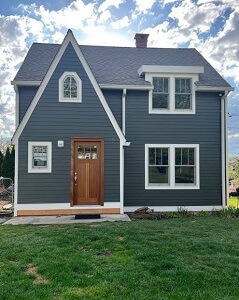 Material cost depends on both the price per gallon and the number of gallons the surface consumes. Behr Premium Plus Exterior lists 250 to 400 square feet of coverage per gallon for one coat. On an assumed 1,700-square-foot exterior with two finish coats, the coating workload is 3,400 coat-square-feet. At 400 square feet per gallon, that is 8.5 gallons. At 250, it is 13.6 gallons.
Purchase size turns that coverage swing into cash. Home Depot listed a Behr Premium Plus flat exterior five-gallon pail at $215 when checked, equal to $43 per gallon. Buying only five-gallon pails for this scenario means two pails at the high-coverage end and three at the low-coverage end. Material spend moves from $430 to $645, a $215 difference before primer, trim paint, tax, waste, or other products.
That is a sensitivity model, not a promise about the exact gallons a contractor will buy. Texture, porosity, color change, application method, primer, touch-ups, and product choice can change coverage. Some states also add paint-stewardship fees. Current container-based stewardship charges on containers larger than two gallons through five gallons run from $1.50 in California up to $2.75 in Washington among listed programs. Those fees are small beside labor, but they are real receipt-level costs where the program applies.
Three Project Budgets
A measured-area case shows why the quantity comes before the rate. Using the 1,700-square-foot paintable-area example and the cited $1.50 to $5 rate produces an arithmetic range of $2,550 to $8,500. HomeGuide rounds its 2,000-square-foot home example to $2,600 to $8,500. This case is useful for budgeting, but the house geometry is an example rather than a rule for every home.
A local contractor case can be built from the Orange County prices already cited. Start with the published two-story trim-and-siding package at $6,950 to $8,450. Add the separately listed two-car garage-door exterior at $250. The itemized scenario becomes $6,950 + $250 = $7,200 at the low end and $8,450 + $250 = $8,700 at the high end. The combined $7,200 to $8,700 figure is calculated here, not a documented customer invoice.
A prep-heavy case uses the earlier stripping model. If 425 square feet needs stripping, the added modeled work is about $213 to $850. Do not add that amount automatically to a quote that already includes stripping. Ask which square feet need removal, which areas only need scraping, and whether priming follows. The worked cases exclude major wood replacement, moisture correction, unusual access, specialty coatings, and any lead-safe work not already priced in the contractor’s written scope.
DIY, Hire Out, or Repair First
DIY can make financial sense on a sound, low-access exterior where the homeowner already owns the basic equipment and can perform prep without creating a safety or lead-dust problem. The material model above also shows why a DIY budget should not be built from one gallon price alone. Coats, coverage, primer, tools, masking, ladders, waste, and disposal all affect the cash outlay. A professional bid includes labor and business overhead that a DIY material list does not.
Hiring out becomes more attractive when access, preparation, schedule, or regulatory work carries real cost or risk. Painting also stops being the right comparison when the substrate itself is failing. Rotten sections, chronic moisture, failed sheathing, or siding that cannot hold a coating need repair diagnosis before another finish is applied. A replacement discussion can start with current CertainTeed siding costs, but replacement and repainting should never be presented as the same scope.
Makes sense if
- The siding is sound and the coating is faded, chalking, or locally peeling.
- The written bid identifies prep, coats, surfaces, repairs, and excluded items.
- High access or complex trim makes professional setup valuable.
- Applicable pre-1978 work needs a qualified lead-safe contractor.
Does not make sense if
- Rot or moisture damage needs correction before coating.
- The cheaper quote omits prep that another bid includes.
- A body-only price is being compared with a body-and-trim package.
- A safe low-access DIY job saves too little after materials and equipment are counted.
Answers to Common Questions
How much does it cost to paint a 2,000-square-foot house exterior?
A useful national planning range is about $3,000 to $10,000, but the correct quantity is paintable exterior area rather than 2,000 square feet of floor space. Stories, siding, prep, trim, access, and local labor can move the quote outside that band.
How much do painters charge per square foot outside?
Current published ranges include about $1.50 to $5 per paintable square foot. A per-square-foot number only becomes useful when the contractor defines what area is being measured and what prep, primer, coats, and trim are included.
Does exterior painting include power washing?
Sometimes. Some contractors bundle cleaning into preparation, while other scopes price it separately. Current prep references put standalone power washing around $240 to $400, so the estimate should state whether cleaning is included before another charge is added.
How much can paint coverage change a DIY budget?
In the 1,700-square-foot two-coat scenario used above, the cited coverage range changes the requirement from 8.5 to 13.6 calculated gallons. Buying the referenced five-gallon pail size moves the modeled purchase from $430 to $645 before primer, trim paint, tax, and waste.
Disclosure: Educational content, not financial advice. Prices reflect public information as of the dates cited and can change. Confirm current rates, fees, taxes, and terms with official sources before purchasing. See our methodology and corrections policy.