
How Much Does It Cost to Refill the Strategic Petroleum Reserve?
Published on | Written by Alec Pow
This article was researched using 12 sources. See our methodology and corrections policy.
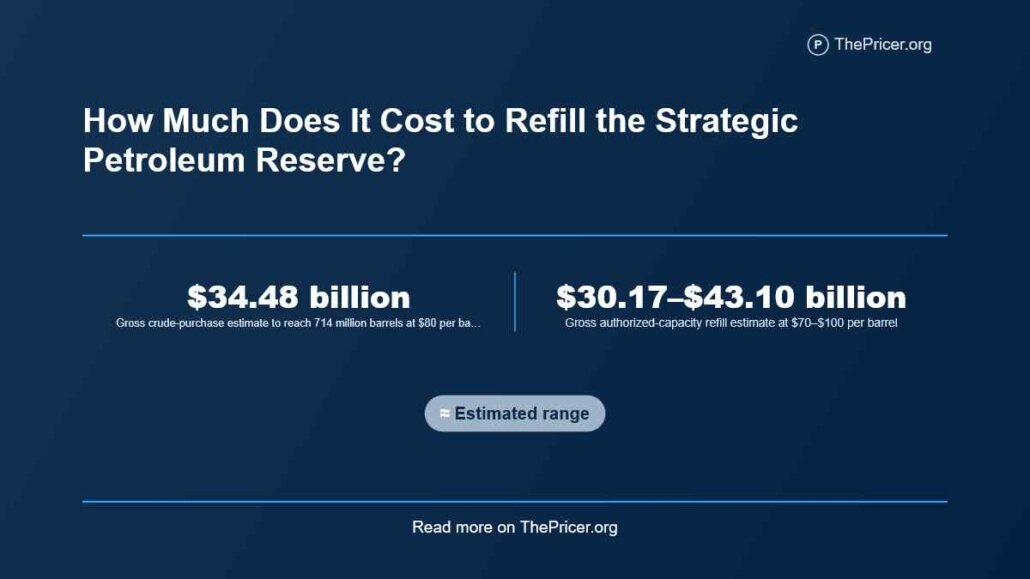
Refilling America’s Strategic Petroleum Reserve could cost $34.5 billion in crude oil alone at an assumed purchase price of $80 per barrel. Congress has provided just $171 million for direct purchases, equivalent to less than 0.5% of the oil needed to restore the reserve to its authorized capacity at that price.
The reserve held approximately 283 million barrels at the end of September 2026, leaving a 431-million-barrel gap below its authorized 714-million-barrel capacity. Buying that quantity at $70 per barrel would cost $30.2 billion. At $100, the bill rises to $43.1 billion.
These figures are calculated purchase scenarios, not an approved federal spending plan. Some borrowed oil is scheduled to return through exchanges, the reserve cannot currently use all its authorized capacity, and the Government Accountability Office estimates that approximately $650 million in repairs and upgrades would be needed to support maximum refill operations.
Article Highlights
Jump to sections
- The SPR held 282.983 million barrels in the week ending October 2, 2026.
- Restoring its authorized 714-million-barrel capacity would require approximately 431 million additional barrels.
- At $80 per barrel, the gross purchase-cost estimate is $34.48 billion.
- Congress appropriated $171 million for direct oil purchases, alongside $218 million for maintenance and repairs.
- GAO estimates $650 million in work to support maximum refill operations, but that is not a complete infrastructure budget.
- Every $10 change in the average oil purchase price changes the 431-million-barrel calculation by $4.31 billion.
How Much Oil Is Missing?
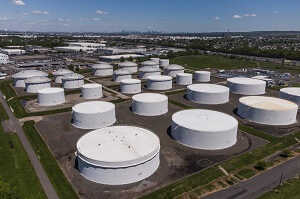
The Strategic Petroleum Reserve is a federal emergency stockpile of crude oil stored in underground salt caverns at four sites in Texas and Louisiana. It is intended to help the United States respond to serious petroleum supply disruptions.
The Department of Energy’s SPR inventory report listed 283 million barrels on September 30, 2026, against an authorized capacity of 714 million barrels.
The Energy Information Administration’s weekly inventory data recorded 282.983 million barrels for October 2. Using that more precise figure produces a capacity gap of 431.017 million barrels.
There is an important physical limitation. In its 2026 investigation, the Government Accountability Office reported that DOE estimated effective peak storage capacity at approximately 680 million barrels, below the authorized 713.5 million barrels.
At the current inventory level, reaching that effective peak would require approximately 397 million additional barrels rather than 431 million. The larger figure answers how much oil is missing relative to authorized capacity. The smaller figure reflects DOE’s assessment of usable storage at the time of GAO’s review.
Neither target establishes how much oil the federal government will actually purchase. Exchange returns, further releases, changes in storage capability and future policy decisions can all change the requirement.
The Refill Bill at Different Oil Prices
Oil price is the largest variable in a gross refill calculation. The federal government purchases crude through contracts rather than buying hundreds of millions of barrels at one publicly quoted market price.
The following scenarios use approximately 431 million barrels for authorized capacity and 397 million for the effective peak. They assume every missing barrel must be purchased directly, with no credit for future exchange returns.
| Average oil price | Refill to 680 million barrels | Refill to 714 million barrels |
|---|---|---|
| $60/barrel | $23.82 billion | $25.86 billion |
| $70/barrel | $27.79 billion | $30.17 billion |
| $80/barrel | $31.76 billion | $34.48 billion |
| $90/barrel | $35.73 billion | $38.79 billion |
| $100/barrel | $39.70 billion | $43.10 billion |
| $120/barrel | $47.64 billion | $51.72 billion |
The prices in this table are assumptions used to illustrate sensitivity. They are not DOE contract offers or forecasts.
Market conditions make the choice of price especially consequential. Reuters reported West Texas Intermediate crude settling at $89.43 per barrel on October 5, 2026, amid continuing Middle East supply disruptions. That benchmark is not identical to the price DOE would pay for crude delivered to SPR facilities.
For the authorized-capacity scenario, buying at an average of $90 rather than $70 adds $8.62 billion. A difference of just $5 per barrel changes the calculation by approximately $2.16 billion.
This sensitivity explains why the refill bill cannot be reduced to a single permanent number. It also explains why officials may prefer smaller purchases over time, provided the security risks of delaying replenishment are acceptable.
How Much Has Congress Funded?
The contrast between the estimated purchase requirement and the amount appropriated for direct purchases is unusually large.
GAO reported that Congress provided $171 million for SPR oil purchases under the 2025 reconciliation law. It also provided $218 million for maintenance and repair work.
At an assumed purchase price of $80 per barrel, the direct-purchase appropriation is equivalent to approximately 2.14 million barrels before associated expenses. That would cover about 0.50% of the 431-million-barrel authorized-capacity gap.
It is therefore accurate to say the funding represents roughly half of one percent of the calculated oil requirement. It would be inaccurate to say Congress has appropriated enough money to refill the reserve.
The Energy Department’s November 2025 contract announcement confirmed the award of contracts for approximately 1 million barrels, with deliveries scheduled from December 2025 through January 2026.
That procurement was a concrete refill action. It was not a commitment to purchase the entire missing inventory.
GAO also documented an earlier DOE estimate of approximately $20 billion to acquire 250 million barrels at $80 each. The estimate reflected an earlier inventory position and a 680-million-barrel target. It should not be used as the complete refill cost from the much lower inventory reported in October 2026.
Funding for infrastructure must remain separate from money available to buy crude. The $218 million maintenance appropriation cannot simply be counted as additional oil-purchase funding.
Does Every Barrel Need Buying?
No. The distinction between oil purchases and oil exchanges is essential to understanding what a refill might actually cost taxpayers.
In an SPR exchange, the government temporarily supplies crude to a company under an agreement requiring the company to return oil later, generally with additional barrels. The arrangement differs from a permanent sale.
On October 10, 2026, the Department of Energy authorized an exchange of up to 4 million barrels to address hurricane-related supply disruptions. ExxonMobil and BP America were each authorized to receive up to 2 million barrels.
DOE said participating companies would return the borrowed oil, plus premium barrels, in 2027. The announcement described the arrangement as replenishing inventory without an additional taxpayer purchase for those returned barrels.
Earlier in 2026, the department also advanced much larger emergency exchanges in connection with Middle East supply disruptions. A September 29 DOE announcement described another solicitation of up to 40 million barrels and previous exchange awards totaling more than 133 million barrels.
Those are substantial contractual volumes. They cannot simply be added to current inventory because some deliveries, returns and premiums occur at different dates. The amount outstanding must be reconciled against actual movements and contract terms.
Consider a simplified illustration. If 100 million of the 431 million missing barrels eventually returned through exchanges and no further withdrawals occurred, the remaining direct-purchase requirement would fall to 331 million barrels.
At $80 each, buying 331 million barrels would cost $26.48 billion, compared with $34.48 billion for all 431 million. That is an $8 billion difference.
The 100-million-barrel return in this example is a hypothetical quantity, not a forecast of outstanding obligations. Its purpose is to show why gross replacement cost and actual federal cash spending are different measures.
The $650 Million Infrastructure Problem
Purchasing crude does not guarantee that the SPR can immediately receive and store it.
GAO’s 2026 investigation found that aging equipment, construction outages and maintenance deficiencies were limiting the reserve’s operating capability. As of December 2025, DOE estimated that effective fill capability was only 56% of its original design rate.
The agency reported that DOE estimated approximately $650 million in repairs and updates would be required to support maximum fill operations. That estimate covers a particular operational priority, not every outstanding infrastructure need.
GAO also identified a major maintenance backlog of approximately $230 million as of December 2025. The backlog and the maximum-fill estimate may cover overlapping work. Adding them together without identifying that overlap would risk double counting.
The GAO’s infrastructure assessment described equipment failures, deferred repairs and a modernization project that had not resolved all operational concerns.
The condition of the system has consequences beyond refill speed. GAO documented failures involving piping, brine disposal and other essential equipment. The reserve relies on those systems both to inject crude and to withdraw it when needed.
The $650 million estimate is approximately 1.9% of the $34.48 billion oil-purchase scenario. That does not make the infrastructure work optional. Without sufficient operational capacity, purchased crude may not be deliverable into storage at the desired rate.
It would also be misleading to present $35.13 billion, the sum of those two figures, as an official all-in refill budget. The oil price is hypothetical, the infrastructure estimate covers a defined priority, and some repairs may already be funded or required regardless of the refill decision.
What Previous Purchases Tell Us
Historical purchases show that the government can acquire crude at prices materially different from those prevailing during emergency releases.
In November 2024, the Energy Department reported replenishment purchases totaling approximately 59 million barrels at an average price below $76 per barrel. It compared that purchase level with an average sale price near $95 per barrel during the 2022 emergency drawdown.
Using $76 as a rounded calculation, 59 million barrels would cost $4.48 billion. Valuing the same quantity at $95 produces $5.61 billion, approximately $1.12 billion more.
This is a comparison of unit prices, not proof of a complete government trading profit. The purchases and sales occurred at different times and involved different contractual and operational circumstances.
An earlier DOE purchase update documented 32.3 million barrels acquired at an average price of $76.98 per barrel. That provides another actual procurement benchmark, although it is not a quote available for future purchases.
DOE also described nearly 200 million barrels purchased or retained through a combination of acquisitions, accelerated exchange returns and canceled congressionally mandated sales.
These categories should not be combined as if the government paid cash for every barrel. Canceling a planned sale preserves existing oil. Returning borrowed oil restores inventory under a contract. A direct purchase requires an actual acquisition payment.
How Long Could Refilling Take?
 The timeline depends on procurement funding, crude availability, storage readiness and the pace of net inventory additions.
For the approximately 397-million-barrel gap to the effective 680-million-barrel peak, three hypothetical net refill rates produce very different schedules.
At 100,000 barrels per day, the calculation is roughly 10.9 years. At 500,000 barrels per day, it falls to about 2.2 years. At 1 million barrels per day, it is approximately 13 months.
These are arithmetic scenarios, not DOE schedules. They assume the same net rate every day and exclude additional emergency withdrawals.
The GAO’s broader SPR review found that Congress and DOE had not established a unified long-term plan aligning the reserve’s intended size, infrastructure needs and investment priorities.
Meanwhile, oil-market conditions remain unsettled. Reuters reported in October 2026 that industry executives expected replenishing depleted global oil inventories to take considerable time following major supply disruptions.
That global estimate should not be mistaken for a forecast of the U.S. SPR’s refill schedule. It does show that the federal government would be competing for crude in a market facing other inventory-rebuilding demands.
Should the U.S. Refill Now?
The lowest possible purchase price is not the only consideration. The reserve exists to provide emergency supply protection, and leaving it depleted carries a risk that cannot be measured solely by the cost of replacing each barrel.
A faster refill could improve emergency preparedness sooner, but it would require sufficient funding, suitable crude and storage infrastructure capable of accepting deliveries. Purchasing aggressively during a tight market could also mean paying more.
A slower refill may create opportunities to acquire oil at lower prices and allow infrastructure work to proceed. It also extends the period during which emergency inventory remains comparatively low.
A faster refill makes sense if
- Officials judge the remaining emergency inventory insufficient for plausible supply disruptions.
- Suitable crude can be acquired at acceptable contract terms.
- Storage and delivery infrastructure can support the additional volume.
- Congress supplies funding consistent with the chosen inventory target.
A slower refill makes sense if
- Near-term crude prices are unusually elevated relative to procurement objectives.
- Critical repairs constrain safe injection rates.
- Substantial contractual exchange returns are already scheduled.
- The government has not established a clear, fundable long-term inventory target.
The most meaningful policy comparison is therefore between the cost of restoring emergency protection sooner and the risks of delaying it. The purchase bill is one input, alongside infrastructure capability and the value of having oil available during a future disruption.
What We Verified
- Checked the latest available DOE and EIA inventory figures against the reserve’s authorized capacity.
- Confirmed GAO’s 680-million-barrel effective capacity, $171 million purchase appropriation and $218 million repair appropriation.
- Confirmed GAO’s approximately $650 million maximum-fill infrastructure estimate and identified the separate maintenance backlog without adding overlapping estimates.
- Checked DOE’s October 10, 2026 exchange announcement and distinguished contractual returns from direct purchases.
- Recalculated the price scenarios, sensitivity estimates and refill timelines from their stated inputs.
- Kept hypothetical purchase prices and net refill rates separate from actual government contracts.
Answers to Common Questions
How much would it cost to refill the Strategic Petroleum Reserve completely?
At $80 per barrel, purchasing enough crude to reach the authorized 714-million-barrel capacity would cost approximately $34.48 billion, based on the October 2, 2026 inventory. That is a gross purchase-cost scenario, not a funded government plan.
Why did DOE previously estimate only $20 billion?
The earlier estimate assumed buying 250 million barrels at $80 each to reach an effective capacity of 680 million barrels. Inventory has since declined, increasing the calculated gap.
How much money has Congress approved for refilling?
GAO documented $171 million for direct crude purchases under the 2025 reconciliation law, plus $218 million for maintenance and repairs. Those are separate funding purposes.
Will taxpayers have to buy every missing barrel?
No. Some oil is due to return through emergency exchange contracts, potentially with additional premium barrels. The eventual direct-purchase requirement depends on those returns, future releases and the inventory target.
How much would a $10 increase in oil prices add?
For a gross 431-million-barrel refill, every $10 increase in the average purchase price adds approximately $4.31 billion to the calculated oil bill.
Disclosure: Educational content, not financial advice. Prices reflect public information as of the dates cited and can change. Confirm current rates, fees, taxes, and terms with official sources before purchasing. See our methodology and corrections policy.