
How Much Does it Cost to Remove Braces?
Updated on | Written by Alec Pow
This article was researched using 14 sources. See our methodology and corrections policy.
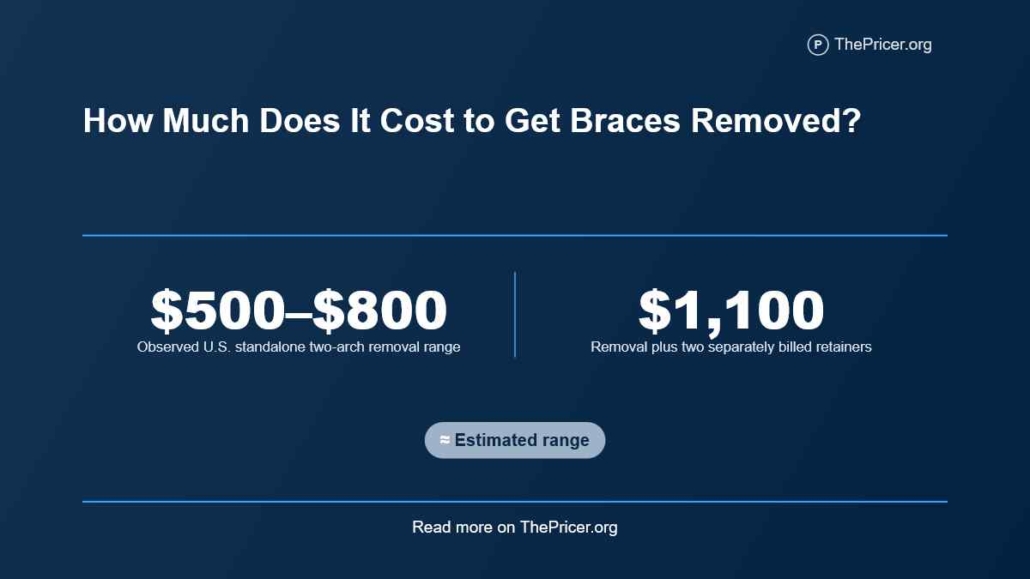
Standalone braces removal of both arches costs about $500 to $800 across the current U.S. prices reviewed. A Phoenix provider posts $500 for upper and lower removal, a Tulsa orthodontist lists $500 for removal, polishing, and contouring, and a Jacksonville office charges external patients $800 for two-arch removal. This is a small observed sample, not a national average.
Many patients never see a separate braces-removal bill because debonding, adhesive cleanup, final records, and the first retainers may already be bundled into the original orthodontic fee. The biggest budgeting mistake is comparing a removal-only price with a package that includes retainers, imaging, polishing, or follow-up care.
Article Highlights
Jump to sections
- Standalone two-arch removal fees in the U.S. examples reviewed range from $500 to $800 (at $30 per hour, earning that amount would take about 2.1 to 3.3 full-time workdays, before taxes).
- Four posted removal charges in the like-for-like sample are $500, $500, $600, and $800.
- A useful planning figure for a straightforward two-arch removal is about $500 to $600 before separately billed retainers.
- Retainers can add hundreds of dollars when they are not part of the removal package.
- If debonding is bundled into the original orthodontic contract, the separate removal charge may be $0.
How Much Does It Cost to Get Braces Removed?
The price of getting braces off depends heavily on whether the office is finishing its own case or taking over someone else’s appliances. The four current offers in the table use different combinations of imaging, polishing, consultation, and cleanup, so the published price needs to be read together with the service scope.
| Published U.S. example | Price | Published scope |
|---|---|---|
| Phoenix, Arizona | $500 (about 2.1 full-time workdays at $30 per hour) | upper and lower removal service, with panoramic imaging and adhesive cleanup |
| Tulsa, Oklahoma | $500 | removal, polishing, and contouring under an a la carte fee schedule |
| Richmond near Houston, Texas | $600 | both-arch removal and cleanup, with retainers listed at $250 per arch and the required exam credited if removal proceeds |
| Jacksonville, Florida | $800 | external-patient removal for both arches, including exam, imaging, adhesive cleanup, and polishing |
For the four examples that publish a clear removal charge of $500, $500, $600, and $800, the simple average is $600 and the midpoint between the two middle observations is $550. Those figures describe this small reviewed sample only. They should not be presented as a national average because each office bundles a different mix of records, polishing, consultation, and retention services.
When Removal Is Included
A patient who completes treatment at the same orthodontic office may owe no separate removal fee. The American Association of Orthodontists notes that some practices use all-inclusive orthodontic pricing that covers braces, appointments, emergency visits, and post-treatment retainers. In that type of contract, debonding is part of the treatment the patient has already paid for.
The distinction changes the answer. Someone nearing the planned end of a fully paid treatment may see $0 as a separate braces-removal line item. A transfer patient can face several hundred dollars because the new office did not collect the original treatment fee and may need to examine the case, review records, take new images, remove unfamiliar appliances, clean residual bonding material, and create a retention plan.
Ask the original orthodontist for the financial agreement before paying another office. Look for language covering appliance removal, final records, retainers, and post-treatment visits. If those services were prepaid, leaving the practice before the scheduled finish can create a very different financial situation from completing treatment there. The separate cost of braces is much larger than the debond fee, so the original contract deserves attention before a second office is paid to finish the case.
What the Removal Fee Covers
Professional braces removal is more than snapping brackets off the teeth. The clinician removes wires and brackets, then removes the composite bonding material left on the enamel and polishes the tooth surfaces. The AAO continues to teach clinicians about safe appliance and adhesive removal, which is one reason a low fee should be compared by scope rather than by price alone.
Some published packages also include an exam, photographs, panoramic imaging, a 3D scan, or a retainer consultation. Others stop after debonding and polishing. That is why two charges of $500 (about 2.1 full-time workdays at $30 per hour) can buy different services. One may be the entire braces-off appointment, while another may leave imaging or retainers for separate billing.
Package wording matters. A fee labeled as debonding may cover less than a package that explicitly includes final records and polishing, so two prices should be compared only after their service lists are matched.

A written quote should state whether the fee covers one arch or both arches, bracket and wire removal, adhesive cleanup, polishing, records, imaging, and the retainer impression or scan. When panoramic imaging is billed outside the package, the separate panoramic dental X-ray cost can become part of the real braces-off budget.
The Hidden Cost
The next cost is retention. It can be the largest predictable charge outside a removal quote. The AAO says the first set of retainers is often included in the full orthodontic treatment fee, while replacement retainers may carry a separate charge. A transfer patient or someone paying only for debonding needs to ask whether any retainer is included at all.
The University of Iowa orthodontic FAQ lists clear retainers at $200 per arch on its published retainer fee page. Two clear retainers cost $400 at that clinic. This is a clinic-specific fee rather than a national average.
The hidden-price effect becomes obvious when removal and retention are combined. A $600 two-arch removal plus $500 for two retainers, using the Houston provider’s posted fees from the table, produces a $1,100 braces-off total. The required $99 exam does not increase that total if the patient proceeds because the office applies it to the removal charge. The same removal without separately billed retainers stays at $600. That $500 gap is why an advertised removal fee should never be mistaken for the complete post-braces budget.
Retainer prices vary by design, provider, lab, and whether one or both arches need an appliance. Readers comparing the next stage can use the separate retainer cost guide after confirming which style their clinician plans to use.
Why Quotes Differ
The strongest price driver is package scope. A fee that covers one arch cannot be compared directly with a both-arch fee. A transfer-patient appointment with new imaging and an exam also has a different workload from a scheduled final visit at the office that already has the patient’s records and treatment history.
Retainers create another large difference. Some offices separate removal and retention into two charges, while others publish a higher package that pairs debonding with a same-day retainer. Those offers are not interchangeable because the payable total depends on what happens after the brackets are removed, not only on the debond fee.
Time in braces by itself is not a reliable pricing shortcut. Treatment duration alone does not establish removal difficulty or price. A quote is better explained by the provider’s fee structure, number of arches, records needed, appliance design, cleanup work, and the post-removal retention plan.
Geography can also move the fee because professional charges differ by market. A small set of published office prices can illustrate the spread, but it is too narrow to support state-by-state averages.
What Happens at Removal
During a routine debond appointment, the orthodontic hardware is loosened and removed, residual adhesive is cleaned from the enamel, and the teeth are polished. A medically reviewed braces removal process describes pressure or discomfort as possible, places the full removal and cleanup visit around an hour, and warns against removing bonded braces at home. Extra records or retainer work can extend the appointment.
The procedure should not be described as guaranteed painless. Many patients report pressure rather than sharp pain, but sensitivity varies. Adhesive cleanup can also feel different from bracket removal. A clinician can slow down, change instruments, or address sensitivity when needed.
Do not remove bonded braces at home. Brackets, wires, and adhesive are attached to tooth surfaces, and professional debonding includes controlled removal and enamel cleanup. A home attempt can damage enamel, leave sharp wire or bracket fragments, or leave bonding material that still needs professional removal.
Once the appliances are off, the retention phase begins. Teeth can move after active orthodontic treatment, which is why the next appointment step is often a fixed or removable retainer rather than simply ending care.
Insurance and Payment
Insurance should be checked before assuming that a standalone removal fee will be reimbursed. Orthodontic benefits can have age limits, waiting periods, network rules, coinsurance, and lifetime maximums. MetLife’s current orthodontic coverage overview notes that many plans do not cover orthodontics and that plans that do may use lifetime benefit caps. A benefit that helped pay for the original braces does not automatically create a new payment for an unrelated office’s debond fee.
Ask the removal provider for the exact charge and ask the insurer whether that service is covered. If the office is out of network, ask whether any out-of-network orthodontic benefit remains. If the lifetime maximum is already exhausted, removal and retention may be entirely out of pocket.
Tax-advantaged accounts can help when the expense qualifies. IRS Publication 502 lists braces among eligible dental treatments in its medical and dental expense rules. HSA and FSA reimbursement has its own account rules, so the patient should keep the itemized receipt and check the plan administrator’s requirements.
For a removal bill of a few hundred dollars, a long financing plan may cost more than it solves if interest or fees apply. Compare the total paid, not only the monthly payment. Ask about the cash price, card fees, installment terms, and whether retainers are included before choosing the payment method.
Three Removal Budgets
A patient finishing at the original orthodontist may have the easiest budget. If the signed treatment fee already includes debonding and the first retainers, the separate braces-removal bill can be $0. The money was paid as part of the larger orthodontic contract, so this is not free treatment. It is a bundled service that should not be compared with a new patient’s standalone removal quote.
A transfer patient paying a removal-only fee could budget around $500 to $600 from the middle of the published U.S. examples reviewed. Two separately billed clear retainers can add about $400 to $500. A higher-priced external-patient service with imaging and a retainer can reach or exceed $1,000 without unusual dental work.
One itemized scenario uses the Houston prices already introduced. Both-arch removal is $600. Two retainers are $500. The exam is $99 but is credited when removal proceeds. The payable total is $600 + $500 = $1,100. If the patient skips the separately billed retainer, the same visit is $600. The $500 difference is entirely the retention decision.
Makes sense if
- The original orthodontist cannot complete the case and another office must remove the appliances.
- The quote states whether it covers one arch or both arches.
- Imaging, adhesive cleanup, polishing, and retainers are listed as included or separate.
- The patient has a retention plan for the same day or soon after debonding.
Does not make sense if
- The original treatment contract already includes removal and the patient can still finish there.
- The cheaper quote excludes services that make its payable total higher.
- The plan is to remove bonded brackets without professional dental care.
- The budget ignores retainers even though they will be billed separately.
Answers to Common Questions
How much does it cost to get braces removed by another orthodontist?
Published U.S. two-arch examples reviewed for transfer or external patients run from about $500 to $800, with several removal charges at $500 to $600. The exact amount depends on what the new office includes.
Is braces removal included in the original treatment price?
It often can be. Some orthodontic practices sell an all-inclusive treatment package that covers the final debond appointment and may also include retainers. The financial agreement from the original office gives the answer for a specific patient.
How much can removal plus retainers cost?
A straightforward removal can rise above $1,000 when retainers are billed separately. In the itemized scenario above, $600 for two-arch removal plus $500 for two retainers produces a $1,100 total.
Does it hurt to get braces off?
Many patients feel pressure or temporary sensitivity rather than sharp pain, but the experience varies. Adhesive cleanup and polishing can also create vibration or sensitivity.
How long does braces removal take?
A routine braces-off appointment can take around an hour when removal and cleanup are included. Imaging, final records, or retainer work can make the visit longer.
Disclosure: Educational content, not medical advice. Pricing varies by provider, location, and insurance. Confirm eligibility, coverage, and out-of-pocket costs with a licensed clinician and your insurer. See our methodology and corrections policy.