
How Much Does It Cost To Renew Green Card?
Updated on | Written by Alec Pow
This article was researched using 11 sources. See our methodology and corrections policy.
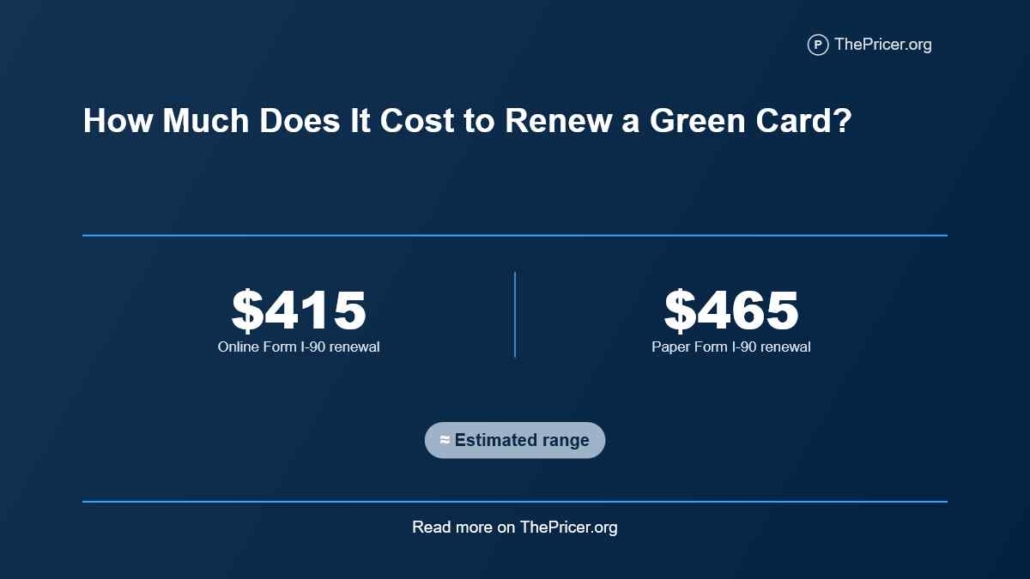
Renewing a Green Card currently costs $415 when Form I-90 is filed online or $465 when it is filed on paper. There is no separate $85 biometric services fee under the current USCIS fee schedule, even though applicants may still be required to attend a biometrics appointment. Some applicants qualify for a $0 fee, including certain fee-waiver applicants and specific replacement situations caused by DHS errors or non-delivery.
The online application therefore saves $50, or about 10.8%, compared with filing the same standard Form I-90 on paper. USCIS also currently extends the validity of an expiring or expired Green Card for 36 months when a qualifying renewal Form I-90 is properly filed and the applicant receives the appropriate receipt notice.
Article Highlights
Jump to sections
- Online Form I-90: $415 (at $30 per hour, earning that amount would take about 1.7 full-time workdays, before taxes).
- Paper Form I-90: $465.
- There is no separate $85 biometrics fee under the current fee schedule.
- Filing online saves $50, or about 10.8%.
- Some I-90 filings qualify for a $0 government fee.
- A qualifying I-90 renewal receipt can extend the card’s validity for 36 months.
- A two-year conditional Green Card normally is not renewed with Form I-90.
- Attorney or document-preparation costs are optional and separate from the USCIS filing fee.
How Much Does It Cost to Renew a Green Card?
The current USCIS fee schedule lists the standard Form I-90 fee at $415 (about 1.7 full-time workdays at $30 per hour) for online filing and $465 for paper filing.
| Green Card Renewal Expense | Online | Paper |
|---|---|---|
| Form I-90 filing fee | $415 | $465 |
| Separate biometrics fee | $0 | $0 |
| Total USCIS fee | $415 | $465 |
This is a major correction from older Green Card renewal guides that still add an $85 biometrics charge. USCIS may require fingerprints, a photograph, or a signature, but its current Form I-90 instructions do not impose a separate biometric services fee on top of the standard I-90 charge.
A secondary check with Boundless’s current Green Card renewal guide reaches the same total: $415 online or $465 by mail, with biometrics included rather than separately charged.
Online vs Paper
For a straightforward renewal, filing online saves exactly $50 (about 1.7 hours of work at $30 per hour).
The percentage difference is:
$50 ÷ $465 × 100 = about 10.8%
Someone who has the choice and is comfortable using a USCIS online account therefore pays about 11% less in government filing fees than someone submitting the paper version.
The USCIS Fee Calculator is worth checking immediately before filing because immigration fees can change. An application submitted with the wrong amount can be rejected.
What Form I-90 Covers
Form I-90 is formally called the Application to Replace Permanent Resident Card. Despite the name, it is used both to renew an expiring 10-year Green Card and to replace cards in several other circumstances.
Common reasons include:
- A 10-year Green Card has expired or will expire soon.
- The card was lost, stolen, or destroyed.
- The card was damaged or mutilated.
- Biographical information has legally changed.
- The card contains incorrect information.
- A card that USCIS issued was never received.
The exact reason for filing matters because some categories carry the normal $415 or $465 fee while others are fee-exempt.
When Renewal Is Free
USCIS currently lists several I-90 filing situations with a $0 government filing fee.
One important example occurs when USCIS issued the previous card but it was returned to the agency as undeliverable. Another applies when the card contains incorrect information because of a Department of Homeland Security error.
The current USCIS non-delivery system allows cardholders to investigate cards that were mailed but never received. If the card was not returned to USCIS as undeliverable, however, the normal lost-card replacement rules may apply instead.
A DHS error is also different from a personal name change or an error supplied by the applicant. USCIS’s I-90 instructions say that a card with incorrect data caused by DHS can qualify for the no-fee category, while other corrections can require the normal filing fee.
Fee Waivers
Some applicants who otherwise owe the I-90 fee may request a waiver.
USCIS’s Form I-912 fee-waiver materials consider factors including receipt of qualifying means-tested benefits, household income at or below the applicable Federal Poverty Guidelines threshold, and qualifying financial hardship.
A fee waiver is not automatic simply because paying $415 or $465 would be inconvenient. The applicant must qualify under USCIS rules and provide the documentation required for the basis claimed.
There is another practical tradeoff: a person requesting a fee waiver generally has to file the benefit request on paper rather than simply paying and filing Form I-90 online.
Worked Examples
Example 1: Standard online renewal. A permanent resident has a normal 10-year Green Card that expires in four months and files Form I-90 through USCIS online. Government cost: $415.
Example 2: Standard paper renewal. The same person chooses to mail Form I-90 instead. Government cost: $465. That is $50 more than filing online.
Example 3: USCIS printing error. USCIS sends a Green Card containing incorrect information because of an agency error. If the applicant satisfies the applicable I-90 requirements for a DHS-error replacement, the government filing fee can be $0.
Example 4: Paid legal review. Someone pays the $415 online I-90 fee and separately chooses to hire an immigration attorney to review a complicated history. The legal fee is not part of USCIS’s $415 charge, so the actual all-in cost depends on what that attorney charges.
You might also find our guides to the cost of an immigration lawyer, becoming a U.S. citizen, and getting a REAL ID useful when comparing related expenses.
36-Month Extension
One of the most important changes for Green Card renewal planning has nothing to do with the filing fee.
USCIS now says an I-90 receipt notice can extend the validity of an expired or expiring Green Card for 36 months from the expiration date printed on the card when Form I-90 is properly filed to renew it.
The USCIS Contact Center guidance explains that the expired card and qualifying receipt notice can be presented together as evidence of continued lawful permanent resident status while the renewal remains pending.
This corrects a common misconception: expiration of a standard 10-year physical Green Card does not by itself terminate lawful permanent resident status. The card is evidence of the status.
That does not mean it is wise to ignore renewal. An expired card without the appropriate supporting documentation can complicate travel, employment verification, or other situations requiring proof of status.
When to File
USCIS guidance says a person with a standard 10-year Permanent Resident Card generally should renew it if the card has expired or will expire within the next six months.
There is normally no financial reward for waiting until the last day. Filing when eligible gives the resident time to receive the I-90 receipt notice and resolve any unusual issue before the old card becomes difficult to use as proof.
Processing itself can take months. USCIS’s FY2026 historical processing statistics show a national median of approximately 7.9 months for I-90 renewal and replacement cases through June 30, 2026. That is a historical median, not a promise that a particular case will take 7.9 months.
Conditional Cards
One of the most consequential mistakes is assuming every expiring Green Card can simply be renewed with an I-90.
A person with a two-year conditional Permanent Resident Card generally does not use Form I-90 merely to renew expiring conditional status. The appropriate process depends on how conditional residence was obtained.
USCIS’s current I-90 instructions direct marriage-based conditional residents toward Form I-751 and qualifying investor-based conditional residents toward Form I-829 to remove conditions.
That distinction matters because the forms, evidence, filing windows, and fees are completely different from an ordinary $415 Green Card renewal.
Hidden Costs
 The government fee is easy to identify. The indirect costs can be less obvious.
Legal assistance is optional for many straightforward I-90 renewals but may be useful when a case involves unusual immigration history, criminal issues, abandonment concerns, conflicting records, or uncertainty about which filing is appropriate. Attorney charges are private-market fees rather than part of USCIS’s renewal price.
Document replacement can also add expense. Someone who needs certified marriage, divorce, court, or name-change records may have to pay the issuing authority before filing.
Travel problems can become considerably more expensive if a permanent resident is outside the United States without acceptable documentation. USCIS maintains a separate Form I-131A carrier-document process for certain permanent residents abroad who need documentation to board transportation back to the United States. That is not part of an ordinary I-90 renewal.
Bad immigration help can be more expensive still. The U.S. Department of Justice warns that immigration consultants and “notarios” who are not properly authorized cannot provide legal advice or represent people as immigration practitioners. Its guidance on authorized immigration representation distinguishes licensed attorneys and accredited representatives from unauthorized consultants.
Biometrics
USCIS can still require an I-90 applicant to provide fingerprints, a photograph, a signature, or attend an Application Support Center appointment.
The important cost distinction is that this does not currently mean adding an $85 biometrics fee to the $415 or $465 I-90 price.
The old $85 charge remains embedded in many outdated websites and articles because it was part of earlier USCIS fee structures. Using that older structure produces the incorrect $500 online and $550 paper totals.
Payment
Online I-90 applicants pay electronically through the USCIS system.
For paper filings, USCIS’s current fee guidance lists accepted methods that can include check, money order, ACH debit, and credit card, subject to the filing and payment instructions in effect when the application is submitted.
Applicants should verify the current amount immediately before sending the form. USCIS can reject a filing submitted with an incorrect fee.
Long-Term Cost
A standard Green Card is normally valid for 10 years, so repeated renewal fees can add up for someone who remains a permanent resident for decades.
At today’s $415 online price, three renewals would cost:
3 × $415 = $1,245
Five renewals at today’s rate would total:
5 × $415 = $2,075
Those are useful illustrations rather than lifetime forecasts. USCIS fees can change, so someone renewing 20 or 30 years from now should not expect today’s $415 price to remain fixed.
Naturalization can also change the long-term calculation for eligible residents because a U.S. citizen no longer renews a Green Card. Whether someone should pursue citizenship is an individual legal and personal decision, not simply a fee comparison.
What We Verified
We verified the current I-90 fee directly against USCIS. The standard government charge is $415 online or $465 on paper. The previous article’s additional $85 biometrics charge is obsolete.
We verified the 36-month extension. USCIS currently states that qualifying I-90 renewal receipt notices extend the validity of the Green Card for 36 months from the expiration date shown on the card.
We checked the $0 filing categories. Current USCIS fee materials include no-fee I-90 situations such as qualifying DHS errors and cards issued but returned to USCIS as undeliverable, as well as certain applicants approved for a fee waiver.
We also removed unverified named experts, fixed attorney-price claims, unsupported “rush” charges, the outdated age-79 biometrics-fee discussion, and the claim that every applicant faces a separate biometric fee.
Answers to Common Questions
How much does it cost to renew a Green Card in 2026?
The current USCIS Form I-90 fee is $415 when filed online or $465 when filed on paper.
Do I still have to pay an $85 biometrics fee?
No separate $85 biometrics fee appears in the current standard I-90 fee schedule. USCIS may still require biometrics, but the standard government total remains $415 online or $465 on paper.
Can Green Card renewal be free?
Yes, in certain situations. Examples include qualifying DHS errors, some cards that USCIS issued but that were returned as undeliverable, and applicants approved for a qualifying USCIS fee waiver.
Does my permanent resident status end when my 10-year Green Card expires?
No. Expiration of the physical 10-year card does not by itself terminate lawful permanent resident status. However, an expired card can create practical problems proving that status, which is why timely renewal matters.
How long does the I-90 receipt extend an expired Green Card?
USCIS currently provides a 36-month extension for qualifying I-90 renewal filings. The receipt notice is used together with the expired card.
Should I renew a two-year conditional Green Card with Form I-90?
Generally, no. A person whose two-year conditional residence is expiring normally must use the appropriate process to remove conditions, such as Form I-751 or I-829, rather than filing I-90 merely to renew the conditional card.
Is filing online cheaper?
Yes. Filing online costs $415 compared with $465 on paper, a savings of $50.
Disclosure: Educational content, not financial advice. Prices reflect public information as of the dates cited and can change. Confirm current rates, fees, taxes, and terms with official sources before purchasing. See our methodology and corrections policy.