
How Much Does It Cost to Rent a Pallet Jack?
Published on | Written by Alec Pow
This article was researched using 17 sources. See our methodology and corrections policy.
Renting a pallet jack in the United States commonly costs about $47 per day for a manual unit and about $78 per day for an electric unit. BigRentz currently gives manual benchmarks of $47 per day, $130 per week, and $260 per month, while its electric figures are $78 per day, $229 per week, and $624 per month. Those figures come from its current pallet jack pricing and vary with location and availability.
The main rental entities are manual hydraulic pallet jacks, electric walkie pallet trucks, and electric rider pallet trucks, quoted by the day, week, or month. Capacity, fork dimensions, battery power, rider configuration, rental duration, local inventory, delivery, and pickup can all change the bill. National rental companies such as United Rentals, Sunbelt Rentals, and Home Depot compete with local rental yards, but many providers still price by market rather than posting one nationwide rate.
Direct manual listings reviewed for this article run from $32 to $60 per day. Powered units can cost more as capacity and configuration rise, and a fixed delivery charge can erase much of the apparent savings on a cheap one-day manual rental. The useful comparison is the full rental total for the correct machine, not the lowest equipment rate by itself.
Article Highlights
Jump to sections
- Manual pallet jack rental benchmarks are about $47 (at $30 per hour, earning that amount would take about 1.6 hours of work, before taxes) per day, $130 per week, and $260 per month.
- Electric pallet jack benchmarks are about $78 per day, $229 per week, and $624 per month.
- Current direct manual listings reviewed for this article range from $32 to $60 per day.
- A fixed delivery charge can outweigh a low one-day equipment rate.
- At one published rate ladder, three daily manual rentals cost more than the weekly rate, and four daily rentals cost more than the monthly rate.
- A current $378 manual-jack retail listing creates a useful rent-versus-buy reference point for frequent users.

How Much Does It Cost to Rent a Pallet Jack?
Published manual pallet jack prices are not uniform across rental yards. The direct listings below show a $32 (about 1.1 hours of work at $30 per hour) daily rate at one provider and a $60 daily rate at another. The weekly and monthly schedules also move at different speeds. That is why a national benchmark should be paired with a local quote for the actual rental dates.
| Provider or benchmark | Unit and scope | Day | Week | Month or four weeks |
|---|---|---|---|---|
| BigRentz benchmark | Manual pallet jack | $47 | $130 | $260 |
| Suburban Party & Tool Rental | Manual pallet jack | manual daily rate of $32 | Not listed on page | Not listed on page |
| Ultimate Equipment Rentals | 5,000-pound manual jack | 5,000-pound daily rate of $50 | $150 | $300 |
| Redwood City Rental | Manual pallet jack | manual daily rate of $60 | $240 | $720 for four weeks |
| Tool Time Rentals | 6,600-pound manual jack | ten-hour rate of $50 | $200 | Quote required |
Ultimate also lists a half-day rate of $30, while Tool Time lists a three-hour minimum at $30 and a five-day rate of $150. Those shorter blocks can cut the base charge for a brief job, but a renter still has to compare pickup time, return timing, and transport. The advertised equipment fee is only useful when the rental window fits the work.
What You Are Renting
A pallet jack is built to move palletized loads horizontally. Manual models use a hydraulic pump operated through the handle. Electric models add powered travel and lift assistance. Both types raise a pallet only enough to clear the floor, so neither is a substitute for equipment designed to place loads on elevated racks. Jobs that need substantial vertical reach belong in another equipment category, such as a boom lift rental or an appropriate forklift.
The quoted rental also depends on what sits behind the words “pallet jack.” The reviewed manual listings span several capacity classes. Powered offerings can be walk-behind or rider models, and the fork dimensions have to match the pallets being handled. A narrow manual jack can solve a fit problem without adding a motor, while a rider unit is aimed at longer travel and heavier use.
Surface and work pattern matter before price. These machines are suited to firm, level surfaces rather than loose ground. A renter moving one pallet across a small stockroom has a different equipment need from a warehouse crew moving loaded pallets across a large building for a full shift. Picking the wrong class can turn a low rental rate into wasted time or a second rental.
Manual vs. Electric Rates
Electric pricing spreads out because powered pallet jacks are not one uniform product. L.A. Lift Services currently publishes a standard 5,500-pound manual jack at $50 (about 1.7 hours of work at $30 per hour) per day, $125 per week, and $195 per month. On the same published manual and electric rates, a 4,000-pound electric walkie is $65 per day, $250 per week, and $595 per month. Its 6,000-pound rider is $85 per day, $325 per week, and $795 per month, while the 8,000-pound rider is $125 per day, $395 per week, and $895 per month.
That same-provider ladder isolates two price drivers that are easy to miss in a broad national range. Power raises the rental price, and a higher-capacity rider can raise it again. The 8,000-pound rider costs two and a half times the manual unit’s daily rate at that provider. The premium buys powered travel and a different work pattern, not extra vertical stacking height.
A manual jack is usually the cost-focused choice for short travel on level floors with manageable loads. Powered models become more relevant as travel distance, pallet count, load weight, or operator effort grows. The economic choice is tied to workload. Paying less for a manual unit is not useful if the work volume makes the manual process too slow for the available shift.
For another market check, Equipment Rental Compare places typical electric pallet jack rentals around $90 to $180 per day and $300 to $600 per week in its electric rental price guidance. That range is broader than the BigRentz benchmark and reinforces the need to match the quote to the exact powered configuration.
Day, Week, or Month?
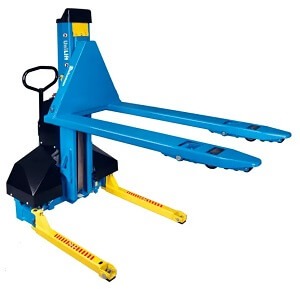 The period printed on a rate card does not tell a renter which block is cheapest for the planned use. L.A. Lift’s manual schedule provides a good test. One day is $50, one week is $125, and one month is $195. Three separate day-rates total $150, which is $25 more than the weekly rate. A renter who expects to keep the jack for three chargeable days should compare the weekly block before booking daily.
The monthly threshold arrives even earlier than its label suggests. Four daily rentals total $200, already $5 more than the published $195 monthly rate. Two weekly blocks total $250, which is $55 more than one month. Those comparisons use one provider’s rate ladder, so they are not national rules. They show why the cheapest period may be longer than the time the jack will actually be used.
Short blocks deserve the same check. Ultimate’s half-day price is $30 against $50 for a day. Tool Time also lists $30 for three hours against $50 for its ten-hour daily period. A tight pickup and return schedule can save money. If timing is uncertain, the longer block may protect against paying for an extension or a second rental day.
Delivery and Other Charges
Transport can dominate a small rental. The University of Utah Campus Receiving program, which is limited to University of Utah and UHealth users, lists a manual pallet jack at $25 per day, an electric unit at $75 per day, and $50 for delivery and pickup fee. For an eligible one-day manual rental, the scheduled total is $75. The delivery portion is 66.7 percent of that total.
That creates a useful price comparison. The delivered manual total of $75 equals the same program’s pickup-only electric base rate of $75. A renter looking only at equipment prices sees a $50 gap between manual and electric. Adding the fixed transport charge to the manual order removes that gap against an electric unit collected in person. This is a program-specific calculation, yet it shows why transport belongs in the budget from the start.
Delivery methods also differ by company. Alpine Equipment Repair in Utah publishes a 5,000-pound manual rate of $37.50 per day and $175 per week, then bills delivery at $165 hourly from its dispatch location. ACT’s equipment-rental requirements also state that delivery and pickup are separate from the equipment rate on its published schedule. A one-day job can be cheap at the counter and much dearer after transport. Ask for the full delivered quote before comparing providers.
Three Rental Scenarios
Three cases show how the same equipment category can produce very different spending. These are calculations from published rates already cited above, with the job duration stated as an assumption. They are not customer invoices.
One-day campus move
An eligible University of Utah or UHealth department needs a manual jack for one day and asks for campus dropoff and pickup. The equipment charge is $25 and delivery is $50. The itemized scheduled total is $75. Taxes or charges not shown on that program page are not added to this calculation.
Three-day warehouse backup
Assume a business can use L.A. Lift’s standard manual unit and expects three chargeable days. Paying the day rate three times would be $150. The listed weekly block is $125, saving $25 before transport. The week is cheaper even though the equipment is needed for less than seven days.
Short local pickup job
Assume the renter can collect and return a 5,000-pound manual unit from Ultimate within its half-day window. The published half-day equipment charge is $30 instead of the $50 daily rate, a difference of $20. That saving can disappear if travel or loading delays push the rental beyond the shorter block.
A moving project may also require a vehicle capable of carrying the palletized goods after the jack positions them. Readers planning that type of job can compare the equipment charge with a U-Haul truck rental rather than treating the jack as the full moving budget.
Rent or Buy?
Frequent manual-jack users should compare rental payments with a current purchase price. Home Depot currently lists an Eoslift standard M25D manual pallet jack rated for 5,500 pounds at $378 on its current 5,500-pound purchase listings. Using L.A. Lift’s already cited $50 daily manual rental rate, the sticker-price threshold is 7.56 rental days. Eight day-rates total $400, which is $22 more than the current retail sticker price.
The longer-period comparison is tighter. Two L.A. Lift monthly blocks at $195 each total $390, only $12 more than the $378 purchase listing. This is not a full ownership break-even. Purchase tax, shipping, storage, maintenance, repairs, financing, and resale value can shift the ownership side, while rental delivery and pickup can shift the rental side.
Rental still carries value when demand is sporadic, a business lacks storage, or a powered unit is needed for a temporary surge. Purchase becomes easier to defend when the same manual jack would be rented repeatedly and can be stored and maintained cheaply. A rental guide updated in July 2026 also treats delivery and repeated-use economics as part of the rent-versus-buy decision. Businesses already comparing several equipment rentals may also find the same duration logic in a store truck rental, where short advertised periods can change once loading and return time are counted.
Picking the Right Rental
Start with the load and the pallet, not the lowest advertised fee. Confirm the heaviest expected pallet, fork length, fork spread, aisle width, floor surface, and travel distance. A standard manual unit may fit a short stockroom move. A powered walkie or rider can be a better match for repeated travel across a large warehouse. If the job requires placing a pallet on a rack, a pallet jack is the wrong machine even if its rental rate is lower.
Powered equipment also changes the operator requirement. OSHA requires employers to train and evaluate powered industrial truck operators under its powered truck training standard. A business should settle the workplace training issue before reserving an electric unit. Charging access matters too. A battery-powered rental that cannot be charged during a multi-day job can create downtime that is more expensive than the difference between manual and electric rates.
Makes sense if
- The need lasts a few hours, days, or a temporary busy period.
- The renter wants backup equipment while an owned jack is unavailable.
- A powered or high-capacity model is needed only for one project.
- Storage and maintenance would make ownership inconvenient.
Does not make sense if
- Repeated manual rentals are approaching the purchase threshold.
- Fixed delivery charges are larger than the short base rental.
- The job needs substantial vertical lifting rather than floor-level pallet movement.
- The workplace cannot meet the operating or charging needs of the chosen powered unit.
Answers to Common Questions
How much is a manual pallet jack rental per day?
A current national benchmark is about $47 per day, while the direct manual listings reviewed here range from $32 to $60 per day. Local inventory, rental period, capacity, and transport can change the quote.
How much is an electric pallet jack rental?
BigRentz’s current benchmark is about $78 per day, $229 per week, and $624 per month. Rider models and higher-capacity units can cost more than walk-behind electric jacks.
Is a weekly rental cheaper than paying by the day?
It can be. On one published manual schedule, three day-rates total $150 while the weekly rate is $125. Always compare the provider’s full rate ladder.
When does buying a manual pallet jack become worth comparing?
A current $378 manual-jack retail listing costs less than eight $50 rental days, which total $400. That is a sticker-price comparison, not a full ownership calculation.
Disclosure: Educational content, not financial advice. Prices reflect public information as of the dates cited and can change. Confirm current rates, fees, taxes, and terms with official sources before purchasing. See our methodology and corrections policy.