
How Much Does It Cost to Rent an NVIDIA GPU?
Published on | Written by Alec Pow
This article was researched using 12 sources. See our methodology and corrections policy.
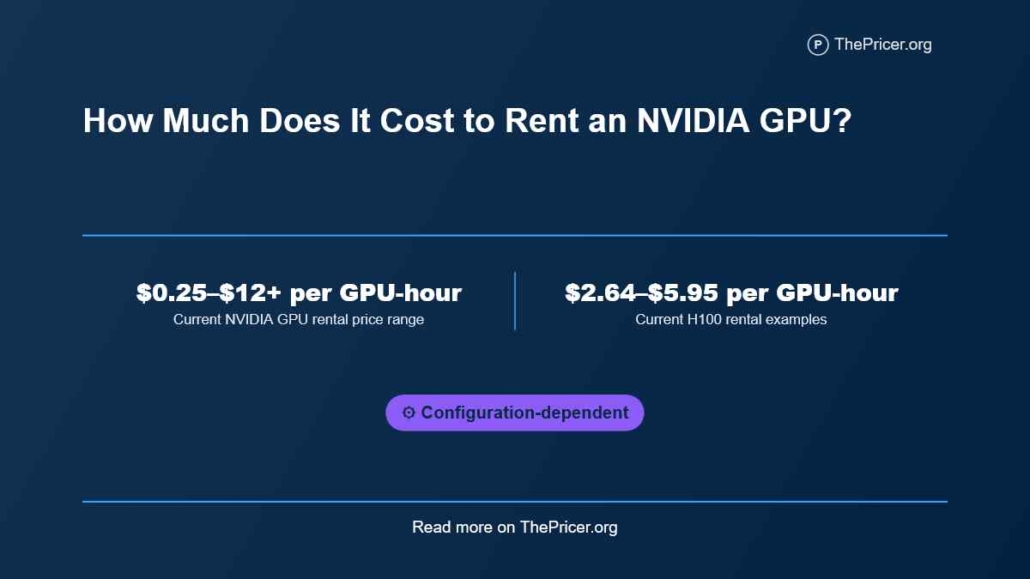
Renting an NVIDIA GPU currently costs about $0.25 to more than $12 per GPU-hour, depending on the GPU, provider, hardware variant and billing model. Lower-cost RTX 4090 and RTX 5090 rentals can sit below $1 per hour, while H100 rentals commonly run about $2.64 to $5.95 per GPU-hour in the current public examples reviewed.
B200 capacity can reach $6.79 to $12.355 per GPU-hour. The hourly rate is only one part of the bill. A machine that stays provisioned while idle, persistent storage, multi-GPU minimums and interruptible-capacity rules can change the real cost more than a small difference in sticker rate.
Article Highlights
Jump to sections
- Low-cost NVIDIA rentals start around $0.25 per GPU-hour for older V100 hardware.
- Current RTX 4090 examples run from about $0.39 to $0.74 per hour.
- H100 examples reviewed range from about $2.64 to $5.95 per GPU-hour.
- An eight-H100 CoreWeave node costs $49.24 (at $30 per hour, earning that amount would take about 1.6 hours of work, before taxes) per hour on demand or $19.71 per hour on spot capacity.
- A dedicated RTX 4090 becomes cheaper than RunPod serverless compute at roughly 67% active use.
- A 100-hour RTX 4090 workload with 500GB of standard network storage can total about $109 per month in the worked example.
How Much Does It Cost to Rent an NVIDIA GPU?
Entry pricing is lowest on older accelerators and consumer-class cards. CloudRift’s current rate sheet lists a V100 16GB at $0.25 per hour, RTX 4090 at $0.39, RTX 5090 at $0.60 and A100 80GB at $1.05. These are on-demand examples from one specialist provider, not market averages. Availability can change during the day, and a lower hourly card may not have enough memory for a particular model.
Higher-memory data-center GPUs move into a different price band. RunPod’s September 2026 pricing lists Secure Cloud rates of $0.74 per hour for RTX 4090, $0.99 for RTX 5090, $1.59 for A100, $2.89 for H100 PCIe, $4.59 for H200 and $6.79 for B200. Lambda’s self-service pricing lists a single H100 PCIe at $3.29 per GPU-hour and a single B200 at $6.99.
| GPU | Provider example | Published rate |
|---|---|---|
| V100 16GB | CloudRift | $0.25/hr |
| RTX 4090 24GB | CloudRift | $0.39/hr |
| RTX 5090 32GB | CloudRift | $0.60/hr |
| A100 80GB | CloudRift | $1.05/hr |
| H100 80GB | Spheron | $2.64/hr |
| H100 PCIe 80GB | RunPod Secure | $2.89/hr |
| H100 PCIe 80GB | Lambda | $3.29/hr |
| H100 80GB | DigitalOcean | $4.41/hr |
| H100 80GB | Paperspace | $5.95/hr |
| B200 180GB | RunPod Secure | $6.79/hr |
| B200 180GB | Lambda | $6.99/hr |
| B200 | AWS Capacity Block | $12.355 (about 25 minutes at $30 per hour)/GPU-hr |
GPU Model Changes the Price
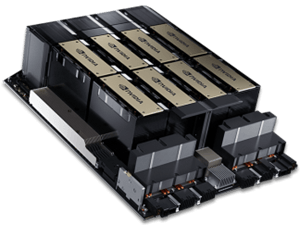
A GPU-hour is one accelerator allocated for one hour, but one GPU-hour does not buy the same amount of memory or throughput across models. NVIDIA’s HGX hardware specifications list 80GB of HBM3 on H100 SXM, 141GB of HBM3e on H200 and 180GB of HBM3e on B200. Memory bandwidth rises from 3.35 TB/s on H100 to 4.8 TB/s on H200 and up to 8 TB/s on B200. That extra memory can determine whether a large model fits on one GPU at all.
Consumer cards sit lower on the price ladder but carry much less VRAM. An RTX 4090 has 24GB, while the RTX 5090 has 32GB. They can be economical for image generation, smaller-model inference, development and some fine-tuning jobs. A workload needing 80GB or more may require model sharding, quantization or several consumer GPUs, which can erase the apparent hourly saving.
Form factor matters too. H100 PCIe and H100 SXM share the H100 name but differ in host configuration and interconnect. Multi-GPU SXM nodes can be valuable for training jobs that move large amounts of data between GPUs. A low single-GPU PCIe rate is not directly comparable with an eight-GPU HGX node carrying NVLink-class connectivity, far more host RAM and local storage. The useful cost unit is the configuration capable of finishing the workload, not the cheapest card name visible on a price list.
Provider Prices
The same GPU family can carry a wide price spread because cloud products include different host resources, regions and access rules. Spheron’s live marketplace lists H100 capacity at $2.64 per GPU-hour. DigitalOcean’s H100 GPU Droplet is $4.41 per GPU-hour and includes 240 GiB of host RAM, 20 vCPUs, a 720 GiB NVMe boot disk, 5 TiB of scratch storage and 15,000 GiB of transfer. Those packages should not be treated as identical merely because both contain an H100.
Another H100 example is Paperspace at $5.95 per hour. AWS Capacity Blocks price a U.S. H100 accelerator at $5.191 per accelerator-hour, while a B200 accelerator is $12.355 (about 25 minutes at $30 per hour). Capacity Blocks are reservation products rather than ordinary minute-by-minute marketplace capacity.
The price difference can exceed twofold before performance is considered. A 100-hour H100 job would cost $264 at the Spheron example, $441 at DigitalOcean, $519.10 at the U.S. AWS Capacity Block rate or $595 at Paperspace. Those totals do not prove that the lowest number is the best value. Availability, H100 variant, host RAM, network fabric, storage, support and reservation rules can all change which service is usable for the job.
Spot and Reserved Capacity
Interruptible capacity can cut a training bill sharply when a job can save checkpoints and resume after a reclaim. CoreWeave currently lists an eight-GPU HGX H100 node at $49.24 per hour on demand and $19.71 per hour on spot capacity. For 100 node-hours, the on-demand bill is $4,924. The spot bill is $1,971. The difference is $2,953, equal to about 60.0% of the on-demand cost.
That saving carries interruption risk. A job that cannot restart cleanly may lose training time, engineer time and already-paid compute. Spot works best for fault-tolerant training, batch processing and other work that can resume from frequent checkpoints. An online inference service with latency commitments may need on-demand or reserved capacity even when the hourly rate is higher.
Reserved pricing trades flexibility for a lower rate or firmer access. CloudRift lists its RTX 4090 at $0.39 per hour on demand, $0.35 with a one-month commitment and $0.33 with a three-month commitment. Lambda publishes lower per-GPU cluster prices as GPU count and commitment rise. These arrangements can reduce the compute rate, but paying for reserved capacity that sits unused can erase the discount. The right comparison is expected paid hours against expected useful hours, with interruption tolerance included.
Serverless vs. Dedicated Rental
Serverless GPU pricing is usually higher for each active hour, but it can win when traffic is bursty. RunPod lists an RTX 4090 Secure Cloud pod at $0.74 per hour and an RTX 4090 serverless worker at $1.10 per active worker-hour. The dedicated-to-serverless price ratio is 0.74 divided by 1.10, or about 67.3%. A dedicated 4090 is cheaper on raw compute once useful work occupies more than roughly 67% of the time that the pod remains provisioned.
Consider 100 active GPU-hours. A dedicated pod stopped immediately after those 100 hours costs $74. Serverless compute costs $110. If the dedicated pod remains provisioned for 200 hours while producing only 100 active hours, its compute bill becomes $148. In that 50% active-use case, serverless saves $38 even though its active-hour price is higher.
The threshold changes with the GPU. RunPod’s B200 pod is $6.79 per hour and its B200 serverless worker is $8.64 per active hour. The same calculation puts the break-even active-use rate near 78.6%. This is why an hourly price comparison can fail for inference. A dedicated machine is attractive when traffic is steady. Serverless can be cheaper when requests arrive in bursts and the alternative is paying for many idle provisioned hours.
Storage and Idle Time
Persistent data is a separate bill on many GPU clouds. RunPod currently prices standard network storage below 1TB at $0.07 per GB per month and high-performance network storage at $0.14 per GB per month. A 500GB dataset costs about $35 per month on the standard tier or $70 on the high-performance tier. Volume-disk pricing also changes between running and idle states, so retaining storage after a compute job ends can keep charges alive.
Powering a machine off does not always stop compute billing. DigitalOcean says a powered-off GPU Droplet continues to be billed because CPU, RAM, disk and IP resources remain reserved until the Droplet is destroyed. Paperspace uses a different rule.
Its machine compute charge stops after shutdown, though attached storage, public IP addresses and other add-ons can continue billing. A user who treats “off” as “free” across every provider can create a surprisingly large idle bill.
Data transfer, taxes and minimum allocation also matter. Some products include substantial transfer allowances. Others can charge for outbound traffic or require several GPUs per instance. A quoted $6 per GPU-hour is not a $6 hourly bill if the smallest rentable node contains eight GPUs. The same warning applies to storage. A low compute rate paired with expensive persistent data can lose to a higher-rate instance that bundles the storage and transfer the workload already needs.
What 100 GPU-Hours Cost
 A small AI team can turn the published rates into a realistic monthly budget. Assume 100 active RTX 4090 hours on RunPod Secure Cloud and 500GB of standard network storage. Compute is 100 multiplied by $0.74, or $74. Storage is 500 multiplied by $0.07, or $35 per month. The modeled core bill is $109 per month, before taxes, data-transfer charges outside any included allowance or other services.
Idle time changes the same budget. If the dedicated RTX 4090 remains provisioned for 200 hours to produce the same 100 active hours, compute becomes $148. Add the same $35 storage amount and the modeled total reaches $183. A serverless 4090 would cost $110 for 100 active worker-hours before any storage architecture used by that deployment. The gap shows why automatic shutdown rules can matter more than negotiating a few cents off the GPU rate.
Higher-end accelerators multiply the stakes. At RunPod’s published rates, 100 H100 PCIe hours cost $289, 100 H200 hours cost $459 and 100 B200 hours cost $679. Running continuously for 730 hours would turn those same rates into about $2,109.70, $3,350.70 and $4,956.70. Those are simple continuous-use equivalents, not monthly subscription quotes. Teams comparing H200 cloud access with hardware ownership can also use ThePricer’s NVIDIA H200 cost guide.
When Renting Beats Buying
Rental has the clearest advantage when demand is temporary, uncertain or bursty. A developer can rent an RTX-class GPU for a few hours without buying a workstation. A research team can book H100 or H200 memory for a short training run. A startup can use an eight-GPU node for a launch period without purchasing servers, networking, rack space, power and cooling. The cloud also makes it easier to change GPU generations when model requirements change.
Buying becomes more attractive when the same hardware can stay busy for long periods and the organization can support it. Continuous rental at $2.89 per hour makes one H100 PCIe roughly $2,109.70 per 730-hour month before attached services. That does not mean hardware purchase automatically wins after a fixed number of months. A fair ownership calculation needs the server chassis, CPUs, memory, storage, network equipment, power, cooling, support, failure risk and residual value. ThePricer’s DGX Spark cost analysis shows the same rent-versus-own tradeoff on smaller local AI hardware.
Makes sense if
- Your workload is temporary or changes GPU requirements often.
- You need high-memory H100, H200 or B200 hardware for short jobs.
- You can use spot capacity for checkpointed training.
- Your inference traffic is bursty enough for serverless billing to avoid long idle periods.
Does not make sense if
- You leave dedicated instances running idle for long periods.
- You compare a per-GPU quote with a full-node minimum without checking GPU count.
- You store large datasets indefinitely without pricing persistent storage.
- Your workload runs continuously for years and owned hardware has been priced on a full-cost basis.
Answers to Common Questions
How much does it cost to rent an NVIDIA H100?
Current public examples reviewed run from about $2.64 to $5.95 per GPU-hour, with some hyperscaler and specialized configurations priced higher.
How much does 100 hours of GPU rental cost?
It depends on the card. At the current RunPod examples used here, 100 RTX 4090 hours cost $74, 100 H100 PCIe hours cost $289 and 100 B200 hours cost $679 before storage and other services.
Is serverless GPU rental cheaper?
It can be for bursty workloads. In the RTX 4090 example, dedicated compute beats the serverless active-hour rate only when useful work occupies roughly 67% or more of the time the dedicated GPU stays provisioned.
Does turning off a cloud GPU stop billing?
Not always. Some providers keep charging for reserved resources until the instance is destroyed, while others stop compute billing after shutdown but continue charging for attached storage or other resources.
Is it cheaper to rent or buy an NVIDIA GPU?
Renting tends to fit short, uncertain and bursty workloads. Buying can become attractive for sustained high use, but the comparison needs hardware, power, cooling, support, networking and residual value rather than GPU purchase price alone.
Disclosure: Educational content, not financial advice. Prices reflect public information as of the dates cited and can change. Confirm current rates, fees, taxes, and terms with official sources before purchasing. See our methodology and corrections policy.