
How Much Does It Cost to Reroute an Oil Tanker Around Africa?
Published on | Written by Alec Pow
This article was researched using 8 sources. See our methodology and corrections policy.
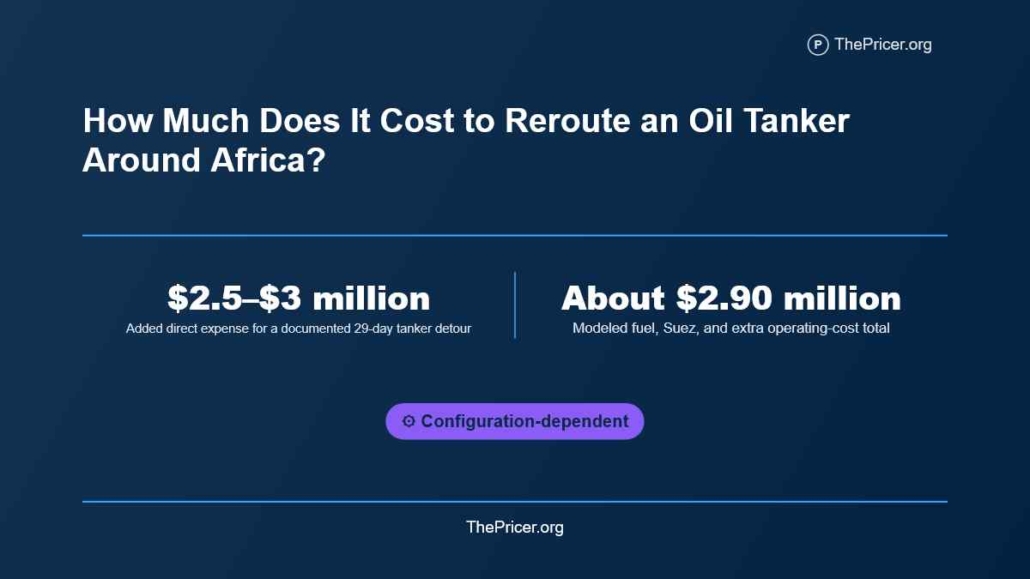
Rerouting an oil tanker around Africa can add roughly $2.5 million to $3 million in direct voyage expense in a well-documented 2026 case, but there is no single Cape of Good Hope surcharge. Reuters calculated that a tanker carrying Saudi crude from Yanbu to Taiwan would need 48 days on a Suez, Mediterranean, Gibraltar and Cape route instead of 19 days through Bab el-Mandeb. Fuel rises from $1.26 million to $2.87 million, while the Suez passage adds about $1 million.
The route adds 29 days. Adding current large-tanker routine operating expense of $9,936 per day produces a bounded ThePricer direct-cost model of about $2.90 million. That amount still excludes war-risk insurance, financing, cargo carrying cost, SUMED handling and the commercial value of tying up the tanker for another month.
Article Highlights
Jump to sections
- Reuters’ 2026 Saudi-to-Taiwan case adds about $2.5 million (at $30 per hour, earning that amount would take about 40 years of full-time work, before taxes) by its rounded estimate.
- The disclosed extra fuel and Suez inputs total $2.61 million.
- Adding 29 days of routine tanker Opex lifts the bounded model to about $2.90 million.
- The detour raises voyage duration by about 152.6% and fuel expense by about 127.8%.
- Twenty-nine extra VLCC days represent about $5.99 million of current earning-capacity exposure at one operator’s booked Q3 rate.
How Much Does It Cost to Reroute an Oil Tanker Around Africa?
The strongest route-specific cost case comes from Reuters’ July 2026 tanker analysis. Shipping data from Kpler and LSEG put the normal Yanbu-to-Taiwan voyage at 19 days and the Suez-Gibraltar-Cape alternative at 48 days. Reuters calculated normal fuel expense at $1.26 million (about 20 years of full-time work at $30 per hour) and rerouted fuel at $2.87 million. LSEG put the Suez crossing near $1 million.
Reuters summarized the extra voyage cost at about $2.5 million. The visible line items reconcile closely but not exactly because the headline number is rounded. Extra fuel is $2.87 million – $1.26 million = $1.61 million. Add the $1 million Suez figure and the disclosed components total $2.61 million.
The $2.5 million figure should be dated rather than treated as a permanent tariff. Marine fuel prices have moved since July. September bunker-market reporting says Singapore very-low-sulphur fuel oil remained more than 60% above pre-war levels even after easing from March peaks. A tanker fixed today could receive a different bunker quote from the July model. Vessel speed and the port where bunkers are purchased can move the fuel line as well, so the Reuters case works best as a documented 2026 benchmark rather than a universal Cape price.
What “Around Africa” Means
The price depends first on the voyage being rerouted. A normal Middle East-to-Europe tanker can bypass the Red Sea and Suez by sailing around the Cape of Good Hope. The U.S. Energy Information Administration says closing Suez and the SUMED route would add about 15 days to a voyage from the Arabian Sea to Europe. That is the classic Cape diversion most shipping discussions mean.
The 2026 Saudi case is different. A tanker starting at Yanbu is already inside the Red Sea. If Bab el-Mandeb is too risky for an eastbound Asian cargo, the ship cannot simply turn south and take the normal Cape bypass. It can instead sail north through Suez, cross the Mediterranean, pass Gibraltar, round the entire African continent and then continue east toward Asia. Reuters puts Yanbu-to-Taiwan at 19 days through Bab el-Mandeb versus 48 days on that long workaround.
That distinction changes the bill. The standard Arabian Sea-to-Europe Cape route avoids Suez. The Yanbu-to-Asia route uses Suez first, so a canal toll remains part of the cost even though the ship later rounds Africa. A reader asking what an Africa diversion costs should specify origin, destination and which chokepoint is being avoided before applying any dollar figure.
Fuel, Canal and Opex
A useful direct-cost model separates variable voyage spending from the ship’s routine daily expense. Okeanis Eco Tankers reported Q2 2026 Daily Opex of $9,936 per calendar day, including management fees. The company reports voyage expenses separately, which makes the figure suitable for adding routine ship-day expense without counting bunker fuel twice.
| Incremental cost in the Yanbu-to-Taiwan case | Amount | Basis |
|---|---|---|
| Extra fuel | $1,610,000 (about 26 years of full-time work at $30 per hour) | $2.87M rerouted less $1.26M normal fuel |
| Suez passage | $1,000,000 | Reuters/LSEG route estimate |
| 29 extra days of routine Opex | $288,144 | 29 × $9,936 |
| Bounded direct-cost model | $2,898,144 | Fuel + canal + extra routine Opex |
The modeled total is about $2.90 million. Divide it by the 29 extra days and the detour represents about $99,936 per added day across these three cost components. That near-$100,000 daily number is specific to this route and these inputs. It is not a universal tanker day rate.
The total deliberately leaves out war-risk insurance, cargo insurance, financing, SUMED fees, port agency charges, cargo inventory cost, charter-party claims and weather delay. Those items can be material. Keeping them outside the worked total is better than inserting an old tariff or an assumed insurance quote that may not match the vessel.
What 29 Extra Days Cost
The time penalty is as important as the fuel bill. Moving from 19 days to 48 days adds 29 days, which is a 152.6% increase relative to the normal voyage. Fuel spending rises by $1.61 million from the $1.26 million base, a 127.8% increase. The percentages show why a long security diversion affects more than the vessel’s arrival date.
Routine ship expenses continue every calendar day. Using the Okeanis fleetwide metric, 29 extra days add $288,144 before separately accounted voyage expense. For the more common Arabian Sea-to-Europe bypass, the EIA’s 15-day time penalty would represent $149,040 of the same modeled routine Opex. That smaller figure is only the daily operating layer, not a full 15-day Cape cost, because a compatible current fuel model for that exact route has not been published.
Longer voyages can also affect cargo scheduling, refinery inventory and fleet planning. One ship spending an extra month on a single cargo is unavailable for another fixture during those days. If many ships make the same diversion, effective tanker capacity tightens even without a vessel leaving the physical fleet. Readers comparing that operating effect with the asset itself can use ThePricer’s oil tanker cost guide, which separates purchase value from daily operating expense.
The Value of Lost Ship Time
The commercial value of 29 extra days can exceed the direct fuel-and-canal bill. Okeanis reported that 48% of its available Q3 2026 VLCC spot days had been booked at an average TCE rate of $206,600 per day, while 42% of Suezmax spot days were booked at $133,000 per day. TCE is an earnings measure, not an operating-cost invoice.
Multiplying those rates by the 29-day detour gives a useful capacity proxy. A VLCC produces 29 × $206,600 = $5,991,400 of booked-rate vessel-time exposure. A Suezmax produces 29 × $133,000 = $3,857,000. These amounts should not be added mechanically to the $2.90 million direct-cost model. TCE reflects voyage economics and revenue capacity, while the direct model already counts specific fuel, toll and routine Opex inputs.
The point is commercial rather than accounting. When tanker rates are strong, tying up a ship for another month carries a high economic cost even if the owner’s extra cash expenses are lower. A shipowner, voyage charterer and cargo buyer can bear different pieces depending on the charter party and sale terms. That is why two companies can describe the same Cape diversion with different “cost” numbers and both may be measuring legitimate but different layers.
Insurance vs the Cape Detour
 War-risk insurance can change the routing decision by millions of dollars. Reuters reported in July that indicative premiums for southern Red Sea voyages rose above 1% of ship value for some operators. Certain Saudi-linked voyages near Yemen and Bab el-Mandeb were quoted as high as 3%. Yanbu and Jeddah carried much lower quoted rates near 0.1% at that point because of their more northerly location.
A percentage-based premium makes ship value matter. A tanker worth $100 million would translate a 1% war-risk quote into $1 million before cargo insurance or other charges. A 3% quote on the same illustrative hull would equal $3 million. Those are arithmetic examples using the reported percentages, not insurance quotes for a real vessel.
The security picture remains active. Reuters’ September 10 Bab el-Mandeb report says the strait carries an estimated 7% of global oil output and that renewed Houthi control concerns could disrupt shipping again. Hormuz is a different insurance market.
Reuters reported on September 9 that some current Hormuz transit and insurance costs have reached $10 million to $20 million. That number should not be copied into a Cape reroute bill because it describes a separate chokepoint and risk set. ThePricer’s Hormuz security cost page covers the military and coalition spending behind that separate shipping problem.
VLCCs, Suez and SUMED
The 2026 Saudi workaround has a physical constraint that changes cost. Reuters reports that very large tankers may need to pass Suez partly loaded because of draft limits, then top up cargo in the Mediterranean using Egypt’s SUMED pipeline. The pipeline links Ain Sokhna on the Red Sea with Sidi Kerir on the Mediterranean and can move about 2.5 million barrels per day.
That arrangement means a VLCC’s route may involve more than fuel and canal dues. Cargo transfer, scheduling and pipeline access can affect the real voyage economics. Public 2026 evidence does not provide a current SUMED tariff that maps cleanly onto the Yanbu-to-Taiwan example, so no SUMED dollar line belongs in the worked total. Missing public pricing is not the same as a zero charge.
The Suez Canal Authority’s current toll framework still contains specific crude-oil-tanker provisions, and its September 2026 notices show active rules and rebates remain in force. Reuters’ route model uses about $1 million for the Suez crossing, which is the right figure for that documented case. A different tanker could face a different canal amount because dues depend on vessel characteristics, condition and current rules.
What Changes the Final Bill
Tanker class, speed and fuel consumption can move the detour cost sharply. A modern eco-designed VLCC can burn less fuel than an older ship at the same speed, while poor weather around the Cape can lengthen the voyage or force speed changes. Laden draft, cargo quantity and destination also influence whether Suez, SUMED or another loading pattern is workable. Bunker purchase location matters because the same fuel grade can carry different prices at Fujairah, Singapore, Rotterdam or other hubs.
Contract structure determines who feels each cost. Under one charter arrangement, the charterer may pay voyage fuel and canal expenses while the owner bears routine vessel Opex. Under another, commercial terms can shift more risk to the owner or cargo interest. Delay can also create delivery penalties or inventory costs that never appear in a bunker invoice.
Rerouting can make financial sense when
- War-risk premiums and physical-loss exposure make the shorter route economically unattractive.
- Coverage is restricted or withdrawn for the direct chokepoint.
- The cargo can tolerate the longer delivery schedule.
- The available ship and loading plan can use the chosen Cape route efficiently.
The direct route may carry a lower commercial bill when
- Coverage remains available at a manageable premium.
- The shipowner and charterer are willing and permitted to use the chokepoint.
- The extra fuel and vessel-days exceed the risk-adjusted savings from diversion.
- Delivery timing makes a multi-week detour particularly expensive.
This is an economic comparison, not advice to send a ship through an active conflict area. Security restrictions, insurer terms and vessel-management decisions can override a nominal cost advantage.
Answers to Common Questions
How much does it cost to reroute an oil tanker around Africa?
A strong 2026 case supports roughly $2.5 million to $3 million in added direct expense for a 29-day Yanbu-to-Taiwan detour. Other routes can cost less or more.
How much extra fuel does the Cape detour use?
In Reuters’ Saudi-to-Taiwan model, fuel rises from $1.26 million to $2.87 million, an increase of $1.61 million or about 127.8%.
How much longer does rerouting around Africa take?
The current Yanbu-to-Taiwan example rises from 19 to 48 days, adding 29 days. The EIA says an Arabian Sea-to-Europe Suez bypass adds about 15 days.
Does rerouting around Africa avoid the Suez Canal fee?
Often it does, but not in the unusual 2026 Yanbu-to-Asia workaround. That tanker starts inside the Red Sea and sails north through Suez before crossing the Mediterranean and rounding Africa.
Can insurance cost more than the reroute?
It can in high-risk cases. Reuters reported southern Red Sea war-risk quotes above 1% of ship value and as high as 3% for some exposed voyages. The actual premium depends on the vessel, route, ownership, insurer and security conditions.
Disclosure: Educational content, not financial advice. Prices reflect public information as of the dates cited and can change. Confirm current rates, fees, taxes, and terms with official sources before purchasing. See our methodology and corrections policy.