
How Much Does It Cost to Run a Small Business Per Month?
Published on | Written by Alec Pow
This article was researched using 14 sources. See our methodology and corrections policy.
A U.S. small business monthly operating budget can include payroll, employer payroll taxes, business insurance, accounting software, business email, payment processing, rent or coworking, utilities, inventory, marketing, professional services, and owner compensation.
The mix depends on whether the company is home-based or location-dependent, has employees, sells products or services, takes card payments, and carries industry-specific insurance or licensing costs.
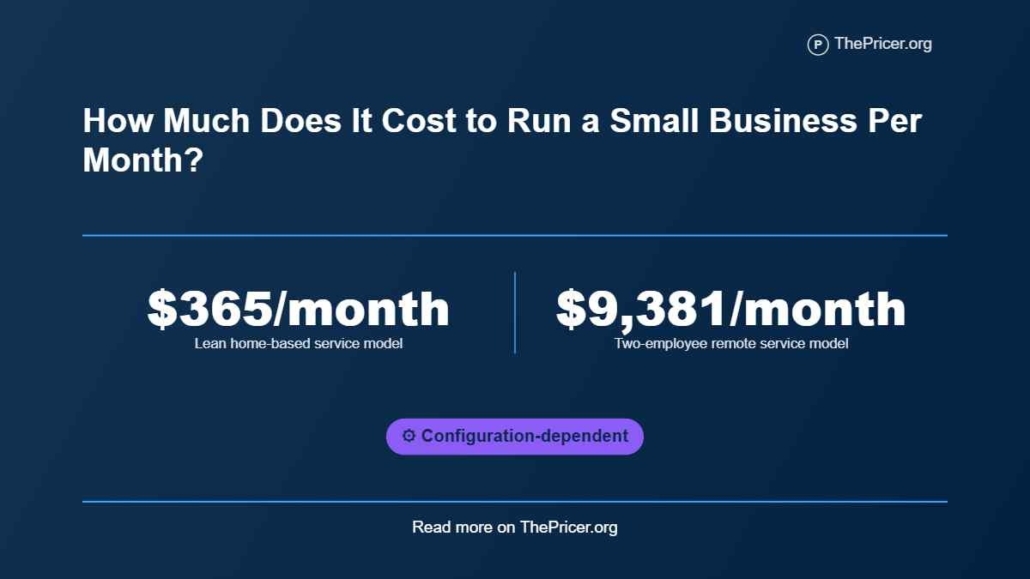
For a lean owner-operated service business, recurring overhead can stay in the low hundreds before owner pay, taxes, marketing, and industry-specific expenses. The illustrative home-based model used below reaches about $365 per month. A remote service company with two full-time employees reaches about $9,381 per month before owner compensation, health benefits, state unemployment taxes, marketing, phone service, travel, and several other business-specific charges.
The useful number is the company’s monthly cash requirement rather than a single national average. Separate fixed overhead from costs that rise with headcount, transactions, inventory, or physical space, then add predictable annual obligations as monthly reserve amounts.
Article Highlights
Jump to sections
- A lean home-based service model can land near $365 (at $30 per hour, earning that amount would take about 1.5 full-time workdays, before taxes) per month before owner pay and many optional expenses.
- One illustrative full-time employee at $25 per hour adds about $4,368 per month from wages, employer FICA, payroll software, and one business-email seat.
- Two employees in the worked model push recurring monthly spending to about $9,381 before health benefits and several state or industry charges.
- At an assumed $100 average ticket, 33 Square card-present sales create about $90.75 in processing fees, slightly above the selected accounting, email, and liability-insurance stack.
- Rent, benefits, stock, and premises can move a real company’s budget above the illustrative totals.
How Much Does It Cost to Run a Small Business Per Month?
A home-based consultant, designer, bookkeeper, or similar owner can keep the fixed software and insurance stack small. QuickBooks currently lists Simple Start at $38 per month, apart from temporary introductory pricing. Google Workspace Business Starter lists a standard annual-commitment rate of $7 per user per month. Insureon reports a median general-liability premium of $45 per month among policies bought by its customers.
Those three lines create a modeled fixed stack of $90 (about 3 hours of work at $30 per hour) per month. Add an illustrative month with $10,000 in card-present sales spread across 100 transactions. Square lists card-present processing at 2.6% plus $0.15 per transaction. The processing charge in the scenario is $275, made from $260 in percentage fees plus $15 in transaction charges. The selected monthly total becomes $365.
That $365 is not a national average or a complete personal-income target. It excludes owner compensation, income and self-employment taxes, phone and internet service, advertising, travel, licenses, and industry tools. It shows how low a recurring stack can be without employees or paid premises.
What Counts as a Monthly Cost?
A monthly operating budget should capture the expenses needed to keep the company functioning after launch. That means recurring bills such as wages, payroll taxes, insurance, accounting tools, communications, software, rent, utilities, merchant fees, supplies, inventory replenishment, advertising, and professional help. A yearly license or policy still belongs in the model when the obligation is predictable, but the owner can convert it to a monthly reserve instead of pretending the charge disappears during the other eleven months.
Startup spending belongs in a different bucket. Formation work, an initial equipment purchase, a lease deposit, furniture, a first inventory load, and a build-out can require cash before normal operations begin, yet treating those purchases as ordinary monthly overhead distorts the run rate. A business that already owns its equipment and a new business buying the same equipment have different near-term cash needs even when their later operating costs match.
The useful split is fixed, variable, and step-up spending. Fixed costs stay similar across a normal month. Variable costs rise with sales or production. Step-up costs stay flat until the company adds a worker, location, vehicle, machine, or software seat. A budget built around those drivers is more useful than one national average because the cost mix changes with the business model.
Payroll
Payroll can change the run rate in one hiring decision. For 2026, the employer share of Social Security is 6.2% on covered wages up to the wage base, and the employer Medicare rate is 1.45%. That creates a 7.65% employer FICA charge for the wage level used in our example. It does not include federal unemployment tax, state unemployment tax, workers’ compensation, paid leave, retirement contributions, or health coverage.
Assume one employee works 160 paid hours in a month at $25 (about 50 minutes at $30 per hour) per hour. Gross wages are $4,000, and employer FICA is $306. Gusto Simple has a monthly base and per-person charge of $49 per month plus $6 per person per month. Add one $7 Workspace seat and the four selected lines reach $4,368 per month. A company already paying the Gusto base fee would add about $4,319 per month for another employee on the same wage and email assumptions.
Published labor data also shows why a wage-only budget can understate staffing cost. In June 2026, private establishments with 1 to 49 workers had average wage and benefit costs of $27.88 per hour in wages and salaries plus $9.76 per hour in benefits. That is a broad establishment benchmark, not a quote for any occupation. Readers comparing payroll providers can also check current ADP payroll costs before choosing a system.
What Space Adds
Physical space can turn a low-overhead service company into a location-dependent business. A storefront, office, studio, kitchen, workshop, or warehouse can add base rent, common-area charges, utilities, internet, cleaning, security, repairs, furniture, deposits, and insurance changes. The monthly effect depends heavily on the city, square footage, lease structure, building class, and whether utilities or maintenance sit inside the rent. A national dollar range without those inputs can be more misleading than useful.
Coworking gives a documented reference point for a business that needs desks without taking a conventional lease. WeWork lists the All Access Basic rate in the United States at $220 per month, or $187 per month with a 12-month plan. Two month-to-month Basic memberships would add $440 per month to the two-employee scenario used later, taking that selected model from $9,381 to $9,821.
Coworking is not a substitute price for an office or retail lease. It is a desk-access comparison. A bakery, salon, repair shop, medical office, or retailer may need dedicated premises, specialized utilities, storage, signage, or build-out work. Those businesses should budget the actual address and lease terms.
Insurance by Business Type
Insurance is another expense where one flat number can hide the real choice. General liability, property, professional liability, cyber coverage, and workers’ compensation address different risks, so adding every policy type to every budget would overstate some businesses and understate others. Insureon reports a median workers’ compensation premium of $54 per month among its small-business customers. The same page says payroll, location, industry, claims history, and employee count can change the premium.
The coverage mix depends on the operation. A consultant may care about professional liability. A contractor may face workers’ compensation and higher liability exposure. A retailer with equipment and stock may compare a business owner’s policy with separate property and liability coverage. A company holding sensitive customer data may price cyber coverage. The existing guides to business liability insurance costs and cyber liability insurance costs give deeper policy-level context.
Health coverage creates a different scale of expense once a business offers it. KFF reports an average annual single premium of $9,211 in 2025 for covered workers at firms with 10 to 199 workers. The same survey says workers with single coverage contributed 16% of the premium on average, including at firms in that size group. Using those inputs, $9,211 times 84% divided by 12 is about $645 per covered worker per month. That benchmark does not describe firms with fewer than ten workers.
Software and Payment Fees
 Software is often a small line next to payroll, but per-user billing creates its own step-ups. Accounting, email, payroll, point-of-sale tools, scheduling, cloud storage, security, customer management, design tools, and industry apps can each add a recurring charge. The right budget lists the tools actually required for the work and separates standard renewal pricing from short introductory discounts. Marketing can be another recurring service line, and current SEO service costs show how an outsourced monthly retainer can dwarf a basic software subscription.
Payment processing behaves differently because the bill follows sales volume and transaction count. Using Square’s cited 2.6% plus $0.15 card-present rate, an assumed $100 sale costs $2.75 to process. The selected solo fixed stack is $90 per month. Divide $90 by $2.75 and the crossover is 32.7 transactions. At 33 transactions, or $3,300 in monthly card sales at that ticket size, processing reaches $90.75.
This crossover is useful because it shows how a variable fee can overtake several visible fixed subscriptions at fairly modest sales volume. It is not a claim that Square is expensive or cheap relative to every processor. A lower average ticket raises the effect of the fixed per-transaction charge, while a higher ticket makes the percentage component more dominant. Online payments can also use a different fee schedule from card-present sales.
Three Monthly Cost Scenarios
The table uses illustrative businesses so the assumptions remain visible. These are not customer invoices or national averages. The online seller case excludes inventory, shipping, returns, advertising, and paid apps.
| Scenario | Selected monthly costs | Modeled total |
|---|---|---|
| Home-based solo service | QuickBooks $38, Workspace $7, general liability $45, Square processing on assumed $10,000 card sales $275 | $365 |
| Remote service firm with two employees | Wages $8,000, employer FICA $612, Gusto $61, Workspace $21, QuickBooks $38, liability $45, workers’ compensation benchmark $54, Square processing $550 | $9,381 |
| Online seller with no employees | Shopify Basic monthly billing $39 plus online card fees on assumed $10,000 across 100 orders at 2.9% plus $0.30 each, based on Basic plan monthly pricing | $359 |
The middle case is the worked total. Two employees at 160 hours each and $25 per hour create $8,000 in wages. Employer FICA adds $612. Gusto costs $61 for the base and two people. Three Workspace users cost $21. QuickBooks contributes $38. The selected general-liability and workers’ compensation benchmarks add $99. Processing assumed $20,000 in card-present sales across 200 transactions adds $550. The arithmetic produces $9,381 per month.
The case still omits owner pay, health benefits, unemployment taxes, paid leave, retirement contributions, phone service, marketing, travel, equipment, and industry-specific costs. The worked total is a starting model, not a promised all-in figure.
How Much Cash to Keep Available
A monthly expense total and a cash reserve answer different questions. The expense total estimates a normal month. Cash on hand must also absorb timing gaps, seasonal dips, annual renewals, repairs, tax payments, deposits, stock purchases, and sudden sales changes. Cash timing can still create a squeeze before customer money arrives.
Build the reserve from the company’s own run rate. Start with fixed bills that continue if sales fall. Add the next payroll cycle, accrued taxes, committed supplier payments, debt service, and annual charges due soon. Then test a weaker-sales month. The two-employee model already reaches $9,381 per month before several omitted costs.
Makes sense if
- You substitute your actual wages, sales volume, transaction count, insurance quotes, and premises cost for the illustrative inputs.
- You separate startup purchases from the recurring run rate.
- You convert predictable annual bills into monthly reserve amounts.
- You test how the budget changes after the next employee, lease, or sales milestone.
Does not make sense if
- You treat $365 or $9,381 as a national average.
- Your business depends on inventory, vehicles, regulated facilities, heavy equipment, or expensive materials not represented in the scenarios.
- You omit owner compensation or taxes and call the remaining total a complete income target.
- You use a national coworking rate as a substitute for a real local lease quote.
Answers to Common Questions
Can a small business run for less than $500 per month?
Yes. A home-based owner with no employees, no paid premises, and a small software stack can stay below $500 per month in selected operating expenses. Owner compensation, taxes, phone service, marketing, travel, and industry-specific costs can push the real cash need higher.
What is usually the biggest monthly expense?
For an employer, payroll can become the largest recurring line very quickly. For a retailer or product company, inventory and premises may rival or exceed labor. The answer depends on how the company produces and sells its work.
Should startup costs be included in the monthly total?
Keep one-time startup spending separate from the recurring run rate. A predictable annual renewal can still be divided into a monthly reserve so the business accumulates the cash before the bill arrives.
How should a business estimate its own monthly cost?
List fixed bills, add payroll and employer taxes, estimate sales-linked fees from realistic volume, add inventory or production costs, and reserve for annual obligations. Run a normal-sales month and a weaker-sales month so the cash requirement is visible before a shortfall occurs.
Disclosure: Educational content, not financial advice. Prices reflect public information as of the dates cited and can change. Confirm current rates, fees, taxes, and terms with official sources before purchasing. See our methodology and corrections policy.