
How Much Does It Cost to Sell a Business?
Updated on | Written by Alec Pow
This article was researched using 14 sources. See our methodology and corrections policy.
For a U.S. privately held business, selling costs can range from a few thousand dollars on a simple owner-led sale to well into six figures on a larger transaction with an M&A advisor, attorney, accountant, and sell-side diligence.
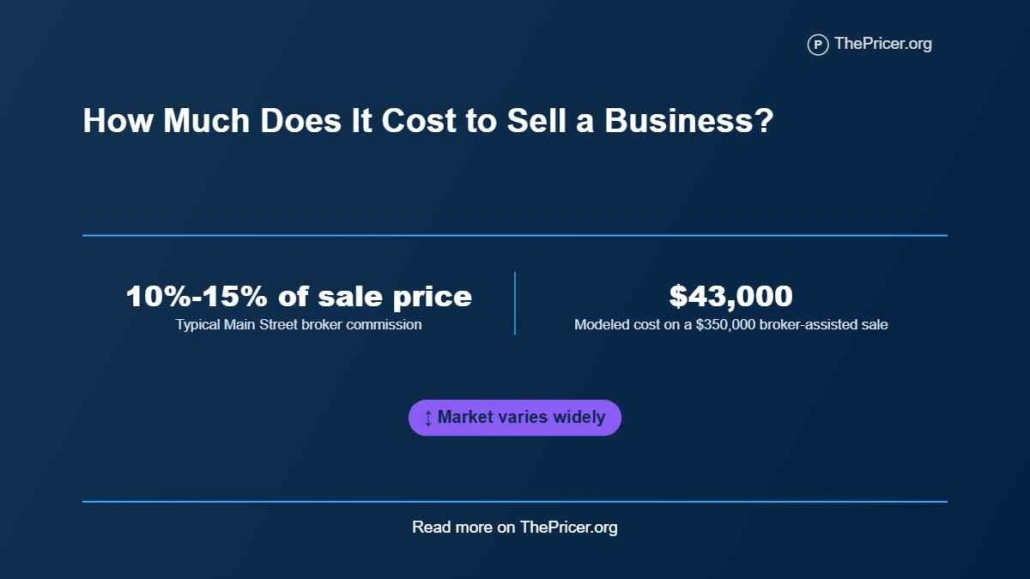
On Main Street deals, BizBuySell says broker commissions commonly run 10% to 15% of the sale price for businesses sold from $100,000 to $1 million, with reduced rates often negotiated above that level. Taxes are separate from these transaction-service costs because the seller’s tax bill depends on structure, basis, and asset allocation.
A seller may pay a business broker or M&A advisor, business-valuation specialist, CPA, transaction attorney, escrow provider, and, on larger deals, a quality-of-earnings firm. Those services are priced through commissions, retainers, success fees, hourly legal work, fixed accounting fees, and project fees. Deal size, record quality, asset-versus-stock structure, earnouts, rollover equity, and closing requirements determine which costs apply and how large they become.
Article Highlights
Jump to sections
- A $350,000 (at $30 per hour, earning that amount would take about 5.6 years of full-time work, before taxes) Main Street sale with a 10% broker commission, an assumed $5,000 legal bill, and $3,000 of CPA work produces a modeled transaction cost of $43,000 before taxes and variable closing charges.
- Professional business valuations can start near $1,500 for abbreviated work, around $4,000 for a fuller informational report, and $7,000 or more for certified work.
- Lower-middle-market advisory engagements may combine an upfront fee with a closing fee, so the contract must state whether the retainer is credited.
- A seller-side quality of earnings report can add $15,000 to $35,000 for one current lower-middle-market scope.
- Taxes from the sale are not a single flat selling fee and can differ across inventory, depreciable property, goodwill, and other assets.
Where Seller Costs Come From
A seller can incur costs before a buyer is found, while the company is being marketed, during negotiations, and at closing. Pre-sale work can include financial cleanup, a valuation, management changes, document organization, and repairs to the operation that make diligence easier. Marketing may be purchased directly or bundled into a broker agreement. Deal execution then brings attorney time, accounting work, disclosure schedules, consents, escrow items, and filing charges.
The first budgeting decision is to separate costs that are common across many sale paths from costs tied to a chosen route. A direct seller may still pay counsel and an accountant but avoid a broker commission. A broker-assisted seller may get valuation help, a selling memorandum, buyer screening, and marketplace exposure inside the commission. BizBuySell’s seller-cost guide lists CPA preparation around $1,000 to $5,000 (about 0.8 to 4.2 full-time workweeks at $30 per hour), direct listing charges around $500 to $1,000 or more, and professionally prepared selling memoranda around $500 to $3,000.
Business-sale taxes should not be folded into a national percentage estimate. The IRS says a sale of a business often represents a sale of several assets, with gain or loss determined by asset class. That makes tax planning a separate net-proceeds exercise rather than another broker or closing charge.
Broker and Advisor Fees
Main Street brokers and lower-middle-market M&A advisors do not price their work the same way. A broker may quote a percentage of the final sale price, sometimes with a flat fee for a very small company. An M&A advisor may charge a one-time engagement fee, a monthly retainer, a success fee, or a combination. Axial’s 2026 survey of 331 M&A advisors found that 71% charged some form of upfront fee. Fixed retainers accounted for 31% of responses and monthly retainers for 29%, while Lehman-style and flat-percentage success-fee structures together accounted for 79%.
Fee formulas also need to be read tier by tier. Salt Creek’s 2026 explanation of the classic Lehman scale uses 5% on the first $1 million (about 16 years of full-time work at $30 per hour), 4% on the second $1 million, 3% on the third, 2% on the fourth, and 1% above $4 million. On a $5 million transaction, that formula produces a $150,000 success fee, equal to 3% of the whole price.
The retainer clause can change the true advisory cost. Assume a $60,000 retainer on the same modeled $5 million deal. If the contract credits the full retainer against the $150,000 closing fee, advisor cost remains $150,000. If no credit applies, the combined advisor bill becomes $210,000, which is 40% higher. The $60,000 retainer is an illustrative assumption, not a quoted universal fee.
Valuation and Financial Prep
A separate valuation is not mandatory for every sale. A broker may provide pricing work as part of the engagement, while a larger or contested transaction may call for a formal report. BizWorth’s 2026 pricing page starts abbreviated informational work around $1,500, fuller informational work around $4,000, and certified valuation work around $7,000 or more. The right scope depends on whether the report is only for sale planning or must satisfy a lender, court, tax matter, or another outside party.
Financial preparation can be smaller than the commission yet still affect the sale process. A seller may need normalized statements, tax returns, supporting schedules, accounts-receivable detail, inventory records, or explanations for owner expenses and one-time items. The cost rises when records are incomplete or when an accountant must rebuild prior periods. Owners comparing accounting support can use CPA cost benchmarks as a second budgeting reference, while the sale-specific scope should be quoted separately.
Paying for a valuation and paying for financial cleanup also solve different problems. Valuation work estimates what the business may be worth. Accounting work helps a buyer test the earnings, cash flow, and balance-sheet items behind that price. Buying both may be useful on a complicated sale, but counting them as one interchangeable service can make the budget look lower than the work actually requires.
Legal and Closing Work
 Seller counsel reviews or negotiates the letter of intent, purchase agreement, disclosure schedules, assignment documents, restrictive covenants, escrow language, and other closing papers. CT Acquisitions, a commercial M&A source rather than a law-firm fee survey, reports seller legal fees of about $3,000 to $8,000 for very small asset sales under $500,000, $8,000 to $25,000 for deals from $500,000 to $3 million, and $25,000 to $75,000 for deals from $3 million to $15 million. It also identifies stock structure, earnouts, rollover equity, consents, and disclosure work as cost drivers.
Those bands are orientation points, not a national schedule. A seller should ask the engagement letter to define the work covered, billing rates, expected range, and what counts as a scope change. Flat or capped pricing may fit a simple small deal, while hourly billing can make scope discipline especially valuable.
Closing charges can include escrow services, state filings, transfer items, unpaid business or property taxes, and consent-related costs. A single U.S. number would be weak because the charges depend on jurisdiction and the deal. The practical budget should list each known closing item rather than hide them inside a broad percentage.
Sell-Side QoE Costs
A quality of earnings report tests the sustainability and presentation of earnings. Breakwater M&A’s September 2026 pricing discussion places a seller-side QoE around $15,000 to $35,000 for the lower-middle-market scope it describes, while its broader QoE range for businesses with $2 million to $20 million of revenue is $15,000 to $50,000.
This is an optional seller expense, not a standard charge on every business sale. A small owner-operated company with straightforward cash-basis books may not need seller-side QoE work before going to market. A larger company priced on adjusted EBITDA may have more reason to document add-backs, customer concentration, revenue quality, and working capital before buyers start diligence.
Provider scope matters as much as the headline fee. A narrow earnings validation, a standard sell-side report, and a large transaction-advisory engagement are not the same product. Sellers should compare deliverables, periods reviewed, data-room requirements, working-capital work, and whether the provider will answer buyer follow-up questions after the report is issued. The quote should state whether lender calls, buyer questions, and later revisions are included in the fixed fee.
Three Seller Cost Scenarios
These scenarios use published ranges plus labeled assumptions. They are planning models, not reported customer invoices. The $350,000 Main Street sale price matches BizBuySell’s 2025 median sale price, which rose 2% from the prior year.
| Scenario | Assumed sale price | Modeled seller costs | Modeled total before tax |
|---|---|---|---|
| Direct Main Street sale | $350,000 | $750 listing, $1,750 selling memo, $5,000 legal, $3,000 CPA | $10,500 |
| Broker-assisted Main Street sale | $350,000 | $35,000 commission at 10%, $5,000 legal, $3,000 CPA | $43,000 |
| Lower-middle-market sale | $5 million | $150,000 classic Lehman fee, assumed $40,000 legal, optional $25,000 QoE | $215,000 |
The direct-sale case uses midpoint assumptions inside the published listing and memorandum ranges. The broker case uses a 10% commission inside the published broker range. The lower-middle-market case uses the documented classic Lehman calculation, a legal assumption that falls inside the cited deal-size band, and an optional QoE assumption inside the cited seller-side range. Removing QoE from that third scenario lowers the modeled total to $190,000.
The broker-assisted Main Street example leaves $307,000 before tax and unmodeled closing charges. Its $43,000 transaction bill equals about 12.3% of the assumed sale price. Adding a separate $5,000 appraisal would raise the modeled total to $48,000, or about 13.7%, but that extra appraisal should not be added when equivalent pricing work is already included in the broker service.
What Pushes Fees Higher
Deal size changes the mix of professional help, but the fee base written into a contract can matter just as much. A success fee may be applied to enterprise value, equity value, cash paid at closing, seller financing, an earnout, rollover equity, or another defined measure. Two advisors quoting the same percentage can produce different dollar bills if their contracts define transaction value differently.
WETYR notes that minimum fees and retainer credits deserve equal attention because a minimum can raise the effective percentage on a smaller sale and a credit can change the cash cost of the engagement. Firmex’s U.S. 2024 to 2025 survey of 212 M&A advisors reported that average engagement fees and average success fees had increased from the prior survey period.
Complexity reaches beyond advisor compensation. Weak records create accounting work. Asset versus stock structure changes legal drafting and tax analysis. Earnouts and rollover equity add documents. Multi-state operations can add tax, consent, or filing work. A seller comparing offers should identify which professional charges are fixed, hourly, contingent, optional, or credited at closing.
Broker or Direct Sale?
A broker commission is expensive enough that the decision should be tested against net proceeds, not just gross price. Using the direct-sale model above, marketing costs are $2,500 from a $750 listing and $1,750 selling memorandum. Common legal and CPA assumptions cancel out when comparing the two paths. A direct $350,000 sale would leave $347,500 before those common costs.
At a 10% broker commission, the broker-assisted price must satisfy 90% of the sale price equals $347,500. The result is about $386,111. That is roughly 10.3% above the direct $350,000 sale. At a 15% commission, the comparable break-even price is about $408,824, roughly 16.8% higher. These are ThePricer’s calculations from the stated assumptions, not claims that brokers routinely increase sale prices by those percentages.
The math gives an owner a useful threshold. A broker can still justify the fee without producing a higher headline price if buyer screening, confidentiality, negotiation help, or process management has enough value to the seller. A direct sale can make financial sense when a credible buyer already exists and the owner can manage marketing while retaining specialist counsel and accounting help.
Makes sense if
- The intermediary has access to qualified buyers the owner cannot reach efficiently.
- The process needs active buyer screening, confidentiality controls, and negotiation support.
- The likely value of a broader buyer process exceeds the expected fee.
Does not make sense if
- A credible buyer is already identified and competitive marketing adds little.
- A minimum fee creates an excessive effective rate for the expected sale price.
- The owner can handle marketing and coordination while retaining specialist legal and accounting help.
Answers to Common Questions
What is the biggest cost when selling a small business?
For many broker-assisted Main Street sales, the broker commission is the largest transaction expense. Legal, accounting, valuation, and closing work can still add thousands of dollars.
Can I sell a business without paying a broker?
Yes. A direct seller can avoid a broker commission, but may still pay for marketplace exposure, marketing materials, legal work, accounting preparation, and closing charges.
Should taxes be included in the cost to sell?
They should be included in a net-proceeds plan but kept separate from transaction-service fees. The tax result depends on entity structure, asset classes, basis, allocation, and the type of consideration received.
Do I need a quality of earnings report before selling?
No. Seller-side QoE work is optional. It is more relevant to transactions where adjusted EBITDA, working capital, add-backs, and financial diligence play a large role in price negotiations.
Disclosure: Educational content, not financial advice. Prices reflect public information as of the dates cited and can change. Confirm current rates, fees, taxes, and terms with official sources before purchasing. See our methodology and corrections policy.