
How Much Does It Cost to Set Up a Reptile Habitat?
Published on | Written by Alec Pow
This article was researched using 13 sources. See our methodology and corrections policy.
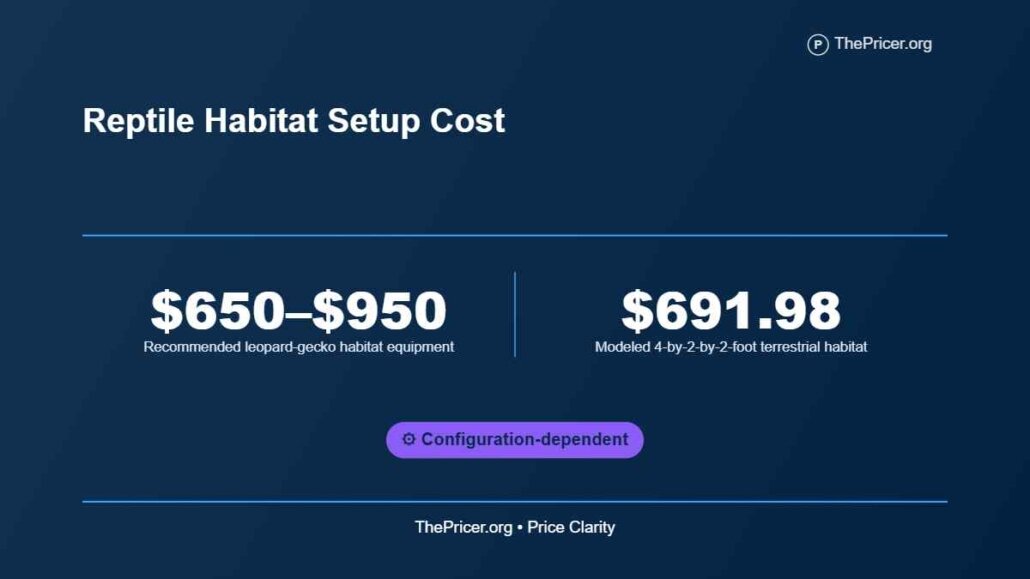
A reptile habitat can cost several hundred dollars before you buy the animal. For a concrete U.S. benchmark, ReptiFiles estimates $650–$950 for its recommended leopard-gecko supplies in its complete equipment shopping list. The adult-size terrestrial setup calculated below totals about $692, while a bioactive substrate upgrade brings that same example close to $972.
These are defined examples, not a national average for every reptile. Species, adult enclosure dimensions, lighting, heat control, and furnishings determine the bill. All prices are in U.S. dollars, with advertised equipment prices separated from chosen budgeting allowances. The habitat totals exclude the reptile, food, veterinary care, sales tax, and any delivery charges.
Article Highlights
Jump to sections
- A specialist leopard-gecko equipment list is estimated at $650–$950 before buying the animal.
- One advertised 4-by-2-by-2-foot enclosure costs $299 before equipment and furnishings.
- The itemized terrestrial habitat example totals $691.98 before tax and delivery.
- A matched bioactive substrate substitution raises that example to $971.93.
- The electricity scenario adds about $74–$109 annually, depending on the assumed heater duty cycle.
What the Habitat Includes
A habitat budget covers the enclosure and the equipment that makes it usable for the selected animal. Housing, heating, lighting, controls, measuring instruments, substrate, shelter, and access for cleaning belong in the same purchasing plan.
They serve different functions. A thermometer measures temperature, while a thermostat controls a compatible heater. A lighting fixture and the lamp it holds are separate purchases unless the package includes both.
Species requirements set the scope before shopping begins. The RSPCA’s bearded dragon housing guidance specifies a minimum adult vivarium of 120 by 60 by 60 centimeters, a warm-to-cool gradient, regulated heat, UVB lighting, and humidity monitoring. That guidance describes one species, not a universal shopping list for snakes, geckos, tortoises, and turtles. A quote is meaningful only when its contents match the animal you intend to keep.
Separate functional furnishings from cosmetic upgrades in your budget. Shelter, suitable surfaces, and usable climbing or digging space should be planned before a decorative background. Record which pieces come with the enclosure, which arrive in another bundle, and which remain missing. This prevents buying two thermometers by accident while overlooking the controller. Keep the animal purchase outside this calculation so a low reptile price does not conceal an incomplete habitat.
How Much Does It Cost to Set Up a Reptile Habitat?
The enclosure is a major upfront purchase, but its price does not represent a complete setup. Dubia advertises its 4-by-2-by-2-foot V3 enclosure at $299, against a displayed original price of $349, on its PVC enclosure product listing. Treat that as a current advertised equipment price. Confirm stock and the delivered total before ordering, because a sale figure does not establish permanent availability.
Vertical kits offer a different comparison. Josh’s Frogs lists an 18-by-18-by-24-inch crested-gecko package at $270.90, marked sold out, with a terrarium, substrate, vines, plants, a dish, monitoring equipment, and spraying supplies on its habitat kit contents page. Its listed contents do not include the lighting and heat-control equipment used in the terrestrial example below. The lower package price is not evidence that the two habitats deliver the same size or equipment scope.
Compare actual dimensions. Gallon labels alone can hide differences in floor area and height. Measure the intended location, door access, and any supporting furniture before committing to the enclosure. An adult habitat that fits the room is a better purchasing target than a temporary tank selected only because it is discounted. The ball python ownership costs provide a species-focused companion when budgeting for the snake and its care beyond housing.
Heating, Lighting, and Controls
Heat control has its own price, separate from the heat source. Chewy advertises the Zoo Med ReptiTemp Dimming Thermostat at $59.99, and specifies control of up to 600 watts of dimmable heating equipment, in its dimming thermostat listing. The heater is sold separately. A controller’s wattage rating describes its capacity, not how much electricity the habitat automatically consumes.
A UVB package should also be compared by included components. MorphMarket lists the Arcadia ProT5 24-inch kit with a 12% bulb at $82.99, including the fixture, reflector, lamp, cable, and mounting hardware, on its UVB lighting kit page. Buying another identical fixture for the same lighting position would duplicate something already included. Buying only a replacement tube would leave the initial installation incomplete.
Select these components as a compatible group. The appropriate lamp, controller, mounting position, and enclosure layout need to match the species and the manufacturers’ instructions. The budget below prices one defined combination without presenting it as a prescription for every reptile.
Before checkout, identify whether guards, mounting brackets, a timer, or an additional heat source remain outside the package. Price each missing function rather than assuming that a product called a kit contains everything.
Habitat Budget
This illustrative terrestrial habitat uses the previously cited enclosure, thermostat, and UVB kit prices. The other rows are explicit planning allowances, not advertised retailer quotes. They cover a heat source and compatible fixture, measuring tools, initial substrate, furnishings, and a timer. The example assumes an existing suitable support surface and no paid assembly. It is intended to show the purchasing arithmetic for a 4-by-2-by-2-foot habitat, subject to species-specific approval of its contents.
| Setup component | Price basis | Budget |
|---|---|---|
| 4-by-2-by-2-foot enclosure | Advertised listing cited above | $299.00 |
| UVB fixture and included lamp | Advertised listing cited above | $82.99 |
| Dimming thermostat | Advertised listing cited above | $59.99 |
| Heat source, fixture, and mounting | Chosen allowance | $60.00 |
| Temperature and humidity tools | Chosen allowance | $35.00 |
| Initial substrate | Chosen allowance | $40.00 |
| Hides, bowls, and functional furnishings | Chosen allowance | $100.00 |
| Timer | Chosen allowance | $15.00 |
| Initial habitat total | Equipment plus stated allowances | $691.98 |
The three advertised components total $441.98. The chosen allowances add $250, producing $691.98, or roughly $692. Buying the enclosure alone leaves $392.98 of this modeled setup unfunded. That gap explains why a tank price is a poor answer to the complete habitat question.
Change the allowances when you have actual quotes. If furnishings cost $150 instead of the assumed $100, the total becomes $741.98. If you already own compatible equipment, subtract only the items you can genuinely reuse. Do not subtract the entire UVB kit because you own a tube without its fixture. This calculation excludes the animal, feeding supplies, veterinary expenses, tax, shipping, optional furniture, and any extra equipment your room or species requires.
Hidden Upgrade Bill
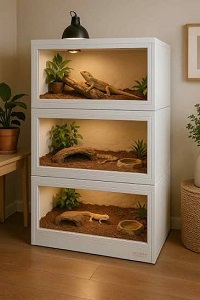 A temporary enclosure can lower today’s checkout total while raising the amount spent before the adult habitat is finished. Consider an illustrative owner who pays $150 for an initial enclosure and later buys the cited $299 enclosure. If no money is recovered from the first purchase, enclosure spending reaches $449, compared with $299 when buying the eventual enclosure directly. The $150 difference is the assumed discarded purchase, not a researched national upgrade fee.
Some equipment may transfer between enclosures, so do not count every lamp and controller twice. Check what remains compatible with the larger layout. Replacement brackets, another fixture, or additional furnishings should enter the upgrade budget only when the new design requires them. A used enclosure can also reduce acquisition spending, but calculate its total after missing doors, lids, supports, or hardware have been priced.
UVB replacement creates another continuing expense. Arcadia specifies a 12-month replacement lifespan for its Desert lamps on its UVB lamp specifications page. Apply the instruction for the exact product rather than treating every lamp as interchangeable. For budgeting, a chosen $35 annual replacement allowance would add $175 across five replacements. That is an illustrative reserve, not a current bulb quote. Visible light alone should not be used to decide whether scheduled replacement spending can be skipped.
Bioactive and Aquatic Extras
A bioactive package can be an interior materials purchase rather than an enclosure. The Bio Dude’s 4-by-2-by-2-foot Terra Sahara kit costs $319.95 and lists substrate, moss, leaves, and Bioshot on its bioactive substrate kit page. Its contents do not include the enclosure, heating equipment, or UVB fixture. Check plants, lighting for plants, and other desired additions separately.
Substituting that package for the worked example’s $40 substrate allowance produces $691.98 minus $40 plus $319.95, or $971.93. The modeled increase is $279.95. Adding the package without removing the original substrate row would overstate this substitution by $40. Keep the furnishings allowance because the package does not replace the entire habitat interior.
Aquatic housing uses a different bundle. Petco displays the Zoo Med 40-gallon Aquatic Turtle Kit at $329.99, with a filter, dock, lamps, fixture, and other supplies, on its aquatic turtle kit listing. Availability indicators on the page are mixed, so treat it as a listed-price reference rather than a confirmed order. Check the turtle’s adult housing requirements, water-heating needs, and filtration capacity before using a kit price as the final budget. Larger-reptile planning also differs from these examples, as the iguana ownership cost article illustrates.
Electricity and Consumables
Running cost depends on power drawn over time. The EIA distinguishes watts from watt-hours and defines one kilowatt-hour as one kilowatt used for one hour in its electricity measurement explanation. For a conditional habitat calculation, assume a 100-watt heater and a 24-watt lamp operate for a 12-hour daytime window, with electricity priced at a chosen $0.20 per kWh. That rate is an assumption, not the national average.
If the heater draws full power throughout that window, annual consumption is 124 divided by 1,000, multiplied by 12 and 365, or 543.12 kWh. The calculated electricity bill is $108.62 annually. If the heater averages 60% of its rated power during the same window while the lamp remains on, consumption falls to 367.92 kWh and the bill to $73.58. The difference is $35.04. Neither scenario includes overnight heat, pumps, plant lighting, or whole-room heating.
Adding those electricity scenarios and the chosen $35 replacement reserve to the worked setup gives about $801–$836 for equipment, electricity, and that reserve. It is not the full first-year ownership bill. Substrate replenishment, cleaning products, food, veterinary care, and other replacements remain separate. Use the local utility rate and measured power consumption to replace the assumptions once the habitat is operating.
Buying Once or in Stages
Buying supplies over several months can spread the expense without changing the final setup. Start with a species-specific equipment list and keep the animal purchase until the required habitat is ready. Price the adult enclosure and its complete contents before treating a smaller kit as a bargain. Saving on cosmetic finishes has a different consequence from leaving a necessary function unbudgeted.
For a used setup, inspect the included equipment and obtain replacement prices before agreeing to the total. A seller’s bundle can contain useful items alongside components you cannot use. Assign savings only to the compatible pieces that replace something on your list. Keep food and veterinary money outside the enclosure budget. The emergency veterinary cost guide explains that separate expense category, although a local reptile practice must quote the actual care.
Makes sense if
- You have priced the adult habitat and all missing equipment.
- You can keep paying for electricity and scheduled replacements.
- You can finish and check the setup before acquiring the animal.
Does not make sense if
- Your budget covers only the enclosure or the reptile.
- You assume a starter kit fits every species or adult size.
- You need to omit required equipment to afford decorative upgrades.
Answers to Common Questions
How much should I budget before buying the reptile?
The worked terrestrial habitat totals about $692 before tax and delivery. ReptiFiles’ leopard-gecko list is estimated at $650–$950. These examples exclude the animal and are not universal species budgets.
Is a starter kit a complete habitat?
Check its actual contents and dimensions. A kit can omit equipment required for your chosen species or need replacing as the animal grows.
Does bioactive mean the enclosure is included?
No. The cited Terra Sahara package contains substrate materials. The enclosure, heat control, and lighting remain separate purchases.
Can buying used save money?
It can when compatible equipment replaces items on your list. Calculate the saving after missing parts, replacement lamps, and other necessary purchases have been priced.
Disclosure: Educational content, not medical advice. Pricing varies by provider, location, and insurance. Confirm eligibility, coverage, and out-of-pocket costs with a licensed clinician and your insurer. See our methodology and corrections policy.