
How Much Does It Cost to Start a Bookkeeping Business?
Published on | Written by Alec Pow
This article was researched using 14 sources. See our methodology and corrections policy.
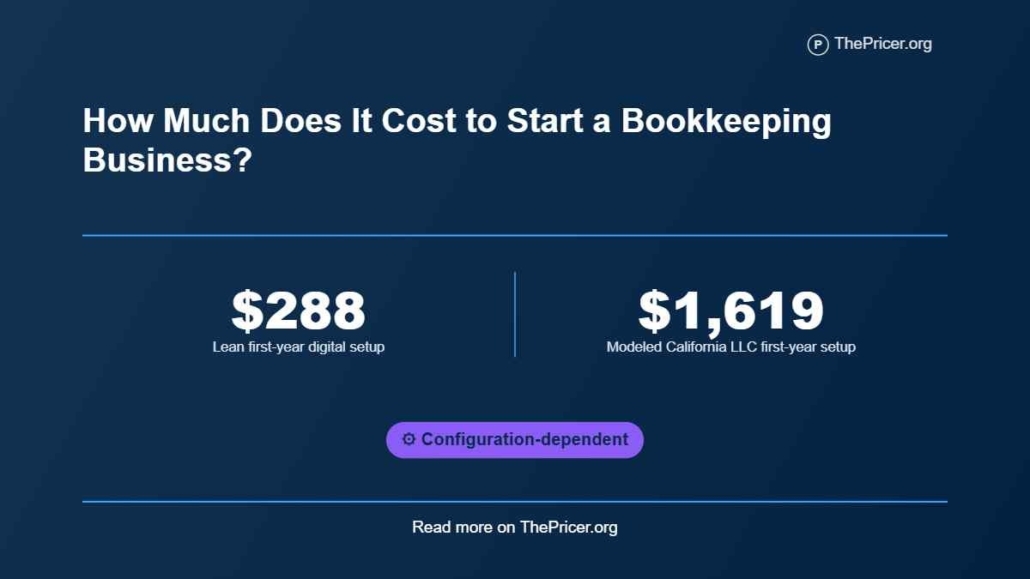
Starting a bookkeeping business in the United States can cost about $288 for a lean first-year digital setup, about $729 with bookkeeper errors and omissions insurance, or about $1,619 in the modeled California LLC setup used below. These are ThePricer calculations rather than national averages. They assume a home-based solo owner with an existing computer, one business-email user, a basic website, no paid advertising, and client accounting subscriptions kept outside the firm’s fixed overhead.
The cost model centers on the entities that create or control those charges: the IRS for an EIN, Intuit and QuickBooks for accounting access and client subscriptions, Google Workspace for business email, Wix for the website, Insureon for the bookkeeper insurance benchmark, and California’s Secretary of State and Franchise Tax Board for the LLC example.
The pricing units are one-time filing fees, monthly software charges, annual insurance premiums, and recurring state obligations. That separation matters because a $70 filing fee, a $38 per month client software plan, and an $800 annual state tax belong to different cost buckets and should not be merged into one unexplained startup range.
Article Highlights
Jump to sections
- A lean website and business-email setup can be modeled at about $288 (at $30 per hour, earning that amount would take about 1.2 full-time workdays, before taxes) for the first year before insurance, state filings, and local licenses.
- Adding bookkeeper errors and omissions insurance raises that modeled fixed setup to about $729.
- A California LLC version of the same setup reaches about $1,619 after current formation, information-statement, and annual-tax charges.
- An EIN obtained directly from the IRS costs $0.
- Client accounting subscriptions can sit outside firm overhead when the client pays Intuit directly.
- Optional certification can add hundreds or more than a thousand dollars to the launch budget.
How Much Does It Cost to Start a Bookkeeping Business?
A solo bookkeeper can build the basic operating shell without a large software stack. The IRS states that an EIN obtained directly through its online process carries $0 in filing fees. That makes paid EIN filing services an avoidable setup charge for an eligible U.S.-based applicant, and the agency warns that third-party sites may charge for something it provides free.
For a basic professional presence, current Google Workspace billing lists Business Starter at $7 per user per month under an annual commitment, equal to $84 (about 2.8 hours of work at $30 per hour) for one user over a year. The flexible version is $8.40 per user per month, or $100.80 across twelve months. The lower monthly price comes with a yearly commitment.
A simple DIY business site can be another modest fixed line. Wix lists its Light plan at about $17 per month as of August 2026, so twelve months model to about $204. The tier is described as suitable for a simple brochure-style presence. Readers planning a custom site can use the separate guide to website creation costs for a wider build-versus-DIY comparison.
What Counts as a Startup Cost?
A bookkeeping business exchanges recurring financial-record services for client fees, so the launch budget is mostly administrative and digital rather than inventory-heavy. The core cost groups are entity registration, business communication, a basic web presence, professional-risk coverage, and any firm software that the owner actually pays for.
Hardware belongs in the calculation only when a new machine is required. A laptop already owned for suitable business use does not create a new cash outlay simply because the owner starts taking clients.
Client subscriptions need separate treatment. A bookkeeping firm may work inside a client’s existing accounting account, arrange a discounted subscription, or pay a subscription and rebill it. Those structures produce different margins. Treating every client software bill as a fixed launch expense inflates the apparent cost of opening the firm. Treating every software product as free has the opposite problem. The useful boundary is the party that receives the bill and carries the recurring obligation.
Location belongs outside any single fixed national total because city and state charges are not uniform. The scenarios below use a defined digital base and then add a state-specific case rather than blending unrelated local fees into one average. That keeps the headline useful for a home-based solo owner while leaving room for local registration, permits, banking, and hardware when those items apply to the actual setup.
Software and Client Accounts
QuickBooks can be either a small firm cost or a sizable client-related cost depending on billing. Intuit says participation in ProAdvisor Preferred Pricing is free for eligible Intuit Accountant Suite users. Its pricing page lists the Simple Start price at $38 (about 1.3 hours of work at $30 per hour) per month and shows a $26.60 per month example under the 30 percent ProAdvisor discount. The same terms distinguish firm-billed and client-billed arrangements.
That distinction changes the startup math. If the client pays Intuit directly, a new bookkeeping firm does not need to place twelve months of that client’s accounting subscription inside its own fixed startup budget. If the firm chooses to pay and rebill, the subscription becomes working-capital exposure until the client pays the invoice. One Simple Start account at $26.60 per month would represent $319.20 across twelve months at that stated discounted rate, but that is a client-account scenario rather than a universal opening expense.
The same Intuit pricing page shows why client scope matters. A bookkeeping firm serving a very small client may need a lower software tier than a client with more complex workflows, so folding one client plan into every firm’s fixed overhead creates a false comparison. Readers comparing the structure of those client plans can also review QuickBooks Online pricing, while current purchase decisions should use Intuit’s live figures because plan prices change.
Registration and State Fees
Business formation can turn a few-hundred-dollar launch into a four-figure first year. California illustrates why a filing fee cannot stand in for the full state cash requirement. The Secretary of State lists $70 for LLC formation and $20 for the initial Statement of Information, which is due within 90 days of initial registration.
The Franchise Tax Board separately says every LLC doing business or organized in California must pay an $800 annual tax, with the temporary first-year exemption applying only to tax years beginning from 2021 through 2023. The page was last updated March 5, 2026. A 2026 California LLC in the modeled case can face $890 in those three state lines before local licenses or income-based LLC fees.
ThePricer’s derived comparison exposes the hidden difference. Divide that $890 state total by the advertised $70 formation charge and the first-year state cash is about 12.7 times the filing fee. A reader deciding between entity types may also want the separate CPA cost guide when paid tax or entity advice is needed.
Insurance and Data Risk
Bookkeepers handle records that can create financial disputes when work is alleged to be late, inaccurate, or negligent. Insureon’s bookkeeper data puts E&O coverage at an average $37 per month, or $441 annually. The dataset is based on policies purchased by bookkeepers through the marketplace, and the provider says premium levels vary with services, revenue, location, employees, property value, policy limits, and deductibles.
Errors and omissions coverage is not identical to general liability. Insureon says the two policies address different risks, with general liability covering third-party bodily injury or property damage and professional liability covering financial-loss claims tied to professional mistakes. A home-based solo operator may need a different policy mix from a firm leasing space or meeting clients on site. The related business liability insurance cost page gives broader pricing context.
Insurance is also a useful reminder that low fixed overhead does not mean zero risk spending. The $729 professional scenario below uses the bookkeeper-specific E&O figure because it maps directly to the work. Cyber coverage, fidelity bonds, higher limits, and contract-required policies can add separate costs. Those items stay outside the modeled headline unless a documented quote or applicable requirement places them inside the reader’s own setup.
Credentials, Website, and Marketing
 Certification is a discretionary line in these startup scenarios, and it can become one of the largest optional cash items. NACPB currently lists a bookkeeping certification bundle at $359 for its lower listed rate and $449 at the standard listed rate.
That package includes an accounting fundamentals course plus the bookkeeping certification exam and certificate. Its larger Certified Public Bookkeeper bundle is priced higher and includes more coursework and exams.
AIPB offers a different route. Its 99-hour Certified Bookkeeper online course is listed at $1,495, with a $1,475 member price. The regular fee includes certification registration, instructor-led lessons, six workbooks, and Prometric testing fees. These products are not equivalent, so their prices should not be averaged into a supposed certification norm.
The size of either purchase becomes clearer beside the lean professional scenario. Adding NACPB’s $449 standard-rate bundle to the modeled $729 setup raises cash needs by about 62 percent. Adding AIPB’s $1,495 regular course raises that same base by about 205 percent. Website upgrades and paid advertising can raise the bill again, but the article’s core total uses no paid ad budget because there is no defensible national amount every new bookkeeper must spend.
Three First-Year Scenarios
The scenarios below use the same digital base so the effect of insurance and entity choice stays visible. Each assumes an existing computer, a home office, one Google Workspace Business Starter user under the annual plan, a Wix Light site at the cited approximate monthly rate, no paid advertising, and no client accounting subscriptions charged to the firm. Local permits, separate registered-agent service, new hardware, banking fees, and optional credentials are excluded.
| Modeled first-year setup | Included lines | First-year total |
|---|---|---|
| Lean sole proprietor digital setup | Website $204, business email $84, EIN $0 | $288 |
| Insured professional setup | Lean setup $288, E&O insurance $441 | $729 |
| California LLC setup | Professional setup $729, formation $70, statement $20, annual LLC tax $800 | $1,619 |
The worked California total is reproducible from those inputs. Add $204 + $84 + $441 + $70 + $20 + $800 and the result is $1,619. The EIN contributes $0 and does not change the sum. This is a calculated first-year scenario, not an official California estimate and not a claim about every California bookkeeping firm.
The lean case is deliberately narrow. A new computer, a custom website, office rent, separate cyber coverage, or paid certification can move spending well above $1,619. The value of the scenarios is the ability to swap a documented line in or out without treating every optional purchase as mandatory. That produces a budget tied to the reader’s actual launch choices.
How Fast Can Startup Costs Be Recovered?
NerdWallet’s 2026 bookkeeping pricing guide says small-business bookkeeping typically costs around $300 per month, with complexity affecting the bill. The figure is useful for revenue context, but it is not a promise that a new firm will sign a client at that rate or keep every dollar as profit.
Using $300 per month only as a gross-sales yardstick, the $729 insured startup equals about 2.43 client-months of revenue. The $1,619 California LLC scenario equals about 5.40 client-months. Taxes, unpaid sales time, client churn, payment fees, extra software, and owner labor remain outside that calculation. This ThePricer recovery measure answers a narrower question: how much contracted gross billing would equal the modeled opening cash outlay.
Makes sense if
- You already own suitable hardware and can work from a home office.
- Clients can hold or directly pay their accounting subscriptions.
- A basic site and one business-email account cover the initial communication needs.
- You want to add credentials or broader insurance only when the service mix supports the expense.
Does not make sense if
- Your budget treats an LLC filing fee as the full first-year state cost.
- You need office space, staff, new hardware, and paid acquisition from opening day.
- Your firm will absorb every client subscription without including that cost in its fee structure.
- You count optional training as mandatory while omitting state charges that apply to the chosen entity.
Answers to Common Questions
Can I start a bookkeeping business for under $500?
Yes. The lean scenario is about $288 for one year of a basic website and business email, with an EIN at $0. It assumes existing hardware and excludes insurance, entity charges, local permits, paid ads, and optional credentials.
Do I need to buy QuickBooks for every client?
No. Client billing arrangements vary. Intuit supports direct client billing and firm billing under its accountant pricing program, so a client subscription does not have to become part of the firm’s fixed startup cost.
Is bookkeeping certification required to open the business?
The core scenarios do not include paid certification. NACPB and AIPB credentials are separate purchases from the government filing charges used in the modeled examples. Verify any licensing or credential rule that applies to your location and service mix before launch.
What is the biggest hidden startup cost?
State entity obligations can be larger than the advertised formation fee. In the California LLC model, the $70 formation charge sits beside a $20 initial statement and an $800 annual LLC tax, producing $890 in those state lines for the modeled first year.
Disclosure: Educational content, not financial advice. Prices reflect public information as of the dates cited and can change. Confirm current rates, fees, taxes, and terms with official sources before purchasing. See our methodology and corrections policy.