
How Much Does It Cost to Start a Mobile Notary Business?
Published on | Written by Alec Pow
This article was researched using 14 sources. See our methodology and corrections policy.
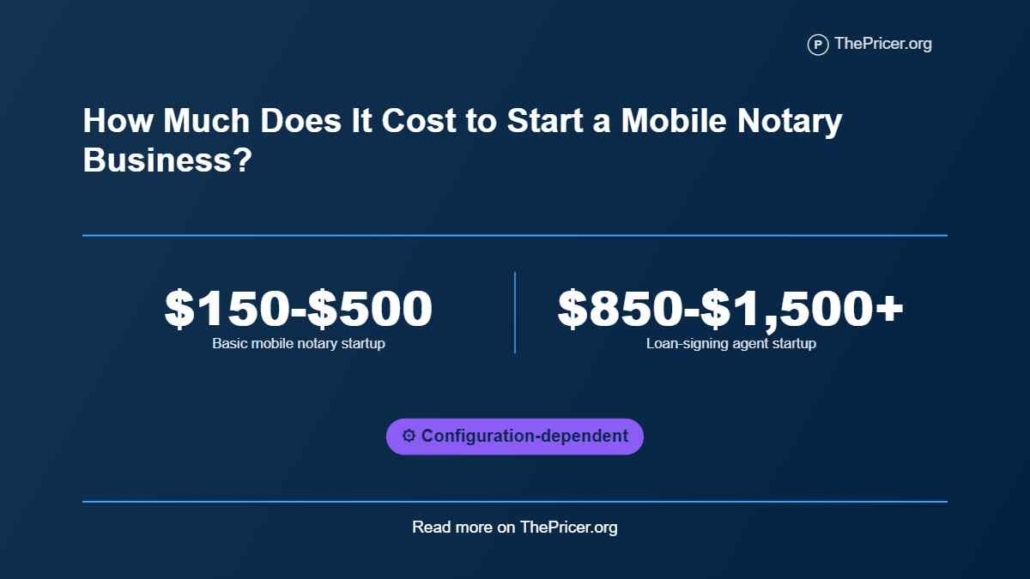
Starting a mobile notary business in the United States can cost about $150 to $500 for a basic in-person setup when you already own a reliable vehicle, phone, and computer. A loan-signing setup can reach $850 to $1,500+ because the cited signing-agent certification package starts at $199 and a suitable dual-tray laser printer listing is $479.99. These estimates exclude a new vehicle, optional LLC formation, and a large advertising campaign.
A mobile notary business combines a state notary public commission with a travel-based local service. The startup cost can involve the commissioning authority, notary bond, notary seal or stamp, record journal, errors and omissions insurance, background screening, signing-agent certification, printer and scanner equipment, paper and toner, business registration, mileage, and payment processing.
One current bundled Florida commission package is advertised at $102.95 with the bond, filing fee, training, stamp, and other listed items, showing why a state filing fee alone is not the full business startup cost.
Article Highlights
Jump to sections
- A practical general mobile-notary startup budget is about $150 to $500 (at $30 per hour, earning that amount would take about 0.6 to 2.1 full-time workdays, before taxes) when a vehicle, phone, and computer are already owned.
- A loan-signing setup is better budgeted at about $850 to $1,500+ when new print equipment is needed.
- The cited NNA certification package starts at $199.
- The cited Brother dual-tray laser printer is $479.99.
- State commission costs are only one part of the launch budget. Bonding, supplies, insurance, travel, and business registration can matter just as much.
How Much Does It Cost to Start a Mobile Notary Business?
There is no national notary application price. States set their own fees, training rules, bond requirements, and filing process. California lists a $40 (about 1.3 hours of work at $30 per hour) new or reappointing application charge and a separate Live Scan cost that depends on the provider. Texas lists a $20 traditional-notary education charge and a $21 application charge. Florida law sets $39 in combined application, commission, and surcharge payments.
| State example | Published government charge | Related requirement | Budget effect |
|---|---|---|---|
| California | California commission application forms list $40 | Live Scan processing is extra and provider-priced | The filing fee understates the finished commission cost |
| Texas | Texas notary fee schedule lists $20 education and $21 application charges | A $10,000 surety bond is required | Bond and supplies sit outside the state charges |
| Florida | Florida notary fee statute totals $39 in listed state charges | A $7,500 bond is required for the four-year commission | A processor package may bundle filing, bond, training, and stamp |
These examples show why a national estimate needs a range. A person in one state may face a small application bill and inexpensive supplies. Another applicant may need education, fingerprinting, a bond, an exam, or county filing before taking paid appointments. Check the current commissioning authority in your state before buying branded supplies because seal wording and recordkeeping rules can differ.
What You Are Paying For
A mobile notary business has three cost layers that should stay separate. The first is the legal authority to act as a notary in your state. The second is the business layer that lets you travel to customers, collect payment, keep records, and market a local service. The third is an optional signing-agent layer for real-estate loan packages. Mixing those layers makes a low-cost commission look like a complete business launch when it is not.
The basic path fits acknowledgments, jurats, oaths, and other acts your state commission permits. A mobile operator then adds transportation and a way to schedule customers. Loan-signing work can call for a background screening, extra training, higher insurance expectations, a printer, a scanner, and larger paper supplies. Remote online notarization is another separate path with state authorization and technology costs, so it is outside the headline mobile budget here.
This cost model treats a commission fee as a government cost, a surety bond as a public-protection requirement where applicable, and E&O insurance as protection purchased for the notary. It also treats a vehicle you already own as an operating asset rather than a startup purchase. Someone who must buy a car, laptop, or smartphone would face a much larger initial bill than the estimates on this page.
Supplies, Bond, and Insurance
The commission itself does not put a working kit in your bag. A traditional setup can require a seal or stamp, a journal where state law calls for one, loose certificates, secure document storage, pens, and a way to take payment. Some states also require a surety bond. The bond amount is not the premium you pay. A $10,000 (about 8.3 full-time workweeks at $30 per hour) bond requirement in Texas or a $7,500 requirement in Florida describes the bond’s face amount, not a $10,000 or $7,500 startup bill.
E&O insurance is a different product. It is bought to protect the notary against covered mistakes rather than to satisfy a claim against a statutory bond. Current Florida E&O policy prices show $18 for one year of $25,000 coverage and $65 for four years at that limit. Those figures are Florida-specific retail prices, not a national insurance quote.
A low-cost launch can stay near the lower end of the $150 to $500 model when required supplies are bundled and the owner skips optional upgrades. The range rises if the state requires paid training or fingerprinting, if the operator buys higher E&O limits, or if local registration adds another charge. Replacing a lost seal, adding locking storage, or carrying duplicate supplies also creates costs after launch rather than on day one.
Loan Signing Upgrade
Loan-signing work changes the equipment and credential budget. The National Notary Association says its signing-agent path includes a background screening, training and exam, supplies, and at least $25,000 in E&O coverage. The signing-agent eligibility requirements also say state restrictions can limit this work. That makes state eligibility a purchasing decision. Buying a printer and certification before checking local rules can strand several hundred dollars.
The biggest single equipment jump is often printing. Loan packages can mix letter and legal paper, which is why a dual-tray monochrome laser printer is a practical benchmark. Using the already cited $199 certification package and $479.99 printer, the two items alone add $678.99. Added to the modeled $150 to $500 basic launch, the subtotal becomes $828.99 to $1,178.99 before extra paper, toner, scanning, or shipping supplies.
That arithmetic is the basis for the broader $850 to $1,500+ signing-agent budget. It also shows why a person who already owns a capable printer can enter this line of work for much less. Background screening is a recurring business issue for many signing assignments, so operators comparing vendors can also review background check pricing apart from the notary-specific certification bundle.
Business Setup Costs
 A notary commission and a business entity are separate decisions. The U.S. Small Business Administration notes that business structure, registration, licenses, permits, insurance, and location can all affect launch paperwork and cost. The federal business launch guidance also explains that a sole proprietorship exists when a person conducts business without registering another type of entity. Local licensing and assumed-name rules can still apply.
For that reason, the headline $150 to $500 estimate does not insert a made-up national LLC fee. An LLC filing can be relevant for one owner and unnecessary for another, and state charges vary. The same caution applies to city business licenses, county filings, home-occupation rules, and sales-tax registrations. A prospective owner should price those items from the state and locality where the business will operate rather than adding a generic internet average.
One federal setup item should not increase the budget. The IRS says the direct EIN application process costs $0 and warns that businesses never have to pay a fee for an EIN. Banking, card processing, a domain, bookkeeping software, and paid advertising are separate commercial choices. A lean operator can delay several of them until appointments begin producing cash.
Three Startup Scenarios
A lean Florida-style launch illustrates the low end. Start with the cited $102.95 package that includes the commission certificate, bond, state filing fee, course, stamp, and listed extras. Add the cited one-year $18 E&O policy and an illustrative $50 reserve for simple local marketing. The modeled total is $170.95. It excludes any local license, new electronics, and vehicle purchase.
A more protected general-notary setup can use the same package, the four-year $65 E&O option, and an illustrative $150 reserve for secure storage, replacement supplies, and initial marketing. That produces $317.95. The reserve is an assumption, not a researched market price. It is included so the scenario reflects a working mobile service rather than only the legal commission.
The worked signing-agent example adds the cited $199 certification package and $479.99 dual-tray printer to the Florida package and four-year E&O policy. Add an illustrative $250 operating reserve for paper, toner, folders, and early marketing. The itemized math is $102.95 + $65 + $199 + $479.99 + $250 = $1,096.94. It excludes a new vehicle, phone, laptop, scanner, LLC filing, and local business-license charges. A person who already owns suitable print equipment would cut this scenario by $479.99, bringing it to $616.95.
Travel Changes the Economics
Mobile work creates an operating cost that many startup lists hide. The 2026 business standard mileage rate is 72.5 cents per mile. The IRS explains that the business rate is based on fixed and variable automobile costs. It is useful here as an economic proxy, not as a claim that every mile burns 72.5 cents of fuel.
Assume a mobile appointment takes a 20-mile round trip. At that IRS rate, the vehicle-cost proxy is $14.50 per appointment. Fifty such appointments create 1,000 business miles, equal to $725 on the same basis. That is larger than the modeled startup budget for many general mobile notaries. The calculation changes the planning question from only “Can I afford to start?” to “Can each appointment cover travel and still leave enough for my time?”
Before setting a service radius, read your state’s current rules on what may be charged for the notarial act and for travel. Then compare those limits with the distance you plan to serve. For customer-side context, what customers pay for notarization shows why a customer’s total bill can differ from the notary’s base act fee. A compact service area can preserve more revenue than a broad radius filled with low-value trips.
Is the Higher Budget Worth It
The general-notary route fits an owner who wants to test local demand with limited equipment. The signing-agent route asks for more cash before the first assignment, but it also targets a different service category with heavier document handling and industry screening. The choice is less about finding one perfect startup number and more about matching purchases to the assignments you are actually allowed and prepared to take.
Spending near the upper end makes little sense if the local market is untested or if state rules limit the work you planned to pursue. A lower-cost launch can preserve cash while you learn appointment patterns and travel distances. Buying specialized equipment becomes easier to defend once there is a realistic use case for it. The same logic applies to an LLC, paid advertising, a second printer, and larger insurance limits.
Makes sense if
- You already own the vehicle, phone, and computer needed for mobile appointments.
- Your state commission path is clear and you have priced every required filing, bond, training step, and supply.
- You have identified local customers or signing sources that fit the service you plan to sell.
- You can keep enough cash outside the startup budget for mileage, toner, paper, and slow early months.
Does not make sense if
- You are buying signing-agent equipment before checking state restrictions and likely assignment volume.
- Your budget uses only the commission fee and ignores supplies, insurance, business filings, and travel.
- You would need to finance a vehicle or major electronics just to begin taking appointments.
- Your proposed service radius turns small appointments into long, unpaid driving blocks.
Answers to Common Questions
Can I start a mobile notary business for under $200?
Yes, in some states. The lean Florida-style scenario modeled above is $170.95 using a current bundled commission package, one-year E&O coverage, and a small assumed marketing reserve. Local licensing or extra supplies can push the total higher.
Do I need an LLC to work as a mobile notary?
Not in every case. Business structure and registration rules vary by state and locality. The headline startup range excludes optional LLC formation so it does not pretend one filing price applies nationwide.
How much extra does loan-signing work add?
The cited certification and printer add $678.99 together before extra paper, toner, scanning, and other supplies. That is why the modeled signing-agent launch moves into the $850 to $1,500+ range.
Is a surety bond the same as E&O insurance?
No. A required surety bond protects people who may be harmed by a notary’s breach of duty, while E&O insurance is purchased for covered claims against the notary. The bond’s face amount is not the premium paid to buy it.
What cost is easiest to underestimate?
Driving can become larger than the initial supplies. At the 2026 IRS business-mileage proxy, 50 appointments with 20-mile round trips equal $725 in vehicle-cost value.
Disclosure: Educational content, not financial advice. Prices reflect public information as of the dates cited and can change. Confirm current rates, fees, taxes, and terms with official sources before purchasing. See our methodology and corrections policy.