
How Much Does It Cost to Start a Pet-Sitting Business?
Published on | Written by Alec Pow
This article was researched using 14 sources. See our methodology and corrections policy.
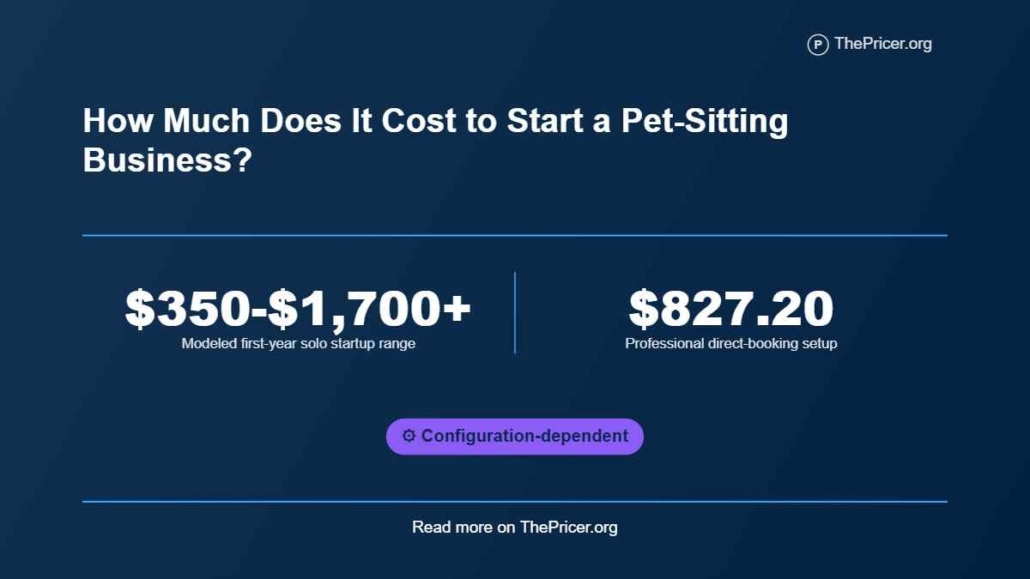
A solo in-home pet-sitting business in the United States can cost about $350 to $1,700+ to start in the first year under the documented model used here. The low end assumes the owner already has a phone and vehicle and buys basic insurance plus pet first-aid training.
A more professional direct-booking setup reaches $827.20 before state LLC costs, local permits, advertising, supplies, driving, and taxes. State entity costs can move the total higher, which is why the article separates a lean launch, a professional setup, and state-specific LLC examples instead of treating one national figure as universal.
The model follows the costs a solo sitter actually encounters. Pet Care Insurance anchors the insurance line, Pet Sitters International covers membership and contract pricing, and Time To Pet covers scheduling and payment costs. Rover provides a visit-price benchmark, while the IRS provides the mileage proxy used in the route calculation.
Texas and California agencies illustrate how state LLC charges can change the first-year total. Home boarding, employees, leased space, and a vehicle purchase are outside this scope.
Article Highlights
Jump to sections
-
- A lean insured setup in the model starts at $357.20 (at $30 per hour, earning that amount would take about 1.5 full-time workdays, before taxes) before local permits, supplies, marketing, and driving.
- The professional direct-booking example totals $827.20 before LLC formation and location-specific fees.
- Texas adds a documented $300 LLC formation fee in the state example.
- California can add $890 in formation, initial statement, and annual LLC tax under the modeled first-year case.
- An eight-mile drop-in visit priced at $21.80 leaves about $14.77 after the modeled mileage proxy and card fee, before labor, taxes, and fixed overhead.
How Much Does It Cost to Start a Pet-Sitting Business?
Insurance is the largest documented line in the lean example. Pet Care Insurance lists pet-sitter coverage from $332.20 per year or $29.43 (about 59 minutes at $30 per hour) per month. Its base policy includes pet protection, veterinarian reimbursement, and lost-key coverage. Optional add-ons start at $5.67 per month for broadened property damage, $5.75 per month for added pet protection, and $4.92 per month for employee dishonesty coverage. A solo sitter with no staff should not automatically add an employee-related option simply because it appears on an insurance menu.
Professional association costs are optional, but they are easy to price. Pet Sitters International lists U.S. membership at $155 per year plus a $5 first-year application charge, making the first year $160. Membership does not replace insurance or a local license. PSI also sells an editable pet-sitting service contract for $80 to nonmembers or $60 to members. The download includes the service contract plus client, pet, medication, emergency, and notification forms. Local permit charges belong on the same pre-booking checklist when the jurisdiction requires them.
What an LLC Can Add
An LLC is not one national price. Texas charges a $300 filing fee for an LLC certificate of formation. The same state instructions say credit-card payments are subject to a 2.7% convenience fee. Paying the $300 (about 1.3 full-time workdays at $30 per hour) filing charge by card would add $8.10, making that payment $308.10. The modeled Texas budget below uses the basic $300 filing fee and excludes the convenience charge because another payment method may avoid it.
California shows why a national LLC average can mislead. The Secretary of State lists $70 for Articles of Organization and $20 for the initial Statement of Information, which is due within 90 days. Those California formation and statement fees total $90. The Franchise Tax Board says an LLC doing business or organized in California must pay an annual LLC tax of $800, subject to stated exceptions. The modeled first-year state layer is $890 for a continuing LLC that does not qualify for an exception.
The entity choice should follow liability, tax, administrative, and local-law needs rather than a desire to hit a target startup budget. A sole proprietor can have a much lower filing line, while an LLC can create formation and recurring state obligations that persist after the first client.
Software and Payment Costs
Scheduling software can be a recurring fixed cost rather than a launch requirement. Time To Pet lists its Lite plan for a one-person company at $25 per month or $250 per year on annual billing. The Solo plan is $50 per month or $500 per year. A business with staff moves into different pricing. Those plan choices give a solo operator a clean decision point. Paying for Lite adds $250 to the first-year fixed stack used below, while delaying paid software leaves that cash available for insurance, permits, or working capital.
Payment acceptance creates a different cost because it rises with transactions. Time To Pet says U.S. credit and debit card payments cost 3% plus $0.30 per transaction, while ACH costs 1.3% plus $0.30. Those rates mean a $21.80 card payment carries about $0.95 in processing fees. That is small beside annual insurance, yet it repeats every time a client pays through that method.
Fixed and variable software costs should not be blended. A sitter can pay $250 for a yearly plan and still owe card fees on every processed invoice. A free invoicing plan can remove the subscription line but not necessarily the payment-processing charge. That distinction matters most for operators with many low-value visits.
Driving Can Change the Math
 Travel is easy to understate because fuel is only one part of vehicle use. For July through December 2026, the IRS lists the optional business mileage rate at 76 cents per mile. The rate is a tax-cost proxy, not a claim that every sitter literally spends 76 cents in cash on each mile. It gives a consistent way to test how route length changes the economics of an in-home service.
Use a chosen eight-business-mile round trip for one drop-in visit. Eight miles multiplied by $0.76 equals a $6.08 mileage proxy. Rover’s national data lists a drop-in at $21.80 per visit, based on rates pulled in September 2025. The figure is a dated benchmark rather than a guaranteed 2026 local selling price. Subtracting $6.08 from $21.80 leaves $15.72 before payment fees, labor, taxes, insurance, and other overhead.
Route density can matter more than shaving a few dollars from software. Four modeled business miles carry a $3.04 mileage proxy. Twelve miles carry $9.12. A tight service area preserves more of each visit price without changing the client-facing service itself.
Three First-Year Budgets
The table uses documented prices plus stated assumptions. It is not a national average. The lean case buys the base PCI annual policy and the Red Cross course. The professional case adds Time To Pet Lite, first-year PSI membership, and the member-priced PSI contract. The LLC case applies the same professional stack to two state filing examples while leaving local licenses, supplies, advertising, driving, income taxes, and emergency cash outside the total.
| Startup case | Included cost | Modeled first-year total |
|---|---|---|
| Lean insured sitter | PCI annual policy $332.20 plus Red Cross course $25 | $357.20 |
| Professional direct-booking sitter | Lean case plus Time To Pet Lite $250, PSI first year $160, PSI member contract $60 | $827.20 |
| Professional sitter with LLC | Professional case plus Texas filing $300, or California modeled state layer $890 | Texas $1,127.20, California $1,717.20 |
The itemized professional total is reproducible. Add $332.20 for insurance, $25 for the first-aid course, $250 for annual Lite software, $160 for first-year PSI membership, and $60 for the member contract. The sum is $827.20. The total is a calculated first-year scenario, not an official package sold by one company.
The hard-to-see cost is the state layer. The California example is $590 above the Texas example before any city or county charge. That gap comes from documented state obligations, not from a higher estimate for insurance or software. A founder comparing generic startup ranges can miss that difference if every LLC is treated as one national line item.
How Many Visits Repay Startup Cost?
Gross revenue alone gives an overly optimistic payback count. At the Rover benchmark of $21.80, dividing the professional fixed stack of $827.20 by the full visit price gives about 38 visits. That calculation ignores travel and card processing. Using the eight-mile scenario, the mileage proxy is $6.08 and the Time To Pet card fee is about $0.95. The amount left after those two modeled costs is about $14.77 per visit before owner labor, income taxes, fixed overhead, supplies, and other expenses.
Divide $827.20 by $14.77 and the fixed-cost recovery point rises to about 57 visits. The same method gives about 77 visits for the $1,127.20 Texas LLC case and about 117 visits for the $1,717.20 California LLC case. These are calculated scenarios based on the documented prices already cited and the chosen eight-mile route. They are not forecasts of how quickly a new sitter will win clients.
Distance sensitivity changes the result again. At four business miles, the amount left after the mileage proxy and card fee is about $17.81, which puts the professional fixed-cost recovery near 47 visits. At twelve miles, about $11.73 remains, pushing the same recovery point to about 71 visits. One scheduling decision can move the target by roughly two dozen visits.
What to Buy Now and What Can Wait
Spend early on costs tied to actual risk, legal requirements, or the way clients will book. Insurance has a direct role in the modeled launch. A required city or county license belongs ahead of optional branding. A service contract becomes useful before direct clients are accepted. Paid scheduling software can wait if the operator has only a few clients and can handle booking, records, and invoices with simpler tools.
Training and association membership are professional upgrades rather than universal legal requirements. The same applies to insurance add-ons that address staff or services the business does not yet provide. If the model later expands into boarding, staff employment, or pet transport, revisit the budget instead of stretching the solo in-home estimate to cover a different operation. Pet owners comparing an in-home sitter with a facility can see how that care model differs in the separate dog boarding cost analysis.
Makes sense if
- You already own the phone and vehicle needed for local visits.
- You can start solo and keep the service radius compact.
- You can verify local registration and permit rules before advertising.
- You can delay paid extras until client volume makes them useful.
Does not make sense if
- The plan requires a new vehicle before the first booking.
- You intend to open a boarding facility rather than provide in-home care.
- You need employees at launch and have not budgeted payroll-related costs.
- Your service area forces long drives for low-priced individual visits.
Answers to Common Questions
Can I start a pet-sitting business for under $500?
Yes, under the defined solo model. The lean case totals $357.20 for the cited base annual insurance and online pet first-aid course. Local permits, supplies, marketing, driving, and taxes can raise the amount.
Do I need an LLC to start pet sitting?
An LLC is not part of every launch. Business structure depends on legal, tax, liability, and state requirements. The state examples show why forming one can add hundreds of dollars to the first year.
How much should I budget for pet-sitting software?
The documented solo software example is $250 per year for Time To Pet Lite or $500 per year for Solo. A new operator can use a different system and may choose to delay paid scheduling software.
What is the biggest hidden startup cost?
Travel can be easy to miss because it is tied to every in-home visit rather than paid once at launch. In the eight-mile scenario, the IRS mileage proxy is $6.08 per visit before labor and other business costs.
Disclosure: Educational content, not financial advice. Prices reflect public information as of the dates cited and can change. Confirm current rates, fees, taxes, and terms with official sources before purchasing. See our methodology and corrections policy.