
How Much Does IV Hydration Therapy Cost?
Updated on | Written by Alec Pow
This article was researched using 14 sources. See our methodology and corrections policy.
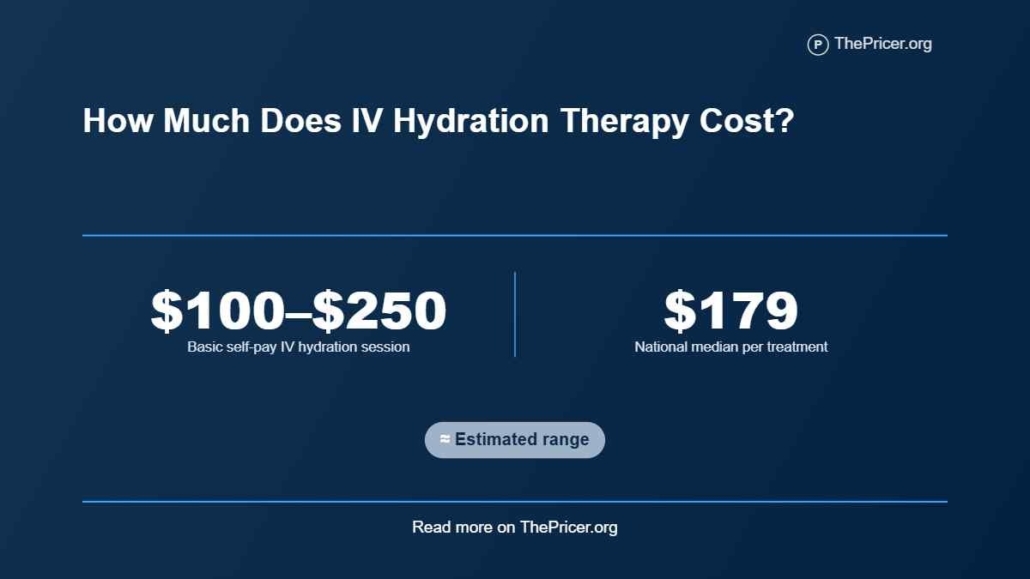
IV hydration therapy usually costs about $100 to $250 for one basic self-pay session in the United States. Next Health currently lists a Hydration IV at $99, while Drip Hydration lists an at-home treatment at $249. A national secret-shopper study found a median payment of $179 for IV hydration spa treatment, placing a broad national benchmark between those current advertised examples.
Current clinic and health-system examples from Next Health, Prime IV, and Ochsner Health cover basic or self-pay hydration, while Drip Hydration and Hydration Room show how mobile travel and membership rules can change the bill. The purchased unit is usually one IV session, but fluid volume, electrolytes, vitamins, medications, NAD+, mobile delivery, and recurring membership terms can change the total. Hospital IV care, IVIG, iron infusions, chemotherapy, and IV antibiotics use different medical and billing structures, so they should not be mixed into the consumer hydration range.
Article Highlights
Jump to sections
- A basic self-pay hydration session commonly lands near $100 to $250 (at $30 per hour, earning that amount would take about 0.4 to 1 full-time workdays, before taxes).
- The national study benchmark was a median $179 per treatment.
- Mobile treatment can carry a separate travel charge on top of the IV price.
- Specialty formulas can cost several hundred dollars more than plain fluids.
- A monthly membership can lower the effective visit price when every included credit is used.
How Much Does IV Hydration Therapy Cost?
Current advertised prices show why a working budget of $100 to $250 (about 0.4 to 1 full-time workdays at $30 per hour) is useful. Prime IV lists Pure Hydration at $119 on its Geneva, Illinois menu, while several vitamin and recovery formulas on the same menu rise to $175 or $210. The side-by-side menu makes the scope difference visible instead of presenting one blended IV price.
Ochsner Health offers another pricing model. Its participating urgent-care locations list IV hydration at $130 out of pocket for eligible adults. The service is a health-system program rather than a wellness-spa membership, which is why setting and eligibility should stay attached to any quoted number.
| Current example | Advertised price | What the figure buys |
|---|---|---|
| Next Health Hydration IV | $99 | Basic clinic IV hydration |
| Prime IV Pure Hydration | $119 | Electrolyte-focused hydration at the Geneva location |
| Ochsner Urgent Care | $130 | Out-of-pocket hydration at participating urgent-care sites |
| Drip Hydration Dehydration treatment | $249 | Mobile IV fluids and electrolytes delivered to the patient |
The table is a set of current advertised examples, not a national average. Location, ingredients, mobile delivery, and service setting explain much of the spread.
What IV Hydration Includes
IV hydration sends fluid into a vein through a catheter. A basic consumer service may use saline or another balanced fluid with electrolytes. The same clinic may also sell drips containing vitamins, minerals, anti-nausea medication, pain medication, amino acids, glutathione, or NAD+. Those products should not be treated as one price category merely because they use the same delivery method.
The purchased unit is usually one session. A quote should identify the fluid volume, the ingredients included in the base formula, who performs the infusion, and whether a clinical screening is part of the visit. Some providers sell a plain hydration bag first and price each ingredient upgrade separately. Others sell named formulas whose posted price already includes several ingredients. That difference can make two prices look comparable when the purchased services are not.
Hospital IV fluids belong to another billing system. A hospital or emergency department can combine hydration with an evaluation, laboratory testing, imaging, medications, and facility charges. Readers comparing those settings can see how a self-pay emergency room bill is built. Elective wellness hydration should also be kept apart from prescription infusion treatments such as IVIG therapy costs, where drug dose and medical supervision drive the bill.
Membership Math
Hydration Room lists its IV Therapy Membership starting at $165 per month. It includes one IV per month and compares that benefit with a nonmember price of $220+ (about 7.3 hours of work at $30 per hour) per IV. The plan requires a four-month commitment, unused credits can roll over, and credits expire after one year. Mobile service fees and selected specialty services are excluded from the membership benefit.
The minimum four-month membership spend is $660, calculated as four payments of $165. Four comparable pay-as-you-go visits at the stated $220+ benchmark start at $880. Using every monthly IV credit creates at least $220 in nominal savings across those four visits, equal to 25% of the lower-bound walk-in total.
Usage decides whether that discount has practical value. Someone who wants four qualifying IVs during the commitment period can capture the lower unit cost. Someone who uses only one or two credits is tying up $660 to obtain fewer visits, even though unused credits can roll forward for a limited period. The monthly fee should be compared with the number of eligible sessions the buyer expects to use, not with the highest-priced service on the clinic menu.
Clinic vs Mobile
Mobile service can raise the payable total even when the IV formula itself has not changed. Hydration Room lists a travel fee of $175 for one or two IV patients and $225 for three to five patients, with the cost of each IV added afterward. The travel component is separate, so a consumer cannot use the clinic treatment price alone as the mobile quote.
The group structure creates a useful cost effect. Using the company’s published nonmember benchmark of $220+ for an IV, one patient facing a $175 travel charge starts at $395+. Two people buying the same assumed $220 IV each would start at $615 together. Split evenly, that is $307.50 per person. The second person reduces the lower-bound per-person total by $87.50, or about 22%, because the travel charge is shared.
That calculation is a scenario, not an advertised bundle. It shows why a statement such as “mobile IV costs more” is incomplete without the travel-fee rule and party size. A mobile provider that builds travel into its treatment price will present the bill differently. For a medical problem that needs examination or testing, the cost structure is also different from a wellness house call. A related urgent-care self-pay comparison can help separate those settings.
Add-Ons and Specialty Drips
The largest pricing mistake is comparing plain hydration with a premium formula. Next Health currently lists a Hydration IV at $99, a Hydration IV add-on at $55, a 300 mg NAD+ IV at $500, and a 750 mg NAD+ IV at $1,000. Those are separate products with different ingredient and dose scopes, showing how quickly the price can move once the purchase changes from fluids to a specialty infusion.
An add-on can be a smaller charge than switching to a premium drip, but several extras can compound. Ask whether extra fluid, anti-nausea medication, pain medication, minerals, antioxidants, or injections are already inside the named formula. A posted drip price that looks low can cease to be the low-cost option after several separate additions.
NAD+ deserves its own comparison because dose can alter both price and session scope. It should not be used to set the upper end of a basic hydration range. The same caution applies to iron infusions, prescription antibiotics, chemotherapy, and other medically directed infusion treatments. They may use an IV line, but the drug, diagnosis, monitoring, and billing structure make them different services.
Insurance and HSA Rules
Elective IV hydration at wellness spas is commonly paid directly by the customer. In the national secret-shopper research, 81 facilities supplied typical payment amounts and the median was $179, with an interquartile range of $136.25 to $216.89. Among 86 facilities asked about insurance, none accepted insurance for the services studied. Thirty of 85 facilities mentioned HSA or FSA payment. The published study reports figures from calls made in 2024.
HSA or FSA card acceptance does not make every wellness purchase a qualified medical expense. IRS guidance says medical expenses must be tied to diagnosis, cure, mitigation, treatment, or prevention of disease and excludes expenses that are merely beneficial to general health. Its wellness expense tax guidance applies that medical-purpose test to HSA, FSA, HRA, and related reimbursement arrangements.
A medically necessary IV ordered to treat a diagnosed condition can enter a different insurance and tax framework from an elective hydration drip bought for general wellness. Ask the insurer or plan administrator about the exact service and diagnosis rather than assuming the payment method settles coverage.
Three Price Cases
 The clinic-menu case uses two basic prices already documented above. The $99 Next Health Hydration IV and $119 Prime IV Pure Hydration price differ by $20. Prime’s listed amount is about 20% higher than the Next Health figure. That spread is a comparison of two advertised offers, not a national clinic markup.
The health-system case uses Ochsner’s cited $130 out-of-pocket hydration price and the study median of $179. The difference is $49. Those figures come from different settings and evidence periods, so the subtraction is a scale check rather than a claim that Ochsner is $49 cheaper than a matched competitor.
The mobile case exposes the hidden-total problem. Using Hydration Room’s previously cited $220+ nonmember IV benchmark and its cited $175 one-to-two-patient travel charge produces a lower-bound one-person total of $395+. The arithmetic is $220 + $175 = $395. Optional add-ons are excluded. A different IV selection raises the total, while a second patient can reduce the travel cost per person because the same travel charge covers up to two patients.
Each case changes a real pricing driver. The first compares two basic clinic menus, the second places a health-system self-pay price beside a national study benchmark, and the third adds mobile travel to the treatment price. The differences explain more than a single blended average would.
What to Compare Before Paying
Ask for the payable price for the exact formula, not just the name of the service. The quote should state fluid volume, included ingredients, any separate medication or vitamin charges, mobile fees, and whether the first clinical review costs extra. If the provider sells a membership, ask which IVs qualify for the monthly credit and which premium services remain outside the plan.
Price is only one part of the decision. Ask who will administer the IV, what license that person holds, how the clinic reviews health history, and how the ingredients are sourced. Ask who is available if a reaction occurs. A very cheap quote loses its value if the ingredients, screening process, or final charges are unclear.
Makes sense if
- The quoted price identifies the IV formula and fluid scope.
- You know whether travel and add-ons are separate.
- You will use enough membership credits to justify the commitment.
- You can compare like-for-like clinic or mobile services.
Does not make sense if
- A plain hydration bag is being compared with NAD+ as if the services match.
- The mobile quote leaves the travel charge unstated.
- You expect insurance to pay for a wellness drip without confirming coverage.
- A membership is being judged by a premium service that the plan excludes.
Answers to Common Questions
How much is one IV hydration session?
A practical self-pay budget for basic U.S. hydration is about $100 to $250 per session, with some clinic promotions or basic menus below that band.
Why can mobile IV hydration cost more?
Mobile service may add nurse travel or house-call charges. A separate travel fee can push a basic visit well above the clinic price.
Does insurance cover IV hydration therapy?
Elective wellness-spa hydration is commonly self-pay. Coverage can differ when IV fluids are medically necessary and billed as part of covered medical care.
Are IV memberships cheaper?
They can be for repeat users. A plan starting at $165 per month can beat a $220+ pay-as-you-go benchmark when the included monthly credit is used and the selected service qualifies.
Disclosure: Educational content, not medical advice. Pricing varies by provider, location, and insurance. Confirm eligibility, coverage, and out-of-pocket costs with a licensed clinician and your insurer. See our methodology and corrections policy.