
How Much Does KOR Whitening Cost?
Updated on | Written by Alec Pow
This article was researched using publicly available sources. See our methodology and corrections policy.
KöR Whitening generally costs about $400 to $1,800 in the United States, depending on which KöR system your dentist recommends. Current published dental-office prices put KöR Home around $400–$800, KöR Max around $600–$1,200, KöR Ultra around $900–$1,500, and KöR Ultra-T around $1,000–$1,800.
The system is sold through dental professionals and combines custom KöR-Seal trays with professional whitening gel. More advanced protocols add in-office whitening and longer at-home treatment periods. KöR Ultra-T is specifically positioned for difficult tetracycline staining.
Article Highlights
Jump to sections
- KöR Home: roughly $400–$800 (at $30 per hour, earning that amount would take about 1.7 to 3.3 full-time workdays, before taxes) at current U.S. practices.
- KöR Max: approximately $600–$1,200 and is the company’s mainstream combined treatment.
- KöR Ultra: approximately $900–$1,500 for more difficult discoloration.
- KöR Ultra-T: roughly $1,000–$1,800, with treatment designed specifically for tetracycline staining.
- Maintenance gel, dental work needed before whitening, and restorations that no longer match your newly whitened natural teeth can push the long-term cost higher.
How Much Does KöR Whitening Cost?
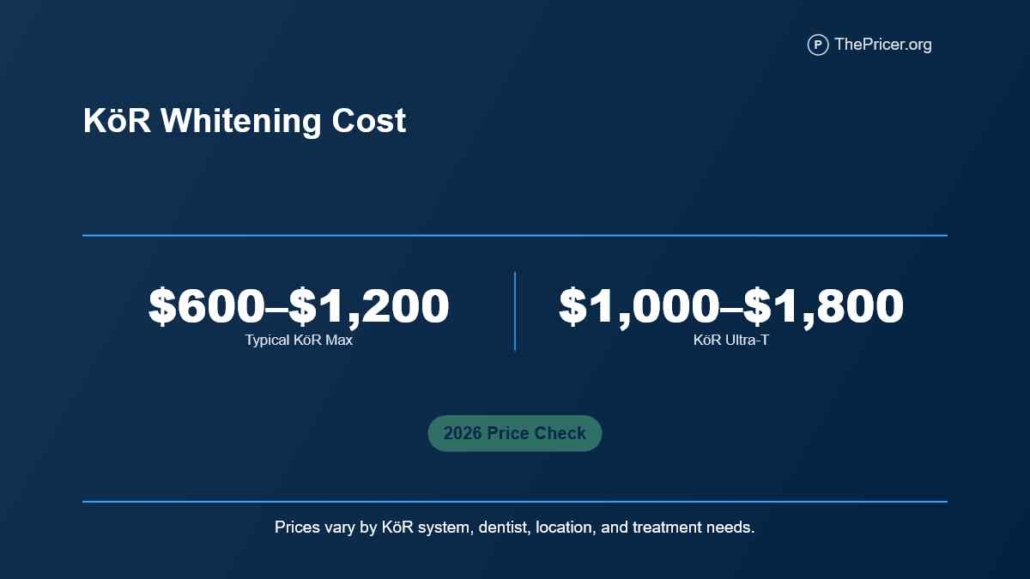
YOU HAVE TO GIVE ME A PRICE! A realistic budget for KöR Whitening is $600 to $1,200 (about 0.5 to 1 full-time workweeks at $30 per hour) for the treatment most patients are likely to encounter, KöR Max. The overall KöR range extends from about $400 for basic dentist-supervised home whitening to around $1,800 for advanced Ultra-T treatment at currently published U.S. prices.
| KöR System | Current U.S. Price Range | Generally Used For |
|---|---|---|
| KöR Home | $400–$800 | Dentist-supervised take-home whitening |
| KöR Max | $600–$1,200 | Typical combined home and office whitening |
| KöR Ultra | $900–$1,500 | More stubborn discoloration |
| KöR Ultra-T | $1,000–$1,800 | Tetracycline staining |
| Maintenance/touch-up | About $75–$200 | Gel or periodic maintenance, depending on practice |
These aren’t manufacturer-set national retail prices. KöR dentists establish their own fees.
For example, Grand Mission Dentistry currently publishes KöR Home at $400–$600, Max at $600–$900, Ultra at $900–$1,400, and Ultra-T at $1,200–$1,800.
Pure Dental Care in New Jersey currently lists Home at $450, Max at $650, Ultra at $950, and Ultra-T at $1,000. Its current KöR maintenance kit is $75.
At another end of the market, a Colorado Springs dental office currently advertises Home at $800, Max at $1,200, and Ultra at $1,500.
That variation is why a nationwide average is less useful than a range.
At a $30 hourly wage, a $650 KöR Max treatment represents about 21.7 hours of gross earnings. A $1,200 treatment equals 40 working hours, while an $1,800 Ultra-T plan represents approximately 60 hours, or one and a half 40-hour workweeks, before taxes.
KöR Home, Max, Ultra, and Ultra-T
KöR itself currently lists four primary system families: Home, Max, Ultra, and Ultra-T.
KöR Home is the dentist-supervised take-home option. The patient uses custom KöR trays and professional whitening gel at home.
KöR Max is the company’s best-selling system for the typical whitening patient. Current practices commonly combine the home phase with an in-office whitening appointment.
KöR Ultra is intended for more stubborn cases, including discoloration such as fluorosis or especially dark teeth.
KöR Ultra-T is the specialized protocol developed for tetracycline staining, one of the more difficult types of intrinsic tooth discoloration.
The more intensive systems generally cost more because they involve longer treatment protocols, additional whitening material, and more dentist chair time.
Whitening Light or Laser
This is an important correction to older descriptions of the treatment.
KöR specifically markets its whitening process as not requiring bleaching lights or lasers. The manufacturer says the system instead relies on its peroxide formulations, continuously refrigerated gel, custom trays, and its treatment protocols.
That means a quote should not become more expensive because a dentist claims that a standard KöR treatment requires a proprietary KöR whitening lamp. If another technology is being added, ask what it is and whether it is actually part of the KöR protocol.
Real Published KöR Prices
Actual dental-office prices show how widely the same branded system can vary.
Draper Smiles currently advertises KöR-Night at $349 (about 1.5 full-time workdays at $30 per hour), in-office KöR Power White at $449, and KöR Max at $699. Its Max package includes digital scanning, custom KöR-Seal trays, at-home whitening, and in-office treatment.
Lakeview Dental in Florida publishes KöR Max at $800, Ultra at $1,000, and Ultra-T at $1,200.
Grand Mission Dentistry publishes a considerably broader range, topping out at $1,800 for Ultra-T.
These live examples support using approximately $400–$1,800 as the useful overall U.S. budgeting range rather than pretending every KöR provider follows one national fee schedule.
What Is Included in the Price?
Exactly what the quoted price includes depends on the dentist.
A KöR treatment commonly includes evaluation of the discoloration, impressions or a digital scan, custom whitening trays, whitening gel, instructions, and the treatment protocol appropriate for the selected system.
Max, Ultra, and Ultra-T may also include one or more in-office whitening appointments depending on the protocol used by the provider.
Before paying, ask whether your quote includes the consultation, scans or impressions, trays, all whitening gel required for the initial treatment, desensitizing products, in-office visits, and the first follow-up.
This makes comparisons far more useful than simply comparing two advertised package prices.
One Dentist May Charge More
The individual dentist sets the retail price, not KöR.
That explains how one currently advertised KöR Max package can cost $650 while another office charges $1,200.
Part of the difference may come from what is included. One practice may advertise only the whitening system itself, while another package may include the examination, digital scanning, multiple appointments, follow-up, or additional gel.
Geographic overhead and the practice’s own pricing model can also affect the quote.
The important point is that there is no evidence for a universal rule such as “rural KöR costs exactly $200 less.” Compare the actual treatment components rather than assuming a geographical discount.
Existing Crowns and Veneers
 One of the most important costs to consider has nothing to do with the whitening gel.
The American Dental Association explains that whitening treatments affect natural teeth but not tooth-colored restorations. Crowns, veneers, fillings, and bonding therefore do not simply become whiter along with the surrounding enamel.
If your visible natural teeth become substantially lighter, an older front crown or veneer can suddenly appear darker.
That does not mean the restoration automatically needs replacement. But if the color mismatch bothers you, replacing cosmetic dental work becomes a completely separate expense.
Anyone with visible restorations should discuss the shade issue before whitening rather than discover it after spending $600 to $1,500 on treatment.
Maintenance Cost
KöR is not necessarily a once-and-never-again purchase.
The amount of maintenance depends on staining habits, the original discoloration, the result achieved, and your dentist’s protocol.
Pure Dental Care currently lists a $75 KöR Maintenance Kit containing whitening gel and desensitizer. Grand Mission Dentistry gives a wider estimate of approximately $100–$200 for periodic touch-up maintenance.
A sensible long-term budget is therefore not a fixed $70 every year. Instead, plan for occasional $75–$200 maintenance purchases when your dentist considers touch-up whitening appropriate.
Is KöR Whitening Safe?
Professional teeth whitening is still dental treatment rather than simply a cosmetic retail product.
The American Dental Association says both extrinsic and intrinsic staining can respond to whitening, while the most common adverse effects of vital-tooth bleaching are temporary tooth sensitivity and gingival irritation.
The ADA recommends consulting a licensed dentist to determine whether professional whitening is appropriate for the individual patient.
That matters especially if you have untreated decay, gum problems, extreme sensitivity, existing restorations, or discoloration whose cause has not been established.
KöR vs Other Whitening Options
KöR sits toward the premium end of professional whitening because the higher-tier protocols can exceed $1,000.
A conventional dentist-provided take-home system can cost less, while a single in-office whitening procedure may also have a lower upfront price. Over-the-counter strips are cheaper again.
The tradeoff is that these are not identical treatments.
KöR differentiates itself through dentist supervision, custom trays, refrigerated peroxide gel, and protocols for difficult discoloration including tetracycline staining. Those features matter most when the patient has more difficult intrinsic discoloration rather than simple surface staining.
You might also like our articles about the cost of teeth whitening in general, Zoom whitening, or teeth cleaning.
Insurance, HSA, and FSA Coverage
Patients should generally plan to pay the entire KöR bill themselves.
Professional whitening is normally performed for cosmetic purposes, and dental plans commonly exclude elective cosmetic treatments. Current CareCredit guidance likewise notes that insurance may exclude elective services such as whitening.
There is another important limitation: ordinary cosmetic teeth whitening is not an eligible federal medical expense.
IRS Publication 502 specifically states that amounts paid to whiten teeth cannot be included as medical expenses. FSAFEDS likewise lists teeth bleaching or whitening as not eligible for reimbursement.
That means you should not assume an HSA or healthcare FSA can be used simply because the treatment is being performed by a dentist.
Can You Finance KöR Whitening?
Some dental offices accept CareCredit or offer their own payment arrangements.
CareCredit currently advertises promotional financing on qualifying purchases of $200 or more, with participating providers potentially offering 6-, 12-, 18-, or 24-month promotional periods.
But “no interest if paid in full” does not mean the balance can simply be carried indefinitely interest-free.
CareCredit states that if a qualifying deferred-interest promotional balance is not paid in full by the end of the promotional period, interest is charged from the purchase date. Minimum required payments may also be insufficient to clear the entire balance before that deadline.
For example, dividing a $900 whitening treatment evenly across 12 months works out to $75 per month. That is merely the arithmetic needed to clear $900 in a year, not a guarantee that a specific dentist will offer that exact financing arrangement.
How to Spend Less on KöR Whitening
Price-shopping can make a surprisingly large difference because current dental-office fees for the same KöR tier vary substantially.
For Max, for example, current published examples include approximately $650, $699, $800, $600–$900, and $1,200.
Ask at least two or three KöR providers for an all-in quote and compare what each package includes.
Also ask about the cost of maintenance gel before starting treatment. A slightly higher initial package that includes follow-up supplies could ultimately cost less than a low advertised rate with several extras.
Avoid choosing the wrong protocol solely because it is cheaper. Paying for KöR Home and later moving to a much more intensive treatment can cost more than choosing the appropriate protocol from the beginning.
What We Verified
KöR’s current manufacturer materials confirm four primary system families: Home, Max, Ultra, and Ultra-T. The manufacturer also explicitly states that KöR does not rely on whitening lights or lasers.
We checked currently published U.S. dental-office prices rather than relying on an undocumented national survey. Those live examples support an overall range of roughly $400 to $1,800, with KöR Max commonly falling around $600 to $1,200.
We also removed unsupported patient invoices, fabricated expert quotations, assumed annual refill schedules, seasonal price claims, supposed dental-school pricing, and warranties for which we could not establish reliable current evidence.
Answers to Common Questions
How much does KöR Whitening usually cost?
Most patients should budget approximately $400 to $1,800 depending on the system. KöR Max, the mainstream combined option, currently runs about $600 to $1,200 across published U.S. practices.
How much is KöR Ultra-T?
Current published prices put KöR Ultra-T at roughly $1,000 to $1,800. It is the KöR protocol designed specifically for difficult tetracycline staining.
Does dental insurance pay for KöR Whitening?
Usually not. Whitening is generally considered elective cosmetic dentistry, so patients should expect to pay out of pocket unless their particular plan explicitly says otherwise.
Can KöR Whitening whiten crowns or veneers?
No. Dental whitening changes the shade of natural teeth, not crowns, veneers, tooth-colored fillings, or bonding. If a visible restoration no longer matches after whitening, discuss the cosmetic options and costs with your dentist.
Disclosure: Educational content, not medical advice. Pricing varies by provider, location, and insurance. Confirm eligibility, coverage, and out-of-pocket costs with a licensed clinician and your insurer. See our methodology and corrections policy.