
How Much Does Lahinch Golf Club Membership Cost?
Published on | Written by Alec Pow
This article was researched using 14 sources. See our methodology and corrections policy.
Lahinch Golf Club is a private members’ golf club in County Clare, Ireland, with the Old Course and Castle Course available within the same club. Public visitor play is also offered, but buying a tee time is different from becoming a member.
The membership question has two parts. Annual dues are publicly reported, yet admission is tightly restricted and Lahinch does not publish a current per-person entrance fee for ordinary new members. That makes eligibility at least as important as the recurring subscription.
For U.S. readers, euro amounts can be translated into dollars using a dated exchange rate. Lahinch charges in euros, so the dollar equivalent will move even when the club’s euro charge stays unchanged.
How Much Does Lahinch Golf Club Membership Cost?
Jump to sections
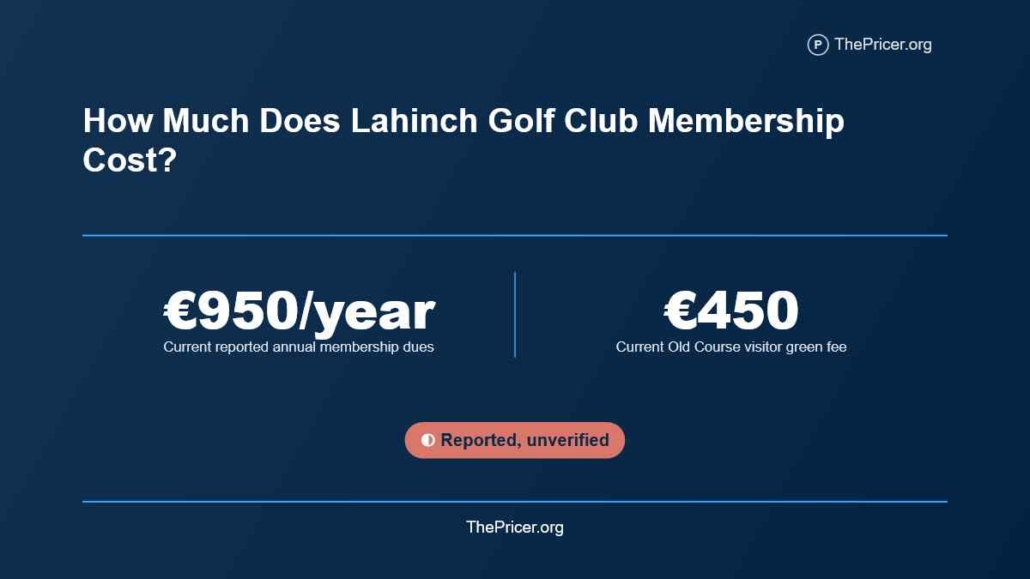
- An August 2026 membership report puts annual dues at €950, notes about 2,500 members, and lists Old Course visitor play at €450, while the September 4 ECB rate converts the dues to about $1,103 (at $30 per hour, earning that amount would take about 4.6 full-time workdays, before taxes) and two visitor rounds to €900, €50 less.
- A member can take out a guest for €50 on the first 10 guest rounds before the guest charge rises to €100, and the 2027 Old Course visitor rate is reported at €500, according to the Irish green fee report.
- Lahinch recorded €1.26 million in ordinary member subscriptions during 2025 and another €150,000 from Overseas Life Membership, according to the 2025 club accounts report.
What membership at Lahinch Golf Club means
Lahinch is a continuing membership club rather than a course where paying an annual amount automatically creates membership. Members gain club access tied to Lahinch’s two-course setup, member tee times, competitions, clubhouse use, and the wider rights attached to their membership category. The Old Course is the championship links for which Lahinch is best known, and the Castle Course gives members another course on the property.
Joining involves more than recurring dues. Admission eligibility, any entrance charge attached to a successful application, membership category, and guest privileges are separate pieces of the financial picture. Lahinch also records an Overseas Life Membership category in its accounts. Public visitors remain outside these member categories and buy rounds through the club’s visitor system instead. Membership is not open enrollment.
Lahinch membership vs visitor play
The recurring subscription can look inexpensive beside repeated Old Course visitor rounds, but that comparison does not mean a visitor can switch to membership simply to save money. Current reporting describes the membership population as large and admission from outside established club connections as extremely difficult.
The annual fee is what an eligible member pays after gaining membership, not a retail price that guarantees entry to the club.
Visitor play offers the cleaner comparison for someone planning a trip to County Clare. A public golfer buys an individual round and remains responsible for the visitor service charges attached to that round. A member guest occupies a third category because the lower guest fee depends on being brought out by an existing member. Private-club economics elsewhere can work differently, as shown in broader country club membership costs. Lahinch’s low recurring dues and narrow admission route should be read together rather than as separate facts.
Annual Lahinch Golf Club membership dues
The current annual subscription is the strongest public number for ordinary Lahinch membership because it comes from recent reporting tied directly to the club. It covers membership at Lahinch rather than one round, and the same current report says members can play the Castle Course as part of that membership. That makes the recurring fee quite different from the Old Course visitor charge, which is paid each time a nonmember books public play.
Club-wide subscription revenue should not be divided by the reported member population to manufacture another annual rate. Lahinch can have different categories, life members, nonstandard payment arrangements, and members whose treatment in financial accounts differs from a simple head count.
The published annual subscription is the better individual reference. A similar distinction applies at restricted U.S. clubs where published dues do not tell a prospective member how admission works, as seen in Oakmont membership pricing. The dues number answers the recurring-payment question. It does not answer the joining-price question.
Initiation fees and Overseas Life Membership
No verified public 2026 per-person initiation or entrance fee for an ordinary new Lahinch member appeared in the club pages and financial reporting reviewed for this article. Historical evidence confirms that entrance charges have existed, and current accounts still record money connected with new members and Overseas Life Membership. Those records do not supply a current ordinary joining quote.
| Published Lahinch figure | Amount | What it establishes |
|---|---|---|
| 2012 entrance fee record | €10,000, reduced from €25,000 | Historical joining charge, not a 2026 quote |
| 2023 membership income | €220,000 entrance fees and €185,000 Overseas Life Membership | Category revenue without a per-person rate |
| 2024 membership accounts | €245,000 from new Overseas Life Memberships | Confirms the category remained active |
The club’s Overseas Life Membership deserves separate treatment because it is not the same thing as ordinary annual membership. Public accounts disclose category revenue but do not say how many people bought those memberships or what each person paid. Dividing a revenue total by an assumed number of members would create a figure that the source does not support.
Membership can matter more than the dues
Lahinch’s membership economics are unusual because the recurring subscription is modest relative to the club’s global reputation, yet access is narrow. Recent reporting says new members are drawn mostly from families of existing members and describes outsider admission as close to impossible, so the biggest obstacle for a prospective member is not producing the annual subscription payment.
A golfer researching membership should separate three questions before comparing Lahinch with another club. First comes eligibility and the chance of being admitted. Second comes any entrance charge that applies to the membership category offered at that time. Third comes the recurring annual subscription after admission. Public reporting gives a good answer to the third question and only partial evidence for the first two.
Older records show that Lahinch has run competitive membership elections and has restricted candidate pools, but those older procedures should not be converted into a claim about a standing 2026 application system without current club rules. This access pattern differs from clubs where a published initiation fee and dues schedule gives a prospective member most of the financial answer.
Visitor fees
 Public visitor play is the straightforward route for golfers who cannot join. During the 2026 visitor season, the Old Course is €450 and the Castle Course is €60, with both courses operating as walking layouts without ride-on carts, according to an April visitor fee report. The Castle Course is a separate golf course, not a discounted tee time on the Old Course.
A member guest pays on a different schedule from a public visitor and needs an existing member to provide that access. That means the guest rate should never be advertised as a normal visitor discount. The club’s heavy reliance on visiting golfers also explains why public green fees can be high even though annual member dues are much lower. For a U.S. golfer planning Ireland rather than seeking membership, the round price, caddie arrangement, lodging, ground transport, and other courses on the itinerary form the more useful budget. Those travel components can be compared with Ireland golf trip costs.
Caddie and equipment costs
Visitor spending does not stop at the Old Course green fee. Lahinch requires Old Course visitor groups to take at least one caddie. The current official caddie schedule lists a senior caddie carrying one bag at €100, a double-bag senior caddie at €160, and a forecaddie at €40 per golfer with at least three golfers. Pull trolleys are €5 and battery trolleys are €30.
These charges belong to visitor play rather than annual membership dues. A member bringing a guest also has a different access relationship from a full-price visitor, so caddie and guest fees should not be added to the annual subscription when describing what membership itself costs. Golfers bringing their own clubs can also avoid rental expense. The absence of ride-on carts is a practical limitation for anyone who cannot comfortably walk the links. The visitor route stays separate.
Three Lahinch Golf Club cost cases
Member case. An admitted ordinary member pays the annual subscription reported in Key numbers. That figure is useful only after admission because it does not buy membership for an outsider. The member gains continuing club access rather than one public round.
Member-guest case. A golfer invited by a member pays the guest charge rather than the public Old Course rate. The lower fee is tied to the host member’s guest privileges, so a tourist without that relationship cannot budget on this route.
Public visitor case. One Old Course visitor taking a single-bag senior caddie and renting clubs creates the article’s worked total. The club lists the green fee at €450 and rental clubs at €75 on its official visitor schedule, and current booking terms list the senior caddie at €100, so €450 + €75 + €100 = €625 before optional caddie gratuity or travel.
When the membership figure is useful
Makes sense if
- You are describing the recurring annual payment for an admitted ordinary member.
- You keep a possible entrance charge separate from annual dues.
- You recognize that admission is restricted.
- You treat Overseas Life Membership as a separate category.
Doesn’t make sense if
- You treat annual dues as an open joining offer.
- You present the old entrance fee as today’s initiation charge.
- You divide life-membership revenue to invent an individual fee.
- You use the member-guest fee without an eligible member host.
What we verified
- Checked the 2026 Lahinch accounts report, which confirms €1.26 million in member subscriptions and €150,000 from Overseas Life Membership in 2025.
- Confirmed the 2026 financial review, which independently records the club’s strong visitor-fee revenue and 2026 Old Course increase.
- Cross-referenced the 2024 accounts coverage, which records €245,000 from new Overseas Life Memberships without publishing an individual joining fee.
Answers to Common Questions
Can anyone join Lahinch Golf Club?
No open-enrollment route is evident from current reporting. New members are described as coming mainly from existing-member families, which makes admission difficult for outsiders.
Does Lahinch have an initiation fee?
Historical records show entrance fees, but no current 2026 ordinary per-person initiation charge was found in the public material reviewed. The old joining fee should not be treated as current.
Does Lahinch offer overseas membership?
Club accounts record Overseas Life Membership revenue, confirming that this category exists. Current public reports do not disclose the individual fee for obtaining it.
Can nonmembers play Lahinch?
Yes. Visitors can book the Old Course or Castle Course, and golfers playing with a member may qualify for the separate member-guest rate.
Disclosure: Educational content, not financial advice. Prices reflect public information as of the dates cited and can change. Confirm current rates, fees, taxes, and terms with official sources before purchasing. See our methodology and corrections policy.