
How Much Does Lethal Injection Cost?
Published on | Written by Alec Pow
This article was researched using 10 sources. See our methodology and corrections policy.
A lethal injection can cost a state thousands of dollars in drugs for a single execution, but the real government bill can reach hundreds of thousands or even millions of dollars once drug procurement, expired inventory, outside contractors, staffing, facilities and repeated execution preparations are counted.
The documented prices are strikingly different. Arizona paid $1.5 million for 1,000 pentobarbital vials in 2020. Indiana has disclosed at least $1.275 million in pentobarbital spending since executions resumed, with about $600,000 of earlier inventory expiring unused. Tennessee spent nearly $600,000 on execution drugs from 2017 through 2025. Georgia paid more than $1.1 million since the pandemic to at least one contractor involved with its lethal-injection process.
The question is especially current after Tennessee’s September 30, 2026 attempt to execute Christa Pike. The state said it followed its approved protocol but transported Pike to a hospital after the procedure failed to result in her death. Reuters reported that Governor Bill Lee subsequently suspended Tennessee’s remaining 2026 executions and ordered an investigation.
Those figures cannot be turned into one national average. One is a bulk drug purchase, another is multi-year inventory spending, another pays a contractor, and another may cover only medicine consumed during an execution. The useful price question is broader: what does a state spend to keep lethal injection available, prepare for an execution, carry it out, and absorb the cost when drugs expire or the procedure cannot be completed?
Article Highlights
Jump to sections
- Arizona paid $1.5 million (at $30 per hour, earning that amount would take about 24 years of full-time work, before taxes) for 1,000 pentobarbital vials in 2020, equal to $1,500 per vial.
- Indiana has disclosed at least $1.275 million in pentobarbital spending since executions resumed.
- About $600,000 of Indiana’s earlier execution-drug inventory expired unused.
- Idaho disclosed another $200,000 in execution drugs that expired without being used.
- Indiana and Idaho therefore document at least $800,000 in expired execution drugs between them.
- Tennessee spent nearly $600,000 on lethal-injection drugs between 2017 and 2025.
- Georgia paid more than $1.1 million since the pandemic to at least one lethal-injection contractor while carrying out one execution during that period.
- Idaho’s phase-two firing-squad retrofit was priced at $910,802, showing that changing execution methods can create a large infrastructure bill.
- Studies reviewed by Ohio’s Legislative Service Commission found capital cases costing roughly 2.5 to 5 times as much as non-capital cases. That measures the wider death-penalty process, not lethal injection alone.
How Much Does Lethal Injection Cost?
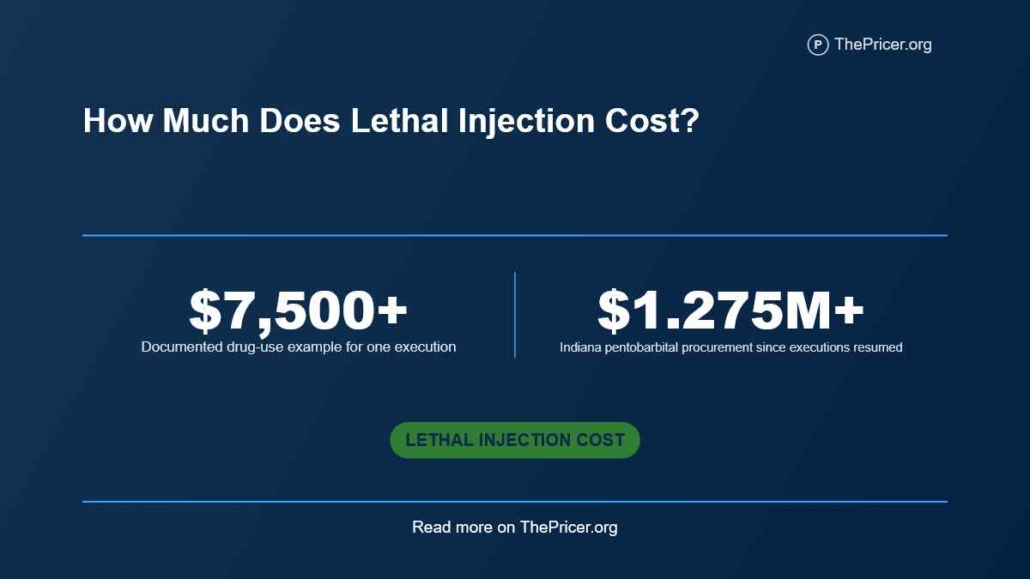
The narrowest answer is that the drugs consumed in one lethal injection can cost several thousand dollars, while keeping a functioning lethal-injection program can cost far more. Arizona provides one of the clearest drug-price examples. The state paid $1.5 million (about 24 years of full-time work at $30 per hour) for 1,000 one-gram pentobarbital vials in October 2020, making each vial cost $1,500. Public records summarized by the Death Penalty Information Center put the drug used for one execution under Arizona’s protocol at roughly $7,500 at those purchase prices.
Arizona’s $1.5 million pentobarbital purchase cannot be treated as a national unit price. Tennessee spent nearly $600,000 over multiple years. Indiana spent more than twice that maintaining and replacing its own inventory. Georgia’s recent records reveal six-figure contractor payments rather than a simple drug invoice.
The definition of “cost” matters. The chemical can be only one line item. State spending may also include a compounding pharmacy, execution-team personnel, medical contractors, security, transportation, testing, training, facility preparation, witnesses, media operations and legal work surrounding the execution.
A state can therefore report a relatively small amount of drug actually consumed during an execution while still having spent hundreds of thousands of dollars maintaining the ability to conduct that execution.
State-by-State Prices
Public records reveal large differences, but they describe different types of spending. Ranking the states from cheapest to most expensive would be misleading unless the records covered the same time period and services.
| State | Documented amount | Period | What the record covers |
|---|---|---|---|
| Arizona | $1.5M (about 24 years of full-time work at $30 per hour) | 2020 purchase | 1,000 pentobarbital vials |
| Indiana | $1.275M+ | 2024-2025 | Pentobarbital purchases after executions resumed |
| Tennessee | Nearly $600K | 2017-2025 | Lethal-injection drug purchases |
| Georgia | $1.1M+ | Since the pandemic | Payments to at least one lethal-injection contractor |
| Idaho | $200K | 2023-2024 | Execution drugs that later expired unused |
| Idaho | $910,802 | 2025 estimate | Phase-two execution-unit retrofit |
Indiana’s 2026 inventory records are particularly valuable because they track purchases, use and destruction rather than disclosing only one invoice. The records put known pentobarbital spending at at least $1.275 million across the state’s three executions following its restart.
Tennessee’s records tell another story. Documents covering 2017 through 2025 show nearly $600,000 spent obtaining execution drugs. Georgia’s recently disclosed contractor records show more than $1.1 million paid since the pandemic to at least one contractor associated with lethal injection, while the state carried out one execution during that period.
The state table is useful precisely because the numbers are not equivalent. It shows the different places where the execution bill can appear.
Why the Drugs Cost More
Pentobarbital itself does not normally command the extraordinary prices seen in some execution-drug records. The execution market is unusual because numerous pharmaceutical manufacturers and distributors restrict their products from being supplied for executions. Corrections departments can be left searching for compounding pharmacies or other specialized suppliers willing to participate.
The Death Penalty Information Center’s current review of death-penalty costs cites an expert estimate that some states have paid markups approaching 1,000% compared with ordinary market pricing. That is not a standard markup applicable to every state or purchase. It illustrates how distorted an unusually restricted procurement market can become.
Arizona’s purchasing history shows the problem. In 2015 the state spent $27,000 attempting to obtain 1,000 vials of sodium thiopental from a supplier in India, but the shipment was seized after federal regulators objected to the importation. By 2020, Arizona had turned to compounded pentobarbital and paid $1.5 million.
That difference cannot be explained only by manufacturing cost. Supplier availability, legal restrictions, secrecy, compounding and the state’s limited ability to shop a conventional pharmaceutical market all affect the final price.
When Drugs Expire
Shelf life may be the most surprising part of lethal-injection economics. A state can buy drugs in preparation for an execution and lose the entire investment if court proceedings, scheduling changes or other delays extend beyond the period in which the drugs can be used.
Indiana disclosed about $600,000 worth of pentobarbital that expired before it was used. At the time the state had publicly acknowledged $1.175 million of drug spending, that meant:
$600,000 ÷ $1.175 million = 51.1%.
Roughly half of the then-disclosed expenditure had therefore become unusable inventory. Indiana later disclosed another purchase, raising known spending to at least $1.275 million.
Idaho supplies a second documented case. Court filings showed the state had spent $200,000 on execution drugs that expired unused. The purchases consisted of $50,000 in October 2023, $100,000 in June 2024 and another $50,000 in October 2024.
Add the two states:
$600,000 + $200,000 = at least $800,000.
Indiana and Idaho alone therefore document at least $800,000 in execution drugs that expired without being used. That is not a national estimate. It is a reproducible subtotal from two states with public records.
Contractors and Staffing
Drug purchases can be smaller than the professional-services bill surrounding the execution. Georgia provides one of the clearest current examples because records released after years of litigation expose large contractor payments while withholding much of the detail about the recipient and services.
ProPublica found Georgia had paid more than $1.1 million since the COVID-19 pandemic to at least one contractor working with the Department of Corrections on lethal injection. One handwritten check dated August 19, 2026 was for $170,000. Recipient information and other details were redacted.
The records create an accounting problem for anyone trying to answer what one Georgia execution costs. The public knows the state made large payments and knows they were connected with lethal injection, but available records do not allow every dollar to be divided cleanly among pharmaceuticals, professional services and execution-specific work.
Other expenses can include correctional officers, execution-team members, medical personnel, transportation, facility security, witness arrangements, media operations and administrative staff. Some are paid through ordinary agency budgets. Others may generate overtime or contractor charges.
Without payroll records and invoices from a particular execution, assigning a national labor amount would create false precision. The better division is between consumable costs, execution-specific labor or contracts, and fixed institutional spending.
When an Execution Fails
A failed or aborted lethal injection can preserve most of the preparation bill while adding another set of expenses afterward. Tennessee has supplied two examples in 2026.
In May, Tennessee prepared to execute Tony Von Carruthers but could not complete the procedure. According to the governor’s official account, medical personnel established the initial IV access but could not complete the additional access required by protocol. The execution was called off and Carruthers received a one-year reprieve.
The state tried to execute Christa Pike on September 30. Tennessee’s Department of Correction said it had followed every step of its approved protocol, but Pike was transported to an outside medical facility afterward. Reuters reported that Pike survived and that Governor Bill Lee suspended the state’s remaining executions for 2026 while an investigation proceeds.
A complete taxpayer cost for either event is not yet publicly available. Pricing one anyway would require unsupported assumptions.
The expense categories are identifiable: execution staff already mobilized, security, medical personnel, facility preparation, supplies or drugs consumed, witness operations, outside medical treatment, subsequent investigation, renewed litigation and potentially a second round of execution preparation.
That means an unsuccessful attempt can cost more than simply replacing the drug. Nearly the whole execution operation may have to be assembled again.
Changing Execution Methods
Difficulty obtaining lethal-injection drugs has pushed several states toward other methods. That can reduce dependence on scarce pharmaceuticals, but it does not make the transition inexpensive.
Idaho is a particularly useful case. State law made firing squad the primary execution method beginning July 1, 2026. The Department of Correction then had to alter its existing execution facility to support the new method while retaining lethal-injection capability.
The state’s updated phase-two construction estimate was $910,802. The work includes a dedicated firing-squad space, witness-area modifications, sound mitigation, safety measures and ballistic protection. Training is required after the physical work is completed.
The nearly $1 million figure is a capital project, not the price of one execution. The distinction produces a useful cost model.
If the $910,802 construction cost were allocated across 10 future executions:
$910,802 ÷ 10 = $91,080 per execution.
Across 20 uses:
$910,802 ÷ 20 = $45,540 per execution.
Neither calculation predicts Idaho’s future execution count. They show how a large fixed expense behaves differently from drugs or other consumables.
It also explains why comparing lethal injection with a firing squad based solely on the price of medicine versus ammunition would miss most of the relevant spending.
An Itemized Cost Model
No state record gives us every cost needed to construct a universal execution invoice. The more defensible approach is to show how documented expenses accumulate and leave unknown items unpriced.
| Cost layer | Documented example | How it should be counted |
|---|---|---|
| Drug procurement | Indiana: $1.275M+ | Multi-execution inventory spending |
| Expired inventory | Indiana: about $600K | Sunk drug cost |
| Expired inventory | Idaho: $200K | Sunk drug cost |
| Outside contractor | Georgia: $1.1M+ | Multi-year contractor spending |
| Method-change infrastructure | Idaho: $910,802 | Fixed capital expense |
| Staffing and security | Varies / incomplete | Execution-specific or normal payroll |
| Medical treatment after failure | Not yet disclosed | Do not estimate without records |
| Litigation | Case-specific | Separate from execution-day spending |
This model reveals why dividing a state’s annual corrections spending by its execution count does not answer the headline question. A $1.5 million bulk purchase can supply inventory for several executions. A $170,000 contractor payment may cover a period rather than one event. A $910,802 construction project can remain useful for years.
The better measure is often the cost of maintaining execution capability. That includes drugs purchased in advance, drugs that expire, specialists retained between executions, training and facilities that must remain available even when no execution takes place.
That distinction also explains why two states performing the same number of executions can report very different bills.
The Wider Death-Penalty Cost
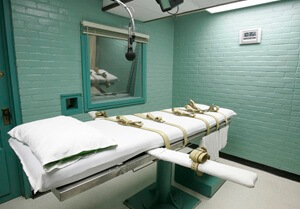 The injection itself is only the final stage of a capital case. Long before an execution date, public spending can include prosecutors, specialized defense teams, investigators, mitigation specialists, expert witnesses, longer jury selection, separate sentencing proceedings, direct appeals, post-conviction litigation and decades of incarceration.
An Ohio Attorney General report quotes a Legislative Service Commission review finding that capital cases cost roughly 2.5 to 5 times as much as non-capital cases in the studies examined. Some studies reviewed there found an additional $1 million to $3 million per case.
The current Ohio Attorney General report puts another number on the issue. Applying earlier study estimates to Ohio’s death-row population produced an estimated $116 million to $348 million in additional capital-case costs. The office supports capital punishment while also describing the existing system as costly, which makes the budget figures useful beyond advocacy arguments on either side.
Those totals are not lethal-injection prices. The majority of the added cost arises before the execution procedure itself.
Legal representation helps explain the scale. Even ordinary high-stakes murder-defense costs can reach six figures per lawyer in private cases, while federal appointed counsel receive higher statutory compensation in capital matters than ordinary criminal cases. Another recurring expense is custody: incarceration costs per day become substantial when multiplied across years or decades, although immigration detention and death-row confinement are different systems and should not share one assumed daily rate.
The useful distinction is therefore:
Lethal injection can create thousands to hundreds of thousands of dollars in direct and supporting costs, while pursuing and maintaining a death sentence can add millions of dollars over the life of a capital case.
Answers to Common Questions
How much does a lethal injection cost?
There is no standard national price. The drugs consumed in one documented execution can cost several thousand dollars, while procurement, contractors, preparation and wasted inventory can push state spending into the hundreds of thousands or millions over time.
How much did Arizona pay for lethal-injection drugs?
Arizona paid $1.5 million for 1,000 pentobarbital vials in 2020, equal to $1,500 per vial.
How much has Indiana spent on execution drugs?
Records released in 2026 show at least $1.275 million in pentobarbital spending since Indiana resumed executions in 2024.
How much execution medicine has expired unused?
Indiana disclosed about $600,000 of expired inventory and Idaho disclosed another $200,000. Together, those two states document at least $800,000 in execution drugs that expired without being used.
Why can execution drugs cost so much?
The pool of willing suppliers is unusually restricted. Manufacturer policies, distribution restrictions, compounding, secrecy and short usable lives can make execution procurement very different from buying the same type of pharmaceutical for ordinary medical use.
What does a failed lethal injection cost?
No reliable national figure exists. A failed attempt can consume much of the same staffing, security and preparation as a completed execution, while adding outside medical care, investigation, litigation and potentially another future execution attempt.
Is a firing squad cheaper than lethal injection?
The consumables may cost less, but converting facilities can be expensive. Idaho’s phase-two firing-squad and execution-unit retrofit was estimated at $910,802.
Does the death penalty cost more than life imprisonment?
Studies reviewed by Ohio’s Legislative Service Commission found the full cost of capital cases at roughly 2.5 to 5 times the cost of non-capital cases. Those estimates cover legal and correctional costs across the case, not only the execution method.
Disclosure: Educational content, not financial advice. Prices reflect public information as of the dates cited and can change. Confirm current rates, fees, taxes, and terms with official sources before purchasing. See our methodology and corrections policy.