
How Much Does Limb Lengthening Surgery Cost?
Updated on | Written by Alec Pow
This article was researched using 9 sources. See our methodology and corrections policy.
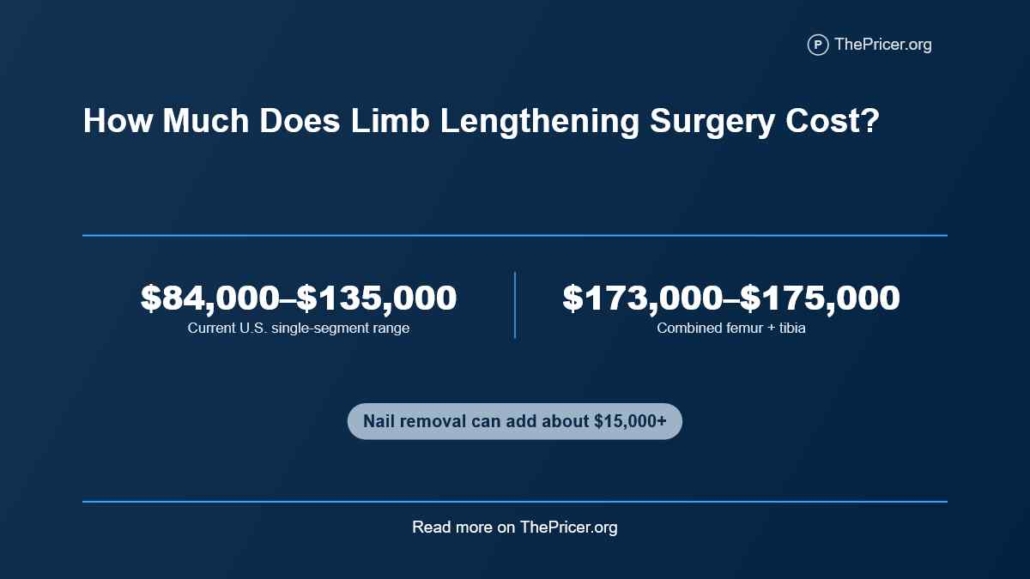
Cosmetic limb lengthening surgery currently costs roughly $84,000 to $135,000 for one bilateral leg segment at major U.S. centers, with combined femur-and-tibia treatment reaching about $173,000 to $175,000 before every ancillary expense. Current 2026 international package prices can be much lower, but the quoted operation is not the same thing as the full financial commitment: housing, travel, medications, extended physical therapy, caregiving, complications, and later nail removal can add thousands or tens of thousands of dollars.
Stature lengthening is a major orthopedic procedure in which the femurs or tibias are surgically cut and gradually separated while new bone forms in the gap. Current centers such as Hospital for Special Surgery (HSS), LimbplastX, Height Lengthening in California, and the Paley Institute use internal magnetic lengthening nails for many adult cosmetic cases.
The surgery can permanently increase height, but it requires months of rehabilitation and carries meaningful risks involving bone healing, joints, nerves, blood vessels, hardware, and soft tissues.
Article Highlights
Jump to sections
- Current U.S. femur pricing: about $84,000 to $125,000 (at $30 per hour, earning that amount would take about 1.3 to 2 years of full-time work, before taxes) at the current clinics researched.
- Current U.S. tibia pricing: about $90,000 to $135,000.
- Combined femur + tibia: about $173,000 to $175,000 at one current U.S. center.
- Turkey package examples: about $26,400 for LON, $54,000 for Fitbone, and $58,000 for Precice 2 at one current 2026 provider.
- Typical height gain: HSS says about 3 inches / 8 cm from a femur lengthening is common; a second tibial procedure can increase total gain further.
- Recovery: roughly 6 months for a typical 3-inch lengthening process, with nail removal around 12 months at HSS.
- Hidden costs: nail removal, housing, travel, home help, medications, additional PT, and complication treatment may not be included.
How Much Does Limb Lengthening Surgery Cost?
The most reliable way to discuss U.S. cosmetic limb lengthening pricing in 2026 is to use current posted prices from actual orthopedic centers rather than old travel-market averages.
Hospital for Special Surgery’s August 2026 stature-lengthening guide currently lists $125,000 (about 2 years of full-time work at $30 per hour) for bilateral femur lengthening and $135,000 for bilateral tibia lengthening. HSS says those prices include the surgical and hospitalization fees, implants, anesthesia, and office visits until lengthening is completed.
LimbplastX in Las Vegas currently publishes $84,000 for bilateral femur lengthening with Precice 2.2 and $90,000 for bilateral tibia lengthening. Its page also lists higher Precice Max package prices of $100,000 for femurs and $110,000 for tibias.
A California center’s current Height Lengthening pricing lists approximately $85,000 to $87,000 for bilateral femurs, $94,000 to $98,000 for bilateral tibias, and $173,000 to $175,000 for combined femur-and-tibia lengthening performed in stages.
| Current U.S. Example | Femurs | Tibias |
|---|---|---|
| HSS | $125,000 | $135,000 |
| LimbplastX, Precice 2.2 | $84,000 | $90,000 |
| Height Lengthening | $85,000–$87,000 | $94,000–$98,000 |
These are advertised clinic prices, not a universal national fee schedule. What each package includes differs, so two figures should not be compared until anesthesia, hospital care, physical therapy, X-rays, medications, follow-ups, travel, and implant removal are accounted for.
Old $35,000 U.S. Estimates Are Misleading
Older medical-tourism directories still circulate U.S. averages in the $25,000 to $50,000 (about 4.8 to 9.6 months of full-time work at $30 per hour) range. Those figures do not line up with the current posted cosmetic stature-lengthening prices at the major U.S. centers researched for this update.
For a modern bilateral internal-nail procedure, the current direct U.S. examples above start around the mid-$80,000s and reach $135,000 for a single segment. A budget article should therefore distinguish an old aggregator estimate from a current clinic quote.
Medical Tourism Prices
Traveling abroad can lower the advertised surgery price substantially, but it also changes what happens if complications develop after returning home.
One current 2026 Turkish limb-lengthening provider advertises all-inclusive single-segment packages of approximately:
- LON: $26,400
- Fitbone: $54,000
- Precice 2: $58,000
The same provider currently advertises quadrilateral packages up to approximately $115,000 depending on the implant combination.
Those are one provider’s package prices, not national averages for Turkey. “All-inclusive” also needs to be read literally against the contract: determine how many days of accommodation and physical therapy are included, what happens if healing takes longer, whether revision surgery is covered, and who manages complications once you return home.
A recent U.S. specialized-center study of patients referred for complications after cosmetic lengthening found that most of the referred index surgeries had been performed outside the United States. Among this selected complication group, the researchers reported hardware failure, malunion/nonunion, deformity, contractures, and nerve problems. That study does not establish a complication rate for every overseas clinic, but it does show why the cost of rescue treatment belongs in a medical-tourism budget.
How Limb Lengthening Works
The modern process uses distraction osteogenesis. The surgeon performs an osteotomy, or controlled bone cut, and places either an internal lengthening nail or an external fixation system. The bone ends are then separated gradually while new bone forms in between.
HSS currently describes lengthening at less than about 1 millimeter per day. After the desired length is reached, the newly formed bone enters a consolidation phase and must harden sufficiently before unrestricted weight bearing.
Internal nails have replaced external frames for many adult long-bone procedures because the device is fully implanted and adjusted through an external magnetic controller. External fixation still has important reconstructive uses, but it carries pin-site and frame-related burdens that are particularly relevant in cosmetic patients.
How Much Height Can You Gain?
There is no single universally “safe” number of centimeters for every patient.
HSS says the most common increase is about 3 inches, or 8 cm, from femur lengthening. If a separate tibial procedure is later performed, total gain can reach approximately 5 to 6 inches.
The Paley Institute’s current guidance similarly explains that Precice 2 can mechanically lengthen up to 8 cm, but not every patient can safely reach that amount. Paley describes up to 5 cm as lower risk, 5 to 8 cm as increasing risk, and greater single-segment lengthening as more difficult for the surrounding soft tissues. The center specifically advises greater caution with tibial lengthening.
A 2025 systematic review of 12 studies and 760 aesthetic limb-lengthening patients found achieved lengthening ranging from about 62 to 87 mm, with an average around 67 mm. The same review documented infections, bone-healing problems, joint and tendon issues, neurological problems, pain, and implant-related complications.
Hidden Price: Nail Removal
The implant is not necessarily a lifetime device.
Current FDA guidance for the titanium Precice intramedullary system says the device should be removed after treatment, and HSS says its stature-lengthening rods are generally removed around 12 months after the original operation.
Nail removal can be a separate bill. LimbplastX currently posts approximately $15,000 for bilateral femur or tibia nail removal and $20,000 for combined femur-and-tibia hardware removal.
Height Lengthening’s current published materials also treat removal as a later separate expense, with the amount depending on insurance and facility arrangements.
This means an $84,000 initial femur package can become roughly $99,000 when a separately priced $15,000 removal procedure is added, before travel or other non-covered expenses.
Housing, Help, and Physical Therapy
Rehabilitation is not optional.
The Paley Institute requires physical therapy five days per week during distraction. It also requires stature patients to remain near the center during that phase and notes that patients need significant help immediately after discharge.
After distraction ends, therapy normally continues during consolidation, often closer to home. HSS likewise emphasizes daily stretching during the early months because muscles and tendons can lag behind the lengthening bone and create joint stiffness.
A patient considering a clinic far from home should budget for:
- Temporary housing for weeks or months
- Flights or long-distance travel
- A caregiver, family member, or paid home assistance
- Wheelchair, walker, or crutches where not included
- Physical therapy after leaving the surgical center
- Repeated X-rays and surgeon follow-ups
- Prescription medications
- Time away from work
Those costs can turn a surgical quote into a much larger total project cost.
Recovery Takes Months
The old idea that distraction and consolidation finish in 12 to 16 weeks understates the full recovery.
HSS’s August 2026 guidance says a typical 3-inch lengthening is approximately a six-month process. The active lengthening phase takes roughly three to four months, followed by another six to eight weeks of bone healing before normal activity resumes for many patients. HSS says most patients return to desired activities around six months, while rods are generally removed at about 12 months.
Individual recovery can be longer. Delayed bone formation, stiffness, nerve irritation, hardware problems, additional surgery, or more aggressive lengthening can extend the timeline substantially.
Complications
Cosmetic limb lengthening has high satisfaction in published series, but high satisfaction does not mean a complication-free course.
A 2025 systematic review found reported complications involving infection, bone healing, joint and tendon problems, neurological or vascular issues, pain, and implant failure. The authors emphasized that evidence quality and reporting vary between studies.
A separate specialized U.S. center report on referred complication cases documented serious problems requiring treatments such as hardware exchange, bone grafting, and soft-tissue release.
The financial implication is important: additional surgery for nonunion, contracture, implant failure, or deformity can add hospital, surgeon, anesthesia, travel, rehabilitation, and lost-work costs that were never part of the original package.
Implant Model Matters
Do not treat “Precice” as one unchanging product.
The FDA’s device database shows that a Precice Max System received a U.S. 510(k) decision on June 18, 2026. At the same time, FDA records contain recall histories affecting other Precice-family devices and earlier models.
Before surgery, ask for the exact manufacturer, model, implant material, weight-bearing restrictions, FDA status, and planned removal schedule. Those details can affect both mobility during recovery and the total bill.
Cosmetic vs Medical Lengthening
Cosmetic stature lengthening and medically necessary limb reconstruction should not be priced as though they are the same insurance claim.
Elective height-increase procedures are generally treated as self-pay. In contrast, limb lengthening performed to correct a clinically significant limb-length discrepancy, congenital deformity, trauma, nonunion, or other reconstructive problem may be eligible for health-insurance coverage depending on the plan and medical-necessity requirements.
Someone undergoing medically indicated reconstruction should therefore obtain an insurer-specific estimate rather than using cosmetic clinic prices as the expected out-of-pocket bill.
Cost in Hours of Work
At a gross wage of $30 per hour, an $84,000 femur procedure represents about 2,800 hours of work.
HSS’s $125,000 femur price equals roughly 4,167 hours. A $173,000 combined femur-and-tibia procedure represents about 5,767 working hours, before nail removal, housing, travel, or lost income.
That is roughly 2.8 years of full-time 40-hour workweeks for the $173,000 surgery alone.
You might also like our articles about the cost of toe shortening surgery, hammertoe surgery, or brachymetatarsia surgery.

What We Verified
- Current HSS pricing: its August 2026 guide lists $125,000 for bilateral femur stature lengthening and $135,000 for tibias, including surgery, hospitalization, implants, anesthesia, and office visits through lengthening.
- Other current U.S. pricing: LimbplastX lists $84,000 femurs and $90,000 tibias with Precice 2.2; Height Lengthening lists roughly $85,000 to $87,000 femurs and $94,000 to $98,000 tibias.
- Combined treatment: one current U.S. center lists staged femur-and-tibia lengthening at about $173,000 to $175,000.
- Turkey pricing: one current 2026 provider publishes $26,400 for LON, $54,000 for Fitbone, and $58,000 for Precice 2. These are provider package prices, not national averages.
- Recovery: HSS currently describes a typical 3-inch lengthening as about a six-month process, with rod removal around 12 months.
- Rehabilitation: major centers require frequent or daily stretching and physical therapy during distraction.
- Risks: recent systematic evidence documents infection, bone-healing problems, joint/tendon issues, neurological problems, pain, and implant-related complications.
- Device status: implant models change over time; the FDA issued a new 510(k) decision for the Precice Max System in June 2026, while other Precice-family devices have separate recall histories.
- Removed content: the previous unsupported Nikita and Maria case studies, the generic $35,970 U.S. average, and the growth-hormone “alternative” were not retained.
Answers to Common Questions
How much does limb lengthening surgery cost in the U.S.?
Current major-center prices are approximately $84,000 to $125,000 for bilateral femur lengthening and $90,000 to $135,000 for bilateral tibia lengthening. Combined staged treatment can approach $175,000 before every ancillary expense.
How much does limb lengthening cost in Turkey?
One current 2026 provider advertises approximately $26,400 for LON, $54,000 for Fitbone, and $58,000 for Precice 2. Those are individual provider package prices and should not be treated as a guaranteed nationwide rate.
How many inches can limb lengthening add?
HSS says about 3 inches, or 8 cm, is a common femur-lengthening target. A separate tibia procedure can add another 2 to 3 inches in selected patients. The safe amount depends on bone, soft tissues, anatomy, and surgeon assessment.
How long does limb lengthening recovery take?
For a typical 3-inch stature procedure, HSS currently describes roughly six months from surgery through lengthening and initial healing, although full rehabilitation can take longer and implant removal commonly occurs around 12 months.
Does insurance cover limb lengthening surgery?
Purely cosmetic height surgery is generally self-pay. Medically necessary limb-lengthening or deformity-correction procedures may qualify for insurance coverage depending on the diagnosis, plan, and authorization requirements.
Disclosure: Educational content, not medical advice. Pricing varies by provider, location, and insurance. Confirm eligibility, coverage, and out-of-pocket costs with a licensed clinician and your insurer. See our methodology and corrections policy.