
How Much Does Meal Delivery Cost Per Month?
Published on | Written by Alec Pow
This article was researched using 14 sources. See our methodology and corrections policy.
A U.S. meal delivery service can cost several hundred dollars per month, depending mainly on meal format and weekly quantity. For the usage levels modeled here, a U.S. meal delivery subscription runs from about $221 per month at Home Chef’s minimum weekly order value to about $667 per month for a 10-meal Factor planning scenario based on current Factor meal costs. Those totals use 52 weeks divided by 12 months, not a four-box shortcut. Tax and optional upgrades can raise the bill.
Meal kits and prepared meals are not identical purchases. Meal kits send measured ingredients that still need cooking, while prepared subscriptions send single-serving dishes that mainly need reheating. A household’s bill depends on weekly quantity, household size, shipping, premium selections, promotional discounts, renewal pricing, and how often deliveries are skipped.
For current U.S. pricing examples, Home Chef, Dinnerly, EveryPlate, and Marley Spoon represent cook-at-home meal kits, while CookUnity and Factor represent prepared-meal subscriptions. Those services differ in per-serving pricing, weekly minimums, box size, shipping, introductory offers, and renewal charges, so the useful comparison is delivered cost for the same number of meals rather than the lowest advertised meal price.
Article Highlights
Jump to sections
- A minimum weekly Home Chef order works out to about $220.78 (at $30 per hour, earning that amount would take about 7.4 hours of work, before taxes) per calendar month.
- Dinnerly’s current two-person plan with three dinners per week works out to about $363.65 per calendar month including shipping.
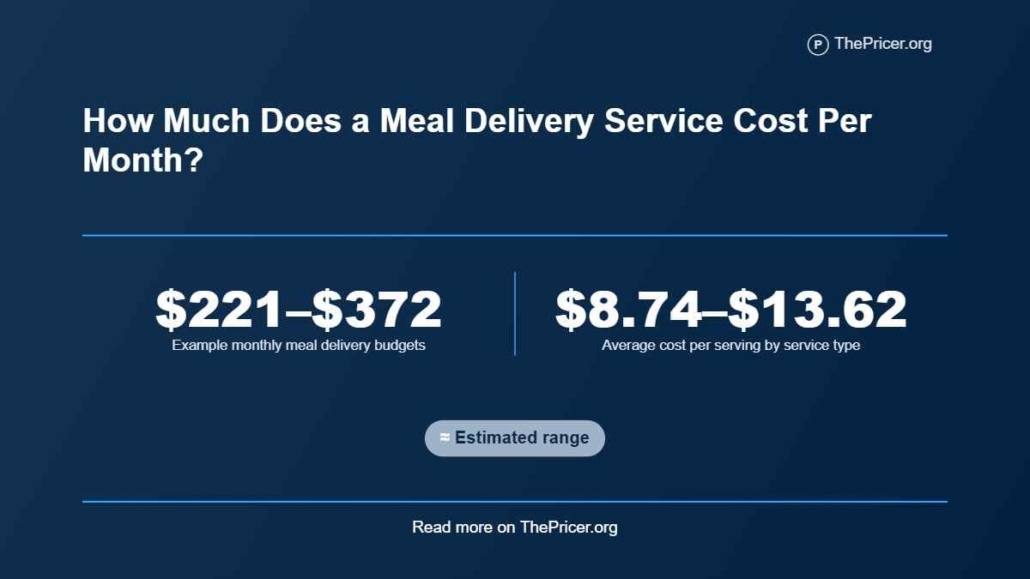
- Six CookUnity prepared meals per week work out to about $362.83 to $371.50 per calendar month, depending on the delivery charge.
- A four-box month can understate a true calendar-month budget because a year contains 52 weekly deliveries, or about 4.33 per month.
- Introductory discounts can cut the first box sharply while leaving shipping and later boxes at a much higher regular rate.
How Much Does Meal Delivery Cost Per Month?
Current transparent price schedules show a wide gap even before premium meals enter the cart. Dinnerly lists three meals for two people at $71.93 (about 2.4 hours of work at $30 per hour) plus $11.99 shipping on its current U.S. plan schedule. That is $83.92 per week, or $363.65 per calendar month using 52 weeks divided by 12.
Marley Spoon lists the same three-dinner, two-person quantity at $82.93 plus $10.99 shipping in its ready-to-cook plan prices. The delivered total is $93.92 per week, or $406.99 per calendar month. CookUnity’s current per-meal plan prices put six prepared meals at $12.29 each, with delivery of $9.99 or $11.99. That produces $362.83 to $371.50 per calendar month. EveryPlate’s current regular pricing starts at $5.99 per serving with a flat $10.99 shipping charge, though the exact weekly bill depends on plan size.
| Service and scope | Weekly delivered cost | Calendar-month cost |
|---|---|---|
| Home Chef minimum weekly order | $50.95 | $220.78 |
| Dinnerly, 3 dinners for 2 | $83.92 | $363.65 |
| CookUnity, 6 prepared meals | $83.73 to $85.73 | $362.83 to $371.50 |
| Marley Spoon, 3 dinners for 2 | $93.92 | $406.99 |
| Factor, estimated 10-meal delivered plan | $153.89 | $666.86 |
These are matched calendar-month conversions, not a national average. They also buy different amounts of food and different levels of preparation. The table works as a planning ladder, not a ranking of value.
What the Subscription Buys
A meal-kit subscription sells a repeatable dinner package rather than a full grocery basket. The provider selects and portions recipe ingredients, packs them for cold shipment, and sends the chosen number of recipes and servings. You still supply basic kitchen equipment and, depending on the recipe, pantry staples such as oil, salt, or pepper. The price pays for portioning, recipe planning, packaging, and delivery as well as the ingredients themselves.
Prepared-meal services move more of the labor to the provider. Meals arrive cooked in individual trays or containers and are usually designed for reheating. That changes both the price and the unit. A two-person meal kit may list six servings because three recipes each feed two people. A prepared plan with six meals normally means six single-serving entrées. Comparing the two by box price alone hides a real scope difference.
The weekly box is the most useful billing unit. Most subscriptions recur unless the customer skips, pauses, or cancels before the provider’s cutoff. A monthly budget is then a projection of weekly orders rather than a flat monthly membership fee. A household that receives every box for a year has 52 deliveries, while someone who skips travel weeks or busy periods will spend less. The subscription schedule matters as much as the menu price.
Kits vs Prepared Meals
The format premium appears in independent 2026 pricing work. MealFan’s 14-service pricing audit reported an average of $8.74 per serving for meal kits and $13.62 (about 27 minutes at $30 per hour) per serving for prepared meals in its June sample. Good Housekeeping’s prepared-meal testing described tested prepared options from about $10 to more than $20 per meal. Those figures come from different methodologies, but both point to the same practical difference. Removing most cooking labor usually raises the unit price.
The Dinnerly and CookUnity examples expose an exception to the category average. Dinnerly’s two-person, three-dinner box supplies six meal-kit servings for $83.92 delivered. CookUnity’s six prepared meals cost $83.73 to $85.73 delivered. At this small order size, the prepared plan lands from $0.19 less to $1.81 more per week, or from $0.82 less to $7.84 more per calendar month. Shipping and plan size can erase much of the format gap in a specific comparison.
Households comparing a particular kit can also check Home Chef subscription costs. A useful comparison asks whether the service replaces supermarket cooking, restaurant delivery, or convenience food. Replacing low-cost home cooking usually raises spending. Replacing frequent takeout can narrow the gap, but the result depends on the restaurant bill being replaced.
Shipping Changes the Math
Small boxes feel shipping most. The same box fee is divided across fewer servings. Dinnerly’s two-person three-dinner example has $11.99 of shipping spread over six servings, adding about $2.00 per serving. Marley Spoon charges $10.99 shipping on the compared ready-to-cook box. CookUnity charges $9.99 or $11.99 depending on ZIP code, which adds about $1.67 to $2.00 to each meal on a six-meal plan.
CookUnity also offers UnityPass in eligible areas. Its membership pricing terms list $23.99 plus tax every 28 days, describe $10 delivery savings per order, say the program is still rolling out, and note that taxes and service fees may remain. The page says the membership pays for itself in two orders, yet two $10 delivery charges total only $20. On delivery savings alone, the third eligible order is the break-even point.
Using the service’s stated $10 delivery saving, four eligible deliveries would avoid $40 in delivery charges. Subtracting the $23.99 membership price leaves $16.01 in delivery-only savings before tax. Premium-meal coverage and other member benefits can add value, but they are separate from this delivery break-even calculation.
Promos vs Regular Price
The first box can mislead. EveryPlate’s current introductory offer displays $2.99 per meal in the banner, while its fine print describes a $2.89 per meal basis for the qualifying two-person, three-recipe first box. The same terms give 10 percent off boxes two through five and exclude shipping plus certain premium items, upgrades, add-ons, and taxes from the promotional reduction.
The regular starting price shown by EveryPlate is $5.99 per serving plus $10.99 shipping. A reader who budgets from the first-box banner can miss two separate changes. The food discount shrinks after the first shipment, and the delivery fee remains payable. The better monthly budget uses the regular price unless the question is limited to the introductory period.
Promotions also distort annual comparisons. A heavily discounted first box affects only a small share of 52 potential weekly deliveries. Someone keeping the service for several months should record the first promotional bills, then model later boxes at the normal plan price. Premium proteins, desserts, extra meals, snacks, and market items need their own allowance because the base serving price may not apply to them.
Household Size Matters
Larger meal-kit orders can reduce the delivered cost per serving even when the weekly bill rises. Dinnerly’s current three-dinner schedule provides a clean comparison. The two-person plan costs $71.93 for six servings plus $11.99 shipping, or $83.92 delivered. That equals about $13.99 per delivered serving.
The six-person version of the same three-dinner schedule costs $137.81 for eighteen servings plus $11.99 shipping, or $149.80 delivered. Divide that total by eighteen and the delivered unit cost is about $8.32 per serving. The larger order cuts the delivered unit cost by about 40.5 percent, even though the household spends another $65.88 per week.
This is a quantity effect, not automatic savings. A larger household that eats all eighteen servings gets the lower unit cost. A smaller household that orders extra servings and throws food away can spend more for no useful gain. Home Chef also states that its per-serving price varies with order size, so the cheapest advertised serving figure may not match a small box.
Monthly budgeting should start with the number of servings the household will actually eat. After that, compare delivered unit cost. Choosing a bigger plan only because the per-serving figure is lower can create a false economy when leftovers are unwanted or the menu does not fit the household’s schedule.
Three Monthly Budgets
A light-use meal-kit customer can start near the Home Chef minimum. The documented minimum weekly Home Chef Plan order is $50.95 including shipping. Across a full year of weekly deliveries, that becomes $2,649.40. Dividing by 12 gives an average of $220.78 per month. Skipping four weeks would reduce the annual total by $203.80 before any menu changes or tax.
A couple using Dinnerly for three dinners every week has a more detailed worked total. Food costs $71.93 and shipping adds $11.99, making the weekly box $83.92. Four boxes would be $335.68, but a calendar-month average uses 52 deliveries across 12 months. The calculation is $83.92 multiplied by 52, then divided by 12, which equals $363.65 per month. The four-box shortcut understates the average monthly budget by $27.97, or about 8.3 percent.
A single person buying six CookUnity prepared meals each week pays $73.74 for meals plus $9.99 or $11.99 for delivery. The weekly total is $83.73 to $85.73. The calendar-month average is $362.83 to $371.50. That is the cleanest illustration of the convenience premium because the customer receives six cooked single servings instead of six recipe-kit servings that still need preparation.
Fit With a Food Budget
Meal delivery should not be compared with a monthly grocery figure without matching the amount of food. The USDA’s July 2026 food plans put the moderate-cost monthly food-at-home amount at $337.10 for a woman age 20 to 50 and $398.70 for a man age 20 to 50 under the agency’s stated assumptions. Those figures represent food prepared at home across the month. They are not prices for a handful of weekly dinners.
A couple’s Dinnerly schedule of three dinners per week covers about 13 dinners per person in an average month, not breakfast, lunch, snacks, beverages, and every other dinner. Its $363.65 monthly cost can sit near one adult’s USDA moderate food budget while covering far fewer eating occasions. That mismatch is why a similar dollar amount does not mean the meal kit and grocery budget cost the same for equivalent food coverage. Readers building a full household plan can compare the service bill with a broader monthly grocery budget, then subtract only the grocery purchases that the subscription truly replaces.
A meal service can still make financial sense when it replaces higher-cost habits or prevents repeated unused grocery purchases. The decision rests on what leaves the budget after the box arrives, not on the subscription charge alone.
Makes sense if
- You will eat nearly every delivered serving.
- The box replaces restaurant delivery or convenience meals several nights each week.
- Portioning and recipe planning remove purchases you would otherwise waste.
- You reliably skip weeks when the meals are not needed.
Does not make sense if
- The box mostly replaces low-cost home cooking.
- You routinely add several premium meals, extra proteins, desserts, or snacks.
- Your household leaves delivered servings uneaten.
- You forget cutoff dates and receive unwanted boxes.
Answers to Common Questions
How much is a meal delivery service for one person per month?
A small weekly meal-kit order can be near $221 per month, while six prepared meals each week can run about $363 to $372 per month in the current examples above. Higher prepared-meal quantities can push the bill much higher.
Are meal kits cheaper than prepared meals?
They often are on a per-serving basis because the customer still does the cooking. The 2026 independent sample cited above found meal kits at $8.74 per serving on average and prepared meals at $13.62.
Should I multiply the weekly cost by four?
Use four only for a four-delivery cash-flow snapshot. For a calendar-month average, multiply the weekly cost by 52 and divide by 12. That method accounts for months that contain parts of five weekly billing cycles.
Does the advertised meal price include shipping?
Often it does not. The current examples above include separate delivery charges as high as $11.99 per box. Compare the delivered cost per serving, not only the menu price.
Can skipping weeks lower the monthly cost?
Yes. Flexible subscriptions can reduce annual spending when orders are skipped before the provider’s cutoff. Missing the cutoff can leave the next box charge in place.
Disclosure: Educational content, not medical advice. Pricing varies by provider, location, and insurance. Confirm eligibility, coverage, and out-of-pocket costs with a licensed clinician and your insurer. See our methodology and corrections policy.