
How Much Does MedExpress Cost?
Updated on | Written by Alec Pow
This article was researched using 13 sources. See our methodology and corrections policy.
MedExpress no longer has one national visit price because its locations have closed in most states and surviving centers can operate under new ownership. For former MedExpress locations in Pennsylvania and West Virginia that are now UPMC-GoHealth Urgent Care, current uninsured same-day pricing runs from $150 for a virtual visit to $175 to $325 for an in-center visit with one procedure.
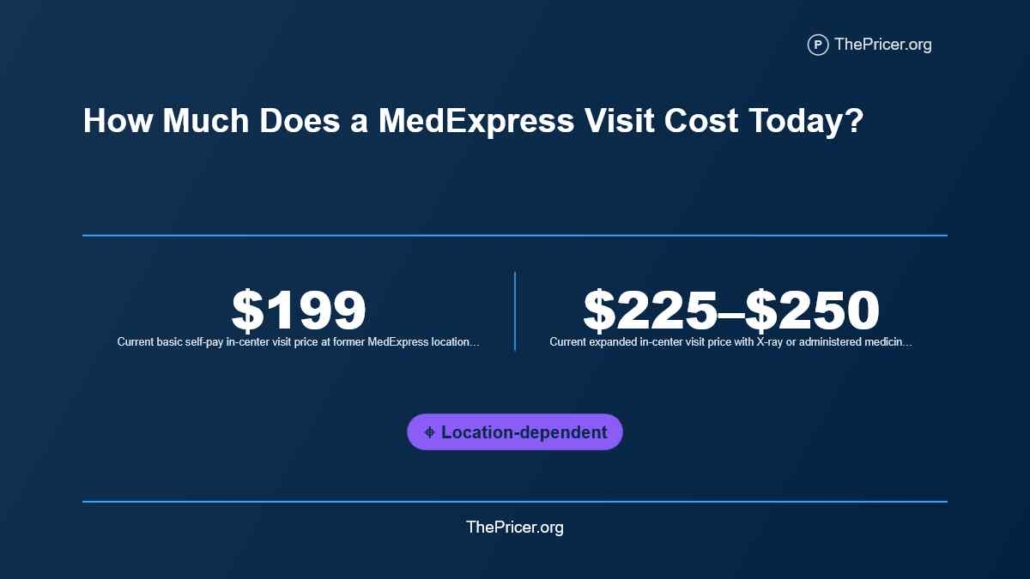
A basic in-center visit is $199, while a visit with an X-ray or administered medicine is $225 to $250. The correct price now depends on the company operating the specific former MedExpress center.
Article Highlights
Jump to sections
- Most MedExpress locations have closed, while many former centers in Pennsylvania, West Virginia, and Virginia now use different urgent-care brands.
- Current UPMC-GoHealth self-pay pricing is $199 (at $30 per hour, earning that amount would take about 6.6 hours of work, before taxes) for a basic visit and $225 to $250 for a visit with an X-ray or administered medicine.
- An advanced visit with one procedure is $175 to $325, while a virtual visit is $150.
- A standard flu shot is listed at $25 and a high-dose flu shot at $55, subject to availability.
- Insurance patient responsibility depends on the plan’s copay, deductible, coinsurance, network rules, and separately billed services.
How Much Does a MedExpress Visit Cost Today?
The current PA and WV menu separates the visit by what care is delivered. The basic tier includes the in-center exam and one instant lab test. The expanded tier adds an X-ray or medicine administered at the center, while the advanced tier covers one procedure such as wound repair, asthma treatment, or splinting. Virtual care sits outside those in-center categories. Vaccine pricing is also listed separately from an illness or injury visit.
| Current service | Self-pay price | What the price covers |
|---|---|---|
| Virtual urgent care | $150 (about 5 hours of work at $30 per hour) | Online video evaluation |
| Basic in-center visit | $199 | Clinical exam plus one instant lab test |
| Expanded in-center visit | $225 to $250 | Clinical exam with X-ray or administered medicine |
| Advanced in-center visit | $175 to $325 | Clinical exam with one procedure |
| Standard flu shot | $25 | Vaccine only, subject to availability |
| High-dose flu shot | $55 | For patients age 65 and older, subject to availability |
These are not nationwide MedExpress prices. They are current published prices from one successor network serving many former MedExpress locations. The pricing page also warns that the bill can rise if complications occur or if a clinician recommends third-party laboratory or testing services.
What Happened to MedExpress?
The MedExpress name still appears in searches, medical records, and location histories, but the company operating the center can now be different. Health-care business reporting documented that Optum acquired MedExpress in 2015 and that UPMC and GoHealth later formed a joint venture to take over former MedExpress centers. The current operator controls today’s pricing, insurance participation, billing channels, and service policies.
In Pennsylvania and West Virginia, UPMC launched 81 centers with GoHealth Urgent Care in July 2025. The Pennsylvania network incorporates former MedExpress, UPMC Urgent Care, and UPMC Express Care sites. UPMC states that all former MedExpress locations in West Virginia became UPMC-GoHealth Urgent Care centers.

Virginia followed a different path. Bon Secours says it completed the integration of 12 centers acquired from MedExpress, and those locations now operate as Bon Secours Urgent Care. The practical effect is simple. A current price search should start with the operator of the local center, not the MedExpress name alone, because the successor company now sets the cash menu and insurance terms. Patients should also use the successor’s current location page for hours, reservations, accepted plans, and billing contacts.
Self-Pay Visit Levels
The current PA and WV menu shows why one urgent-care price can be misleading. A basic illness visit with one instant lab test is $199 (about 6.6 hours of work at $30 per hour). If the visit needs an X-ray or medicine administered at the center, the expanded level is $225 to $250. That is an increase of $26 to $51 from the basic price. The higher number buys a different scope of service, not simply more time in the exam room.
The advanced category spans $175 to $325 and includes one procedure. Its lower end can be below the basic price because these are service categories rather than a simple ladder where every advanced visit costs more than every basic visit. The procedure itself, supplies, clinical need, and local billing rules can affect where a visit falls inside the range. A cut needing closure, a splint, and an asthma treatment do not create identical bills.
This structure fits the broader U.S. urgent-care market. A current urgent care visit without insurance can start in the low hundreds and rise with testing, imaging, medicine, or procedures. The useful comparison is the complete visit scope. Ask what moves the visit from one category to another and whether outside laboratory work, pharmacy prescriptions, medical equipment, or follow-up care will be billed apart from the posted same-day price.
Insurance and the Final Bill
Patients using insurance do not have one fixed MedExpress copay. A current UPMC-GoHealth location states that it is in network with major plans and offers self-pay options, but the amount an insured patient owes depends on the specific policy. A plan can assign an urgent-care copay, apply the negotiated charge toward a deductible, require coinsurance, or treat a service differently when the center or laboratory is outside the plan’s network.
GoHealth’s current billing system explains that a card presented at the visit can later be charged for the patient’s copay, deductible, or coinsurance after the insurer processes the claim. That means the amount collected at check-in is not always the final amount. The insurer’s explanation of benefits shows how the claim was processed and what remains the patient’s responsibility.
Before an insured visit, check the center and the expected service with the insurer. Ask about urgent-care benefits, deductible status, X-ray and lab rules, and whether third-party testing uses a separate network. For self-pay, ask whether payment in full at the visit is required to receive the posted cash rate. A high-deductible plan can leave an insured patient paying a substantial negotiated amount even though the center accepts the insurance card.
X-Rays, Labs, Procedures
Former MedExpress centers operating as UPMC-GoHealth still provide many of the services people associate with a full urgent-care clinic. The current PA and WV service menu includes care for colds, flu, ear infections, urinary tract infections, rashes, injuries, lab testing, X-rays, sports and camp physicals, occupational health, and telemedicine. The billing effect depends on which of those services are actually used during the visit.
An X-ray is the cleanest price example. The established basic visit is $199, while the expanded visit with an X-ray or administered medicine is $225 to $250. The imaging-related step raises the same-day price by $26 to $51 in that published menu. A wound that needs closure can fall into the advanced procedure category instead. Readers comparing that service can use current stitches pricing to see why facility, wound complexity, and the full encounter matter more than counting sutures.
Some services are priced separately from a normal illness visit. The published flu-shot amounts are vaccine prices, while the same pricing page says its listed COVID-19 testing charge requires an in-center evaluation that is not included in that testing price. That is the hidden-cost pattern to watch for. A test price, procedure price, or vaccine price does not automatically include an evaluation, outside lab work, medication, or every follow-up service.
Virtual Care and Alternatives
UPMC-GoHealth lists a self-pay virtual urgent-care visit at $150. Compared with the $199 basic in-center price, virtual care is $49 less. Compared with the $225 to $250 expanded level, it is $75 to $100 less. The comparison only makes sense when the problem can be evaluated remotely and does not need hands-on examination, an X-ray, a procedure, or testing that must be done at a center.
The successor network says virtual visits can address conditions such as allergies, rashes, urinary tract symptoms, pink eye, coughs, colds, and flu-like complaints. A virtual visit can also lead to an in-person referral if the clinician determines that testing or examination is needed. The cheaper starting price does not guarantee that the entire episode will remain virtual.
A retail clinic can be another lower-cost option for narrow services. Current CVS MinuteClinic prices often cover minor illness visits, physicals, vaccines, and limited testing at a different service scope from a full urgent-care center. Compare capabilities rather than brand names. An ankle injury that may need imaging, a deep cut, or a breathing treatment belongs in a different cost category from a routine vaccine or simple screening.
Hours, Walk-Ins, Records
Many current successor locations preserve the walk-in model associated with MedExpress. UPMC-GoHealth’s West Lancaster center lists daily hours from 8 a.m. to 8 p.m. and welcomes walk-ins while also offering online reservations. Bon Secours locations created from former MedExpress centers use a similar pattern. The Charlottesville urgent-care center, formerly MedExpress, lists 8 a.m. to 8 p.m. hours every day and offers onsite X-ray and laboratory services.
Hours can still vary by center, holiday, staffing, or temporary service availability. Check the current operator’s location page before leaving home. A reservation can reduce uncertainty around arrival time, but urgent-care reservation systems are not the same as guaranteed appointment times because higher-acuity patients and unexpected demand can affect flow.
Medical records and billing also follow the current operator. Optum directs former MedExpress patients to different record and billing channels depending on the state. UPMC-GoHealth provides online bill payment and patient support for its centers, while Bon Secours uses its own health-system channels. The name on a years-old MedExpress receipt is not enough to identify today’s billing office. Use the operator shown on the current center page or recent statement.
Verification
- Checked a current Pennsylvania location and confirmed walk-ins, 8 a.m. to 8 p.m. daily hours, X-rays, labs, telemedicine, and self-pay options.
- Confirmed a former MedExpress center in Virginia now operates under the Bon Secours Urgent Care name with daily 8 a.m. to 8 p.m. hours.
- Cross-referenced the occupational health services currently offered through UPMC-GoHealth, including workplace physicals, testing, vaccines, workers’ compensation care, X-rays, and rapid labs.
Urgent Care or the ER?
Urgent care is designed for illnesses and injuries that need prompt attention but are not life-threatening. Current successor clinics treat conditions such as minor cuts, sprains, infections, urinary symptoms, rashes, cold and flu symptoms, and some minor fractures. They can perform basic labs and X-rays, and some can close wounds or apply splints. That scope explains why urgent care can cost much less than an emergency department for a suitable problem.
An emergency department is the right setting for symptoms that may represent a life-threatening condition. Mayo Clinic urgent-care guidance directs patients to emergency care for problems including stroke symptoms, uncontrolled bleeding, severe traumatic injuries, and other emergencies. Sudden severe chest pain, major breathing difficulty, loss of consciousness, or signs of stroke should not be routed to urgent care simply to reduce the bill.
The current emergency room cost is a separate financial category because an ER has hospital-level staffing, diagnostics, monitoring, and emergency capability. A lower urgent-care price only matters when urgent care is medically appropriate for the problem.
Makes sense if
- The illness or injury is non-life-threatening and fits the current center’s service list.
- You need same-day care, a basic X-ray, lab test, splint, or minor procedure.
- You have checked the current operator, insurance network, and self-pay terms.
- A virtual visit fits the complaint and no hands-on test or procedure appears necessary.
Does not make sense if
- You have severe chest pain, major breathing difficulty, stroke signs, or uncontrolled bleeding.
- You rely on an old MedExpress address without checking whether the center changed ownership.
- You compare a test-only price with a complete visit price.
- You assume paying a copay means no later deductible, coinsurance, or lab balance can appear.
Answers to Common Questions
How much does a MedExpress visit cost without insurance?
There is no longer one national MedExpress cash price. At former MedExpress locations now operated by UPMC-GoHealth in Pennsylvania and West Virginia, current self-pay pricing is $199 for a basic visit, $225 to $250 for an expanded visit, and $175 to $325 for an advanced visit with one procedure.
Is MedExpress still open?
MedExpress locations have closed in most states. Former locations in Pennsylvania, West Virginia, and parts of Virginia now operate under other urgent-care brands.
Can I use insurance at a former MedExpress location?
Many successor clinics accept major insurance plans, but network participation and patient responsibility depend on the current operator, location, and specific policy.
How much is a virtual urgent-care visit?
UPMC-GoHealth currently lists an uninsured virtual visit at $150 in Pennsylvania and West Virginia.
Do former MedExpress centers still accept walk-ins?
Many do. Current UPMC-GoHealth and Bon Secours location pages commonly list walk-in care, with hours that should be checked before visiting.
Disclosure: Educational content, not medical advice. Pricing varies by provider, location, and insurance. Confirm eligibility, coverage, and out-of-pocket costs with a licensed clinician and your insurer. See our methodology and corrections policy.