
How Much Does Meta Muse Wonder Cost?
Published on | Written by Alec Pow
This article was researched using 9 sources. See our methodology and corrections policy.
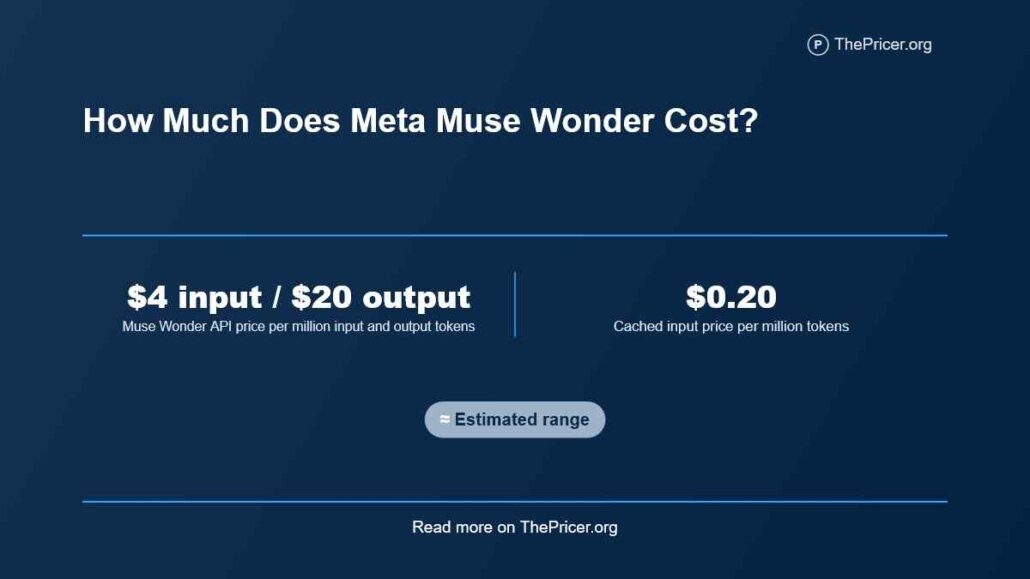
Meta Muse Wonder costs $4 per million input tokens and $20 per million output tokens through the Meta Model API as of October 13, 2026. Reused prompt content eligible for caching costs $0.20 per million cached input tokens. Developers can also access Muse Wonder through Muse Code subscriptions starting at $5 per month, while the more powerful Muse Wonder Full requires a Muse Code Power plan costing $50 per month or Maximum Usage at $200 per month.
Meta introduced both models on October 12, expanding its AI offerings for software development, complex research, long-running agents, and computer-based tasks. Consumers can also access Meta’s Muse assistant through free and paid plans, although Wonder’s rollout to consumer subscribers is gradual. The cost depends on whether someone is using the assistant, subscribing to Muse Code, or building an application with the API.
Article Highlights
Jump to sections
- Muse Wonder API input costs $4 per million tokens, while generated output costs $20 per million tokens.
- Cached input is discounted to $0.20 per million tokens, 95% below the standard input rate.
- Muse Code plans cost $5, $15, $50, or $200 monthly, depending on usage allowances and model access.
- Muse Wonder Full is available only through the $50 and $200 Muse Code subscriptions, not the public Model API.
- The consumer Muse assistant offers paid tiers at $20 and $100 per month, separate from Muse Code.
- API web-search grounding adds $2.50 per 1,000 queries, beyond ordinary token charges.
How Much Does Meta Muse Wonder Cost?
Meta offers Wonder through three different products. The consumer Muse assistant provides a conversational experience, Muse Code supports software development through a command-line agent, and the Meta Model API lets developers pay directly for computational usage.
Meta’s official Muse Wonder model page confirms the API token rates, its one-million-token context window, and the subscription requirement for Wonder Full.
| Product or billing category | U.S. price | What it buys |
|---|---|---|
| Muse assistant, free tier | $0 | Basic Muse access, not guaranteed Wonder access |
| Muse Power | $20/month | Consumer subscription with Wonder rollout |
| Muse Maximum | $100/month | Higher consumer usage allowance |
| Muse Code Everyday | $5/month | Entry-level coding-agent subscription |
| Muse Code High | $15/month | Expanded coding usage |
| Muse Code Power | $50/month | Includes access to Wonder Full |
| Muse Code Maximum | $200/month | Highest published coding-plan allowance |
| Wonder API input | $4/million tokens | Standard uncached input processing |
| Wonder API output | $20/million tokens | Generated model output |
| Wonder API cached input | $0.20/million tokens | Eligible reused prompt content |
These figures describe separate billing arrangements. A Muse consumer subscription does not automatically include developer API credits, and a Muse Code subscription does not make unrelated API-key usage unlimited.
The consumer tiers were reported in Reuters’ coverage of Muse’s launch. Wonder integration is being introduced after the original assistant launch, so access can depend on subscription eligibility and rollout status.
How Much Does the API Cost?
Muse Wonder’s API billing uses tokens, the units of text and other supported content processed by a language model. Developers are charged separately for input supplied to the model and output generated in response.
Meta’s published API pricing documentation confirms that the model identifier is muse-wonder-1.0. Standard input costs $4 per million tokens, while output costs five times as much at $20 per million.
Consider a request that processes 20,000 input tokens and produces 5,000 output tokens.
- 20,000 input tokens at $4 per million: $0.08
- 5,000 output tokens at $20 per million: $0.10
- Combined model charge: $0.18
This is an illustrative request using published rates. It assumes no prompt caching, paid tool calls, retries, or other separately billed services.
For a developer operating an application, the actual bill depends on how frequently users submit requests, the length of conversation histories, and how much content the AI produces.
The model supports a context window of approximately one million tokens. Meta says its published standard rates do not increase simply because a request uses a large portion of that window. The total bill can still rise substantially because longer requests contain more billable tokens.
Muse Wonder Full Subscription Costs
Muse Wonder Full is Meta’s higher-capability model, intended for difficult engineering tasks and longer sequences of work. Unlike standard Muse Wonder, it does not have a published pay-as-you-go API rate.
Meta’s Muse Code subscription page lists Power Usage at $50 per month and Maximum Usage at $200 per month. Both provide access to Wonder Full.
The Power plan offers 20 times the usage allowance of the Everyday plan, while Maximum offers 80 times that baseline. These are relative allowances rather than guarantees of unlimited requests.
Over twelve monthly payments, Power costs $600 and Maximum costs $2,400, assuming the published prices remain unchanged. Moving from Power to Maximum adds $150 per month, or $1,800 over twelve months.
The higher plan makes financial sense only when the user needs its greater allowance. Someone who rarely reaches Power’s limits receives no automatic savings merely by purchasing Maximum.
Meta’s model availability documentation also distinguishes Wonder Full from ordinary Wonder with maximum reasoning effort. Selecting the highest reasoning setting on the API model does not grant access to Wonder Full.
Cheaper Muse Code Plans
Developers who do not need Wonder Full can begin with Muse Code Everyday at $5 monthly or High Usage at $15 monthly.
The Everyday plan supports coding assistance, image and video uploads, voice mode, and web search, with a documented allowance of approximately 10 to 50 prompts per five-hour period. The exact usable amount depends on request complexity.
High Usage provides five times the Everyday allowance. That makes the $10 difference between the two plans meaningful for a programmer who regularly runs into the entry plan’s limits.
Meta’s subscription help documentation states that plan access is tied to Muse Code while signed into the relevant account. API keys created separately can continue generating metered charges.
Subscription limits also reset. Someone who has exhausted an allowance may need to upgrade or wait for the next reset rather than assume unlimited access.
These plans are designed for coding workflows. A consumer primarily interested in email management, shopping assistance, or general conversation should compare the ordinary Muse assistant plans instead.
The Hidden Cost of AI Tool Calls
Agentic AI can carry out tasks involving external information and multiple model requests. Such workflows can cost more than a single text response because the model may make several calls before completing the task.
Meta lists web-search grounding at $2.50 per 1,000 search queries, in addition to model-token charges.
One hundred billable search queries would therefore cost $0.25 in search fees. Ten thousand would cost $25, before processing the search results through the model.
Long-running coding agents can create additional token usage when they inspect files, review generated code, or repeat failed steps.
Other charges can arise when a developer combines Wonder with separate products. Meta’s API pricing includes image generation at $0.01 per image, but image generation is a separate service, not automatically included in every Wonder request.
The distinction matters for businesses. A simple chat application and an agent repeatedly searching the web, reading documents, and writing code can have dramatically different costs even if both use the same underlying model.
How Much Would 1,000 Requests Cost?
To estimate a developer’s monthly bill, start with the expected number of requests and average token consumption rather than treating the model’s per-million-token rate as a subscription.
Suppose a business sends 1,000 requests per month. Each request contains 10,000 uncached input tokens and produces 2,000 output tokens.
The monthly calculation is as follows.
- Total input: 10 million tokens at $4 per million = $40
- Total output: 2 million tokens at $20 per million = $40
- Total modeled monthly API cost: $80
The model expense is approximately 8 cents per request under these assumptions.
Now consider a variation in which 75% of input tokens qualify for caching. That leaves 2.5 million tokens billed at the full input rate and 7.5 million at the cached rate.
Uncached input would cost $10, cached input $1.50, and output would remain $40. The resulting total is $51.50.
That is a reduction of $28.50 per month, or approximately 35.6%, compared with the original $80 scenario. Caching saves 95% on eligible input tokens, but it does not discount output generation.
The calculation assumes the stated cached share is actually achieved. Real cache effectiveness depends on prompt structure, repeated prefixes, and provider behavior.
Muse Wonder vs Muse Spark
 Muse Spark remains the cheaper option for developers who do not need the capabilities of Wonder.
Meta’s standard API prices for Muse Spark 1.3 are $1.25 per million input tokens and $4.25 per million output tokens. Wonder costs $4 and $20 for the same respective token quantities.
Wonder is therefore 3.2 times as expensive on uncached input and approximately 4.7 times as expensive on output.
The TechCrunch launch report describes Wonder as Meta’s more capable frontier-class offering, focused on demanding coding and agent tasks.
Using the previous 1,000-request workload, Spark 1.3 would cost $12.50 for 10 million input tokens and $8.50 for 2 million output tokens. The combined amount would be $21, compared with $80 for Wonder.
That is a $59 monthly difference for this illustrative workload, or approximately 74% less spending with Spark.
Price alone does not establish which model is more economical. A stronger model could finish some tasks with fewer retries or less human intervention. A less expensive model could be entirely sufficient for straightforward classification, summaries, and routine responses.
Developers need measurements of task success and total token use before assuming that either option is cheaper per completed outcome.
Will Muse Wonder Be Free?
Meta’s consumer Muse assistant already offers free access, but that does not mean users receive unrestricted access to Muse Wonder.
In the October 12 launch announcement, Meta said Wonder would begin powering Muse experiences through a rollout starting with subscribers.
The consumer product has separate Power and Maximum subscription tiers at $20 and $100 per month. Broader availability is planned, but Meta has not established that all future Wonder capabilities will be available without charge.
Over a year, those monthly subscription prices equal $240 and $1,200, assuming continuous enrollment with no discounts or changes.
There is a related but distinct product called Meta One. Its subscription packages and prices concern bundled services across Meta’s apps and business products. They should not be confused with the Wonder developer model or Muse Code subscriptions.
Users comparing conversational AI services can also examine ChatGPT subscription costs, while developers focused on AI programming tools may prefer to compare GitHub Copilot pricing.
Those products have different access arrangements, model limits, and included features. Similar monthly prices do not necessarily purchase equivalent usage.
Does Privacy Affect the Price?
Meta’s AI pricing introduces a distinction between ordinary standard billing and certain discounted Contributor arrangements.
Standard Mode uses the published model rates and, according to Meta, does not use customers’ submitted content to train its future models.
Contributor Mode permits specified customer content to be used for model improvement in exchange for reduced pricing or additional usage. This includes prompts, files, context, and generated responses, subject to the service terms.
Wonder is not offered in the discounted Contributor Mode on the pay-as-you-go Model API. Muse Code subscribers, however, can access Contributor settings within their subscription environment.
This matters particularly when software development work involves proprietary source code or business documents. A cheaper plan is not automatically preferable when its data-use terms conflict with the customer’s requirements.
Meta’s Muse Wonder research announcement also describes its Active Memory and Active Focus features, intended to improve longer tasks. Those features can increase the value of the service, but they make careful review of data access and retention policies relevant.
Makes sense if
- Using pay-as-you-go Wonder for applications with measurable, variable demand.
- Selecting Muse Code Power when complex coding tasks justify Wonder Full access.
- Using prompt caching when substantial portions of requests are repeatedly reused.
- Keeping standard data-use protections for sensitive business work.
Does not make sense if
- Buying Maximum Usage without approaching a lower plan’s limits.
- Using Wonder for tasks that a cheaper model completes with comparable reliability.
- Assuming a Muse subscription includes unlimited external API usage.
- Choosing discounted data-sharing arrangements without reviewing their implications.
What We Verified
- Checked Meta’s October 12 launch announcement and official Wonder model pricing.
- Confirmed standard input, output, cached-input, and separately billed search rates.
- Compared Muse Code subscription plans and Wonder Full eligibility.
- Distinguished consumer Muse subscriptions from developer access and Meta One bundles.
- Calculated two illustrative monthly API workloads and a caching sensitivity example.
- Reviewed independent launch reporting without treating Meta’s performance claims as independently proven.
Answers to Common Questions
How much does Muse Wonder cost per million tokens?
The Meta Model API charges $4 per million input tokens and $20 per million output tokens. Eligible cached input costs $0.20 per million tokens.
Is Meta Muse Wonder free?
Meta offers a free consumer Muse assistant, but that does not guarantee unrestricted Muse Wonder access. The developer API uses metered billing, and Wonder’s consumer rollout begins with paid subscribers.
How much does Muse Wonder Full cost?
Wonder Full is available through Muse Code Power at $50 per month and Maximum Usage at $200 per month. It does not have a published standalone per-token API price.
Can I use Muse Wonder with the $5 Muse Code plan?
Yes. Meta lists ordinary Muse Wonder access across its Muse Code plans. The more capable Wonder Full requires Power or Maximum Usage.
Is Muse Wonder cheaper than Muse Spark?
No, not on the standard API rate card. Wonder costs more per input and output token. It may still be worth using for tasks where its additional capabilities produce better results or reduce repeated work.
Disclosure: Educational content, not financial advice. Prices reflect public information as of the dates cited and can change. Confirm current rates, fees, taxes, and terms with official sources before purchasing. See our methodology and corrections policy.