
How Much Does Midjourney Cost?
Updated on | Researched and reviewed by Alec Pow, Founder & Pricing Investigator
Prices, claims, and calculations checked against 14 cited sources. See our research methodology and corrections policy.
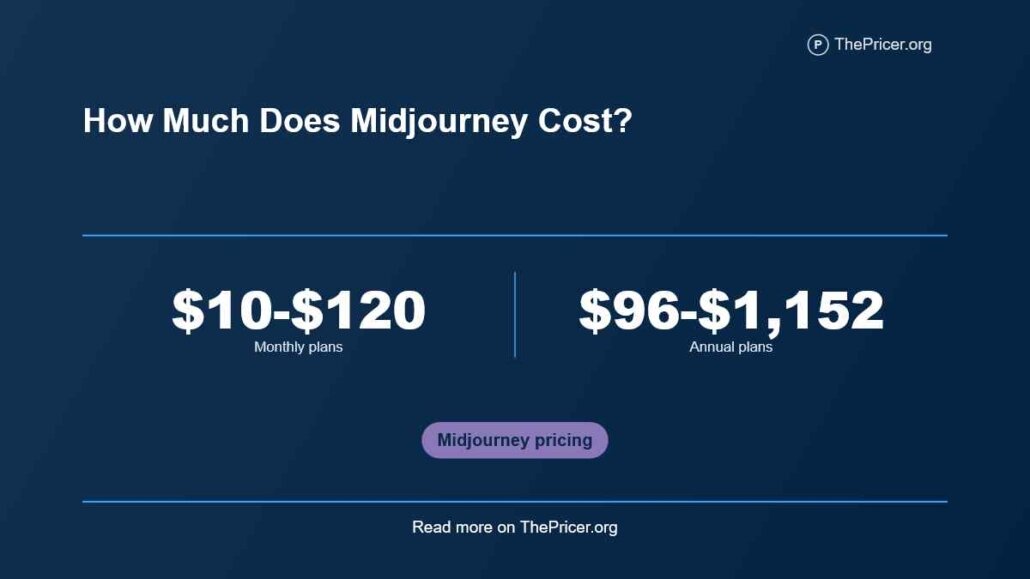
Midjourney costs $10 to $120 per month in the United States, according to a September 2026 pricing record. Basic is $10 per month, Standard is $30, Pro is $60, and Mega is $120. Paying for a full year upfront cuts each tier by 20%, bringing the annual totals to $96, $288, $576, and $1,152.
The main limit is not a fixed image count. Midjourney sells access through monthly Fast GPU time, while higher tiers add unlimited Relax generation, more concurrent jobs, video capacity, and Stealth Mode. That structure replaces the older Corporate-plan and free-trial pricing model described in the previous article.
Article Highlights
Jump to sections
- Monthly plans run from $10 to $120.
- Annual plans cost $96 to $1,152 upfront and are 20% cheaper than paying monthly for 12 months.
- Fast GPU time ranges from 3.3 hours on Basic to 60 hours on Mega.
- Extra Fast time costs $4 per hour on every tier.
- Stealth Mode is included only with Pro and Mega.
- Free access is limited to a limited Niji mobile trial. Midjourney does not offer a free trial on its website or Discord.
How Much Does Midjourney Cost?
Midjourney currently sells four individual subscription tiers rather than the old Basic, Standard, Pro, and Corporate structure. Its current plan comparison lists Basic at $10 per month, Standard at $30, Pro at $60, and Mega at $120. The same page lists annual prices of $96, $288, $576, and $1,152, paid for the full year upfront.
| Plan | Monthly price | Annual price | Fast GPU time | Relax access |
|---|---|---|---|---|
| Basic | $10 | $96 | 3.3 hours | None |
| Standard | $30 | $288 | 15 hours | Unlimited images |
| Pro | $60 | $576 | 30 hours | Unlimited images and SD video |
| Mega | $120 | $1,152 | 60 hours | Unlimited images and SD video |
Those prices buy a compute allowance, not a promised number of finished images. Basic also lacks Relax Mode, while Standard adds unlimited Relax images. Pro and Mega add Stealth Mode and Relax access for SD video. Pro and Mega also allow more concurrent image prompts than the two lower tiers, which matters for production workflows that run several jobs at once.
That makes a plan comparison different from a conventional software subscription such as Adobe Premiere pricing, where the main decision centers on access to the software rather than a monthly pool of GPU processing time. A buyer should compare the amount of Fast time, Relax access, privacy needs, and concurrency before treating the monthly fee as the only difference.
Annual Billing
The annual option is a straight 20% reduction in list price, but the entire year is charged upfront. Basic falls from twelve monthly payments totaling $120 to $96, Standard falls from $360 to $288, Pro from $720 to $576, and Mega from $1,440 to $1,152.
The independent pricing record cited above shows the same four monthly list prices at several snapshots from July 2023 through September 20, 2026, so the current decision is driven more by usage and commitment length than by a recent list-price increase.
The useful threshold is 9.6 months. Divide each annual price by its monthly rate and the result is the same across all four tiers. A user who expects to keep one tier for 10 months or longer spends less on the annual option before tax, while someone who needs Midjourney for a short project keeps more flexibility with monthly billing.
The yearly savings are $24 on Basic, $72 on Standard, $144 on Pro, and $288 on Mega. Paying annually also locks the cash outlay into one upfront charge, so the discount has less value when demand is seasonal or uncertain. Monthly billing costs more across a full year but lets the user stop after a shorter production run.
Fast and Relax Modes
Fast time is the metered resource behind Midjourney’s pricing. The official GPU usage rules say an SD image prompt uses about 0.8 GPU minutes and an HD image prompt about 1.3 minutes. Subscription Fast time resets at renewal and unused time does not carry into the next month. Standard, Pro, and Mega can shift image work into unlimited Relax Mode, where requests enter a queue and can wait up to 30 minutes.
 That changes the value of Standard. Basic’s 200 Fast minutes can support about 250 SD prompts if every minute were used only for 0.8-minute SD jobs. The figure is a theoretical capacity calculation, not a promised image allowance, because edits, upscales, variations, video, and other tasks consume different amounts. Standard users can reserve their 15 Fast hours for priority jobs and move non-urgent image work to Relax. Relax is slower, but it removes image generation from the Fast-time meter.
That separation matters when exploration produces many variations before a final image is chosen. Basic has no Relax pool, so every metered job comes out of its 200 monthly Fast minutes. Standard and higher tiers can spend Fast time on urgent work while shifting slower image experiments into the unlimited queue.
Which Plan Fits
The plan grid becomes easier to compare once the $4 per extra Fast hour rate is included. Starting from Basic, buying 5 extra hours adds $20, taking the monthly bill to $30. That matches Standard’s price, yet Basic would provide only 8.3 Fast hours in that month compared with Standard’s 15 hours plus unlimited Relax images. Standard reaches Pro’s $60 price after 7.5 purchased hours, while Pro reaches Mega’s $120 price after 15 purchased hours.
An illustrative heavy month makes the choice concrete. A Standard user who buys 10 extra Fast hours pays $30 + $40 = $70 before tax. Pro costs $60, supplies 30 Fast hours rather than the 25 hours available in that Standard-plus-extras scenario, and adds Stealth Mode. In that month, choosing Pro instead saves $10 and supplies 5 additional Fast hours. The same cost logic applies when comparing other AI subscriptions, including GitHub Copilot pricing, where the headline monthly fee matters less than matching the tier to actual usage.
Makes sense if
- Basic fits occasional image work that can stay within 200 Fast minutes.
- Standard fits frequent image generation when slower Relax jobs are acceptable.
- Pro fits workflows that need privacy, 30 Fast hours, or heavy SD video use.
- Mega fits users who can exhaust Pro’s 30 Fast hours repeatedly.
Does not make sense if
- Buying repeated extra hours pushes the monthly total above the next tier.
- An annual commitment would cover months when the account will sit unused.
- Basic is chosen for a workflow that depends on unlimited Relax generation.
Privacy and Business Use
Privacy is a plan feature, not a universal default. Midjourney’s subscription and ownership terms, effective May 27, 2026, say content posted in public settings is publicly viewable and remixable by default. Stealth Mode is part of Pro and Mega, but content created in a shared or open Discord space can still be visible to people in that space. A client workflow involving unreleased products or confidential concepts should account for that distinction before treating Stealth as blanket secrecy.
The same terms also change the plan decision for larger businesses. Midjourney says a company, or an employee of a company, with more than $1 million in annual revenue must use Pro or Mega to own assets created with the service. For other paid users, the terms say users own the assets they create to the fullest extent possible under applicable law, subject to the agreement and third-party rights. That is much narrower than the old claim that every large company needed a separate Corporate plan.
There is no current Corporate tier. A paid plan can support commercial work, but copyright, trademark, client confidentiality, and third-party rights remain separate legal questions. The plan fee buys service access and usage rights under Midjourney’s contract. It does not remove rights that may belong to other parties.
Image and Video Usage
Midjourney’s image model has changed far beyond the V4 system described in the older article. The current version notes identify V8.2 as the default model since July 24, 2026. Current V8.1 and V8.2 image jobs are priced in GPU time at about 0.8 minutes for SD and 1.3 minutes for HD. That lets a user estimate how much work a Fast allowance can support without pretending every prompt costs exactly the same amount.
Video consumes the allowance much faster. Midjourney’s video batch costs list 8 GPU minutes for a batch of four SD videos and 26 minutes for four HD videos. An illustrative Basic month with 100 SD image prompts uses about 80 minutes. Four HD video batches use another 104 minutes, producing a total of 184 minutes and leaving only 16 of Basic’s 200 Fast minutes. The same 100 images without the video work would leave about 120 minutes.
A creator planning mixed media should budget GPU minutes by task rather than counting prompts. Video can turn a workable Basic budget into a tight one even when the number of requests looks modest, and HD work makes that pressure stronger than SD work.
Trials and Refunds
The old 25-minute Discord trial no longer describes Midjourney. Its free-trial policy says a limited trial is available through its Niji mobile app for iOS and Android, while no free trial is offered through Discord or midjourney.com. That removes the old strategy of repeatedly relying on a general free Midjourney tier before deciding whether to pay. Someone evaluating the main Midjourney service should budget for at least one paid month rather than count on the older 25-minute trial allowance.
Refunds are also narrow. Midjourney’s refund rules say an account qualifies only if it has used fewer than 20 GPU minutes across its lifetime, including Fast, Turbo, and Relax time. Eligible users see the refund option during cancellation, and processing can take up to 10 business days.
Once usage passes that threshold, the refund option is not offered under the published policy. That makes early testing expensive if the user burns through the threshold before deciding whether the service fits. Readers comparing online subscription mechanics can also use the BeenVerified cost article as a separate billing example, but its cancellation and refund rules do not apply to Midjourney.
Taxes and Extras
The advertised subscription is not always the final card charge. Midjourney’s tax and VAT rules state that sales tax or VAT may be added according to billing location. Midjourney also bills only in U.S. dollars. Its USD billing policy says customers paying in another currency rely on their bank’s conversion rate and may face a foreign-transaction fee. Those charges sit outside the published plan table.
Teams also have a less conventional setup than many business software products. Current group billing rules say Midjourney offers no special organization discount or free plan for nonprofits and educational institutions. Organizations needing 50 or more annual Pro or Mega subscriptions can ask for bulk billing, but the arrangement adds no discount beyond annual pricing.
Midjourney also says it does not provide seat or admin management or SSO. A 50-seat annual Pro purchase is $28,800 before tax because 50 × $576 equals $28,800. The billing can be consolidated, but the published policy does not turn it into a discounted enterprise package.
Answers to Common Questions
How much is Midjourney per month?
Midjourney costs $10 per month for Basic, $30 for Standard, $60 for Pro, and $120 for Mega. The plans differ mainly in Fast GPU time, Relax access, privacy, and concurrency.
Is Midjourney free?
Midjourney does not offer a free trial on its main website or Discord. A limited Niji mobile trial is available on iOS and Android. Regular Midjourney subscriptions start at $10 per month.
Which Midjourney plan includes Stealth Mode?
Stealth Mode is included with Pro at $60 per month and Mega at $120 per month. Basic and Standard do not include it.
Can Midjourney be used commercially?
Paid subscriptions operate under Midjourney’s general commercial terms. Companies making more than $1 million in annual revenue must use Pro or Mega to own assets under Midjourney’s current terms, while third-party rights and applicable law still matter.
Disclosure: Educational content, not financial advice. Prices reflect public information as of the dates cited and can change. Confirm current rates, fees, taxes, and terms with official sources before purchasing. See our methodology and corrections policy.