
How Much Does New York University Cost?
Updated on | Researched and reviewed by Alec Pow, Founder & Pricing Investigator
Prices, claims, and calculations checked against 11 cited sources. See our research methodology and corrections policy.
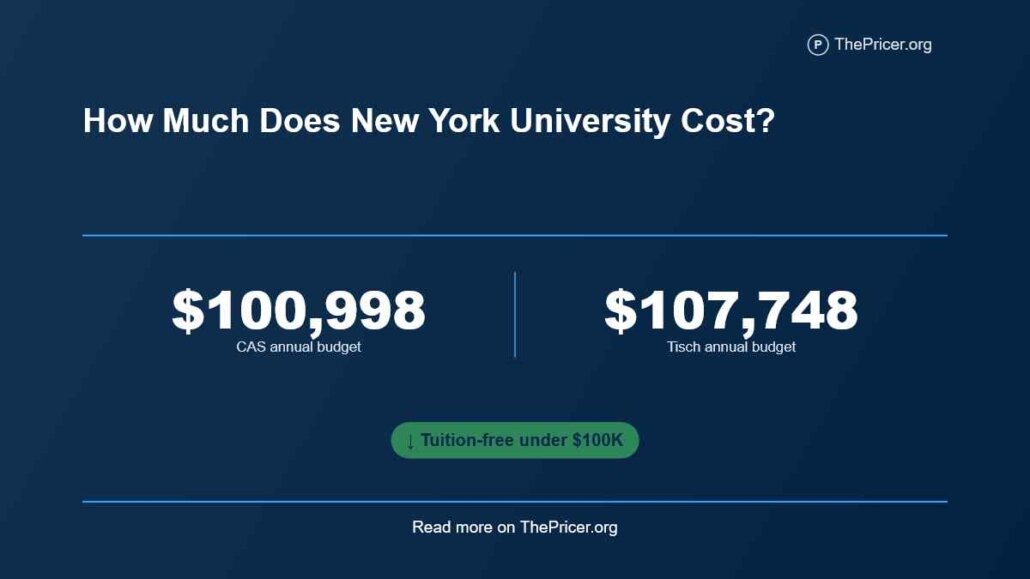
New York University costs about $100,998 per year for a full-time undergraduate in the College of Arts and Science living away from family in 2026–27. That budget includes $68,576 for tuition and fees, $26,438 for food and housing, plus books, transportation, and personal expenses. Some NYU schools cost more. Stern undergraduate reaches $102,886, while Tisch reaches $107,748.
The sticker price is not what every family pays. Under the NYU Promise, eligible first-time first-year students admitted to the New York campus from families earning under $100,000 with typical assets do not pay tuition, and NYU says it meets 100% of demonstrated financial need for first-year admits. Transfer students follow different aid rules.
Article Highlights
Jump to sections
- College of Arts and Science costs $100,998 in the standard 2026–27 budget.
- CAS tuition and fees are $68,576.
- NYU budgets $26,438 for food and housing.
- Stern undergraduate costs $102,886, while Tisch reaches $107,748.
- Families under $100,000 with typical assets can qualify for tuition-free attendance through the NYU Promise.
- NYU Law’s 2026–27 student budget reaches $127,668.
- NYU Grossman medical students receive a full-tuition scholarship covering $65,500.
How Much Does New York University Cost?
NYU’s 2026–27 undergraduate budget puts College of Arts and Science tuition and fees at $68,576. Food and housing add $26,438. Books and supplies are budgeted at $1,492, transportation at $2,438, and personal expenses at $2,054.
Add those pieces and the standard annual cost of attendance becomes $100,998. The food-and-housing figure represents a student living on campus or off campus away from family. NYU bases that estimate on a double-occupancy room and a 225-meal-per-semester flex dining plan. Students living elsewhere can spend more or less.
| 2026–27 NYU undergraduate school | Tuition and fees | Total standard budget |
|---|---|---|
| College of Arts and Science | $68,576 | $100,998 |
| Gallatin | $68,576 | $100,998 |
| Liberal Studies | $68,576 | $100,998 |
| Tandon Engineering | $68,576 | $100,998 |
| Stern undergraduate | $70,464 | $102,886 |
| Tisch School of the Arts | $75,326 | $107,748 |
The range within NYU matters. Tisch costs $6,750 more per year than CAS in tuition and fees. Over four years at unchanged rates, that difference alone would equal $27,000.
Housing and Food
NYU budgets $26,438 for housing and food, but that is an estimate rather than one fixed room-and-board charge. The university says actual spending depends on the residence hall, room type, meal plan, or off-campus arrangement selected. Its standard cost model assumes a double room with a 225-meal flex plan.
NYU does not require New York campus first-year students to live in university housing. About 90% choose to do so, according to NYU’s first-year housing guidance. Students who begin in NYU housing can retain housing eligibility in later years if they remain in the system.
That corrects an important claim in the old article, which described campus housing as mandatory for freshmen. A student with family housing in New York City can choose to commute instead. Someone comfortable finding an off-campus apartment can also live outside NYU housing, though the cost of New York rent can erase any apparent saving.
The room decision can move the budget sharply. NYU’s own financial-aid model uses the same $26,438 housing-and-food allowance for students living on campus or independently off campus because those costs are often similar. A cheaper shared apartment can lower actual spending, while a private Manhattan studio can push it far above the university allowance.
Housing is not automatically the cheaper choice.
NYU Promise and Aid
The NYU Promise is the most important affordability change missing from the old article. For first-time first-year undergraduates admitted to the New York campus, families earning less than $100,000 per year with typical assets do not pay tuition.
NYU also says it meets 100% of demonstrated financial need for full-time first-year undergraduate admits. Scholarships for those students are adjusted as tuition rises, helping prevent an aid award from losing value simply because NYU increases tuition in later years.
The distinction between tuition-free and cost-free matters. CAS tuition and fees are $68,576, but the full cost-of-attendance budget is $100,998. A family whose tuition is fully covered can still face housing, food, transportation, books, and personal expenses unless its broader need-based aid package covers those costs too.
The aid rules are much weaker for most transfer students. NYU states that transfer students generally do not qualify for NYU scholarships or the NYU Promise, apart from selected programs. Federal aid, outside scholarships, and private financing can still be available.
First-year applicants seeking institutional need-based aid use both the FAFSA and CSS Profile. NYU’s financial-aid schedule lists February 1 as the Regular Decision deadline for both forms.
Commuting and Living at Home
A student who can live with family in New York has one of the strongest ways to cut the practical cost of NYU. The university’s $26,438 standard food-and-housing budget disappears as a university housing charge when a student lives at home, though food and household expenses do not fall to zero.
An illustrative calculation shows the scale. Start with CAS tuition and fees of $68,576, then add the standard $1,492 books allowance, $2,438 transportation budget, and $2,054 personal allowance. Excluding the university’s $26,438 housing-and-food assumption leaves $74,560 before the student’s actual contribution to food or family housing.
That is $26,438 lower than the standard $100,998 published budget, but the full amount should not be called guaranteed savings. Commuters may pay more for subway travel, meals away from home, or a household contribution. A family already paying the student’s housing and food sees a different economic result from a student who previously rented elsewhere.
First-year commuting is allowed.
NYU estimates transportation using local New York travel plus one round trip home during the academic year. Students who fly internationally or travel across the country several times may spend more than the $2,438 allowance.
Law, MBA, Medicine, Dentistry
“NYU tuition” is not one university-wide number. Professional programs have dramatically different prices. NYU Law’s 2026–27 student budget lists $87,312 tuition and a total cost of attendance of $127,668 after fees, housing, food, books, insurance, transportation, and loan fees.
NYU Stern’s first-year MBA budget is even higher at $140,668. Tuition is $92,658, and the first year includes a $2,040 orientation charge plus roughly $45,970 in living expenses, insurance, books, transportation, and loan fees.
Medicine works differently. NYU Grossman School of Medicine lists $65,500 annual tuition for its four-year MD, then offsets the full amount with a $65,500 full-tuition scholarship for every student. NYU Langone also subsidizes the student’s health-insurance premium. First-year cost after those two subsidies is about $38,616, driven mostly by fees and living expenses.
Dental school moves in the opposite direction. The 2026–27 DDS tuition is $111,240, with a $7,100 dental instrument fee before housing, food, insurance, books, transportation, and personal expenses.
Hidden Costs and Insurance
Health insurance is one of the largest add-ons missing from NYU’s standard undergraduate cost-of-attendance table. Students are automatically enrolled in an NYU-sponsored plan unless they successfully waive it with qualifying outside coverage. NYU’s 2026–27 Comprehensive Plan is about $5,397 per year in published university estimates.
Adding that insurance to the $100,998 CAS budget produces an illustrative $106,395 annual total for a student who needs the university plan. That is not NYU’s official headline cost of attendance because the insurance charge is kept outside the standard undergraduate figure.
There are smaller cash-flow costs too. NYU’s semester payment plan spreads eligible charges across installments but carries a $50 nonrefundable enrollment fee per semester. Using it in both fall and spring adds $100 for the academic year.
Program materials can exceed the standard $1,492 books-and-supplies allowance. Tisch students can face production materials, instruments, equipment, or project spending. Tandon students can need specialized software or hardware. Those expenses depend on the exact course load and should not be converted into one universal NYU surcharge.
The old article’s claim that mandatory supplemental fees add about $10,000 per year is misleading. NYU’s published undergraduate figures already bundle standard tuition and fees together rather than layering seven separate generic charges worth another $10,000 onto every student’s tuition.
Four-Year Cost and Fit

Holding today’s CAS standard budget unchanged for four years produces a sticker-price model of $403,992. Four years at Stern’s undergraduate budget would equal $411,544, while four years at Tisch’s current budget would reach $430,992. These calculations do not predict future tuition increases or subtract financial aid.
The NYU Promise can change that comparison completely. A first-year admit from a qualifying family below the $100,000 income threshold could have tuition removed from the calculation, while a family paying full price would carry the entire sticker cost. A student living at home can also remove most of the housing burden from the household’s incremental college cost.
Makes sense if
- Your NYU grant package cuts the six-figure annual sticker budget to a sustainable net price.
- You qualify for the NYU Promise or substantial institutional need-based aid.
- You can commute from family housing and avoid a large New York housing bill.
- The specific NYU school gives you opportunities that justify the remaining net cost.
Does not make sense if
- You are comparing NYU using the old $60,000 to $80,000 annual range.
- Your package requires heavy private or parent borrowing after grants.
- You assume an old scholarship description applies without a written award from NYU.
- A comparable program provides similar outcomes at a much lower confirmed net cost.
For other university comparisons, see University of Michigan costs, Arizona State University costs, and University of Georgia costs.
Answers to Common Questions
How much does NYU cost per year?
A College of Arts and Science undergraduate has a standard 2026–27 budget of $100,998. Stern is $102,886 and Tisch is $107,748.
How much is NYU tuition?
CAS tuition and fees are $68,576 for 2026–27. Stern undergraduate tuition and fees are $70,464, while Tisch is $75,326.
Is NYU free for families earning under $100,000?
Eligible first-time first-year New York campus students from families earning below $100,000 with typical assets can have tuition covered through the NYU Promise. Housing, food, books, and other costs depend on the full aid package.
Do NYU freshmen have to live on campus?
No. NYU says New York campus first-year students are not required to live in university housing, although most choose to do so.
How much would four years at NYU cost?
Holding the current CAS budget unchanged gives a four-year sticker-price model of $403,992 before grants, scholarships, health insurance, or future rate changes.
Disclosure: Educational content, not financial advice. Prices reflect public information as of the dates cited and can change. Confirm current rates, fees, taxes, and terms with official sources before purchasing. See our methodology and corrections policy.