
How Much Does Opzelura Cream Cost?
Updated on | Researched and reviewed by Alec Pow, Founder & Pricing Investigator
Prices, claims, and calculations checked against 9 cited sources. See our research methodology and corrections policy.
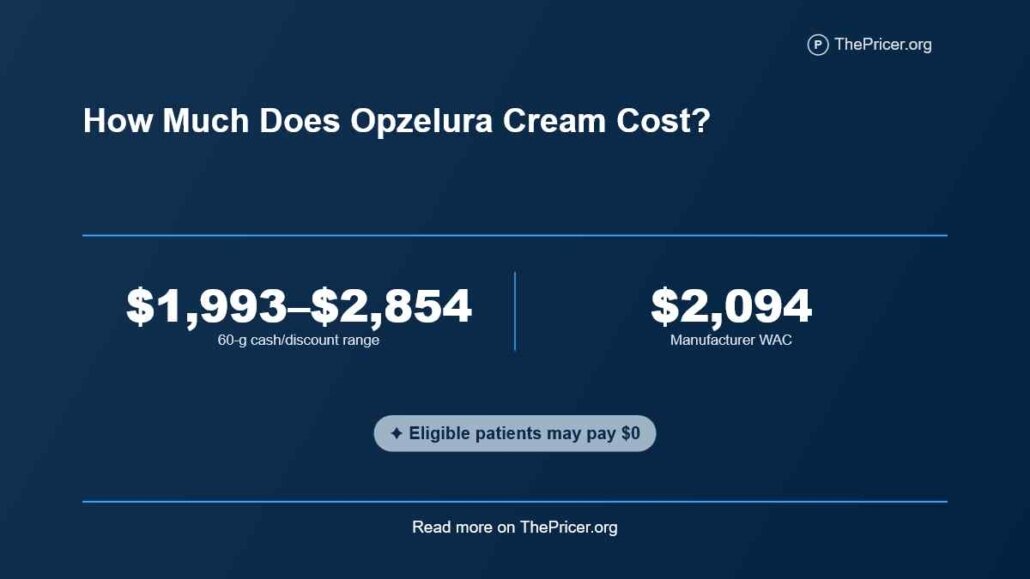
Opzelura cream can cost about $2,000 to $2,850 or more for one 60-gram tube when paying without insurance, depending on the pharmacy and discount used. Manufacturer Incyte currently lists a $2,094 wholesale acquisition cost (WAC) per tube, while a September 2026 cash-price check shows approximately $2,853.63 for a 60-gram tube before discounts and about $1,993 with a prescription coupon.
What a patient actually pays can be dramatically lower. Eligible commercially insured patients may pay as little as $0 per tube through the manufacturer’s copay program, while certain commercially insured patients whose plan does not cover Opzelura can pay $35 per prescription at participating pharmacies. Uninsured patients and some Medicare Part D beneficiaries who meet assistance-program requirements may receive the medicine at no cost.
Article Highlights
Jump to sections
- Incyte currently lists Opzelura’s wholesale acquisition cost at $2,094 per tube.
- A September 2026 cash-price check puts one 60-g tube around $2,854 without insurance and roughly $1,993 with a discount coupon.
- Eligible commercially insured patients can pay as little as $0 per tube using the manufacturer’s savings program.
- Opzelura is currently approved for eligible atopic dermatitis patients age 2 and older and nonsegmental vitiligo patients age 12 and older.
- 2026 Medicare Part D rules cap annual out-of-pocket spending on covered Part D drugs at $2,100, although the patient’s exact Opzelura cost still depends on formulary coverage and plan rules.
How Much Does Opzelura Cream Cost?
The most useful way to describe Opzelura’s price is to separate the manufacturer’s list benchmark from what a cash-paying patient may actually encounter at a pharmacy.
Incyte’s current published Opzelura cost information lists a $2,094 wholesale acquisition cost for one tube. WAC is a manufacturer pricing benchmark and is not necessarily what an uninsured patient pays at the pharmacy.
A current September 2026 pharmacy-price check gives a cash price of approximately $2,853.63 for one 60-g tube of 1.5% cream. The same source lists a discounted price as low as approximately $1,993.26 with its coupon.
| How Opzelura Is Purchased | Current Cost Example |
|---|---|
| Manufacturer WAC benchmark | $2,094 per tube |
| 60-g retail cash example | About $2,854 |
| 60-g discount-card example | About $1,993 |
| Eligible commercial insurance + manufacturer card | As little as $0 |
| Eligible commercial plan that does not cover Opzelura | $35 at certain participating pharmacies |
| Eligible IncyteCARES assistance recipient | $0 |
Prescription prices change, so a patient paying cash should check the exact 60-g or 100-g prescription, pharmacy, insurance status, and available discount immediately before filling it.
What Is Opzelura?

Opzelura is the brand name for ruxolitinib 1.5% topical cream, a Janus kinase, or JAK, inhibitor manufactured by Incyte.
Its current FDA prescribing information covers two uses.
For atopic dermatitis, Opzelura is indicated for short-term and non-continuous chronic treatment of mild-to-moderate disease in non-immunocompromised adults and children 2 years and older whose condition is not adequately controlled by topical prescription therapies or when those therapies are not advisable.
For nonsegmental vitiligo, it is approved for adults and children 12 years and older.
The vitiligo indication was added in 2022, when the FDA identified Opzelura as the first FDA-approved drug for repigmentation in nonsegmental vitiligo.
Cash Prices Higher Than $2,094
The $2,094 figure is WAC, not a guarantee that a pharmacy will sell the medicine to an uninsured patient for $2,094.
Retail pharmacy prices incorporate the supply chain and can vary by pharmacy and discount arrangement. That is why the live cash example above is closer to $2,854 even though the manufacturer lists a $2,094 WAC.
Using those prices:
$2,853.63 ÷ 60 grams = about $47.56 per gram
The $1,993.26 coupon example works out to approximately:
$1,993.26 ÷ 60 = $33.22 per gram
The difference between those two prices for the same 60-g quantity is approximately:
$2,853.63 – $1,993.26 = $860.37
That makes checking both insurance and legitimate prescription-discount options unusually important with this medication.
Insurance Approval
For many patients, the biggest cost issue is not the published $2,094 WAC. It is whether their prescription plan covers Opzelura and what conditions the insurer places on that coverage.
Plans can require prior authorization, meaning the prescriber must document that the patient meets the plan’s clinical requirements before coverage is approved.
Some formularies may also apply step-therapy requirements or prefer other topical medications first.
This can produce very different outcomes for two people holding prescriptions for exactly the same 60-g tube. One may owe a small copay after authorization and manufacturer assistance, while another may initially encounter a pharmacy claim costing thousands of dollars.
For that reason, the most important questions before filling a prescription are:
- Is Opzelura on the plan’s formulary?
- Does it require prior authorization?
- Is there a deductible to satisfy first?
- What is the cost after authorization?
- Can a manufacturer savings program legally be used with that insurance?
Opzelura Copay Card
Eligible patients with commercial prescription insurance can use Incyte’s current Opzelura copay savings program and may pay as little as $0 per tube.
There is another useful provision for some patients whose commercial insurance does not cover the drug. Current program terms say eligible patients can pay $35 per prescription through certain participating pharmacies.
Maximum benefits per tube and per calendar year apply.
The program is not available to patients using government-funded prescription coverage such as Medicare, Medicaid, TRICARE, Veterans Affairs coverage, or state prescription assistance programs. It also cannot be used by someone simply paying cash without commercial insurance.
That distinction is important because a “$0 Opzelura coupon” is not available to everyone.
Opzelura Cost With Medicare
The old Medicare Part D structure often quoted in older Opzelura cost articles is no longer current.
According to the 2026 Medicare Part D benefit rules, the standard deductible is $615. After the deductible, beneficiaries generally pay 25% coinsurance for covered Part D medicines during initial coverage.
More importantly, annual out-of-pocket spending on covered Part D drugs is capped at $2,100 in 2026.
That does not mean every Medicare beneficiary automatically pays exactly $2,100 for Opzelura.
The actual amount depends on whether the person’s specific plan covers Opzelura, the plan’s prior-authorization requirements, other prescriptions purchased during the year, and other Medicare cost-assistance programs.
Commercial manufacturer copay cards cannot be used with Medicare.
Medicare beneficiaries also have access to the Medicare Prescription Payment Plan, which can spread qualifying out-of-pocket prescription costs across monthly payments instead of requiring the entire amount at the pharmacy counter.
It does not reduce the total cost owed, but it can change the timing of those payments.
Free Opzelura Through IncyteCARES
Some patients who cannot afford Opzelura may qualify to receive it at no cost through the manufacturer’s assistance program.
Current IncyteCARES eligibility information says the Patient Assistance Program may cover eligible people who are uninsured or have Medicare Part D and cannot afford their copay.
For 2026, the program generally uses an income ceiling of 400% of the federal poverty level, along with other requirements.
Examples published by the program include annual household income limits of:
| Household Size | 2026 Income Limit |
|---|---|
| 1 person | $63,840 |
| 2 people | $86,560 |
| 3 people | $109,280 |
| 4 people | $132,000 |
Medicare Part D applicants have additional requirements, including documented difficulty affording the medication and, generally, completion of the plan’s prior-authorization and appeal process when coverage is denied.
Program eligibility and income thresholds can change, so patients should verify the current requirements rather than relying on an old dollar amount for annual assistance.
How Much Opzelura Can Be Used?
Price-per-tube calculations should not be converted into a self-directed dosing plan.
The current FDA label sets specific application limits.
For atopic dermatitis, Opzelura is applied twice daily to affected areas covering up to 20% of body surface area. Patients age 12 and older should not use more than one 60-g tube per week or one 100-g tube every two weeks. Children age 2 through 11 should not use more than one 60-g tube every two weeks.
For nonsegmental vitiligo, it is applied twice daily to affected areas covering up to 10% of body surface area, with a maximum of one 60-g tube per week or one 100-g tube every two weeks.
Actual refill frequency can be much lower because it depends on the size of the treated area and the prescriber’s instructions.
Is There a Generic Opzelura?
There is currently no generic ruxolitinib topical cream equivalent to Opzelura on the U.S. market.
A current 2026 medication review lists Opzelura as the available brand formulation and notes that no generic is currently available.
That matters because a pharmacist cannot simply substitute a $20 generic version when the brand price is unaffordable.
For atopic dermatitis, clinicians may consider lower-cost topical treatments when medically appropriate, including topical corticosteroids or calcineurin inhibitors. Those are alternative therapies, not generic versions of Opzelura.
For vitiligo, treatment options also differ by the location and extent of disease and can include topical medications, phototherapy, and other dermatologist-directed approaches.
Patients should not replace a prescribed drug solely on price without discussing the alternative with the prescriber.
Why Is Opzelura So Expensive?
The largest pricing factor is that Opzelura remains a brand-name specialty medication without a directly substitutable generic cream.
It also introduced the first FDA-approved topical JAK-inhibitor approach for these dermatologic uses and remains part of a comparatively small specialty market.
But manufacturer development cost alone does not tell a patient what the drug “should” cost. U.S. prescription prices are affected by manufacturer pricing, pharmacy-benefit arrangements, insurer formularies, rebates, pharmacy pricing, discounts, and patient-assistance programs.
That is why the same medicine can simultaneously have a $2,094 WAC, a retail cash quote above $2,800, a coupon price near $2,000, and a $0 manufacturer-assisted copay for different patients.
Opzelura Storage
The current FDA prescribing information says Opzelura should be stored at 68°F to 77°F (20°C to 25°C), with permitted temperature excursions between 59°F and 86°F.
The current label does not instruct patients to discard the tube eight weeks after opening.
Keep the medication according to the pharmacy label and current prescribing information rather than relying on outdated online storage instructions.
Safety Matters
Opzelura should be used according to the prescription rather than applying less often, splitting a tube over an arbitrary number of months, or changing the treated area merely to save money.
The current FDA label includes a boxed warning for JAK inhibitors and safety information concerning serious infections, malignancy, major cardiovascular events, thrombosis, and other risks.
The label also states that combining Opzelura with therapeutic biologics, other JAK inhibitors, or potent immunosuppressants such as azathioprine or cyclosporine is not recommended.
Anyone struggling with the price should ask the prescriber or pharmacy about coverage, assistance, and clinically appropriate alternatives instead of changing the prescribed use to make the medication last longer.
Where Can You Get Opzelura?
Opzelura requires a prescription.
Depending on insurance and local stock, a prescription may be filled through a retail pharmacy, specialty pharmacy, or another pharmacy specified by the patient’s prescription plan.
Cash-paying patients can compare pharmacy-discount prices, but those discounts are alternatives to insurance billing rather than benefits normally stacked on top of insurance.
If the medication itself is affordable only through insurance, also consider the cost of getting the prescription. Our guide to the cost of a dermatologist visit without insurance shows what an uninsured consultation can add to the initial treatment budget.
You can also compare other skin-treatment costs in our guides to cold laser therapy and Garra Rufa fish, although neither should be considered a substitute for prescription treatment of eczema or vitiligo.
What We Verified
Manufacturer price: Incyte currently publishes a $2,094 WAC for one tube of Opzelura.
Cash price: a live September 2026 pharmacy-discount source lists approximately $2,853.63 for one 60-g tube without insurance and approximately $1,993.26 with its discount.
Age: the current FDA indication for atopic dermatitis begins at age 2, not age 12. Vitiligo remains approved for age 12+.
Medicare: the 2026 standard Part D deductible is $615 and the annual out-of-pocket threshold for covered Part D medications is $2,100.
Commercial savings: eligible commercially insured patients may pay as little as $0; some eligible patients whose commercial plans do not cover Opzelura can pay $35 through participating pharmacies.
Patient assistance: qualified uninsured and certain Medicare Part D patients may receive the medication free through IncyteCARES.
Storage: the current FDA label calls for controlled room-temperature storage and does not contain the old eight-week-after-opening disposal instruction.
Answers to Common Questions
How much is a 60-g tube of Opzelura without insurance?
A current September 2026 cash-price example is approximately $2,853.63 for one 60-g tube. Discount-card pricing can bring the same quantity closer to $1,993. Pharmacy prices can change.
Why does Opzelura say $2,094 if pharmacies charge more?
The $2,094 amount is the manufacturer-published wholesale acquisition cost, not a guaranteed retail cash price. Pharmacy cash prices and negotiated discount prices can be higher or lower.
Can Opzelura cost $0?
Yes, some eligible commercially insured patients can pay as little as $0 per tube through the manufacturer savings program. Separate patient assistance can provide free medication to certain qualifying uninsured and Medicare Part D patients.
Is there a generic version of Opzelura?
No directly substitutable generic ruxolitinib cream is currently available in the United States.
Do you have to use Opzelura for life?
Not necessarily. For atopic dermatitis, the FDA indication specifically describes short-term and non-continuous chronic treatment. Vitiligo treatment can require prolonged therapy, but treatment duration should be determined by the prescribing clinician based on response, treated area, safety, and the approved instructions.
Disclosure: Educational content, not medical advice. Pricing varies by provider, location, and insurance. Confirm eligibility, coverage, and out-of-pocket costs with a licensed clinician and your insurer. See our methodology and corrections policy.