
How Much Does PhD Weight Loss Cost?
Updated on | Written by Alec Pow
This article was researched using 13 sources. See our methodology and corrections policy.
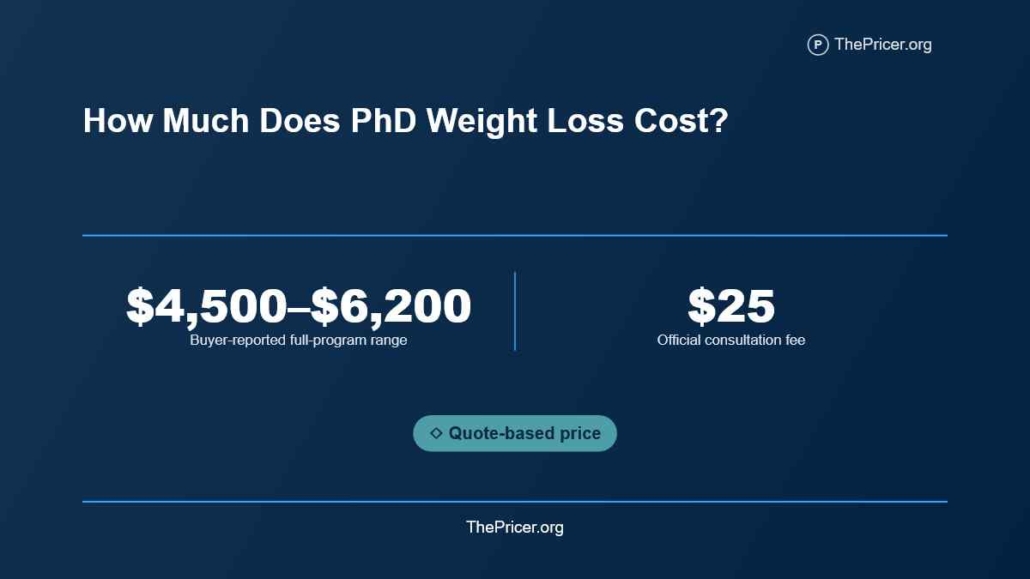
PhD Weight Loss does not publish a standard full-program price. Public customer complaints describe program charges of $4,500, $5,000, and $6,200, putting the clearest visible buyer-reported range around $4,500 to $6,200. Those figures are individual complaints rather than a company rate card, so they are useful as price signals, not as a guaranteed quote. BBB complaint records provide the underlying reports. The spread between the low and high reports is $1,700, or about 37.8% of the lower reported charge.
The company does publish one small front-end charge: the consultation costs $25. PHD says that fee is not applied to the later program investment, there is no baseline package price, CareCredit is accepted, weekly one-on-one coaching is part of the plan, and the company does not work directly with insurers. PHD’s nationwide program page also says supplied protein products can account for roughly 85% of daily food intake.
For a buyer, the important units are the total package price, number of weeks or months covered, food arrangement, financing balance, and cancellation terms. Those numbers make two PHD quotes comparable even when the sales presentation frames them differently.
Article Highlights
Jump to sections
- The consultation is only the entry appointment. The main PHD package is quote-only.
- Public customer reports point to multi-thousand-dollar commitments rather than a low monthly subscription.
- Normalizing a package into monthly, weekly, and daily equivalents makes different program lengths easier to compare.
- Refund and cancellation language can matter more than small add-ons because a prepaid program may remain non-refundable after an early exit.
- Financing can reduce the monthly cash burden without reducing the contract price.
- PHD should not be price-matched directly against a medication clinic unless the services, drugs, food, medical care, and time period are made comparable.
How Much Does PhD Weight Loss Cost?
A second public buyer signal comes from a BBB review in which a customer describes paying more than $5,000 (at $30 per hour, earning that amount would take about 4.2 full-time workweeks, before taxes) and being asked to pay more to extend the plan. The customer review is anecdotal, but it gives a useful round-number package for testing what a large PHD quote means in monthly and weekly terms.
| Budget lens | ThePricer math on a $5,000 package | What the number tells you |
|---|---|---|
| 12-month equivalent | $5,000 ÷ 12 = $416.67 per month | Useful for comparing an annual commitment with a monthly program. |
| 52-week equivalent | $5,000 ÷ 52 = $96.15 per week | Shows the bundled weekly cost of coaching and program support. |
| 365-day equivalent | $5,000 ÷ 365 = $13.70 per day | A budgeting normalization, not a daily purchase price. |
| First-year amount with consultation | $5,000 + $25 = $5,025 | Spread across 12 months, that becomes $418.75 per month. |
Mini case 1, pay in full: A buyer quoted $5,000 who pays the separate consultation has $5,025 tied to the program before counting any groceries or other spending outside the package.
Mini case 2, comparing by week: The same $5,025 first-year commitment is about $96.63 per week across 52 weeks. That figure is far more useful when comparing PHD with another coaching program advertised by the week.
Mini case 3, own-food path: PHD says clients may use their own food instead of supplied products. A written quote should state whether choosing that path changes the package price. Without that answer, it would be wrong to assume buying your own groceries automatically reduces the PHD fee.
Worked total: Program package $5,000 + consultation $25 = $5,025. Normalize that to $418.75 per month or $96.63 per week across one year. The calculation does not assign a dollar value to groceries because no public PHD source establishes how much a buyer’s normal food spending changes.
The $25 Price Is Only the Door
The consultation charge buys the intake appointment, not the complete weight-loss program. The full package is priced after the intake rather than selected from a public menu, which makes the small front-end fee a poor stand-in for the eventual commitment.
The consultation price is easy to overvalue because it is the only clean number before the quote. Against a reported $5,000 (about 4.2 full-time workweeks at $30 per hour) package, the $25 intake fee equals only 0.5% of the package amount. Put another way, 99.5% of that example sits beyond the advertised entry charge.
The useful comparison is full-program cost against full-program cost. Ask for the program length, products included, coaching cadence, maintenance access, total amount due, financing amount, and cancellation rules in writing before comparing PHD with another service.
What You’re Buying

PHD Weight Loss is a structured nutrition and coaching program. The company describes weekly weigh-ins, one-on-one coaching, meal planning, accountability, behavior work, and supplied food products as parts of the experience. Clients may use PHD protein products or follow a plan built around their own food, depending on the arrangement.
This is different from paying a dietitian for one appointment, buying a tracking app, or joining a physician-led obesity clinic. PHD uses a mix of nutrition and coaching staff, but that does not mean every client interaction is a medical visit.
The core service is marketed as food-based rather than prescription-based. The buyer is mainly paying for structure, repeated contact, food guidance, packaged products where selected, and accountability over time. That service mix is why comparing only the first appointment price gives a distorted result.
Cancellation
A high program price becomes harder to reverse if unused service is not refundable. PHD’s current terms say program fees are non-refundable, state that clients are responsible for the full program cost regardless of outcome or early termination, and say paid access covered by the subscription terms can renew every four weeks unless canceled. The terms call for 30 days’ written notice before the next billing cycle. PHD’s payment terms contain those provisions.
That changes the math on a multi-thousand-dollar commitment. Leaving after a few weeks does not automatically turn a prepaid package into a few-weeks purchase. The signed agreement for the exact package matters, especially if one part is prepaid and another part renews.
The pre-payment questions should be concrete: how much is charged today, how much can renew later, whether any part is refundable, and what exact date written cancellation must arrive. For PHD, those answers can affect the final bill more than a small optional purchase.
CareCredit
PHD accepts CareCredit, but financing changes payment timing rather than the program’s sticker price. CareCredit says qualifying deferred-interest purchases may use 6, 12, 18, or 24-month promotional periods, and accrued interest can be charged from the purchase date if the promotional balance is not paid in full by the deadline. CareCredit’s financing principles also warn that minimum monthly payments may not clear the balance before the promotion ends.
For a hypothetical $5,000 (about 4.2 full-time workweeks at $30 per hour) PHD charge that qualifies for a deferred-interest promotion, equal principal payoff targets would be:
- 6 months: about $833.33 per month.
- 12 months: about $416.67 per month.
- 18 months: about $277.78 per month.
- 24 months: about $208.33 per month.
Those figures are arithmetic, not CareCredit minimum payments and not a promise that every promotional term will be offered for a PHD purchase. They show the cash flow required to clear $5,000 evenly within each period.
This creates another ThePricer check. A $5,000 balance stretched from 6 months to 24 months drops the equal principal target by $625 per month, from $833.33 to $208.33, while the amount financed stays exactly the same. A smaller payment can hide an unchanged large commitment.
Do Not Compare PHD With GLP-1 Clinics
PHD’s food-and-coaching model belongs in a different price bucket from physician-supervised programs that may prescribe weight-loss medication. Putting their monthly prices side by side without adjusting for services can create a false bargain in either direction.
Medi-Weightloss currently lists a self-pay new-patient visit at $199, followed by 1-, 3-, or 6-month program options. Medication is priced separately. It also says many insured patients pay $0 to $50 per visit, depending on coverage. Medi-Weightloss pricing says the new-patient fee includes a medical assessment and lab work.
Noom’s current medication programs show the same problem from another angle. Its site lists one path from $79 initially and $199 per month afterward, and another from $149 initially and $349 per month afterward, with medication and clinical-service conditions attached. Noom’s current pricing is tied to a service mix that is not the same as PHD’s core food-and-coaching model.
The better comparison is an all-in time horizon. Put six months or one year of each program on the same page, then add required food, drugs, clinical visits, coaching, laboratory work, and renewal charges that sit outside the base fee.
When This Cost Makes Sense
Federal weight-management guidance says a sound program should include a healthy eating plan, physical-activity guidance when appropriate, support for habit change, and a plan for keeping weight off. It also tells consumers to ask for the full start-to-finish price and whether food, supplements, counseling, follow-up, or online services cost extra. NIDDK’s weight-loss program checklist is a useful way to pressure-test a PHD quote.
Makes sense if:
- You want weekly accountability rather than a mostly self-directed app.
- You prefer a food-based program instead of making prescription treatment the center of the service.
- You can afford the full quoted commitment without depending on a later refund.
- You place real value on supplied food products and repeated coaching.
Does not make sense if:
- You only want occasional nutrition appointments or basic tracking tools.
- You need physician-led obesity treatment or medication management as the core service.
- You are uncomfortable with a large commitment before reviewing refund and cancellation language.
- Your budget works only if an early exit reduces the amount owed.
HSA or FSA eligibility is separate from whether PHD bills an insurer. The IRS says a weight-loss program can qualify for reimbursement when it treats a specific disease diagnosed by a physician, such as obesity, diabetes, hypertension, or heart disease. A program purchased only for general health or appearance does not qualify on that basis. IRS reimbursement guidance also gives narrower rules for food and nutritional supplements.
What We Verified
- Checked: IRS Publication 502 says qualifying weight-loss program fees can count as medical expenses when the program treats a physician-diagnosed disease, while ordinary diet food is usually excluded. Publication 502 rules provide the federal distinction.
- Confirmed: CareCredit says deferred interest can be charged from the purchase date when a qualifying promotional balance is not paid in full by the end of the promotional period. CareCredit’s financing FAQ states that minimum payments may not pay the balance off in time.
- Cross-referenced: Medi-Weightloss says many locations accept insurance and that covered services can include visits and preventive medical counseling. Medi-Weightloss’s insurance FAQ reinforces why a medical-clinic quote is not a clean match for PHD.
Related Weight-Loss Costs
PHD is closest to programs where coaching and food structure make up much of the bill. SOTA Weight Loss pricing gives another example of a coaching-heavy plan where user-reported package math helps reveal the real commitment.
A medical model needs a separate comparison. Red Mountain Weight Loss costs involve a different mix of clinical oversight and treatment options.
At the lower-commitment end, GOLO Diet costs center on supplements and diet materials instead of a multi-thousand-dollar one-on-one coaching package.
Answers to Common Questions
How much does the full PhD Weight Loss program cost?
PHD does not post a baseline package price and says the amount varies by client. Its program cost page directs buyers toward a customized quote. Public buyer reports provide budgeting signals, but they are not official rates.
Does PhD Weight Loss include food?
The nationwide program says supplied protein products can make up a large share of daily intake, while clients may also use their own food under the program’s guidance. Ask the coach to list exactly what your quote includes.
Can HSA or FSA funds pay for PhD Weight Loss?
They may qualify when the program is used to treat a specific disease diagnosed by a physician. Federal rules do not treat a general wellness or appearance-focused weight-loss purchase the same way.
Is PhD Weight Loss a medication program?
PHD markets its core program as food-based and coaching-based rather than a prescription weight-loss service. Someone seeking medication treatment should compare it with a physician-led program instead.
Can I finance PhD Weight Loss?
PHD says CareCredit is accepted. Financing terms depend on the credit offer, and a promotional payment schedule should be judged against the full financed balance rather than the smallest monthly payment shown.
Disclosure: Educational content, not medical advice. Pricing varies by provider, location, and insurance. Confirm eligibility, coverage, and out-of-pocket costs with a licensed clinician and your insurer. See our methodology and corrections policy.