
How Much Does Political TV Advertising Cost?
Published on | Written by Alec Pow
This article was researched using 10 sources. See our methodology and corrections policy.
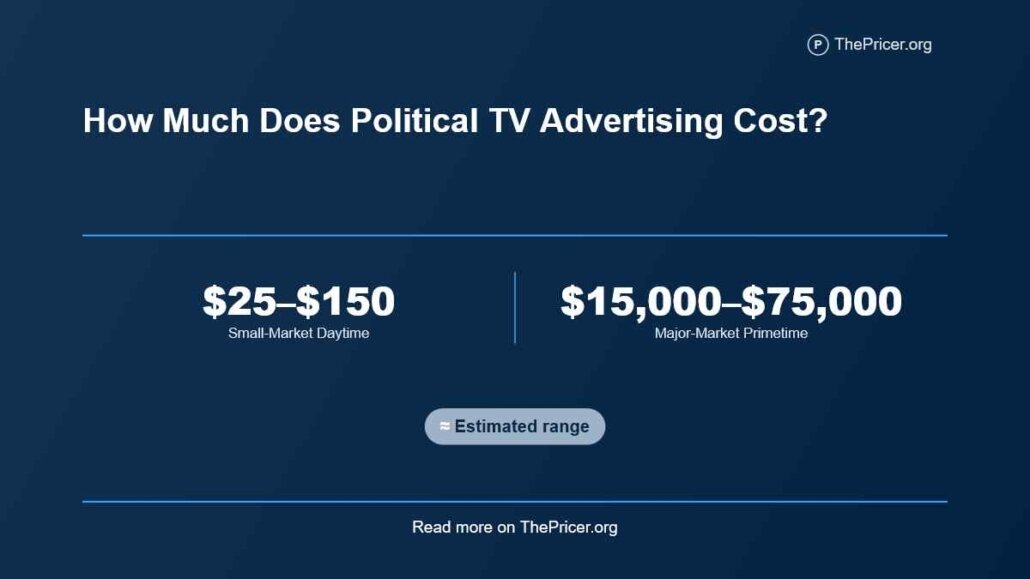
A 30-second political TV advertisement can cost as little as $25 to $150 for an off-peak airing in a small television market, while prime-time placements in major markets can reach $15,000 to $75,000 per spot. Producing the commercial adds another expense, commonly $5,000 to $35,000 for a professionally made 30-second campaign advertisement.
Those are market ranges, not guaranteed station quotes. Actual political ad contracts show much wider variation, including candidate spots priced at just $60 and premium sports placements costing $60,000.
Most campaigns purchase multiple airings rather than one commercial. A modest local television campaign might spend tens of thousands of dollars, while a competitive statewide campaign can spend millions on television advertising alone.
The November 3, 2026, midterm elections have brought the economics of political television into unusually sharp focus. Intense competition for advertising time has driven prices higher in some markets, making the distinction between a candidate’s protected advertising rate and a PAC’s market rate especially important.
Article Highlights
Jump to sections
- A small-market daytime political TV spot may cost $25 to $150, while premium major-market placements can exceed $50,000.
- A 2024 candidate contract showed a $60 afternoon airing and a $1,100 evening-news airing on the same station.
- In October 2026, a Texas Senate campaign reportedly paid $12,000 for one 30-second baseball-game advertisement.
- Basic professional production commonly costs $5,000 to $15,000 per 30-second commercial.
- Qualified candidates receive special broadcast pricing during the 45 days before a primary and 60 days before a general election.
- Independent political groups generally face higher broadcast prices, although certain coordinated party advertisements received expanded rate treatment under contested 2026 FCC guidance.
- Connected-TV advertising offers an alternative, with one provider advertising $20 to $35 per thousand impressions.
How Much Does Political TV Advertising Cost?
Political advertising prices depend heavily on the television market, the program, the audience, and when the advertisement airs.
A 2026 political advertising rate guide provides the following planning ranges for 30-second local broadcast commercials.
| TV placement | Small market | Mid-sized market | Top-10 market |
|---|---|---|---|
| Daytime | $25–$150 | $100–$600 | $500–$3,000 |
| Morning news | $50–$300 | $300–$1,500 | $1,500–$10,000 |
| Evening news | $100–$600 | $500–$3,000 | $3,000–$20,000 |
| Prime time | $200–$2,000 | $2,000–$10,000 | $15,000–$75,000 |
These are indicative market ranges assembled by an advertising service, not a published price schedule from every station. A candidate’s actual invoice can fall outside them.
News, sports, and highly watched entertainment programs command a premium because one airing reaches more viewers. Election-season demand can also consume available inventory, meaning a campaign with sufficient money may still struggle to purchase its preferred time slots.
The cost of a commercial is separate from the wider cost to run for president, which also includes campaign employees, travel, fundraising, legal work, and other operations.
What Campaigns Actually Paid
Real advertising contracts offer stronger evidence than generic rate charts.
Media educator Frank W. Baker examined Federal Communications Commission political advertising files and documented a revealing 2024 comparison at WLTX, the CBS affiliate in Columbia, South Carolina.
The Nikki Haley campaign paid approximately $60 for an afternoon television spot and $1,100 for an evening-news placement. Both were on the same station, but the evening-news airing cost about 18.3 times as much.
Baker’s advertising contract investigation also identified a Super PAC purchase costing $11,500 for a 30-second AFC Championship broadcast placement. That purchase involved a different advertiser and program, so it cannot be used as a direct candidate-versus-PAC rate comparison.
Prices rose dramatically in some markets during the 2026 midterms.
According to Bloomberg’s October 2026 investigation, James Talarico’s Senate campaign paid $12,000 for a 30-second advertisement during a baseball game on a Fox affiliate in Harlingen, Texas. Bloomberg reported that this was 26 times the price of a comparable placement during the 2024 Senate race.
The same report identified a $60,000 Sunday Night Football advertisement purchased by Ken Paxton’s campaign.
These are exceptional high-demand placements, not ordinary prices for every local television commercial. They show how the same product, 30 seconds of airtime, becomes far more expensive when the audience and political competition change.
Candidate Rates vs. PAC Rates
One of the largest pricing differences has nothing to do with video quality. It depends on who purchases the airtime.
Under federal broadcasting law, legally qualified candidates receive the lowest unit charge for the same class and amount of broadcast time during specified periods before elections.
The protected windows are 45 days before a primary or primary runoff and 60 days before a general or special election involving the candidate.
The rule does not mean every candidate receives the cheapest advertisement on the station. A non-preemptible prime-time placement and a lower-priority daytime placement can belong to different pricing classes.
Independent PACs and Super PACs ordinarily do not receive the candidate’s statutory protection. They can face substantially higher market prices.
The effect was measurable in the closing weeks of the 2026 midterms. An October 29 Wesleyan Media Project analysis, using AdImpact data, found that outside groups accounted for 71% of spending on Senate broadcast advertisements but only 43% of the airings during the period examined.
Those two shares imply that the average outside-group airing cost approximately 3.2 times the average airing purchased by all other sponsor categories combined during that period.
The calculation is based on spending shares divided by airing shares. It does not isolate identical stations, programs, or commercial lengths. It demonstrates an observed cost difference, not a guaranteed PAC surcharge.
Important 2026 development. The FCC expanded its interpretation of lowest-unit-charge eligibility to certain joint fundraising and coordinated political-party advertising. The interpretation was challenged, and the Supreme Court issued stays affecting the litigation in September and October 2026. The October 14 Supreme Court order addressed the procedural dispute without finally deciding the underlying rate-eligibility question.
A campaign or political committee should therefore verify the current classification of its specific advertisement rather than assuming that every party-related or independent purchase qualifies for candidate pricing.
What Production Costs
Airing a political commercial is only part of the budget. The campaign must also make the advertisement.
According to Beverly Boy Productions’ 2026 estimates, professional production prices for a 30-second political spot fall into several broad tiers.
- $5,000–$15,000: Basic candidate-to-camera advertisement with lighting, sound, graphics, and editing.
- $15,000–$35,000: More involved production with location filming, additional footage, music, and editing.
- $35,000–$75,000+: Larger shoots involving multiple locations, extensive post-production, actors, or more demanding production requirements.
A simple advertisement assembled from existing footage may cost less, particularly if the campaign already employs production staff. The ranges above describe quoted professional production services, not mandatory minimum prices.
The production company also identifies additional charges that may arise from licensed music, archival footage, last-minute editing, travel, and creating multiple versions for television and digital platforms.
These production expenses overlap with the costs described in broader commercial production budgets, but political campaigns face unusually compressed timelines and specific disclosure requirements.
A Worked Campaign Budget
Consider a local candidate planning a two-week campaign using a professionally produced 30-second commercial and the historical WLTX price examples.
This is an illustrative purchase, not a quote from WLTX or a claim that its 2024 rates remain available in 2026.
- Basic professional commercial production: $10,000
- Ten evening-news airings at $1,100 each: $11,000
- Twenty daytime airings at $60 each: $1,200
- Illustrative total: $22,200
The budget buys 30 airings of one commercial. Airtime accounts for $12,200, or approximately 55% of the total, while production represents the remaining 45%.
That ratio changes as additional airings are purchased. If the same advertisement is reused and airtime purchases double, the modeled total rises to $34,400, rather than doubling to $44,400. The fixed production expense has already been paid.
There is another important comparison. Purchasing 30 evening-news placements at the historical $1,100 rate would cost $33,000 in airtime alone, compared with $12,200 for the mixed schedule.
The mixed schedule saves $20,800 in airtime relative to that all-news scenario. It does not necessarily deliver equivalent audience reach, frequency, or voter exposure.
The campaign should compare actual station audiences, geographic coverage, and available times before interpreting the cheaper schedule as better value.
The Hidden Price of TV Ads
Several expenses can make an apparent bargain substantially more expensive.
Agency fees. Campaign consultants and media-buying firms may charge production fees, management fees, or commissions. One broadcaster’s 2026 advertising rate sheet describes a 15% agency commission arrangement. This is evidence of a real contracting structure, not proof that every political TV purchase carries an additional 15% charge.
Geographic waste. A broadcast signal can reach far beyond an electoral district. A city council candidate may purchase exposure to thousands of viewers who cannot vote in the race.
Placement uncertainty. Cheaper preemptible advertisements may be displaced by higher-priority customers. A campaign should compare the price of guaranteed placement with the possibility that a lower-priced spot will not air as planned.
Revisions and compliance. Changes to the script, required sponsor identifications, new footage, additional edits, and rapid-response advertisements can create costs beyond the initial creative quote.
Scheduling pressure. Stations have limited advertising inventory. A late campaign purchase may face more competition, and the available programs may be poorly matched to the intended audience.
For federal candidates, broadcast advertising can also involve specific candidate-approval requirements. A commercial that does not meet applicable rules may affect eligibility for protected rates.
The financial implications of these rules extend beyond the advertising contract. Campaign financing and compliance are separate expenses within a candidate’s total political operation.
Government-funded advertising follows a different financial model from candidate and PAC commercials. Instead of campaign donations paying for airtime, public agencies may use taxpayer-funded contracts for advertising campaigns. For a real-world example, see our investigation into how much the U.S. government is spending on Trump-related TV ads, which examines federal advertising contracts, production expenses, and reported airtime spending.
Broadcast vs. Streaming TV
 Connected TV, or CTV, delivers advertisements through streaming applications and television-connected devices. It is increasingly important in political advertising because campaigns can often target narrower geographic audiences than a broadcast station’s entire coverage area.
A published 2026 connected-TV rate guide advertises approximately $20 to $35 per thousand impressions for self-service political CTV advertising.
At a $25 CPM, a $5,000 media budget would purchase approximately 200,000 impressions. Those are ad displays, not 200,000 distinct voters. Repeated exposure, household targeting, and platform measurement can change the number of people actually reached.
CTV may be attractive to small-district campaigns that would otherwise waste broadcast impressions outside their electorate. Traditional television can remain valuable when a campaign needs broad coverage across a large media market.
The spending shift is substantial. A peer-reviewed 2026 presidential advertising study estimated that the fall 2024 general-election campaign generated approximately $1.1 billion in broadcast and cable television advertising, alongside $346 million in connected-TV spending.
Those amounts describe a particular presidential campaign period. They should not be confused with total political spending across every race during the complete election cycle.
Radio remains another alternative, especially where a campaign wants frequent local exposure. The relative value depends on the audience and the cost of reaching eligible voters, not merely the price of an individual advertisement. Campaigns considering that route can compare radio advertising costs separately.
Is Political TV Worth It?
The right purchasing decision depends on the size of the race, the intended audience, and the campaign’s available budget.
Makes sense if the campaign needs broad awareness, has access to favorable candidate rates, and can afford enough airings to reach voters repeatedly.
- A competitive congressional or statewide race requires broad geographic coverage.
- Local news or other programming attracts a relevant voter audience.
- The campaign can purchase an appropriate schedule rather than one expensive symbolic airing.
- The budget covers production and airtime without sacrificing essential campaign operations.
Does not make sense if most of the television audience lives outside the district or a small budget can purchase only a few poorly placed commercials.
- A local race covers only a small portion of a broadcast market.
- Streaming or radio can reach the intended voters with less geographic waste.
- Premium sports inventory consumes most of the advertising budget in one purchase.
- The buyer has not established whether the contract receives candidate, coordinated-party, or independent-group pricing.
The scale of 2026 spending confirms that television remains a major political advertising channel. During October 12–25, the Wesleyan Media Project recorded approximately $1.39 billion in political advertising across the congressional and gubernatorial races it tracked, with about 63.5% going to local broadcast television.
That spending demonstrates demand for the medium. It does not prove that every individual commercial changes votes or delivers a positive return for the campaign purchasing it.
What We Verified
- Compared published 2026 advertising ranges with documented television purchases from 2024 and 2026.
- Checked candidate rate protections against federal law and the latest Supreme Court proceedings available during the 2026 election.
- Separated candidate, coordinated-party, and independent-group advertising rather than assigning them one universal rate.
- Used independent political advertising research to calculate the difference between outside-group spending share and airing share.
- Separated commercial production, airtime, potential agency arrangements, and streaming impressions in the budget comparisons.
Answers to Common Questions
How much does a 30-second political TV ad cost?
Small-market daytime placements can cost $25 to $150, while major-market prime-time spots may cost $15,000 to $75,000. Actual contracts vary considerably, with high-profile sports broadcasts sometimes costing more.
Do political candidates get discounted TV advertising?
Legally qualified candidates are entitled to the lowest unit charge for comparable classes of broadcast time during the 45 days before a primary and 60 days before a general election, subject to applicable conditions. Certain coordinated political-party purchases have also been affected by contested 2026 FCC guidance.
Why do Super PACs pay more for TV ads?
Independent Super PAC purchases generally do not qualify for the same statutory pricing protection as candidate advertisements. Their costs also depend on which stations, programs, and time slots they purchase.
How much does it cost to produce a political commercial?
A professionally produced 30-second advertisement commonly costs $5,000 to $35,000, with more elaborate productions reaching $75,000 or more. Airtime is purchased separately.
Is streaming TV cheaper than broadcast advertising?
It can be more economical for narrow geographic targeting. Some political CTV services advertise rates near $20 to $35 per thousand impressions. The better choice depends on eligible-voter reach, frequency, inventory availability, and the final quoted media price.
Disclosure: Educational content, not financial advice. Prices reflect public information as of the dates cited and can change. Confirm current rates, fees, taxes, and terms with official sources before purchasing. See our methodology and corrections policy.