
How Much Does Prime Drink Cost?
Updated on | Written by Alec Pow
This article was researched using 10 sources. See our methodology and corrections policy.
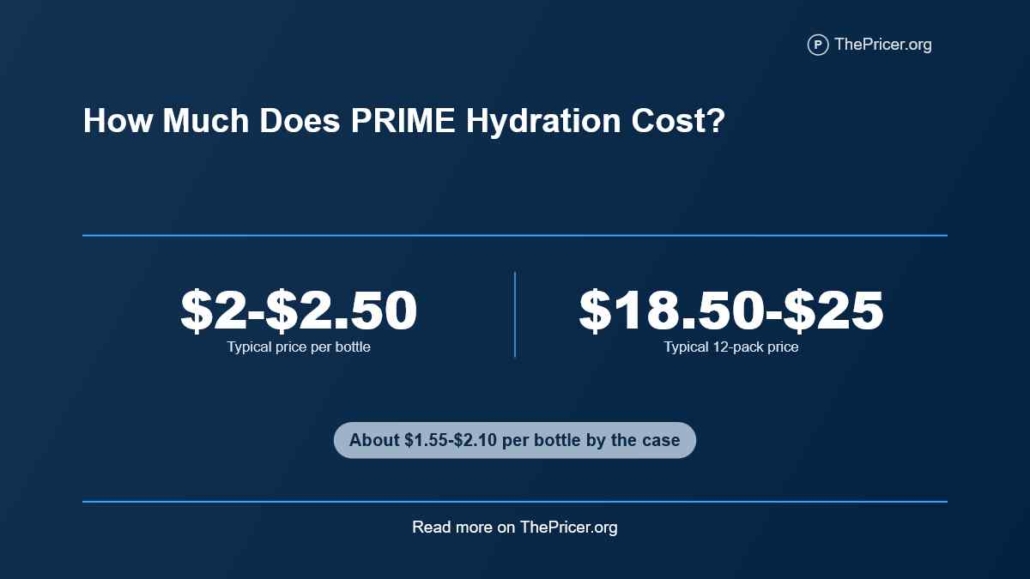
PRIME Hydration typically costs about $2 to $2.50 for one 16.9-fl.-oz. bottle, while a 12-pack commonly sells for roughly $18.50 to $25 in 2026. That puts the normal multipack cost at approximately $1.55 to $2.10 per bottle. Limited-edition flavors, third-party sellers, delivery, and smaller packs can push the price higher.
The original $29.99-per-case price associated with PRIME’s early years is no longer a good universal estimate. Current Walmart listings have put some 12-packs below $20, while other retailers continue to sell cases around $24.99. Single bottles at Kroger are currently around $2 to $2.39 in examples we checked.
PRIME also sells several different products now, so shoppers need to distinguish PRIME Hydration from PRIME Energy, Hydration+ powder sticks, Rapid Rehydration products, and newer product lines. This article focuses primarily on the caffeine-free bottled Hydration drink created by Logan Paul and KSI.
Article Highlights
Jump to sections
- Single bottle: usually around $2-$2.50 for 16.9 fl. oz. / 500 mL.
- 12-pack: approximately $18.50-$25 (at $30 per hour, earning that amount would take about 37 to 50 minutes, before taxes) at current mainstream and specialty retailers.
- Cost per bottle in a case: roughly $1.55-$2.10.
- Hydration+ sticks: often around $13.99 for six packets, or about $2.33 per serving before adding water.
- PRIME Energy: a separate caffeinated product and should not be confused with PRIME Hydration.
- Most current Hydration flavors contain 20-25 calories, zero added sugar and 10% coconut water.
- The electrolyte profile is unusual for a sports drink because PRIME is high in potassium but very low in sodium compared with many conventional sports drinks.
How Much Does PRIME Hydration Cost?
PRIME pricing is less uniform than it was at launch because the drink is now sold through supermarkets, mass retailers, supplement stores, convenience channels, online sellers, and the company’s own distribution network.
| PRIME Product | Current Price Range | Approx. Cost per Serving |
|---|---|---|
| Hydration single bottle | $2-$2.50 | $2-$2.50 |
| Hydration 12-pack | $18.50-$25 (about 37 to 50 minutes at $30 per hour) | $1.54-$2.08 |
| Hydration+ sticks, 6-pack | About $13.99 | About $2.33 |
| Rapid Hydration sticks, 6-pack | About $17.99 | About $3.00 |
| PRIME Energy 12-pack | About $24.99 | About $2.08 |
One current Walmart PRIME Hydration listing showed a 12-pack at $19.98, equal to about $1.67 per bottle. Another flavor recently appeared at $18.51, showing that promotional and flavor-specific pricing can move even within one retailer.
At Kroger, one 16.9-ounce PRIME Hydration bottle was listed at $2, while another collaboration flavor was $2.39.
A supplement retailer, Nutrition Faktory, currently lists PRIME Hydration 12-packs at $24.99. That works out to about $2.08 per bottle.
The takeaway is that $20 to $25 is a more realistic current case budget than automatically assuming $29.99.
Multipack Savings
Buying a case can make a meaningful difference if you drink PRIME regularly.
Suppose a local store charges $2.39 for individual bottles. Buying 12 separately would cost:
$2.39 × 12 = $28.68 (about 57 minutes at $30 per hour).
If the same quantity is available as a $19.98 case:
$28.68 – $19.98 = $8.70 saved per 12 bottles.
That is a savings of approximately 30%.
For someone drinking four bottles per week, that difference would amount to roughly 17 cases per year. Using those example prices, case buying could reduce annual spending by around:
17 × $8.70 = $147.90 per year.
The calculation assumes you would have bought all of those drinks anyway. Buying a large case to save $8 does not save money if half of it sits unused.
PRIME vs Competitors
PRIME is no longer unusually expensive compared with many branded ready-to-drink sports beverages.
For example, Walmart recently listed a 12-pack of 16-ounce BODYARMOR at approximately $15.98 to $17.52 for certain flavors, while some third-party or less-discounted varieties were considerably higher. A current 12-pack of 20-ounce Gatorade sold by a third-party Walmart seller was about $26.
| Drink | Example 12-Pack Price | Approx. Price per Bottle |
|---|---|---|
| PRIME Hydration | $19.98 | $1.67 |
| BODYARMOR | $15.98-$17.52 | $1.33-$1.46 |
| PRIME at specialty retailer | $24.99 | $2.08 |
| Gatorade third-party example | $26.02 | $2.17 |
These examples should not be treated as permanent national prices. Promotions, sellers, pack sizes, shipping, and flavors change frequently. They do show that PRIME’s price premium has narrowed considerably since the period when demand and shortages pushed bottles well above normal retail.
Hydration vs Energy
One of the most important corrections to the old article is terminology. PRIME Hydration is not an energy drink.
PRIME now has separate Hydration and Energy ranges. The company’s current product catalog lists Hydration, Zero Hydration, Energy, Hydration+ Sticks, Rapid Rehydration and other products separately.
Regular bottled PRIME Hydration is marketed as caffeine-free. PRIME Energy is the caffeinated product.
That distinction matters particularly for younger consumers. The American Academy of Pediatrics has long emphasized that sports drinks and energy drinks are fundamentally different products, with energy drinks containing stimulants such as caffeine.
If you are comparing caffeinated alternatives instead, see our guide to the cost of energy drinks.
What’s in PRIME?
The formulation varies slightly by flavor, so there is no single nutrition table that perfectly represents every bottle.
Current official product pages describe regular PRIME Hydration as containing 10% coconut water, electrolytes, BCAAs, B vitamins, antioxidants and zero added sugar. Most current flavors contain about 20 to 25 calories per 500-mL bottle.
A current Kroger nutrition label for the Orange flavor lists:
| Calories | 20 |
| Total carbohydrate | 5 g |
| Total sugar | 2 g |
| Added sugar | 0 g |
| Sodium | 10 mg |
| Potassium | 700 mg |
| Magnesium | 124 mg |
| Vitamin A | 900 mcg |
| Vitamin E | 15 mg |
| Protein | 0 g |
The old version of this article claimed the formula contained “825g electrolytes” and 25 mg of BCAAs. Those figures were erroneous. Current PRIME bottles advertise approximately 835 mg of electrolytes on some labels, not 825 grams, and current UK product information, for example, lists 250 mg of BCAAs.
Ingredients in several core U.S. flavors include filtered water, coconut water from concentrate, citric acid, dipotassium phosphate, trimagnesium citrate, natural flavor, the BCAAs leucine, isoleucine and valine, vitamins, sucralose, and acesulfame potassium.
The Electrolyte Difference
PRIME’s electrolyte numbers deserve more explanation than simply saying “835 mg of electrolytes.”
A large share of its electrolyte content comes from potassium and magnesium. Several current labels show around 700 mg of potassium but only approximately 10 to 30 mg of sodium per bottle.
That matters because sweat contains substantial sodium. A 2026 review of sports drinks and exercise hydration notes that traditional sports beverages are designed to replace water, sodium and other electrolytes lost during prolonged exercise, often while also supplying carbohydrates.
A separate review of hydration-drink composition found that sodium concentration is particularly relevant for fluid retention during and after prolonged or high-intensity exercise.
This does not mean PRIME cannot contribute to hydration. It contains water and electrolytes. But “more total electrolytes” does not automatically mean “better for every athletic situation,” because the type of electrolyte matters.
Cleveland Clinic similarly notes that water is typically sufficient for workouts lasting an hour or less at moderate intensity under normal conditions. Sports drinks become more relevant as duration, intensity, heat and sweat losses increase.
Current Flavors
The original eight-flavor list is now outdated. PRIME has released a large number of permanent, seasonal, collaboration and limited-edition Hydration flavors.
The company’s current U.S. catalog includes or has recently featured flavors such as:
- Blue Raspberry
- Cherry Freeze
- Ice Pop
- Lemon Lime
- Lemonade
- Meta Moon
- Strawberry Banana
- Strawberry Watermelon
- Tropical Punch
- Glowberry
- Summer Pop
- Frostbite Fusion
- Orange Swirl
- Future Freeze
- and branded collaboration releases
The official Glowberry product page, for example, lists 25 calories, 10% coconut water, BCAAs, B vitamins, electrolytes and no caffeine.
Because limited editions come and go, an exhaustive flavor list becomes outdated quickly. Availability also differs by country and retailer.
Powdered PRIME
PRIME Hydration+ Sticks offer another buying option. Instead of paying to ship a bottle that is mostly water, you mix a powder packet into your own water.
The company’s Hydration+ stick range carries many of the same flavor and ingredient claims as bottled Hydration, including 10% coconut-water ingredients, electrolytes, B vitamins and no caffeine.
Current third-party retail pricing has placed a six-pack of regular Hydration sticks at about $13.99, or:
$13.99 ÷ 6 = $2.33 per serving.
That is actually more per serving than buying a $19.98 case of bottled PRIME:
$19.98 ÷ 12 = $1.67 per bottle.
So the powder is not automatically the cheapest PRIME product. Its advantage is portability and storage rather than guaranteed savings.
The Hidden Price
The biggest hidden cost of PRIME can be how and where you buy it.
A mainstream $19.98 12-pack costs $1.67 per bottle. A $24.99 case costs $2.08 each. Buying twelve $2.39 singles costs $28.68, or $2.39 each.
| Buying Method | Cost for 12 Servings |
|---|---|
| $19.98 case | $19.98 |
| $24.99 case | $24.99 |
| 12 × $2.39 singles | $28.68 |
| 6-pack sticks × 2 | $27.98 |
Between the cheapest and most expensive examples above is an $8.70 difference for exactly 12 servings.
Shipping is another hidden cost. The GNC PRIME listing, for example, notes that shipping charges depend on the selected method and order. A case that looks cheaper online may stop being cheaper once delivery is added.
Limited editions also attract third-party resellers. Unless you specifically want a collectible bottle or discontinued flavor, paying a scarcity markup rarely makes sense when mainstream Hydration performs the same basic function.
Worked Cost Example
Consider someone who drinks five bottles of PRIME each week.
That equals:
5 × 52 = 260 bottles per year.
At $2.39 per single bottle:
260 × $2.39 = $621.40 per year.
At the $1.67-per-bottle price of a $19.98 case:
260 × $1.67 = about $434.20 per year.
Buying cases instead of individual bottles would therefore save around $187 per year in this example.
At an illustrative $30-per-hour wage, the $434 annual case-buying cost represents roughly 14.5 hours of gross earnings. Paying single-bottle prices increases that to almost 21 hours.
And plain tap water, of course, costs a tiny fraction of either amount.
Is PRIME Worth It?
From a purely financial perspective, PRIME is a branded convenience beverage rather than an inexpensive way to obtain water or electrolytes.
You are paying for the flavor, bottle, formulation, brand, portability and convenience. If you like PRIME and buy it by the case at around $1.60 to $2 per bottle, its price is now broadly competitive with other premium ready-to-drink sports beverages.
If your only objective is routine hydration, water is dramatically cheaper. And for a normal moderate workout lasting less than about an hour, medical guidance commonly says water is sufficient for most healthy people.
If you are doing prolonged strenuous exercise, meanwhile, the relevant question is not simply which bottle boasts the highest total electrolyte number. Sodium, carbohydrate needs, fluid volume, sweat rate, duration and environmental heat all matter.
Research comparing potassium-rich drinks with conventional sports beverages has found that extra potassium does not automatically result in better post-exercise rehydration. One controlled study found better fluid retention with a conventional sodium-containing sports drink than water, while a potassium-rich beverage did not clearly outperform it.
In other words, choose PRIME because its particular combination of taste, low calories and ingredients fits what you want, not because the front-label electrolyte number alone proves it is universally superior.
Where to Buy

PRIME Hydration has moved a long way from the shortages that characterized its early launch. It is now widely distributed across supermarkets, mass merchants, supplement retailers, convenience outlets and online stores.
Major U.S. sellers include Walmart, Kroger-family stores, GNC and other grocery and nutrition retailers. Stock varies by flavor and location.
When comparing online options, look at the actual seller. Marketplace listings can come from third parties charging substantially more than a product sold directly by a major retailer.
If you are comparing other nutrition and wellness products, see our guides to the cost of Balance of Nature and Smoothie King drinks.
What We Verified
What we verified: We checked PRIME’s current 2026 product catalog and nutrition information, current Walmart and Kroger prices, GNC availability, specialty-retailer case pricing, competing sports-drink pricing, and current exercise-hydration research.
Answers to Common Questions
How much does one PRIME Hydration cost?
A 16.9-fl.-oz. bottle commonly costs around $2 to $2.50. Current Kroger examples we checked were $2 and $2.39.
How much is a 12-pack of PRIME?
A realistic current range is approximately $18.50 to $25. Walmart has recently listed some cases around $18.51 to $19.98, while a specialty retailer lists 12-packs at $24.99.
Is PRIME Hydration an energy drink?
No. Bottled PRIME Hydration is a caffeine-free sports/hydration beverage. PRIME Energy is a separate caffeinated product.
How many calories are in PRIME?
Most current standard Hydration flavors contain approximately 20 to 25 calories per 500-mL bottle, although formulas can differ by flavor and market.
How much sugar does PRIME Hydration have?
Several current U.S. flavors contain around 1 to 2 grams of naturally occurring total sugar and zero added sugar. Check the exact bottle because formulas can vary.
How many electrolytes are in PRIME?
Some current bottles advertise roughly 835 mg of electrolytes. Much of that comes from potassium and magnesium. Several labels show approximately 700 mg potassium and 124 mg magnesium.
Is PRIME high in sodium?
No. Several current formulations are unusually low in sodium for a sports drink, with labels showing roughly 10 to 30 mg per bottle. That is worth considering for prolonged, high-sweat exercise because sodium is an important electrolyte lost in sweat.
Is PRIME cheaper by the case?
Usually. A $19.98 12-pack costs approximately $1.67 per bottle, compared with $2 to $2.50 when bottles are purchased individually.
Is PRIME Hydration good for children?
Regular PRIME Hydration is caffeine-free, but children generally do not need sports drinks for routine everyday hydration. Water remains the usual first choice. PRIME Energy is a different caffeinated product and should not be confused with Hydration.
Disclosure: Educational content, not financial advice. Prices reflect public information as of the dates cited and can change. Confirm current rates, fees, taxes, and terms with official sources before purchasing. See our methodology and corrections policy.