
How Much Does Prince Harry’s Security Cost?
Published on | Written by Alec Pow
This article was researched using 14 sources. See our methodology and corrections policy.
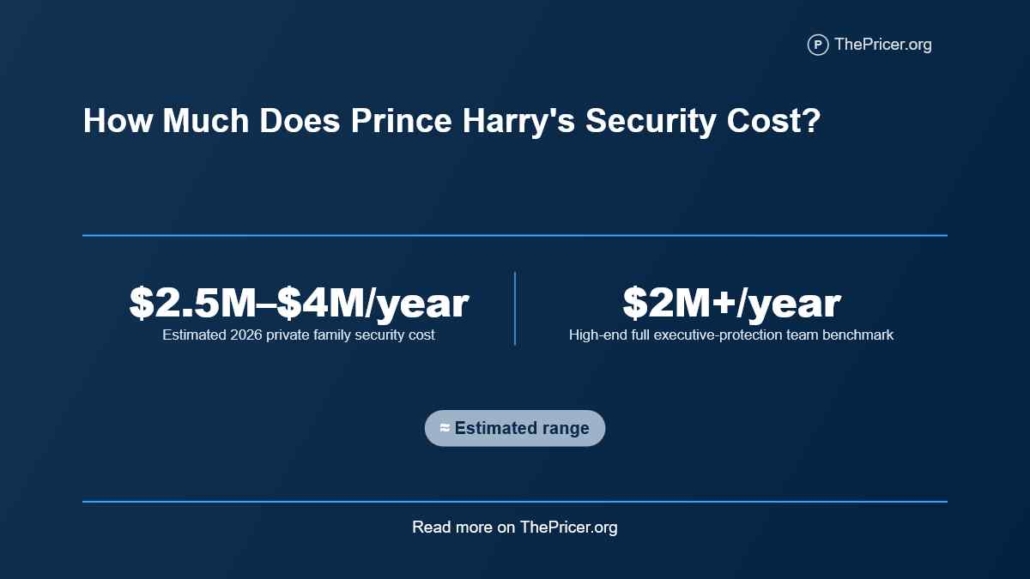
Prince Harry’s private family security likely costs about $2.5 million to $4 million per year in 2026. That is a ThePricer estimate, not a disclosed Sussex contract. It updates a Harry-specific 2021 estimate of $2 million to $3 million annually using the U.S. CPI-U index, which moved from 264.877 in March 2021 CPI data to 334.980 in the August 2026 CPI release.
The range covers a high-end private protection program for Harry, Meghan and their children. It does not represent a known taxpayer bill for British police protection.
Article Highlights
Jump to sections
- A current private-security estimate is $2.5 million to $4 million (at $30 per hour, earning that amount would take about 40 to 64 years of full-time work, before taxes) per year.
- The older Harry-specific estimate was $2 million to $3 million per year in 2021.
- Three modern protection layers can total about $1.2 million to $1.8 million or more before every service is counted.
- Harry and Meghan’s children are changing schools after security concerns about the school commute.
- A new British risk review does not mean police protection has already been restored.
How Much Does Prince Harry’s Security Cost?
The clearest Harry-specific calculation starts with the 2021 estimate and updates its purchasing power. The March 2021 CPI-U level was 264.877 and the August 2026 level was 334.980. Dividing 334.980 by 264.877 gives 1.2647. Applying that factor to the historic range produces about $2.53 million (about 41 years of full-time work at $30 per hour) at the low end and $3.79 million at the high end. Rounded to match the uncertainty in the original estimate, that supports a 2026 range of about $2.5 million to $4 million per year.
This inflation method has a limit. CPI measures broad consumer prices, not the wage growth of elite executive-protection staff. The result is a benchmark, not a claim that the Sussex contract rose by exactly 26.47 percent. It is still useful because it prevents a five-year-old security estimate from being repeated as though its dollar value had not changed.
Illustrative worked total
- Threat monitoring midpoint of $250,000.
- Two security-trained drivers midpoint of $375,000.
- Residential protection midpoint of $875,000.
- Three-layer subtotal of $1.5 million.
- Gap to the published $2 million full-team floor of about $500,000.
A second calculation checks the estimate against modern component prices. Using the midpoints of the published monitoring, driver and residential ranges gives $250,000 plus $375,000 plus $875,000, or $1.5 million. Against the published full-team floor of $2 million, there is about $500,000 left before reaching that floor. That gap can absorb other protection functions named in the same market report. It is not a separate vendor quote.
What the Estimate Means
The $2.5 million to $4 million (about 40 to 64 years of full-time work at $30 per hour) figure is best read as a current private-market estimate for continuous family protection, not a quote from Prince Harry’s security company. The estimate uses the historical price evidence identified above as a starting point, then adjusts it for current purchasing power. A modern contract could land above or below the modeled range because staffing, travel and residence arrangements can change.
The scope also matters. A single guard hired for one appearance is a different purchase from protecting a family at home, on the road and during public events. Harry’s case adds several cost drivers at once, including a globally recognizable principal, family coverage, regular travel and a residence that may require its own protective layer. Those features make a standing executive-protection program the better comparison than an hourly event guard.
The estimate should not be read as a claim that Harry personally writes one annual check for the full amount. Private protection can be purchased through several contracts and may include personnel, transport, monitoring and residence work billed on different schedules. The central number answers the annual spending question while keeping those separate pieces visible.
What Private Protection Buys
Modern high-end protection is not priced as one bodyguard standing beside a client. Forbes reported in 2025 that elite 24-hour threat monitoring can cost $200,000 to $300,000 per year, two security-trained drivers can cost $250,000 to $500,000, and residential security can run $750,000 to more than $1 million. The same executive protection market report puts a full team at at least $2 million per year, with travel and advance work pushing some programs higher.
| Protection layer | Published high-end price | What it covers |
|---|---|---|
| Threat monitoring | $200,000 to $300,000 yearly | Continuous monitoring for threats and exposed personal information |
| Security-trained drivers | $250,000 to $500,000 for two | Dedicated transport personnel with security training |
| Residential security | $750,000 to more than $1 million | Home cameras and protective personnel |
| Full executive-protection team | $2 million or more yearly | Broader protection with travel, medical capability and advance work |
Those figures are market references, not Sussex invoices. They show why a family detail can reach several million dollars without requiring an implausible hourly rate. The bill grows because protection is built from overlapping layers. A residence program does not replace transport security, and transport does not replace protective coverage at public appearances.
Britain Changes the Bill
Harry and Meghan’s move back to Britain changes the security problem because their private team does not have the same powers or intelligence access as British police protection. ITV reported on September 14 that the couple pays for its own private security personnel, while those personnel cannot carry guns in the UK and do not have access to MI5 and MI6 intelligence. ITV also reported that new risk reviews are underway for both Harry and Meghan after the family’s relocation, and that commissioning the reviews does not mean their protection level will rise.
The children have now become part of the current security story. Reuters reported on September 14 that Prince Archie, 7, and Princess Lilibet, 5, are moving to another school after two days. The family’s security team raised concerns about the distance and heavy traffic on the trip from their new home. A spokesperson said the decision was not a criticism of the school or its staff.
That development does not create a published new fee by itself. It does show why school transport can affect the scope of family protection. A standing program may need to cover home life, child transport, public engagements and travel at the same time. More protected movements can mean more labor hours and transport coordination even when the annual contract remains private.
Who Pays for UK Protection
At present, the private-security bill belongs to Harry and Meghan, while any state-funded police package would be a separate public-security arrangement. The distinction matters because a police decision changes the payer and the capabilities available, but it does not make protection costless. British protective security is funded from public resources when the state grants it under the relevant process.
A public-protection decision and a private contract answer different accounting questions. If the state takes responsibility for some protective functions, the household’s private bill may fall, stay similar or change shape depending on what remains outside the police package. A risk review alone does not tell readers which private services would disappear, so it cannot be converted into a dollar saving before an actual protection decision and scope are known.
No official annual taxpayer figure has been published for a new Sussex police package. Former Metropolitan Police commander Dal Babu told Sky News in August 2026 that protection could run into millions of pounds, but that remains an attributed estimate rather than an approved budget. The UK security cost report is useful for scale, not for assigning a precise future taxpayer bill.
What Public Records Leave Out
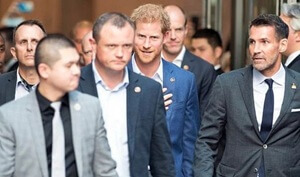 Government security records can look much cheaper than private protection because they may count a narrower slice of spending. Canada provides a useful Harry-specific case. The RCMP disclosed C$66,918 in protection costs from December 1, 2019 through January 31, 2020, split between overtime and other expenses. The official Canadian protection cost disclosure states that regular salary costs were not released because that information could expose security posture.
That omission changes the comparison. A private contract pays for labor as part of the bill. A government disclosure that reports overtime, travel and operating expenses while withholding base salaries is not a like-for-like annual price. Readers who compare C$66,918 with a multimillion-dollar private estimate are comparing a partial public cost with a fuller private cost.
The same accounting problem appears in larger public-security budgets. A related G7 summit cost analysis shows how policing can be only one line inside a broader government total. For Harry, the useful question is not which number looks smaller. It is which expenses each number actually includes. That distinction is especially important when ordinary salaries, shared infrastructure or agency overhead stay outside a published release.
Security Costs at Similar Profiles
Corporate filings give another reality check because public companies sometimes disclose what they spend protecting high-profile executives. Snap reported $3,274,014 for Evan Spiegel’s security in 2025 in its annual SEC filing. That figure sits inside the same broad order of magnitude as the ThePricer estimate for Harry, although the people, locations, threat profiles and services are different.
Alphabet disclosed $8,803,400 for Sundar Pichai’s 2025 personal security. Its 2026 proxy statement says the arrangement included residential security, monitoring, car and driver services, and protection during travel. Meta reported about $8.50 million in 2025 direct personal-security costs for Mark Zuckerberg plus a $14 million annual pretax security allowance for him and his family in its 2026 proxy filing.
Those filings are not estimates of Harry’s bill. They show how the price can rise when a program covers residences, travel, drivers, equipment and family security on a large scale. Snap is the closer magnitude check. Alphabet and Meta show the upper end of disclosed corporate programs with much broader company-funded scopes. Their value here is scale control, since they warn against treating every high-profile security program as the same purchase.
What Could Change the Estimate
The biggest swing factor is scope. A family living mainly at one residence with limited public travel can buy less protection than a household moving between residences, schools, airports and public events. School transport can add repeated protected movements on weekdays, while public appearances and longer trips can add separate planning needs. Those demands change labor time even when no new contract price is publicly disclosed.
Staffing structure can move the bill too. A 24-hour protective post cannot be staffed continuously by one person, so continuous coverage requires shifts and relief staff. Driving, residence coverage and close protection can also overlap during the same day. That is why multiplying one guard’s day rate by 365 can produce a misleading estimate for a family program with several functions operating at once.
The British review creates the largest uncertainty. If police protection is expanded, Harry’s private spending could change because some functions would be handled by the state. If police protection remains limited, a private team may continue carrying a larger share of the day-to-day work. The result can also shift with residence security, travel frequency and whether Meghan and the children require the same coverage on a given movement.
Estimate fits if
- The comparison is for full-time family protection.
- Residence, transport and travel coverage are included.
- The reader needs a 2026 private-market estimate.
Estimate does not fit if
- The question is one guard for one event.
- The figure sought is only a future UK police bill.
- The comparison is the Royal Family’s entire security budget.
A short-event security budget uses different staffing units and should not be used to price a standing family detail.
Answers to Common Questions
How much does Prince Harry spend on security?
A defensible 2026 private-security estimate is about $2.5 million to $4 million per year. His current contract has not been publicly disclosed.
Do UK taxpayers currently pay for all of Harry’s security?
No. Harry and Meghan pay for their private personnel. A new British risk review is underway, but that review does not mean full state-funded police protection has already been granted.
Why are Archie and Lilibet changing schools?
Current reporting says the family’s security team raised concerns about the distance and heavy traffic involved in the trip from home. The family said the move was not a criticism of the school or staff.
Could Harry’s security cost change after the UK review?
Yes. A change in state police protection could alter which functions remain privately funded. No official annual taxpayer total for a new arrangement has been published.
Disclosure: Educational content, not financial advice. Prices reflect public information as of the dates cited and can change. Confirm current rates, fees, taxes, and terms with official sources before purchasing. See our methodology and corrections policy.