
How Much Does Private Aviation Membership Cost?
Published on | Written by Alec Pow
This article was researched using 12 sources. See our methodology and corrections policy.
Private aviation membership can cost as little as $995 per year in membership dues, but actually using a private jet typically requires a much larger financial commitment. XO requires a $100,000 refundable deposit for its entry membership.
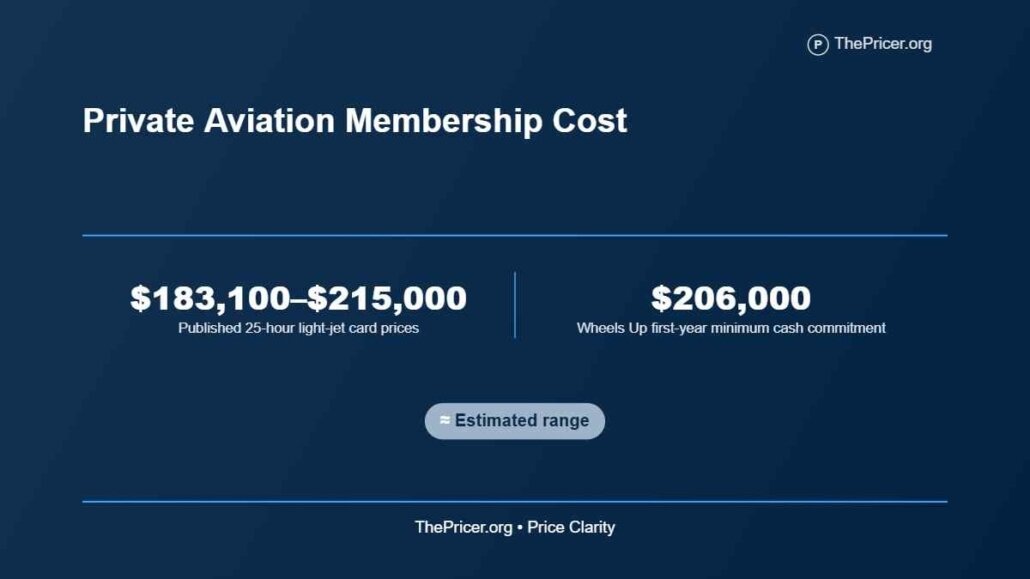
ONEflight offers programs starting with $100,000 in flight funding, with BAJCard annual dues starting at $15,000. Prepaid jet cards from Sentient Jet and NetJets start around $183,100 to $215,000, while fractional aircraft ownership can require an additional capital investment.
The membership fee is not the price of unlimited private flying. Depending on the provider, customers pay hourly aircraft rates, purchase blocks of flight time, or draw flight charges from a funded account. Fuel surcharges, taxes, minimum flight times, and other fees can increase the final expense.
For a U.S. customer expecting 10 to 50 flight hours annually, the most useful comparison is the complete cost of those hours, not the advertised price of joining.
Article Highlights
Jump to sections
- XO Membership costs $995 annually with a $100,000 refundable minimum deposit.
- XO Reserve requires $250,000 in refundable funding, with the same $995 annual fee.
- ONEflight offers JetCards starting at $100,000 without listed membership dues and BAJCards with annual dues starting at $15,000.
- Sentient’s 25-hour light-jet card costs $183,100 before fuel surcharges and applicable taxes.
- NetJets advertises jet cards starting at $215,000, with fractional ownership and leasing available separately.
- Flying too few hours can make annual membership dues a substantial additional cost per flight hour.
How Much Does Private Aviation Membership Cost?
Private aviation programs offer several ways to obtain aircraft access without purchasing an entire jet. Some charge annual dues and hold a refundable flight deposit. Others sell prepaid flying hours, while fractional programs involve an ownership share or lease.
The following prices are published U.S. program benchmarks checked in October 2026. Deposits, annual fees, prepaid hours, and ownership commitments have different financial meanings.
| Provider and program | Entry commitment | Pricing structure |
|---|---|---|
| XO Membership | $100,000 refundable deposit | $995/year plus flights |
| XO Reserve | $250,000 refundable deposit | $995/year plus flights |
| Wheels Up Signature | From $200,000 funded access | Hourly rates and plan fees |
| ONEflight JetCard | From $100,000 | No listed membership dues |
| ONEflight BAJCard | From $100,000 | From $15,000/year dues |
| Sentient SJ25 | $183,100 | 25 light-jet hours, extras apply |
| NetJets Card | From $215,000 | Prepaid flight access |
| NetJets fractional share | Additional ownership capital | From approximately $360,000/year for 50 hours |
These are not equivalent packages. NetJets includes certain standard charges within its card rate, Sentient identifies separate fuel and tax charges, and XO uses dynamic pricing rather than a published universal hourly rate.
An occasional traveler may find a one-time charter more suitable than tying up a large balance. A frequent traveler may value predictable access enough to accept the upfront commitment.
XO Membership and Reserve
XO sells private aviation access through refundable funded memberships, with flights charged against the customer’s available balance.
Its official membership price schedule lists an annual fee of $995 for both XO Membership and XO Reserve.
The standard Membership requires a refundable $100,000 deposit, while Reserve requires $250,000. The higher tier adds priority fleet access, stronger flight assurance benefits, and additional loyalty opportunities.
XO says unused deposits are refundable under its membership agreement. That does not mean flights already purchased, membership charges, or cancellation penalties are automatically refundable.
The XO Reserve program description identifies improved cancellation terms, up to 4% flight loyalty credit, and enhanced access to Vista aircraft.
A member funding $100,000 initially should not report that amount as an automatic nonrefundable annual membership expense. It is primarily committed flight capital, while the annual fee and actual flight charges determine the economic cost.
Wheels Up Membership Pricing
Wheels Up offers funded programs intended for travelers who want access to multiple aircraft categories without owning an aircraft.
The company’s Signature Membership offering advertises Dynamic Access and Fixed Access plans, with funded tiers starting at $200,000 for twelve months of access.
Dynamic Access is designed around greater scheduling flexibility and variable rates. Fixed Access prioritizes more predictable hourly pricing.
Wheels Up also provides custom arrangements for customers with complex itineraries or higher annual flying requirements.
Independent October 2026 rate tracking documents published light-jet hourly rates of approximately $8,531 to $9,295 and super-midsize rates of $9,929 to $13,495, depending on program and aircraft.
These are program rate observations, not all-inclusive flight invoices. A buyer should confirm current dues, funding rules, taxes, chargeable flight time, and aircraft availability before committing.
ONEflight BAJCard Fees
 ONEflight separates funded JetCards from BAJCard memberships, which provide additional program benefits in exchange for annual dues.
Its published membership comparison lists JetCards starting at $100,000 without annual membership dues and BAJCards starting at the same funded entry amount with $15,000 in annual dues.
The company’s 2026 BAJCard pricing schedule distinguishes Silver, Gold, and Platinum memberships with annual dues of $15,000, $25,000, and $40,000.
Higher tiers correspond to larger annual flying commitments and additional benefits. The published fee does not itself purchase unlimited flight hours.
ONEflight operates as a charter broker, arranging flights with licensed direct air carriers. The particular aircraft, itinerary, and booking requirements influence the flight quote.
The separate BAJit flight cost analysis covers route prices, flight funding, and the difference between purchasing an individual charter and joining a membership program.
Jet Cards and Prepaid Flying
Jet cards typically require an upfront purchase of flight time rather than a refundable deposit that remains available for withdrawal on the same terms as cash.
Sentient Jet’s current 25-hour card pricing lists the SJ25 light-jet card at $183,100, equivalent to $7,324 per base flight hour.
Its SJ25+ card begins at $235,850 for 25 hours, or approximately $9,434 per hour when calculated from the published package total. The provider separately displays a starting hourly rate of $9,431, a small published rounding difference.
Sentient expressly excludes fuel surcharges and applicable federal excise tax from those base prices. The final payable amount is therefore higher for taxable flights.
NetJets offers a different approach. Its published private aviation program pricing starts at $215,000 for card access with 275 days of annual availability.
NetJets also describes card programs in 25-hour blocks. Customers need to distinguish the number of flight hours purchased from the number of days on which the program offers access.
Magellan Jets introduced a redesigned customizable card program in June 2026, allowing flight commitments to be tailored to customers rather than relying entirely on traditional fixed-hour packages.
Fractional Jet Ownership Costs
Fractional ownership is different from a conventional aviation membership. The customer purchases a share of an aircraft and pays additional costs associated with operating and managing the fleet.
The NetJets share and card comparison lists fractional arrangements starting at approximately $360,000 annually for 50 flight hours, plus a one-time aircraft capital investment.
Its leasing alternative starts around $225,000 annually for 25 hours and 355 days of access, without the same ownership-capital commitment.
Fractional ownership can provide greater aircraft access and possible resale value, but the owner also faces asset-value risk. Monthly management expenses and occupied-hour costs must be compared with the cost of a jet card.
The detailed NetJets cost comparison examines those ownership and flight-program differences. Similarly, Flexjet program pricing offers another fractional and card-market alternative.
A fractional share should not be evaluated as though its full capital purchase were an annual nonrefundable membership fee.
The Hidden Cost of Flight Hours
An hourly rate does not always mean that a customer pays only for minutes physically spent in the air.
Program agreements can specify minimum chargeable flight time, taxi allowances, repositioning arrangements, peak-day rules, and different rates for shorter trips.
Air charter providers may also pass through airport handling, special catering, deicing, international permits, and overnight crew expenses.
Magellan Jets explains in its jet card terms and features that certain packages cover fuel and crew costs, while inclusions can differ by card type.
The distinction matters for short itineraries. A one-hour journey with a two-hour minimum could be billed for twice the airborne time, depending on the contracted rules.
At a hypothetical $8,000 hourly rate, that changes the charge from $8,000 to $16,000 before other expenses.
Do not apply this example as a universal minimum to every provider. Obtain written confirmation of the occupied-hour and minimum-charge rules for the selected program.
Federal Taxes and Other Charges
U.S. private-charter flights can be subject to federal air transportation taxes, depending on the type of transaction and applicable exemptions.
The Internal Revenue Service’s 2026 air transportation tax instructions specify a 7.5% tax on amounts paid for taxable passenger transportation and a domestic segment tax of $5.30 per passenger per segment.
That segment fee matters for group flights because it is assessed by the number of passengers carried, where applicable.
Consider a taxable charter base of $80,000 with four passengers completing two domestic flight segments. The 7.5% percentage tax would be $6,000, while the segment tax would total $42.40.
The combined tax would be $6,042.40, giving a calculated total of $86,042.40 before any other taxable fees or exemptions.
Fractional-program aircraft can receive different federal excise-tax treatment. Buyers should not apply this calculation automatically to every fractional share or lease.
A Worked 25-Hour Membership Budget
Consider a U.S. customer purchasing Sentient’s published SJ25 card for 25 light-jet flight hours.
The base card costs $183,100. Assume, solely for this worked scenario, that the applicable fuel surcharge averages $600 per billed hour and that the full card purchase and surcharge are subject to 7.5% federal excise tax.
- Base 25-hour jet card: $183,100
- Illustrative fuel surcharge, 25 × $600: $15,000
- Modeled taxable subtotal: $198,100
- 7.5% federal excise tax: $14,857.50
- Modeled total excluding segment fees: $212,957.50
The resulting effective charge is approximately $8,518.30 per purchased flight hour, excluding segment taxes, special itinerary charges, and other expenses.
The assumed fuel surcharge is not a Sentient quotation. It serves to show how separate costs affect the final amount. The exact taxable base and taxes depend on the actual transaction.
This modeled all-in hourly figure is approximately 16.3% higher than the published $7,324 base hourly rate, before domestic segment fees.
When Membership Dues Pay Off
Annual dues have the largest per-hour effect on customers who fly relatively little.
ONEflight’s Silver BAJCard carries $15,000 in annual dues. Spread across ten hours, dues alone add an effective $1,500 per hour. At 25 hours, the allocation falls to $600. At 50 hours, it declines to $300.
This is a meaningful comparison because the aircraft’s hourly charge is payable in addition to dues. The allocation does not imply that 50-hour flying is available under every Silver-plan commitment.
There is also a useful break-even calculation for membership benefits. Suppose a member saves an assumed $800 per flight hour compared with purchasing equivalent charters independently.
Recovering $15,000 in annual dues would require 18.75 eligible flight hours. At only ten hours, the assumed hourly savings would total $8,000, leaving the member $7,000 behind before considering other benefits.
That savings rate is hypothetical, not a documented discount. It shows why buyers should compare real quotations for their own routes rather than assume that membership always reduces spending.
Membership or On-Demand Charter?
Travelers with unpredictable or low annual use may avoid tying up large funds by paying for individual flights.
Private-charter pricing depends on the aircraft, airports, flight time, repositioning, and notice period. The FlyHouse charter cost analysis examines pay-as-you-fly arrangements and charges that can appear beyond advertised hourly estimates.
Membership may instead offer more predictable access, booking priority, dedicated support, and preferred cancellation conditions.
The Federal Aviation Administration’s safe charter guidance distinguishes licensed Part 135 operators from brokers and other arrangements. Joining an aviation membership does not itself mean that the membership company operates the aircraft.
Makes sense if
- You fly often enough to benefit from guaranteed access or preferred hourly pricing.
- You can maintain the required deposit without compromising other liquidity needs.
- You understand flight minimums, cancellation conditions, and excluded fees.
- Your routes fit the provider’s aircraft network and service area.
Does not make sense if
- You need only occasional private flights.
- The membership benefit is smaller than its annual dues.
- Your preferred travel dates or airports frequently fall outside program conditions.
- You assume refundable deposits mean every flight purchase is refundable.
Compare aircraft access programs with the broader full private jet ownership costs before committing to a fractional share. Ownership introduces depreciation, maintenance, management, and resale considerations beyond simple charter access.
Answers to Common Questions
What is the cheapest private jet membership?
XO publishes a membership fee of $995 annually, but requires a $100,000 refundable deposit for its standard membership. Flight charges are separate.
How much does a 25-hour jet card cost?
Sentient advertises a light-jet card at $183,100 before fuel surcharges and applicable taxes. NetJets starts at approximately $215,000 under a different program structure.
Is a private aviation deposit refundable?
Some programs, including XO, describe their unused balances as refundable under stated terms. Prepaid hours, membership dues, and flight cancellation charges can have different refund conditions.
Is fractional jet ownership cheaper than a membership?
It depends on annual usage and the ownership arrangement. Fractional programs require capital or leasing commitments and ongoing costs, while cards generally involve prepaid flying without aircraft equity.
How many flight hours justify a jet membership?
There is no universal threshold. A buyer should compare membership dues, actual member savings, minimum charges, and comparable charter quotes on the routes they expect to fly.
Disclosure: Educational content, not financial advice. Prices reflect public information as of the dates cited and can change. Confirm current rates, fees, taxes, and terms with official sources before purchasing. See our methodology and corrections policy.