
How Much Does Professional Liability Insurance Cost?
Published on | Written by Alec Pow
This article was researched using 14 sources. See our methodology and corrections policy.
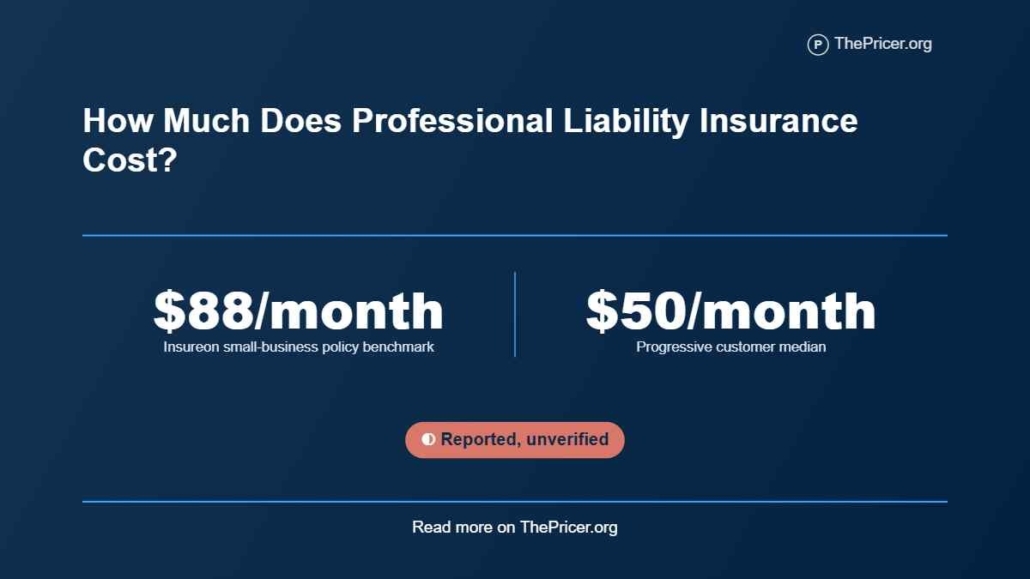
Professional liability insurance for a U.S. small business costs about $88 per month, or $1,051 per year, in Insureon’s current 100,000-customer policy dataset. Also called errors and omissions insurance or E&O insurance, professional liability covers eligible claims tied to professional services, advice, mistakes, omissions, and alleged negligence.
Consultants, accountants, designers, real estate professionals, technology firms, photographers, and other service businesses can face different premiums based on profession, revenue, employee count, policy limits, deductible, location, claims history, contract requirements, and claims-made terms.
The $88 figure is a marketplace benchmark rather than a universal rate. Simply Business reports a customer median of $42 per month, while Progressive Commercial reports a 2025 customer median of $50 and an average of $69 per month for new customers. Those benchmarks come from different books of business, so the best comparison is a quote matched by profession, coverage limit, deductible, business size, location, prior claims, and policy form. Physician and attorney malpractice pricing sits outside this page because those professions use specialized coverage structures.
Article Highlights
Jump to sections
- Insureon’s small-business customer data puts professional liability at $88 (at $30 per hour, earning that amount would take about 2.9 hours of work, before taxes) per month and $1,051 per year.
- Simply Business reports a current customer median of $42 per month.
- Progressive Commercial reports a 2025 median of $50 per month and an average of $69 per month.
- MoneyGeek’s 2026 model shows an employee-count spread four times its displayed state spread across the selected bands analyzed below.
- A deductible is not part of the annual premium, but it can materially change how much cash a business should keep available.
How Much Does Professional Liability Insurance Cost?
Published small-business figures differ because each company is measuring a different book of customers. The table keeps the statistic attached to its source instead of turning several unlike datasets into one supposed national range. Median and average are not interchangeable. A median marks the middle policy in the measured group, while an average can be pulled upward by expensive accounts.
| Published dataset | Monthly figure | Scope |
|---|---|---|
| Insureon | $88 (about 2.9 hours of work at $30 per hour) | Small-business customer policy data, with $1,051 annual figure |
| Simply Business | $42 | Median for policies purchased from July through December 2025 |
| Progressive Commercial | $50 median, $69 average | New customers in 2025 |
Within Progressive’s own 2025 book, the $69 average is $19 per month above the $50 median, a 38% gap. That difference shows why averages and medians should not be mixed casually across providers. Their customer mixes, risk classes, limits, deductibles, and insurer panels differ. Treat these figures as planning anchors rather than a rate card.
A useful quote comparison matches the profession, services, limits, deductible, revenue, staff, claims record, and requested effective date. That discipline is especially useful when reviewing a renewal quote against a published benchmark.
What Professional Liability Covers
Professional liability insurance pays for covered claims tied to professional work, such as alleged errors, omissions, negligence, missed duties, or inaccurate advice. It is also called errors and omissions insurance or E&O. The policy is aimed at financial harm connected to a service or recommendation, rather than a customer slipping in an office or a contractor damaging someone else’s property. Those physical injury and property-damage exposures belong under general business liability coverage.
The buyer is usually a service business whose client could claim that professional work caused a financial loss. Consultants, accountants, designers, real estate professionals, technology firms, photographers, and similar businesses fit that pattern. If a client contract names E&O, the quote needs to meet the stated policy form and limits. Those coverage details belong beside the premium because two quotes with different limits or deductibles are not equivalent purchases.
Medical malpractice is a specialized form of professional liability with a different risk structure, licensing setting, and price profile. Physicians and medical practices should compare against medical malpractice insurance pricing rather than treating a small-business E&O median as a physician quote. Technology firms also need to check whether professional-service claims and third-party cyber events are packaged together or purchased separately.
Costs by Profession
Profession can move the premium because the dollar impact of a professional mistake changes by occupation. Insureon reports that building design businesses pay professional liability at $142 per month, with a common policy profile of a $1 million (about 16 years of full-time work at $30 per hour) per-claim limit and a $1 million aggregate limit. Its photo and video customer data puts professional liability at $42 per month.
Those two Insureon profession pages create a displayed premium spread of $100 per month. The arithmetic is $142 minus $42. On a 12-month basis, the difference is $1,200. Building design is about 3.38 times the photo and video monthly benchmark. This is a comparison of two customer groups, not proof that occupation alone causes the entire difference. Revenue, staff, project size, limits, claims history, and other underwriting inputs can differ between the groups.
The pricing signal still matters for budgeting. A new design practice using a generic small-business median may undershoot its likely premium by a large amount. A photographer using a design-firm figure may budget far too much. The better starting point is the closest profession class available, followed by a quote that matches the firm’s own services and contractual limits.
Limits and Deductibles
A lower premium can hide a different amount of risk retained by the business. Policy limits set the insurer’s maximum payment under covered claims, while the deductible shifts a stated portion of covered loss back to the insured. The Hartford says its professional liability limits can run from $250,000 to $2 million, and its small-business customers typically pay about $76 monthly for standalone coverage. Its listed average minimum is $62 for standalone coverage and $41 for an endorsement.
That standalone-versus-endorsement difference is a do-not-compare warning. An endorsement can sit on another policy and may have a different form, limits, exclusions, and eligibility rules. A buyer should not choose the $41 line merely because it is below $62. The coverage has to satisfy the professional exposure and any client contract. A higher deductible can reduce premium, but it also increases the amount the business may need to fund when a covered claim arrives.
Contract requirements deserve their own check before limits are reduced. A policy that saves money but falls below a client’s required limit may fail the business purpose that triggered the purchase. The deductible should also fit available cash. A premium can be affordable while the retained claim amount is not.
Size and Location Effects
Business size and state can both shift a modeled premium, but they do not move by the same amount. MoneyGeek’s September 2026 model puts a sole proprietor at $38 per month, a business with one to four employees at $56 per month, and a business with 20 to 49 employees at a modeled $98 per month. Its standardized model uses quote data across 151 industries and describes the figures as estimates rather than guaranteed premiums.
Across those employee bands, the modeled spread from zero employees to 20 to 49 employees is $60 per month. The same MoneyGeek model places its state averages from $50 per month in North Dakota to $65 per month in New York, a $15 per month span. ThePricer’s calculated comparison is $60 divided by $15, or 4. Within this model, the displayed employee-count spread is four times the displayed state spread.
That four-to-one result is descriptive, not a causal underwriting rule. It does not say adding workers will multiply a real quote by four, and it does not erase profession, limits, deductible, revenue, claims history, or service mix. Its practical use is narrower. A business comparing a state average with its own quote should check whether its employee band and risk class match the modeled profile before treating geography as the main explanation for a price difference.
Claims-Made Costs
Most professional liability policies are written on a claims-made basis. Triple-I explains that a claims-made policy needs to be in force when the claim is made, with policy timing controlling whether prior professional work falls within coverage. Its professional liability coverage explanation also says policies often carry deductibles from $1,000 to $25,000. Policy wording controls the actual deductible and reporting rules.
This timing can change the real cost decision. Canceling a policy after a project ends does not automatically preserve protection for a claim filed later. The retroactive date, policy expiration, renewal continuity, and any extended reporting option need to be read together. A cheaper replacement can also create a coverage problem if prior acts are not treated the same way.
The hidden comparison is between today’s premium and the cost of preserving protection for earlier work. That price cannot be reduced to one national tail-coverage figure because extended reporting terms and charges vary by insurer and form. A buyer comparing renewals should ask each carrier how prior work is treated, whether the retroactive date is preserved, and what happens to reporting rights if coverage ends.
Real Quote Examples
 Published examples show how quickly scope changes the number. Hiscox gives an illustrative Texas business-consultant profile with $350,000 in annual revenue, a $1 million limit, a $5,000 deductible, and premium of $85.42 per month or $1,025 per year. The same page says E&O can start at $22.50 per month and advertises up to 5% savings when eligible coverage is bundled. Those are insurer figures, not promises for every applicant.
Two current Simply Business quotes show a different comparison. A Maryland tax preparer was quoted $33 per month for a $500,000 limit and $1,000 deductible, while a Virginia real estate agent was quoted $96 per month for a $1 million limit and $1,000 deductible. Both quotes are dated May 2026. The examples differ by profession, state, and limit, so the $63 monthly gap cannot be assigned to one factor.
For a worked example, use Insureon’s consultant book. Consultants pay a median $62 per month for professional liability, with a common $1 million per-claim limit, $1 million aggregate limit, and $1,000 deductible.
For a worked cash-planning example, assume the consultant keeps that $62 monthly premium for 12 months. Premium expense is $62 x 12 = $744. If the business also keeps the full $1,000 deductible available as a claim reserve, the cash-readiness target becomes $744 + $1,000 = $1,744. The deductible reserve is about 1.34 times the annual premium, and the combined reserve is about 2.34 times the annual premium.
The $1,744 figure is not the policy price. The modeled premium is $744. The extra $1,000 is cash held for the deductible and may never be spent. That distinction matters because a business can afford the premium yet lack enough liquid cash for the retained claim amount.
How to Compare Quotes
Start with matched coverage, not the lowest monthly line. Put the profession or service description, per-claim limit, aggregate limit, deductible, retroactive date, covered services, major exclusions, and policy period side by side. A client contract can set a minimum limit or require proof of coverage. If one quote changes any of those items, the price difference may reflect a different product rather than a better rate.
Technology firms should also check whether the quote combines professional services with third-party cyber exposure. The cost of cyber liability insurance answers a related but separate pricing question. A technology E&O form can connect those risks, while a standard professional liability form may not. Read the covered-services wording and cyber provisions before comparing the premium with a plain consultant policy.
Makes sense if
- You provide paid advice, designs, recommendations, or professional services that can cause a client financial loss.
- A contract requires E&O and the quote meets the stated limit and form requirements.
- You need continuous claims-made protection for work completed under earlier policy periods.
- You can fund both the premium and the selected deductible without straining operating cash.
Does not make sense if
- You are using professional liability as a substitute for general liability exposure involving bodily injury or property damage.
- The quoted form excludes the professional service that creates the business’s main exposure.
- The cheaper quote cuts limits below a client contract requirement.
- A specialized malpractice form is the policy actually required for the profession.
Answers to Common Questions
Is $88 per month a national price for every small business?
No. It is an Insureon customer-book benchmark. Other current customer datasets report different medians, and profession, limits, deductible, size, location, and claims history can move an individual quote.
Can a higher deductible lower the premium?
It can. A higher deductible shifts more covered claim cost to the insured. The premium may fall, but the business needs enough cash to pay the selected deductible if a covered claim triggers it.
Is professional liability the same as general liability?
No. Professional liability addresses covered claims tied to professional services or advice. General liability is aimed at risks such as third-party bodily injury and property damage.
Should a business cancel E&O after a project ends?
Not without checking the claims-made terms, retroactive date, and reporting rights. A claim filed after coverage ends may be treated differently from one filed while the policy is active.
Disclosure: Educational content, not financial advice. Prices reflect public information as of the dates cited and can change. Confirm current rates, fees, taxes, and terms with official sources before purchasing. See our methodology and corrections policy.