
How Much Does Professional Translation Cost Per Word?
Published on | Written by Alec Pow
This article was researched using 14 sources. See our methodology and corrections policy.
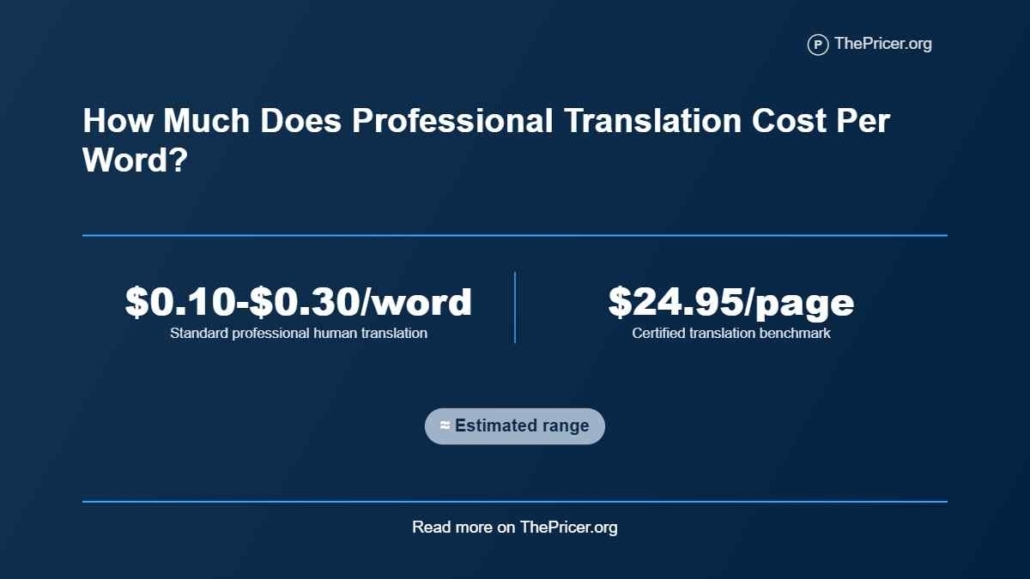
Professional human translation in the United States can reasonably be budgeted at about $0.10 to $0.30 per source word for many standard business jobs in 2026. That is a ThePricer planning estimate, not a national average. A July 2026 U.S. price guide places business translation in the same range, while specialist work, short-document minimums, certified page pricing, and added review can move the payable amount below or above it.
The pricing evidence comes from several distinct parts of the translation market. Gengo, RushTranslate, and U.S. Language Services publish human translation rates by the word, Smartling separates machine, AI-assisted, and traditional human service tiers, and the American Translators Association supplies an older professional-rate benchmark.
Certified document services add page definitions, minimum charges, rush delivery, proofreading, notarization, and other scope differences that can change the final invoice.
The quoted unit matters because a per-word rate does not always describe the whole job. Most business translation quotes use the source text, while certified records may be sold by the page and some character-based languages use character counts. A useful quote identifies the source-count method, language pair, service level, human review, deadline, minimum charge, and separately billed document or layout work.
Article Highlights
Jump to sections
- A working budget for many standard human jobs is $0.10 to $0.30 per source word.
- Current posted entry rates reviewed for this page include $0.09, $0.10, and $0.12 per word.
- A $24 (at $30 per hour, earning that amount would take about 48 minutes, before taxes) minimum can make a 100-word job cost an effective $0.24 per word.
- Specialized legal or technical marketplace pricing can reach $0.25 to $0.50 per word.
- Certified translation may be sold by the page instead of by the word, changing the comparison.
How Much Does Professional Translation Cost Per Word?
Posted U.S.-accessible prices show why one universal rate is hard to defend. Gengo lists Standard from $0.09 per word and Advanced from $0.18 per word. RushTranslate posts Standard at $0.10 per word. U.S. Language Services posts human translation at $0.12 per word with a $24 (about 48 minutes at $30 per hour) or 200-word minimum.
| Pricing evidence | Rate or benchmark | Scope |
|---|---|---|
| Gengo | $0.09 Standard and $0.18 Advanced | Posted starting rates per word |
| RushTranslate | $0.10 per word | Standard translation |
| U.S. Language Services | $0.12 per word | Human translation, subject to its minimum |
| ATA survey | $0.13 Spanish into English and $0.14 English into Spanish | Historical 2019 median source-word rates |
The American Translators Association supplies a useful professional benchmark, but its age needs to stay attached to the numbers. Its sixth compensation survey was completed in October 2021 and reports analyzed results from 2019. Median source-word rates included $0.13 for Spanish into English, $0.14 for English into Spanish, $0.16 for English into French, and $0.15 for English into Japanese. Those are historical practitioner data, not a 2026 rate schedule.
How Per-Word Billing Works
Per-word pricing usually starts with the text before translation. If a file contains 3,000 billable source words and the agreed rate is $0.15 per word, the translation line is $450 (about 1.9 full-time workdays at $30 per hour). That simple multiplication only works when the quote defines what counts as a billable word. Headers, text inside images, spreadsheets, captions, repeated strings, and noneditable files can be handled differently from one service to another.
Source-word billing gives the buyer a count before work begins. Target-word billing waits for the translated text, so the final word count can change with the language direction. Character-based billing is another possibility. A provider may count Chinese, Japanese, or Korean characters instead of space-separated words. Certified records create a separate pricing model because a provider can define a page by a maximum word count and sell the certification package at a flat page fee.
The service level also changes what the number buys. A low unit rate may cover one translator and basic delivery, while another quote may include proofreading, a second linguist, terminology work, project management, or layout. Machine output, AI-assisted human work, and traditional human translation should not be compared as if the deliverables were identical. The safest comparison uses the same source file, language direction, deadline, and review scope.
The Minimum-Charge Trap
A short file can make the advertised per-word rate a poor predictor of the amount paid. U.S. Language Services publishes a $24 minimum covering up to 200 words alongside its $0.12 per-word rate. The minimum and rate were cited in the current-rate section above. The payable amount for a short document is the larger of the minimum or the normal word-count charge.
ThePricer calculation shows the effect. In an illustrative 100-word job, 100 times $0.12 would be $12, but the minimum raises the invoice to $24. The effective rate is $0.24 per word. At 50 words, the same $24 floor produces an effective $0.48 per word. The threshold is 200 words because 200 times $0.12 equals $24. Past that point, the standard unit rate starts governing the translation line.
This is a useful quote check for birth certificates, short letters, labels, and brief records. A buyer comparing a $0.12 offer with a $0.18 offer could assume the lower rate always wins. It does not if the cheaper-looking provider has a minimum that dominates the small job. Ask for the final payable amount, not only the unit rate. For multi-file work, also ask whether the minimum applies to each document or to the whole order.
Certified Document Costs
Certified translation should be separated from ordinary business translation because the unit and deliverable can change. RushTranslate lists certified translation at $24.95 per page, while its standard service is sold per word. Its page-count policy is covered later in the verification block. For immigration filings, the legal requirement matters more than the billing label. Federal rules say a foreign-language document submitted to USCIS must include a full English translation certified as complete and accurate, plus the translator’s certification of competence.
That rule does not make notarization part of every USCIS translation. Buyers should match the order to the receiving authority’s stated document requirements before paying for extras. Readers pricing an immigration packet can connect the translation line to the wider K-1 visa cost, where translated civil records can sit beside filing, medical, travel, and document expenses.
A page quote can also beat a per-word quote on one document and lose on another. A sparse one-page certificate may carry a full page fee even when it has few words. A dense business file may be cheaper to compare by source word. Do not convert every page fee into a supposed industry per-word rate unless the provider states the page definition and the document actually fits that definition.
Language and Subject Premiums
 Language direction and subject matter can move a quote well outside a simple standard band. Upwork’s current translator cost guide lists common-language translation at $0.08 to $0.15 per word, niche-language work at $0.15 to $0.25, and specialized legal or technical translation at $0.25 to $0.50 per word. Marketplace guidance is not the same thing as a fixed agency rate, but it shows the premium attached to scarcer language pairs and subject expertise.
The marketplace bands also separate two effects that buyers often collapse into one. A less common language pair can raise the unit rate because fewer qualified translators may be available, while legal or technical subject matter can raise it again because the translator needs domain knowledge.
A quote for ordinary correspondence should not be used as a benchmark for a patent, clinical record, engineering manual, or contract merely because the source and target languages match.
Billing mechanics can change too. U.S. Language Services states that Chinese, Korean, and Japanese characters are counted as words for its standard service, and its order page shows a 50 percent expedited surcharge on eligible language combinations. A buyer with character-based source text should ask how characters convert to the quoted unit before comparing that offer with a provider using source words.
AI and Human Price Tiers
AI-assisted translation can cut the listed unit rate, but the review layer needs to be named. Smartling’s current pricing page starts machine translation at $0.0075 per word, automated AI Translation at $0.06, AI-Powered Human Translation at $0.12, and traditional human translation at $0.20. The same page states that some platform and language-service costs are separate from these rates.
ThePricer scenario makes the tier gap concrete. For an explicitly chosen 10,000 source-word project, the AI-powered human starting rate yields $1,200, while the traditional human starting rate yields $2,000. The difference is $800, equal to 40 percent of the traditional-human translation line. This scenario excludes platform charges, desktop publishing, managed services, and other items that may be billed outside the selected translation rate.
The lower tier is not automatically the better purchase. Internal knowledge-base text may tolerate a different workflow from a legal filing, marketing launch, medical document, or publication-ready report. Ask who reviews the output, what revision step is included, and what happens to repeated content. Those questions reveal whether two per-word prices describe comparable work.
Rush and Review Add-Ons
Deadline and review choices can turn a small base quote into a much larger payable amount. RushTranslate’s certified service lists expedited turnaround at $14.95 per page, proofreading by an added linguist at $9.95 per page, notarization at $19.95 per order, and a hard copy from $14.95. The provider identifies these as optional services for visa translation orders. That distinction matters because optional add-ons should not be presented as unavoidable translation fees.
For an illustrative two-page certified order, the base translation is two times $24.95, or $49.90. Adding expedited turnaround costs another $29.90, proofreading adds $19.90, and notarization adds $19.95. The calculated total is $119.65. The optional extras alone equal $69.75, so this chosen package costs about 2.4 times the base translation charge. Shipping and apostille service are excluded.
Rush pricing is not the only urgency model. Some services apply a percentage to the normal word charge instead of a fixed page add-on. For a broader adjacent cost, readers who actually need a notarized document can compare the separate notary cost rather than assuming certification and notarization mean the same service.
Comparing Quotes Fairly
A useful quote comparison begins with the same source file and the same requested output. Ask each provider for the source-word or character count, language direction, service tier, review stage, minimum charge, delivery time, file format, and separately billed layout work. If translation memory is part of a business workflow, ask how exact and fuzzy matches change the billable count. The sticker rate alone cannot show those differences.
Certified-document buyers should start with the receiving authority’s requirement, then price only the services needed to meet it. A citizenship applicant, visa applicant, university applicant, and business client may all use translated documents for different purposes. The related U.S. citizenship cost page shows where translation can sit inside a much larger application budget, but the translation quote still needs its own page count and certification scope.
Makes sense if
- The provider names the source-count method and language pair.
- The quote states whether proofreading or a second linguist is included.
- The minimum fee and rush policy are visible before ordering.
- The file format and layout work are part of the written scope.
Does not make sense if
- Two rates use different quality tiers but are treated as equivalent.
- A certified page fee is converted to a word rate without a page definition.
- A short job is compared without applying each provider’s minimum.
- Notarization or apostille work is added without a receiving-office requirement.
Answers to Common Questions
What is a reasonable translation cost per word?
A practical 2026 U.S. planning range for many standard professional human jobs is about $0.10 to $0.30 per source word. Specialist, urgent, certified, or higher-review work can sit outside that band.
Why can a short translation cost so much?
Minimum charges can dominate a small document. With a $24 minimum, a 100-word job has an effective cost of $0.24 per word even when the listed rate is $0.12.
Is certified translation charged per word?
Sometimes, but many official-document services use page pricing. A page definition may cap the number of words, so the buyer should compare page scope rather than dividing every page fee by an assumed word count.
Does AI translation always cost less?
The listed unit rate can be much lower, but machine, AI-only, AI-human, and traditional human tiers do not carry the same review scope. Compare the people, checks, and excluded services behind each rate.
Disclosure: Educational content, not financial advice. Prices reflect public information as of the dates cited and can change. Confirm current rates, fees, taxes, and terms with official sources before purchasing. See our methodology and corrections policy.