
How Much Does Proline Hemi Cost?
Updated on | Researched and reviewed by Alec Pow, Founder & Pricing Investigator
Prices, claims, and calculations checked against 15 cited sources. See our research methodology and corrections policy.
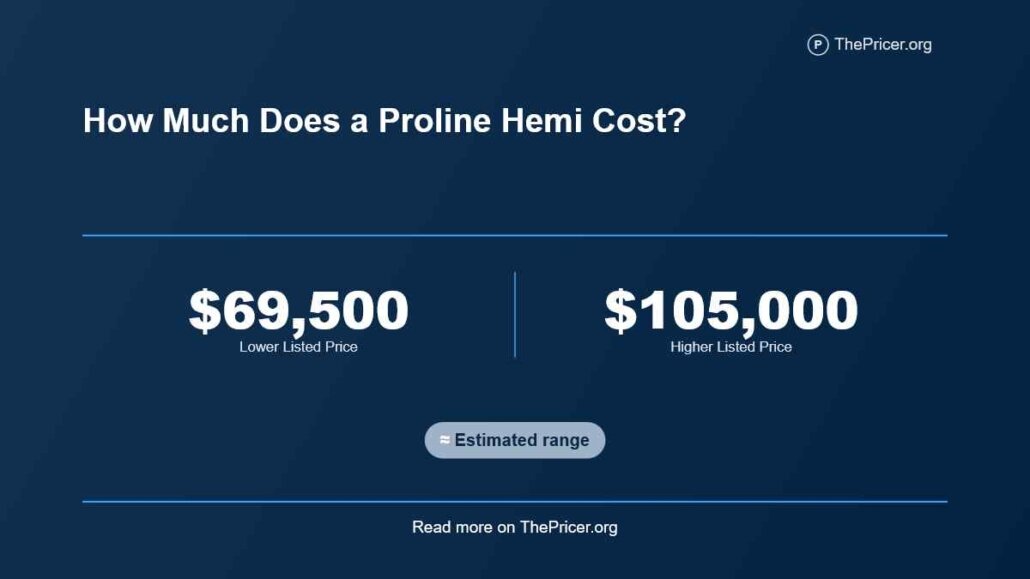
A Pro Line Racing (PLR) Hemi engine costs approximately $69,500 to $105,000 based on current advertised examples of its competition-grade raised-cam engines. A freshened 564-cubic-inch MH7 Hemi is listed for $69,500, while a low-run 588-cubic-inch AJPE Hemi is advertised at $105,000. Another freshened 564-cubic-inch engine was offered for $85,000 but is now marked sold.
These prices are for specific engines, not standardized new-engine packages. The $69,500 example has a repaired billet block following a previous connecting-rod failure. That condition matters as much as the advertised displacement or horsepower potential.
For budgeting, a buyer starting with a $69,500 used engine could spend roughly $77,000 to $85,000 before major fabrication, transmission upgrades, travel, and racing consumables. A more expensive engine, extensive electronics, or missing induction hardware can push the initial investment beyond $110,000. Those installed totals are planning scenarios, not official PLR package quotes.
Article Highlights
Jump to sections
- Current PLR listings include a $69,500 repaired-block 564ci Hemi and a $105,000 low-run 588ci Hemi.
- A separate $85,000 freshened 564ci engine is marked sold, providing useful historical transaction context but not a current offer.
- A comparable ACE Racing Engines 4.9-inch Noonan billet Hemi is advertised at $87,000.
- A FuelTech FT600 ECU is currently advertised from $2,299 on promotion to $2,999 at regular retail pricing, before appropriate wiring and sensors.
- The least expensive listed PLR engine has documented previous block damage, making inspection and repair records essential.
- Engine price, induction equipment, electronics, installation, dyno work, and ongoing maintenance must be quoted separately.
How Much Does a Proline Hemi Cost?
The strongest price evidence comes directly from Pro Line’s raised-cam Hemi listings. PLR builds combinations for Pro Mod, Radial vs. the World, No Prep, Outlaw 10.5, and other high-output drag racing categories.
| PLR engine | Advertised price | Condition and scope |
|---|---|---|
| 564ci MH7 Outlaw raised-cam Hemi | $69,500 | Freshened assembly with disclosed prior rod failure and repaired block |
| 564ci MH7 raised-cam Hemi | $85,000 | Freshened competition engine, currently marked sold |
| 588ci AJPE raised-cam Hemi | $105,000 | Used racing engine advertised with 22 total runs and newer rotating components |
The $69,500 MH7 listing identifies a repaired AJPE block, a Winberg crankshaft with 52 runs, new GRP rods, a mixture of new and previously used pistons, and freshened valvetrain components. PLR also lists a starter, flexplate, and 16 FuelTech injectors.
The description is unusually valuable because it discloses the engine’s repair history and individual component ages. Calling this simply a “fresh engine” would conceal information that could materially affect the purchase decision.
The $85,000 sold example was John Camp’s 564ci MH7 Hemi, freshened with rotating-assembly and valvetrain work. It is associated with a 2026 PDRA Pro Boost record-setting combination. The sold designation establishes that this specific offer is no longer available, not that its advertised price was necessarily the final negotiated sale amount.
At the high end of these examples, the $105,000 AJPE 588ci engine is advertised with 22 runs since new and five runs on its current rotating components. Its listing describes a complete engine from a competitive racing program.
These are asking prices for individual used engines. PLR does not publish one universal price for every newly commissioned raised-cam Hemi specification. A fresh custom build requires a specification-based quotation.
Why Condition Changes the Price
The spread between the lowest and highest current PLR examples is $35,500. Engine size and component selection contribute, but condition is an especially important variable in this small market.
Compare the $69,500 repaired-block engine with the $85,000 freshened example. The lower asking price is $15,500 less, or approximately 18.2% below the other advertised price.
That difference should not be described as a discount available to every buyer. The engines are not identical, and the cheaper assembly has a documented failure and repair history. The relevant question is whether the lower acquisition cost compensates for its condition, remaining component life, and future service exposure.
Before paying a deposit, request:
- The original build sheet identifying the block, crankshaft, connecting rods, pistons, cylinder heads, and valvetrain.
- Repair documentation, particularly for welded or otherwise restored billet-block damage.
- Run counts for the crankshaft, rods, pistons, valve springs, lifters, and other wear-sensitive parts.
- Recent leak-down, compression, and inspection results, where available and appropriate for the engine.
- Confirmation of which accessories in the listing photograph actually transfer with the engine.
Run counts are not interchangeable with a road-car mileage figure. A low-run engine can still have experienced a damaging event, while a higher-run assembly may have received extensive preventive maintenance.
Buyers should also confirm the exact meaning of “freshened.” New rods do not automatically mean a new crankshaft, block, cylinder heads, or complete rotating assembly. Those distinctions are visible in PLR’s own component-level disclosures.
What the Engine Includes
A raised-cam competition Hemi is not a conventional street crate engine. Its architecture, billet components, valvetrain, and induction requirements are selected for a particular racing combination.
A long-block generally includes the block, crankshaft, pistons, connecting rods, camshaft, cylinder heads, and valvetrain. Individual listings can additionally include an intake manifold, oiling components, starter, injectors, or other accessories.
Do not assume the following are included unless the quotation identifies them:
- ProCharger head unit or turbochargers
- Crank drive, belts, brackets, and associated induction hardware
- Fuel pumps, filters, regulators, and plumbing
- Engine-control computer, wiring harnesses, sensors, and ignition hardware
- Headers, exhaust fabrication, cooling equipment, and chassis-specific mounts
- Transmission, converter, clutch, driveshaft, or differential upgrades
- Installation, calibration, testing, freight, and applicable taxes
One source of confusion is the word “ProCharged.” A seller may be describing the combination in which an engine previously operated, rather than promising that the centrifugal supercharger is included in the sale. The written parts inventory determines what the buyer receives.
ProCharger’s Hemi application catalog advertises Pro Mod billet-block crank-drive kits starting at $4,923. That starting figure applies to the specified crank-drive product category, not a complete competition supercharger installation.
A buyer who assumes that a missing crank drive, complete head unit, intercooling arrangement, and plumbing can all be purchased for the crank-drive starting price could substantially underestimate the project.
Electronics and Tuning Costs
Engine management is a distinct part of the budget. The FuelTech FT600 remains a relevant option for high-output racing engines, although the amount paid depends on the retailer and whether the purchase includes wiring.
FuelTech’s FT600 product listing shows a regular price of $2,999. Summit Racing has advertised the same ECU part number at a $2,299 promotional price. Promotional availability can change.
The advertised computer price does not automatically cover a harness suitable for the car. An independent FuelTech dealer configuration lists the FT600 without a harness at $2,999, with a 10-foot unterminated harness at $3,328, and with a PRO600 complete harness at $4,698.
The spread between the ECU-only price and the listed complete-harness configuration is $1,699. That is a substantial addition even before checking the exact ignition and sensor hardware the engine requires.
Dyno and calibration services create another distinction. Performance Engine Fueling Innovations advertises a $1,000 daily rate for trackside or dyno tuning. Its terms exclude certain setup work, dyno facility charges, travel, food, and lodging.
Those exclusions mean a $1,000 tuner day is not necessarily a $1,000 finished calibration. A separate facility charge may apply, and the car might need wiring corrections, injector configuration, safety checks, and additional sessions.
Historical FuelTech dyno-day pricing showed $1,500 for a weekday rental and $1,800 for a weekend or holiday, with further charges for certain assistance. Those posted figures are useful examples of a facility-based pricing structure, but should not be treated as confirmed current bookings without a fresh quote.
For the broader distinction between an ECU purchase and the labor needed to configure it, see the cost of programming and tuning a car computer.
A Realistic Installed Budget
Consider a racer purchasing the currently advertised $69,500 PLR 564ci Hemi for an existing drag car that already has a compatible drivetrain and induction system. The owner needs an ECU, harness, initial tuning, installation labor, and some project supplies.
| Item | Example amount | Basis |
|---|---|---|
| PLR 564ci MH7 Hemi | $69,500 | Advertised engine price |
| FT600 with complete harness | $4,698 | Published dealer configuration |
| One day of specialist tuning | $1,000 | Published tuner day rate |
| Installation labor | $2,625 | Illustrative 15 hours at $175/hour |
| Fluids, fittings, and small parts | $1,000 | Illustrative allowance, not a published package price |
| Freight and handling | $750 | Illustrative allowance; obtain an actual carrier quote |
| Example subtotal | $79,573 | Before tax and unlisted equipment |
The installation labor assumption uses the $175 hourly engine-work rate published by TKM Performance as a reference point. Fifteen hours is a chosen scenario for a relatively compatible installation, not a verified national average for a PLR Hemi swap.
The calculation is $69,500 + $4,698 + $1,000 + $2,625 + $1,000 + $750 = $79,573.
This subtotal deliberately excludes a new supercharger system, major fabrication, a separate dyno facility fee, track testing, transmission changes, sales tax, and unexpected engine repairs. If the car lacks compatible induction hardware, the final bill can rise sharply.
A second useful comparison starts with the $105,000 PLR 588ci engine. Applying the same $10,073 of illustrative supporting expenses would produce an initial subtotal of $115,073. Actual needs may differ because the expensive engine can arrive with a different accessory package.
Neither example should be used as a universal turnkey quote. They show how the same supporting budget produces materially different totals depending on engine condition and purchase price.
PLR Versus Other Engines
 Pro Line is not the only builder of high-output billet Hemi combinations. ACE Racing Engines advertises a 4.9-inch Noonan billet Hemi at $87,000. Its published component specification includes a billet block, forged rotating components, cylinder heads, valvetrain, intake, and oiling hardware.
The ACE price provides a useful cross-check on the cost of a serious competition long-block. It does not establish that its accessory package, delivered readiness, power rating, or warranty terms match any particular used PLR listing.
A 556ci Noonan competition engine is separately advertised at $92,000, described as previously built as a spare and never run. This supports the existence of roughly six-figure standalone competition-engine offers outside PLR.
For a much less demanding application, Awesome Engines lists a 605ci, 1,200-horsepower ProCharger-oriented Hemi at $39,995, with stated options for additional equipment.
That lower-priced combination is not a like-for-like replacement for a max-effort PLR Pro Mod engine. It illustrates how significantly costs decline when the buyer’s actual horsepower requirement, race class, and intended duty cycle are less extreme.
Older reporting can also distort comparisons. A 2024 SlashGear article cited an $82,500 PLR raised-cam Hemi. That figure is historically useful but should not displace the actual PLR listings available in 2026.
The correct buying comparison is therefore not simply which engine has the smallest advertised price. It is which assembly meets the class rules and performance target with the fewest missing components and the most understandable service history.
Maintenance and Ownership
A competition Hemi is an ongoing engine program rather than a purchase that ends at installation. High boost, heavy cylinder pressure, specialized fuel systems, and aggressive operating conditions can make component inspections and refresh work routine.
Teams track run counts and condition for rods, pistons, valve springs, lifters, crankshafts, and related parts. Actual replacement schedules depend on the combination, tune, operating conditions, and engine builder’s recommendations. A universal fixed rebuild interval would be misleading.
Budget separately for:
- Periodic teardown and inspection
- Wear components and replacement valve springs
- Machining, sleeves, and block repairs when needed
- Oil, filters, spark plugs, and race fuel
- Supercharger or turbocharger servicing
- Engine transport, track support, and troubleshooting
Routine passenger-car engine rebuild prices are useful for understanding ordinary machining and labor charges, but they are not a reliable complete refresh quote for an AJPE billet Hemi.
Likewise, typical street-car supercharger installation costs do not represent the complete induction engineering required for a competitive Pro Mod engine.
Keep PLR Hemi ownership separate from a professional Top Fuel dragster budget. Top Fuel engines use a different racing specification and operating model. Applying their per-run parts costs directly to a ProCharged door-car Hemi would give a false maintenance estimate.
A buyer comparing two similarly priced engines should ask for the next anticipated refresh date and a parts list for that work. A cheaper engine approaching a major refresh may have a higher first-season cost than a more expensive assembly with recently documented service.
Answers to Common Questions
How much is a new Pro Line Hemi engine?
There is no single publicly verified fixed price for every newly commissioned PLR raised-cam Hemi. Current advertised used and freshened examples range from $69,500 to $105,000. Request a specification-based quote for a completely new assembly.
Why is the $69,500 Proline Hemi cheaper?
The listing discloses a previous connecting-rod failure that damaged the billet block. PLR repaired the block and documented the sleeves and component histories. Buyers should evaluate that repair alongside the lower asking price.
Does a Proline Hemi price include a ProCharger?
Not automatically. A listing may identify the supercharged racing combination without including the blower itself. Obtain a written inventory covering the head unit, drive, fuel system, engine electronics, and accessories.
How much does a Proline Hemi cost installed?
For a compatible race car using the advertised $69,500 engine, the worked example totals $79,573 before taxes and major missing equipment. A higher-priced engine, new induction system, extensive wiring, or fabrication can put the project above $110,000.
Is a used PLR Hemi worth buying?
It can be, particularly when the build sheet, run counts, and inspection history are complete. The purchase price alone is insufficient. Compare the remaining component life, included equipment, and expected first-season refresh costs before deciding.
Disclosure: Educational content, not financial advice. Prices reflect public information as of the dates cited and can change. Confirm current rates, fees, taxes, and terms with official sources before purchasing. See our methodology and corrections policy.