
How Much Does Red Diesel Cost?
Published on | Written by Alec Pow
This article was researched using 12 sources. See our methodology and corrections policy.
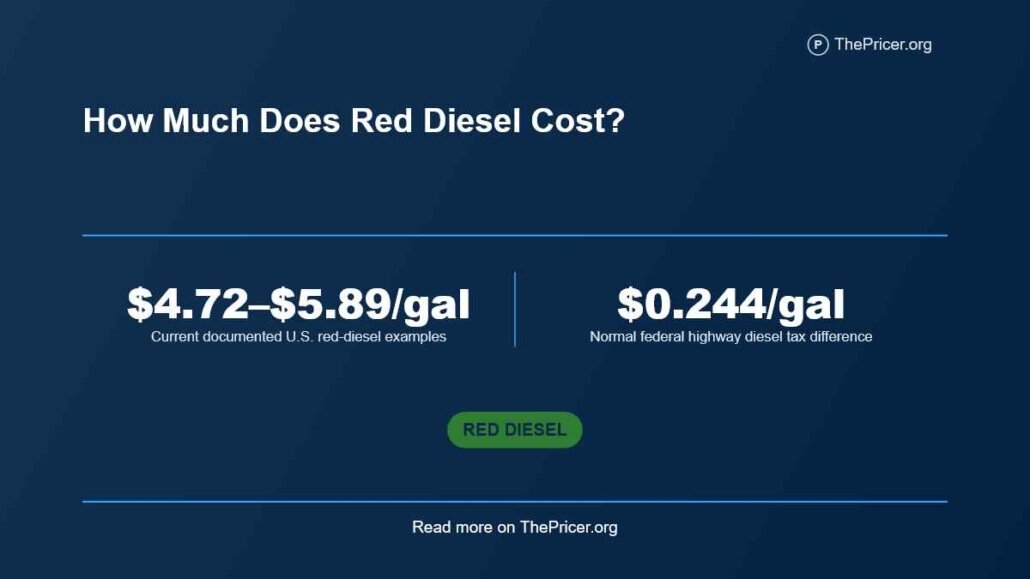
Red diesel currently costs about $4.72 per gallon in one verified October 2026 Ohio market example, but there is no national U.S. red-diesel average. Prices change by state, supplier, delivery volume, terminal price and tax treatment. Scott Equity Exchange posted off-road diesel at $4.719 per gallon on October 6, compared with $5.659 for its on-road diesel.
Red diesel is suddenly national news because President Donald Trump temporarily opened dyed diesel to highway use as ordinary diesel prices climbed above $6 per gallon. The U.S. Energy Information Administration put the national on-highway diesel average at $6.199 per gallon on October 5, 2026. The administration says the temporary measure is intended to reduce fuel costs for truckers, farmers and other diesel users while global diesel supplies remain tight.
The relief is temporary. Trump’s October 5 executive order directs Treasury to defer qualifying federal diesel excise-tax payments and suspends the normal federal dyed-diesel highway-use penalty through December 31, 2026. Unless that policy is extended or federal law changes, ordinary highway restrictions return after year-end. Red diesel itself is not being banned.
Smaller diesel vehicles can also burn red diesel mechanically because the dye identifies its tax status rather than creating a special tractor-only fuel. During the temporary federal relief period, however, a diesel pickup or passenger car receives far less financial benefit than a 200- or 250-gallon truck fill. A 25-gallon purchase represents only $6.10 of the normal 24.4-cent federal highway tax.
Article Highlights
Jump to sections
- Scott Equity Exchange listed off-road diesel at $4.719 per gallon on October 6, 2026.
- The same Ohio supplier listed clear on-road diesel at $5.659 per gallon, a difference of 94 cents per gallon.
- The national average price for on-highway diesel was $6.199 per gallon for October 5.
- The normal federal highway diesel tax is 24.4 cents per gallon.
- A 25-gallon diesel pickup fill represents only $6.10 of federal diesel tax, compared with $61 on 250 gallons.
- Trump’s October 5 order temporarily permits broader highway use of dyed diesel and provides federal penalty relief through December 31, 2026.
- The order initially provides for tax deferral, not automatic permanent forgiveness of every deferred tax liability.
- Unless the relief is extended, normal federal dyed-diesel highway restrictions return after December 31.
- State taxes and dyed-diesel rules remain separate and can materially change the actual saving.
How Much Does Red Diesel Cost?
There is no federal weekly red-diesel price series comparable with the national highway-diesel survey, so a responsible current price has to be built from dated local quotes rather than presented as a fabricated national average.
Scott Equity Exchange, an agricultural cooperative with locations in northwest Ohio, posted October 6 fuel prices of $4.719 per gallon for off-road diesel and $5.659 per gallon for on-road diesel. Its gasoline price on the same date was $3.419.
The observed off-road versus on-road spread at that supplier was:
$5.659 – $4.719 = $0.940 per gallon.
That 94-cent gap is not a national red-diesel discount. It reflects one supplier, one location and one date, including the tax and market conditions embedded in those posted prices.
For comparison, the national on-highway diesel average was $6.199 per gallon for the week of October 5. Regional averages ranged from $5.819 on the Gulf Coast to $7.229 on the West Coast, while California averaged $8.082.
| Diesel price measure | Current price | Scope |
|---|---|---|
| Ohio off-road diesel | $4.719/gal | Scott Equity Exchange, Oct. 6 |
| Ohio on-road diesel | $5.659/gal | Same supplier and date |
| U.S. highway diesel | $6.199/gal | EIA national average, Oct. 5 |
| Federal highway diesel tax | $0.244/gal | Normal federal tax burden |
A farmer, contractor or fleet operator should therefore ask for a local delivered quote rather than assume red diesel will cost $4.72 everywhere.
Why Red Diesel Is in the News
Red diesel moved from an agricultural fuel topic into national news because U.S. diesel prices surged during a global shortage of refined fuels. Reuters reported that the administration’s October 5 action followed diesel prices reaching roughly $6.50 per gallon amid disruptions associated with the Iran conflict, the Russia-Ukraine war and broader pressure on global fuel supplies.
The October 5 policy announcement also came less than a month before the November midterm elections, making diesel affordability a political as well as an economic story. High diesel prices move through trucking, farming, construction and goods distribution, so their effect reaches households that never buy diesel themselves.
The problem is not simply crude oil. Global diesel supplies have become unusually tight as refining disruptions and logistical problems reduced the amount of finished fuel available. Reuters reported in September that U.S. distillate inventories were at their lowest seasonal level on record and that the global shortage could extend into 2027.
Opening red-dyed fuel to highway users does not create new diesel molecules. It temporarily allows fuel sitting in an off-road distribution channel to serve a broader group of users and changes the tax treatment of those gallons.
That is why the policy may lower the bill for someone who can actually obtain red diesel without solving the underlying supply shortage.
Why Red Diesel Is Cheaper
Red diesel is dyed so tax authorities can identify fuel sold for uses that normally do not pay the highway diesel excise tax. Common qualifying uses include farm machinery, construction equipment, generators and other off-highway applications.
The federal highway diesel tax is 24.4 cents per gallon. That figure includes the 24.3-cent diesel excise tax plus the 0.1-cent Leaking Underground Storage Tank tax component described by the U.S. Energy Information Administration.
State highway taxes can add considerably more. Their treatment varies, so red diesel can be much more than 24.4 cents cheaper than clear diesel in one state and have a smaller spread somewhere else.
The current Ohio quote illustrates the difference. The same supplier’s red diesel was 94 cents cheaper than its on-road diesel. The federal tax accounts for only 24.4 cents of that spread. State taxes, supplier pricing and other market factors account for the rest.
At those exact posted prices, a 250-gallon purchase would cost:
250 × $4.719 = $1,179.75 for off-road diesel.
The same volume of the supplier’s on-road fuel would cost:
250 × $5.659 = $1,414.75.
The difference is $235.
That is a useful current market scenario, not proof that every 250-gallon red-diesel purchase saves $235.
The fuel-cost distinction matters when estimating the operating expense of a farm tractor or a diesel-powered bulldozer. High-consumption equipment turns even a 20- or 30-cent difference into meaningful annual spending.
Cars and Pickups
Red diesel is not formulated only for tractors, excavators or semitrucks. ABC News notes that dyed diesel is nearly identical to ordinary clear road diesel apart from the identifying dye. A modern diesel pickup, van, SUV or passenger car can therefore burn suitable dyed ultra-low-sulfur diesel from a fuel-composition standpoint.
The larger issue has historically been legal use, not engine size. Under normal rules, putting tax-exempt dyed diesel into a highway vehicle can trigger federal taxes and severe penalties. The temporary 2026 policy changes that federal enforcement position for the stated relief period.
The economics are also much weaker for a small vehicle than for a tractor-trailer. Using only the normal 24.4-cent federal diesel tax:
| Fuel purchase | Federal tax represented |
|---|---|
| 15 gallons | $3.66 |
| 25 gallons | $6.10 |
| 40 gallons | $9.76 |
| 100 gallons | $24.40 |
| 250 gallons | $61.00 |
A diesel pickup taking 25 gallons therefore receives only about $6.10 of federal-tax relief. A large truck taking 250 gallons has $61 of federal tax in the same calculation.
The Ohio supplier spread gives a larger local scenario. At 94 cents per gallon, 25 gallons creates a $23.50 price difference. That may sound more attractive, but finding the fuel can erase some of the benefit because red diesel is concentrated around farms, bulk suppliers and commercial users rather than every retail filling station.
For an ordinary diesel-car owner, driving a considerable distance to save $6 to $20 on a fill can defeat the purpose.
What Happens After December 31?
 Red diesel is not facing a ban on January 1, 2027. It will remain available for lawful off-road and other qualifying uses. What is scheduled to end is the temporary federal relief allowing much broader highway use without the ordinary dyed-fuel penalty.
Trump’s October 5 executive order covers fuel sold or used on highways during the period from October 5 through December 31, 2026. The order directs the IRS not to impose the normal federal dyed-diesel penalties during that window and directs Treasury to consider deferring qualifying excise-tax liabilities.
Unless the relief is extended, Congress changes the law or Treasury issues other lawful relief, the pre-existing federal highway restrictions apply again after the temporary period.
That creates an unusual practical problem. Red dye can remain detectable after the fuel itself has been diluted by later fills of clear diesel. MarketWatch reports that residual dye after expiration could complicate future enforcement if authorities test vehicle fuel systems after the waiver period.
A driver who lawfully uses dyed diesel during the temporary period should therefore keep dated receipts and any documentation showing when and where the fuel was purchased and used.
The phrase “red diesel ban” can mislead readers. The fuel is not disappearing. The real deadline is the scheduled end of an exceptional highway-use period.
Is the Tax Really Gone?
The administration has repeatedly described the policy as tax relief, but the executive order uses more careful legal language. It directs Treasury to determine whether it can defer payment of certain federal diesel excise taxes incurred during the October 5 through December 31 period.
The White House diesel affordability fact sheet says the order also directs Treasury to explore pathways to eliminate the obligation to pay those deferred taxes.
Those are two different outcomes:
- Deferral: payment is postponed.
- Forgiveness: the liability is permanently eliminated.
The executive order initially provides a pathway for the first and asks Treasury to investigate the second. A driver or business should not treat every deferred 24.4 cents as permanently forgiven until the implementing rules establish that result.
The arithmetic behind the immediate cash-flow benefit is still straightforward. At 250 gallons:
250 × $0.244 = $61.
At 1,000 gallons:
1,000 × $0.244 = $244.
A fleet buying 20,000 gallons during the covered period temporarily avoids paying:
20,000 × $0.244 = $4,880
in that federal tax component, subject to the final rules governing who qualifies and whether the liability is later eliminated or merely collected at a later date.
Bulk Delivery Costs
Red diesel is often bought differently from ordinary retail highway fuel. Farms, construction companies and generator operators commonly receive bulk deliveries into on-site tanks. That makes freight, minimum order size and storage part of the real per-gallon cost.
A supplier can quote a competitive base fuel price but charge more for a small delivery, an emergency fill or a remote site. The delivered invoice may include the terminal fuel price, distributor margin, freight and any applicable taxes or fees.
Volume therefore matters independently of the tax advantage. A $300 delivery charge spread across 200 gallons adds:
$300 ÷ 200 = $1.50 per gallon.
The same $300 spread across 2,000 gallons adds only:
$300 ÷ 2,000 = $0.15 per gallon.
That difference is larger than the normal 24.4-cent federal highway tax in the small-delivery case.
This is one reason a household diesel owner may gain little from chasing red diesel while a farm buying thousands of gallons can have a stronger economic case. The large buyer can spread delivery costs across more fuel and already has storage infrastructure.
Storage has its own expenses. Tanks, pumps, filters, spill protection, security and cash tied up in inventory all belong in the ownership calculation. A diesel generator rental can show the same cost interaction: the equipment rate is only one part of the bill when continuous fuel supply is required.
State Rules Still Matter
The federal order does not automatically suspend every state diesel tax. State governments control their own motor-fuel taxes and can set separate rules for dyed fuel used on public roads.
North Carolina provides a clear example. Its Department of Revenue announced temporary dyed-diesel penalty relief for qualifying farming and agricultural highway use through December 31. The operator or seller must still pay North Carolina’s 41-cent-per-gallon state excise tax and file the required backup-tax return.
That means “federally allowed” does not automatically mean “tax-free in every state.”
Texas normally imposes a 20-cent-per-gallon diesel tax, while qualifying off-road agricultural users can purchase dyed diesel without that highway tax under the state’s agricultural fuel rules.
California uses another structure. The California Department of Tax and Fee Administration explains that properly used dyed diesel can avoid the state’s diesel excise tax but may still face sales and district taxes, with special partial exemptions available to qualifying farm activity.
The state layer becomes especially difficult for interstate trucking. A truck can purchase fuel under one state’s emergency policy and then travel through jurisdictions with different tax and documentation rules.
Businesses crossing state lines should therefore treat the federal order as one part of the compliance question rather than a nationwide replacement for state fuel-tax law.
The Legal Risk
Ordinary federal law makes unauthorized dyed-diesel use expensive. IRS Publication 510 says the normal penalty is the greater of $1,000 or $10 for every gallon involved, in addition to any tax due.
The IRS dyed-fuel penalty means a 250-gallon violation can produce a $2,500 gallon-based penalty:
250 × $10 = $2,500.
For 50 gallons, $10 per gallon would equal $500, so the $1,000 minimum would apply instead.
The October 2026 federal order temporarily tells the IRS not to impose those specified dyed-diesel penalties for qualifying highway sale and use during the covered period. That protection should not be projected beyond December 31 without a later extension or rule.
Documentation becomes valuable because a red tint in a fuel system does not itself tell an inspector when the fuel was purchased. A driver using the temporary relief should retain invoices showing the date, supplier, quantity and vehicle or business use where practical.
The legal risk also explains why buying dyed diesel solely to save a few dollars in a passenger car can be a poor trade once the temporary period ends. A small fill produces a modest tax advantage, while an unauthorized future use can trigger a four-figure minimum federal penalty.
For farms, construction companies and other traditional off-road users, the calculation is different. Red diesel remains part of normal lawful operations even after the temporary highway relief expires, provided it is used for qualifying purposes.
Answers to Common Questions
How much does red diesel cost per gallon?
Scott Equity Exchange in Ohio listed off-road diesel at $4.719 per gallon on October 6, 2026. There is no single national red-diesel average, so local quotes can be higher or lower.
Why is red diesel suddenly in the news?
U.S. highway diesel prices have risen above $6 per gallon amid tight global refined-fuel supplies. President Trump responded on October 5 by temporarily opening dyed diesel to broader highway use and directing federal tax and penalty relief through year-end.
Is red diesel being banned?
No. Red diesel will remain legal for qualifying off-road uses. What is scheduled to end after December 31, 2026 is the temporary federal relief allowing broader highway use without the normal dyed-diesel penalty.
Can I put red diesel in a diesel pickup?
From an engine-fuel standpoint, suitable dyed diesel is essentially the same diesel apart from its identifying dye. The major issue is whether the use is legally permitted and properly taxed. The temporary federal policy changes those rules through December 31, subject to implementing guidance and state law.
Can a diesel car use red diesel?
Mechanically, a diesel passenger vehicle can use compatible red-dyed diesel. Under ordinary law, however, tax-exempt dyed diesel cannot simply be used for normal highway driving. The 2026 federal relief is temporary.
How much would a diesel pickup save?
The normal federal highway tax represents only $6.10 on 25 gallons. Local state-tax differences can increase the price gap, but availability and travel distance can reduce the practical saving.
Disclosure: Educational content, not financial advice. Prices reflect public information as of the dates cited and can change. Confirm current rates, fees, taxes, and terms with official sources before purchasing. See our methodology and corrections policy.