
How Much Does Red Mountain Weight Loss Cost?
Updated on | Written by Alec Pow
This article was researched using 14 sources. See our methodology and corrections policy.
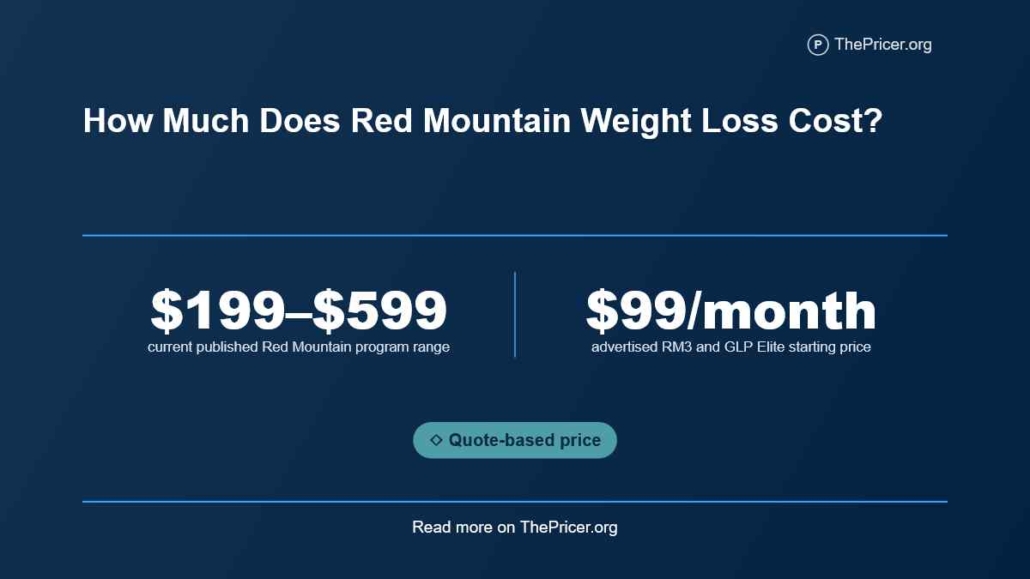
Red Mountain Weight Loss currently publishes more than one price structure, so there is no single reliable monthly figure for every patient. Its main program page lists weight-loss programs at $199 to $599, while current RM3 and GLP Elite pages say programs start as low as $99 per month.
Several location pages also list a $55 new-patient consultation that is credited toward the program when the patient enrolls. Medication, lab work, supplements, shipping choices, and the selected program can change what is paid beyond the advertised starting figure.
The most useful question is not simply what Red Mountain costs per month. It is what the quoted price includes. RM3 includes its proprietary medication, while GLP Elite states that weight-loss medications are sold separately. That distinction can change the real treatment bill more than the difference between two advertised program prices.
Article Highlights
Jump to sections
- Red Mountain’s current general program page lists weight-loss programs at $199 to $599 (at $30 per hour, earning that amount would take about 0.8 to 2.5 full-time workdays, before taxes).
- Current RM3 and GLP Elite pages advertise starting prices as low as $99 per month.
- Several location pages list a $55 initial consultation and apply that fee toward the program when a patient enrolls.
- RM3 includes its proprietary medication, while GLP Elite says weight-loss medication is sold separately.
- Current Red Mountain promotions state that lab fees can be excluded from the advertised offer.
- HSA or FSA funds may cover eligible treatment, but eligibility is different from insurance reimbursement.
How Much Does Red Mountain Weight Loss Cost?
Red Mountain’s current program pricing page says its weight-loss programs range from $199 to $599 (about 0.8 to 2.5 full-time workdays at $30 per hour), depending on the plan, and lists a $55 consultation when a patient does not start a program. A current Arizona location page gives more detail. It says the new-patient fee is $55, that the consultation fee is applied to the selected program after enrollment, and that the one-time program cost ranges from $199 to $599.
Those published numbers do not support the old claim that Red Mountain normally costs $200 to $800+ per month. The company’s own one-time range spans $400. Its $599 upper figure is about three times the $199 lower figure, which shows how much program selection can matter even before separate medication or lab charges enter the bill.
Another complication is newer pricing language. RM3 and GLP Elite now advertise plans starting at $99 per month. That billing unit is different from the $199 to $599 one-time program range still displayed elsewhere. Do not multiply either number into a yearly budget until Red Mountain identifies the chosen program, billing period, medication cost, and required testing in writing.
Red Mountain Shows Different Prices
Red Mountain appears to be using several current offers and billing structures at the same time. Its RM3 page advertises programs starting at $99 per month. The page says RM3 includes its proprietary medication, a low-calorie food plan, monthly clinical consultations, and lifetime maintenance. That is a different presentation from location pages describing a $199 to $599 (about 0.8 to 2.5 full-time workdays at $30 per hour) one-time program cost.
The current GLP program creates another variation. Red Mountain’s GLP Elite page also starts at $99 per month, but it states that weight-loss medications are sold separately. It includes a flexible diet plan, monthly consultations, and lifetime maintenance. A person seeing the same $99 starting figure on RM3 and GLP Elite is not necessarily buying the same bundle.
This is the hidden-price issue. A base fee can describe access to the program rather than the full treatment cost. Red Mountain does not publish enough matched detail on these pages to convert the advertised figures into one national monthly average. The useful comparison is package by package. Before enrollment, ask which published price applies at that location, whether it is one-time or recurring, and whether medication is inside or outside that figure.
What Each Program Includes
Red Mountain currently presents four weight-loss paths with different levels of medication and support. The table below uses the company’s current descriptions rather than older program names or invented monthly tiers.
| Program | Current structure | Medication relationship | Public price status |
|---|---|---|---|
| RM3 | Diet plan, monthly consultations, maintenance | Proprietary RM3 medication included | Programs advertised from $99/month |
| GLP Elite | Flexible diet plan, monthly consultations, maintenance | Weight-loss medication sold separately | Programs advertised from $99/month |
| DirectMed | Medication auto-ship with less program structure | Centered on prescribed weight-loss medication | Personalized pricing |
| Lifestyle | Macronutrient plan for weight loss or maintenance | Appetite suppressants, boosters, vitamins, and supplements can be added | Falls under broader published program pricing |
The current program comparison describes DirectMed as an auto-ship medication option with less program structure than RM3 or GLP Elite. Red Mountain’s Lifestyle program uses an individualized macronutrient plan and says patients may add prescription appetite suppressants, weekly Fat Burner Boosters, and medical-grade vitamins or supplements.
The table should not be read as a medical recommendation or a ranking. It is a billing map. Each path can create a different mix of program fees, medication charges, testing, and optional products.
Medication

Medication is the biggest reason a program headline can differ from the amount paid during treatment. GLP Elite explicitly separates weight-loss medication from the program price.
Red Mountain’s current GLP promotional terms also warn that compounded medications are not FDA approved or reviewed by FDA for safety, effectiveness, or quality. That disclosure matters because the medication charge can sit outside the advertised program fee.
FDA’s current compounded GLP-1 guidance says unapproved versions do not undergo the agency’s premarket review and notes reported dosing errors and adverse events involving compounded semaglutide and tirzepatide.
This does not establish what Red Mountain will prescribe to any patient. It explains why the medication name, source, dose, and price need to be identified separately from the program fee.
Red Mountain’s payment policy adds another cost detail. If a telemedicine patient chooses a written prescription to fill at another pharmacy, the full program fee still applies.
Moving the prescription elsewhere does not erase the program charge. The same policy says prescription medication fees are collected when medication is ordered, which is another reason not to assume that an advertised program price already represents the final monthly spend.
Labs, Supplements, Shipping
New patients can encounter charges outside the headline program figure. Red Mountain’s current GLP promotion says lab fees are not included in that offer. RM3 and Lifestyle pages also state that new patients complete lab work before starting treatment. No current national Red Mountain lab price is published on the pages reviewed, so adding a generic laboratory allowance would create a number the company does not support.
Lifestyle can also include optional appetite suppressants, Fat Burner Boosters, and medical-grade vitamins or supplements. Those items should be treated as separate only when the patient’s quote lists them separately. RM3 has different inclusions, so copying Lifestyle add-ons into an RM3 budget can double count part of the treatment.
Shipping has its own terms. The payment and shipping policy says standard shipping applies to medications from its pharmacy partner and expedited shipping can cost extra. Some membership offers include free medication shipping. Add-ons can accumulate, but there is no defensible universal $50 to $300 monthly supplement charge for every patient.
Keep the written quote itemized. Program access, medication, labs, supplements, shipping, and elective products should each appear once. That makes a $99 starting price or a $599 package far easier to compare with another medical weight-loss service.
HSA, FSA, and Financing
Red Mountain’s current payment options include CareCredit, Advanced Care Card, and HSA or FSA funds for weight-loss services, subject to the applicable terms. Those payment methods should not be described as insurance coverage. Financing changes when the bill is paid, while HSA and FSA accounts use tax-advantaged money for expenses that meet eligibility rules.
The IRS gives the more important boundary. Its current guidance says a weight-loss program may qualify for HSA or FSA reimbursement when it treats a specific disease diagnosed by a physician, such as obesity, diabetes, hypertension, or heart disease. A weight-loss program purchased only for appearance or general wellness does not qualify under that rule.
This means “Red Mountain accepts HSA/FSA” is not the same statement as “every Red Mountain purchase is HSA/FSA eligible.” Program fees, prescribed medication, supplements, and food products can fall under different eligibility rules. Patients using tax-advantaged funds should keep the medical documentation and receipts required by their plan administrator.
Interest-free financing offers can also carry eligibility and term requirements. Compare the cash price, financed principal, fees, payment schedule, and total repayment rather than choosing by monthly payment alone.
The First Payment
The clearest worked example comes from Red Mountain’s location pricing. Assume the patient uses the Swan terms cited earlier, pays the $55 new-patient consultation, and then enrolls in a program priced at the published low end of $199.
Because the consultation is credited toward the program, the remaining program balance is $144. The arithmetic is $199 – $55 = $144. Total program spending remains $199, not $254, before separately billed medication, labs, or add-ons.
At the published high end, the same structure would leave $544 after the consultation because $599 – $55 = $544. Total program spending remains $599. This is an illustrative billing model based on the location page, not a promise that every Red Mountain location or current promotion uses the same credit.
A second useful calculation comes from Red Mountain’s medication-discount membership. The Red Club costs $399 per year, while current terms advertise a $299 discount on a new member’s first medication order from the named compounding pharmacy. Using only those two figures leaves $100 of membership cost to recover through later eligible discounts or other benefits before the membership pays for itself on discounts alone. That calculation ignores taxes, future medication purchases, and non-medication benefits.
How to Compare Quotes
Start by matching program scope rather than comparing one monthly number. RM3 includes its proprietary medication. GLP Elite separates medication. DirectMed centers on medication auto-ship. Lifestyle allows optional medication and booster additions. A Red Mountain quote should identify the program name, billing period, consultation credit, required labs, included medication, separate prescriptions, supplements, shipping, and any membership fee.
For broader market comparisons, SOTA Weight Loss pricing and Livea pricing should be compared by what the fee buys rather than by headline cost alone. A fitness-only service such as D1 Training is another category because it does not replace clinician-led medication management.
Makes sense if
- The written quote names the program and billing period.
- Medication is marked as included or separately priced.
- Required lab work and optional products are identified before enrollment.
- The patient knows whether the consultation fee is credited to the program.
Does not make sense if
- A $99 starting price is treated as the complete cost without checking medication and labs.
- The $199 to $599 one-time range is converted into a monthly average without a stated billing term.
- HSA or FSA acceptance is treated as proof that every purchase qualifies.
- A financing payment is compared without the total amount financed and repayment terms.
Answers to Common Questions
How much does Red Mountain Weight Loss cost?
Current official pages list programs at $199 to $599, while RM3 and GLP Elite advertise starting prices as low as $99 per month. The figures use different billing language, so the exact program and included medication need to be confirmed.
How much is the Red Mountain consultation?
Several current location pages list an initial consultation at $55. Those pages say the fee is applied toward the program if the patient enrolls.
Is medication included in Red Mountain’s price?
It depends on the program. RM3 includes its proprietary medication. GLP Elite states that weight-loss medication is sold separately, and Lifestyle can add prescription products when selected.
Does Red Mountain accept HSA or FSA funds?
Red Mountain lists HSA and FSA as payment options for eligible weight-loss services. Federal eligibility rules still depend on the medical purpose of the expense and the account’s requirements.
Does Red Mountain use compounded GLP-1 medication?
Red Mountain says it may prescribe compounded semaglutide or tirzepatide. The company and FDA both state that compounded GLP-1 products are not FDA approved or reviewed by FDA for safety, effectiveness, and quality.
Disclosure: Educational content, not medical advice. Pricing varies by provider, location, and insurance. Confirm eligibility, coverage, and out-of-pocket costs with a licensed clinician and your insurer. See our methodology and corrections policy.