
How Much Does Reverse Health Cost?
Published on | Written by Alec Pow
This article was researched using 12 sources. See our methodology and corrections policy.
Reverse Health uses personalized subscription offers rather than one fixed public checkout price. The amount shown to a new user can change with the plan, purchase channel, location, and promotional offer presented after the signup quiz.
For U.S. buyers, the main distinction is between a discounted first subscription period and later recurring billing. Optional programs sold through the app can create separate charges beyond the core membership.
The first payment is promotional. The renewal is separate.
How Much Does Reverse Health Cost?
Jump to sections
Reverse Health can start at about $7 per week through promotional pricing, with current independent research placing common subscription pricing around $20 to $40 (at $30 per hour, earning that amount would take about 0.7 to 1.3 hours of work, before taxes) per month, depending on the offer and purchase route, according to an August 2026 pricing review.
Important numbers
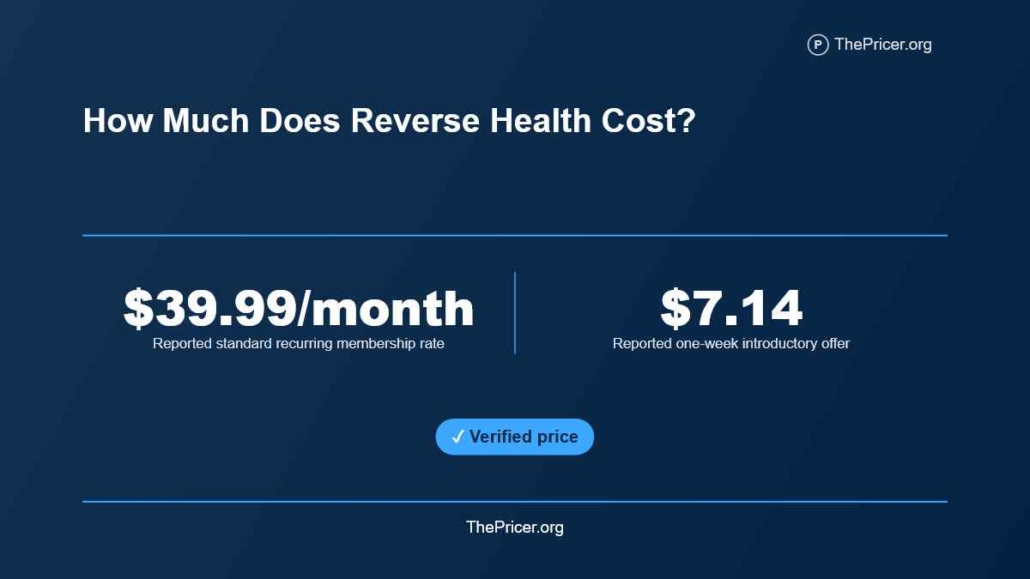
- Fortune reports introductory offers of $7.14 for one week, $15.65 for four weeks, and $26.77 for 12 weeks, followed by a standard main membership rate of $39.99 per month in its 2026 Reverse Health review.
- The current U.S. Apple listing shows Reverse Health Program purchases from $4.99 to $76.99, plus separate paid products, on the Reverse Health App Store page.
What Reverse Health membership includes
Reverse Health is a digital wellness program built around personalized nutrition information, meal planning, home workouts, and tracking tools. New users complete a quiz that collects personal and activity information before a plan is generated, as described in the company’s personalization guide.
Inside the app, members can review planned meals, swap recipes, prepare shopping needs, and follow calorie and macro targets. The meal planning guide also documents advance meal generation and recipe substitutions. The subscription is a digital service rather than an in-person clinic visit or food-delivery plan.
Introductory offers vs monthly renewal
Reverse Health’s low opening price can make the service look cheaper than its continuing cost. The company does not post one universal website rate before the personalization flow, so a buyer may see a discounted introductory period before moving into regular billing.
Current independent testing also found that Reverse Health pricing can change by device and sales route, with different offers appearing through desktop and mobile access in an independent pricing test.
| Pricing stage | Reported amount | How to read it |
|---|---|---|
| One-week introduction | $7.14 | Short promotional entry period |
| Four-week introduction | $15.65 (about 31 minutes at $30 per hour) | Longer discounted entry period |
| 12-week introduction | $26.77 | Lowest effective weekly promotional option in the reported set |
| Standard membership | $39.99 per month | Reported recurring main membership rate after the introduction |
The practical budgeting mistake is comparing only the first charge. Anyone planning to remain enrolled should check both the initial payment and the amount scheduled for the next billing date.
One-week, four-week, and 12-week offers
The three introductory periods reward a longer initial commitment with a lower effective weekly amount. Using the published promotional figures, the one-week choice works out to $7.14 per week, the four-week offer equals about $3.91 per week, and $26.77 (about 54 minutes at $30 per hour) divided by 12 equals about $2.23 per promotional week. Those same effective weekly figures appear in an independent plan comparison.
That does not make the 12-week choice a permanent $2.23 weekly subscription. It only describes the opening period used in that offer. Once the introductory period ends, the subscription can move to the continuing rate attached to the account. A buyer who wants only a short trial of the program should pay close attention to the end date rather than assume the introductory term closes the account automatically.
App Store purchase
Buying through Apple can produce a different price display from buying through Reverse Health’s website. Apple’s U.S. listing currently shows several Reverse Health Program purchase amounts and separate digital items, including challenge products and guides.
The store does not map every displayed purchase to the same durations reported through website pricing, so a $19.99 app-store item should not automatically be labeled as the four-week membership or any other website plan.
This channel difference also matters when checking card statements and renewal records. Someone comparing Reverse Health with a higher-touch program such as Awaken180 pricing should compare only the digital subscription portion rather than mixing in unrelated services.
Auto-renewal, cancellation, pauses
 Reverse Health’s August 14, 2026 terms state that subscription options automatically renew at the end of their subscription period unless canceled before the renewal date, with cancellation available through Manage Subscription, the relevant app store, or company support.
The same current subscription terms say prices are those quoted when the order is submitted, future pricing can change, applicable taxes may be charged, and banks or card issuers can impose separate currency or transaction fees.
Buyers should save the checkout confirmation because that record identifies the plan purchased and provides a better billing reference than a generic online price. Reverse Health also distinguishes one-time purchases from subscriptions, meaning a paid digital product described as lifetime access does not automatically carry the same renewal structure as the main subscription. Website, Apple, and Google purchases can follow different account-management paths. The billing channel matters when a user later needs to cancel or seek a refund.
Active subscribers can pause for one or three months, after which billing automatically resumes, according to the current pause instructions.
Three Reverse Health cost cases
Short entry case. A buyer taking the reported one-week introductory offer starts at $7.14. This is the smallest published promotional figure in the current plan set, and the user must still manage the subscription before renewal if continued access is not wanted.
Longer entry case. The reported 12-week promotional amount is $26.77. That spreads the opening payment across a longer introductory period and reduces the effective weekly entry amount, but it does not turn the purchase into a fixed-price permanent membership.
Continuing member case. Reverse Health publicly responded to a Google Play billing review in June 2026 by describing $9.99 as a promotional first-month discount that transitions to its standard $39.99 rate, providing another current confirmation of the renewal structure on the Google Play listing. Actual checkout offers can still differ by account and purchase route.
Worked yearly total
A continuing subscriber can use the reported standard monthly charge to estimate a full year of recurring membership spending. This is an arithmetic budget model rather than an advertised annual Reverse Health package. Twelve monthly payments of $39.99 equal $479.88.
A 2026 Better Business Bureau complaint record includes a Reverse Health business response identifying a $39.99 subscription charge and confirming cancellation and refund activity in that case on the BBB complaint record.
- Monthly modeled renewal, $39.99
- Number of modeled payments, 12
- Arithmetic, $39.99 × 12 = $479.88
- Modeled membership-only total, $479.88
This calculation excludes introductory discounts and optional purchases. It also does not mean the subscriber must remain enrolled for a year. Someone comparing digital programs can use the same recurring-cost method when reviewing Found Weight Loss costs.
The Reverse Health price number
The most accurate number is the amount shown on the buyer’s own checkout screen and renewal record. Public pricing is useful for setting expectations, but Reverse Health’s sales funnel can present different offers.
The standard monthly figure is the better reference when discussing continuing membership, and the smaller one-week, four-week, or 12-week amounts belong only to promotional entry periods. Apple and Google purchases should be checked against the receipt from that store rather than being forced into a website pricing category.
Users should also separate the core program from challenges, guides, coaching upgrades, or other paid products that may appear around the checkout path. Refund requests need their own review because cancellation alone does not guarantee money back. Reverse Health’s current policy permits refunds in certain technical and medical cases and through its conditional money-back process, which requires documented participation in the program, as explained in the current refund policy.
Refund routing also depends on where the purchase was made. The company’s refund request instructions direct Apple and Google buyers to the applicable store and state that uninstalling the app does not cancel a subscription.
Who the Reverse Health subscription price fits
Reverse Health makes the most financial sense for someone who wants an app-based meal, exercise, and habit program and is willing to manage a recurring subscription. A user who buys after a quiz, checks the renewal date, and wants guided meals, home workouts, food logging, and progress tools can judge the service against other digital weight-management programs without treating it as medical care. Readers comparing recurring programs can also look at WeightWatchers membership costs.
Makes sense if
- You want digital meal and exercise planning.
- You check the renewal amount before buying.
- You are comfortable canceling through an account or app store.
- You can separate the core membership from optional purchases.
Doesn’t make sense if
- You assume the first discounted payment lasts indefinitely.
- You want a subscription that stops automatically after the introductory period.
- You require in-person clinical care from the subscription.
- You expect every customer to receive the same checkout offer.
What we verified
- Checked the current pricing reports against Reverse Health’s active 2026 subscription structure and personalized checkout model.
- Confirmed the current auto-renewal and cancellation language in the August 14, 2026 terms.
- Cross-referenced current pause rules covering one-month and three-month breaks.
- Verified current Apple in-app purchase amounts separately from website plan pricing.
Answers to Common Questions
Does Reverse Health have a free trial?
Current 2026 pricing reviews and the U.S. App Store listing describe paid introductory access rather than a free trial. Check the offer shown at checkout before paying.
Does Reverse Health charge every month?
The main subscription can move into recurring billing after an introductory period. The billing interval attached to the purchased plan should appear in the checkout and subscription record.
Can I cancel Reverse Health before it renews?
Yes. Current terms allow cancellation before renewal through account management, the applicable app store, or support. Access continues until the end of the paid subscription period.
Can I get a refund from Reverse Health?
A refund is not guaranteed for every cancellation. The company lists qualifying technical, medical, and money-back cases, and app-store purchases follow the refund process of the applicable store.
Disclosure: Educational content, not medical advice. Pricing varies by provider, location, and insurance. Confirm eligibility, coverage, and out-of-pocket costs with a licensed clinician and your insurer. See our methodology and corrections policy.