
How Much Does Rocket Money Cost?
Updated on | Written by Alec Pow
This article was researched using 16 sources. See our methodology and corrections policy.
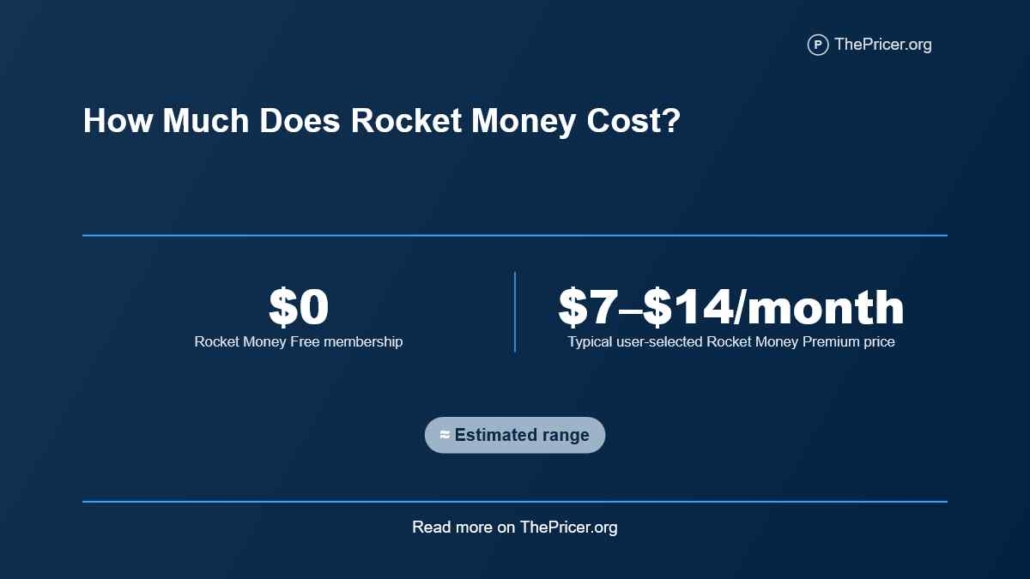
Rocket Money costs $0 for its Free plan, typically $7 to $14 per month for Premium, and $15 per month for Premium+. Premium lets users choose their price within the available range, while Premium+ has a fixed subscription fee. Bill negotiation currently has a separate success fee of 35% to 60% of the first year’s savings for Free and regular Premium users.
A significant change is scheduled for November 2, 2026: new bill negotiations will become exclusive to Premium+, with no additional negotiation success fee. Until then, the existing percentage-based arrangement remains relevant. Rocket Money is therefore not simply a budgeting app with one optional monthly charge. Its total cost depends on which features users purchase, whether they request bill negotiations, and the timing of those negotiations.
The biggest financial question is whether Rocket Money’s convenience creates enough actual savings to offset its membership charges.
Article Highlights
Jump to sections
- Rocket Money Free costs $0 and includes subscription tracking and basic budgeting.
- Premium typically costs $7–$14 (at $30 per hour, earning that amount would take about 14 to 28 minutes, before taxes) monthly, with a seven-day trial for eligible new members.
- Premium+ costs $15 monthly, equivalent to $180 annually before taxes.
- Successful bill negotiations currently cost 35%–60% of first-year savings for Free and Premium users.
- Starting November 2, 2026, new bill negotiations will require Premium+ and will not carry an additional success fee.
- Premium includes cancellation assistance, unlimited custom budget categories, net worth tracking, and desktop access.
How Much Does Rocket Money Cost?
Rocket Money’s January 2026 pricing guide identifies three membership tiers: Free, Premium, and Premium+.
The company uses a pay-what-you-think-is-fair model for regular Premium. Members select an amount within the offered range, and the included Premium features do not improve simply because the user chooses a higher amount.
| Plan | Monthly cost | Annual equivalent | Main purpose |
|---|---|---|---|
| Free | $0 | $0 | Track bills, transactions, and subscriptions |
| Premium | $7–$14 (about 14 to 28 minutes at $30 per hour) typically | $84–$168 | Advanced budgeting and cancellation assistance |
| Premium+ | $15 | $180 | Premium tools, Rowan AI, and fee-free bill negotiation |
These annual equivalents assume twelve full-priced monthly payments, not discounted annual contracts. Rocket Money says the Premium price slider can vary by platform and over time, so the amount presented during enrollment takes precedence.
The official Premium+ enrollment guide confirms its fixed $15 monthly price, plus any applicable taxes.
Independent CNBC Select research also identifies the regular Premium range as $7–$14, with a separate negotiation fee under the existing model.
What Rocket Money Free Includes
Rocket Money Free provides a dashboard for monitoring connected accounts, spending, recurring subscriptions, and upcoming bills. Users can identify repeat charges without subscribing to Premium.
Its budgeting features include transaction categorization and a limited number of custom category budgets. Rocket Money’s public documentation differs slightly on whether the free allowance is two or three custom budgets, so users should check the current app rather than rely on a fixed historical limit.
The company’s official FAQ describes the free tier’s expense tracking, subscription monitoring, and basic budgeting features.
Free members generally cancel subscriptions themselves by contacting the merchant or using the merchant’s website. Viewing an unwanted charge does not mean Rocket Money automatically terminates the service.
Free users also have limited desktop access. According to Rocket Money’s desktop access documentation, full web-based financial management now requires Premium, although Free users retain their mobile-app features.
For someone primarily interested in discovering forgotten subscriptions, Free may provide the most important information without a monthly fee.
What Premium Adds
Premium provides tools that make financial monitoring more customizable and reduce some manual work. It includes unlimited budget categories, transaction rules, detailed reporting, account sharing, financial goals, and subscription cancellation assistance.
Rocket Money’s Premium feature list also includes access to full credit reports, net worth tracking, real-time account syncing, and transaction exports.
Desktop access is another distinction. Members can use the financial dashboard in a browser rather than relying exclusively on the mobile application.
Premium membership generally includes a seven-day trial for eligible new users. After the trial, billing begins at the amount selected during signup unless the membership is canceled.
The price is flexible, but the feature set is not tiered according to the amount paid within Premium. Someone paying $14 (about 28 minutes at $30 per hour) monthly does not automatically receive more features than someone paying $7.
The difference equals $84 over twelve months. Unless a particular checkout offer provides a separate benefit, choosing a higher Premium slider amount primarily means paying more for the same service.
Bill Negotiation Success Fees
Rocket Money’s existing bill negotiation arrangement is the largest potential expense beyond membership fees. The service attempts to reduce eligible recurring bills, such as internet, cable, and phone charges.
Its official fee explanation states that successful negotiations cost 35% to 60% of first-year savings. Users select a percentage within the available range.
This fee is based on the annual savings, not merely one month’s reduction. If a provider lowers a monthly bill by $20, the annualized saving is $240.
At a 35% fee, Rocket Money would charge $84. At a 60% fee, the charge becomes $144, leaving $156 or $96 in first-year savings before other costs.
For a larger negotiation reducing a bill by $100 monthly, the first-year saving is $1,200. A 40% success fee would be $480, leaving $720 in modeled first-year savings.
The original article’s claim that this scenario costs only $40 confuses one month’s reduction with the first year’s total. It understates the fee by $440.
The success fee applies only when the negotiation is successful. Nevertheless, the resulting service terms matter: a temporary promotional discount or contract extension may not provide the same benefit as a permanent reduction.
Greenlight’s August 2026 review also identifies the percentage-based fee as a material drawback for people willing to negotiate directly with providers.
What Changes November 2, 2026
Rocket Money has announced that, beginning November 2, 2026, submitting a new bill negotiation will require Premium+ membership.
According to the official transition announcement, Premium+ negotiations will not carry a separate success fee. Automatic renegotiations end November 1, and members will initiate future negotiations themselves.
Only one negotiation may be in progress at a time. Once it finishes, the member can submit another request through the available workflow.
This is not simply a discount to the older service. It changes eligibility and payment structure: Free and ordinary Premium members will no longer be able to initiate new negotiations under the announced rules.
For users purchasing Rocket Money primarily to lower recurring bills, the upcoming policy is more important than the difference between regular Premium prices.
The current and future models should not be combined when estimating one negotiation. The old success fee and the new Premium+ fee-free arrangement represent different terms.
Is Premium+ Worth $15 Monthly?
Premium+ includes the regular Premium features, Rowan by Rocket Money, and access to bill negotiation without an additional success fee. Its standard annualized subscription cost is $180.
Whether that is worthwhile depends on how much recurring spending can actually be reduced and whether the user values the additional services.
Consider a person expecting one successful negotiation that lowers an eligible bill by $25 monthly for a full year.
- Monthly bill reduction: $25
- First-year gross savings: $300
- Premium+ for twelve months: $180
- Separate negotiation fee: $0 under announced Premium+ terms
- Modeled first-year net benefit: $120
The calculation assumes the lower provider bill lasts all twelve months and the person keeps Premium+ throughout that period. It excludes taxes and any changes to the underlying service contract.
At a full-year membership cost of $180, a continuous bill reduction of $15 monthly exactly offsets the annual Premium+ charge. Greater savings produce a positive monetary result, while smaller savings would not recover the membership cost on negotiation savings alone.
This is an illustrative break-even finding, not a prediction that Rocket Money can secure a particular discount.
Premium+ may still offer value to users who make extensive use of Rowan, advanced budgeting, or automated financial tools even without a successful negotiation.
Cancellation and Other Hidden Costs
Rocket Money Premium includes assistance canceling unwanted subscriptions, but cancellation is not always instantaneous or available for every merchant.
Rocket Money’s Terms of Service authorize its team to contact the subscription provider on the user’s behalf. The provider’s own cancellation and contract terms remain relevant.
A merchant may impose an early termination fee if the underlying agreement has a minimum term. That charge comes from the canceled service, not automatically from Rocket Money.
Rocket Money’s published guidance indicates that assisted cancellation may take several business days, depending on the service. Users should monitor the merchant’s confirmation and subsequent statements rather than assume a request immediately stops future charges.
Financial Goal deposits require separate interpretation. Transfers into a savings goal are movements of the user’s own money, not necessarily Rocket Money service fees.
The company’s account-charge explanation distinguishes Premium subscriptions, negotiation charges, and Financial Goal transfers.
Canceling Premium does not automatically cancel an active negotiated service or remove the user’s basic Rocket Money account. Membership cancellation takes effect at the end of the billing period.
Rocket Money vs. Other Budget Apps
Rocket Money competes with dedicated budgeting tools, bank-provided spending dashboards, and subscription-management applications. Their subscription prices are not directly comparable without considering the included functionality.
YNAB emphasizes assigning money to spending priorities and managing a proactive budget. It is better suited to users willing to regularly plan and adjust their spending rather than mainly identify subscriptions.
Monarch Money focuses on account aggregation, financial planning, household collaboration, and customizable financial reporting. It is a more direct alternative for users prioritizing comprehensive financial tracking.
Mint, mentioned in the original article, is no longer an active standalone budgeting competitor. Intuit’s migration information describes its transition to Credit Karma.
Rocket Money’s distinguishing service is its combination of subscription identification, cancellation assistance, and negotiated bill reductions. That combination can save time, but users should calculate whether the expected monetary benefit justifies paying for it.
Independent Motley Fool research identifies subscription management as a strength while noting limitations in the free edition and the cost of negotiated savings.
Security, Privacy, and Account Linking
Rocket Money usually obtains transaction information through linked financial accounts. This makes it easier to detect subscriptions and categorize spending, but it also means users must be comfortable sharing authorized financial data with the service.
According to Rocket Money’s security documentation, supported account connections use Plaid or other designated providers. Rocket Money says it does not directly receive or store users’ banking passwords.
The company describes encrypted communications and 256-bit encryption for stored data. These protections are useful but do not eliminate all privacy or cybersecurity risks.
Users can unlink accounts, although doing so may remove associated transaction history, categorizations, and in-progress cancellation information.
Before linking accounts, review the requested data access and the company’s privacy terms. Financial aggregation can be convenient, but it is not necessary for everyone who simply wants to review their subscriptions manually.
Who Should Pay for Rocket Money?

Free is the most sensible starting point for users who want to identify recurring payments and understand where money goes. Premium is more appropriate for people who need hands-off subscription cancellation, more detailed budgets, and better access to financial information.
Premium+ is principally worth examining for users who plan to use the enhanced financial assistant or the new fee-free negotiation arrangement.
Makes sense if
- You have many recurring charges that are difficult to monitor manually.
- You regularly use custom budgets, financial reports, or desktop access.
- Subscription cancellation assistance saves meaningful time.
- Expected bill savings can reasonably cover the membership expense.
Does not make sense if
- Your financial accounts already provide sufficient budgeting tools.
- You can identify and cancel subscriptions yourself without difficulty.
- You expect a guaranteed reduction on every bill submitted for negotiation.
- The cost of Premium+ exceeds the realistic savings and value of its additional features.
The best financial outcome may involve identifying expenses manually and canceling unwanted services directly. Rocket Money’s value comes from convenience, organization, and services that users would otherwise perform themselves.
Answers to Common Questions
Does Rocket Money have a free plan?
Yes. The free mobile app includes subscription tracking, spending information, and basic budgeting. Premium is optional.
How much is Rocket Money Premium?
Premium typically costs $7–$14 monthly, with the amount selected by the user from the available range. Premium+ costs $15 monthly, plus applicable taxes.
Does Rocket Money take a percentage of savings?
Under its existing arrangement, successful bill negotiations cost 35%–60% of first-year savings. Starting November 2, 2026, new negotiations will require Premium+ and have no additional success fee under the announced terms.
Can Rocket Money cancel subscriptions for me?
Premium and Premium+ include cancellation assistance for supported services. Completion depends on the merchant and may require additional processing time.
Can I cancel Rocket Money Premium?
Yes. Members can cancel from account settings, with the cancellation generally taking effect at the end of the current billing period. Canceling Premium does not automatically delete the free account.
Disclosure: Educational content, not financial advice. Prices reflect public information as of the dates cited and can change. Confirm current rates, fees, taxes, and terms with official sources before purchasing. See our methodology and corrections policy.