
How Much Does Saratoga Water Cost?
Updated on | Researched and reviewed by Alec Pow, Founder & Pricing Investigator
Prices, claims, and calculations checked against 14 cited sources. See our research methodology and corrections policy.
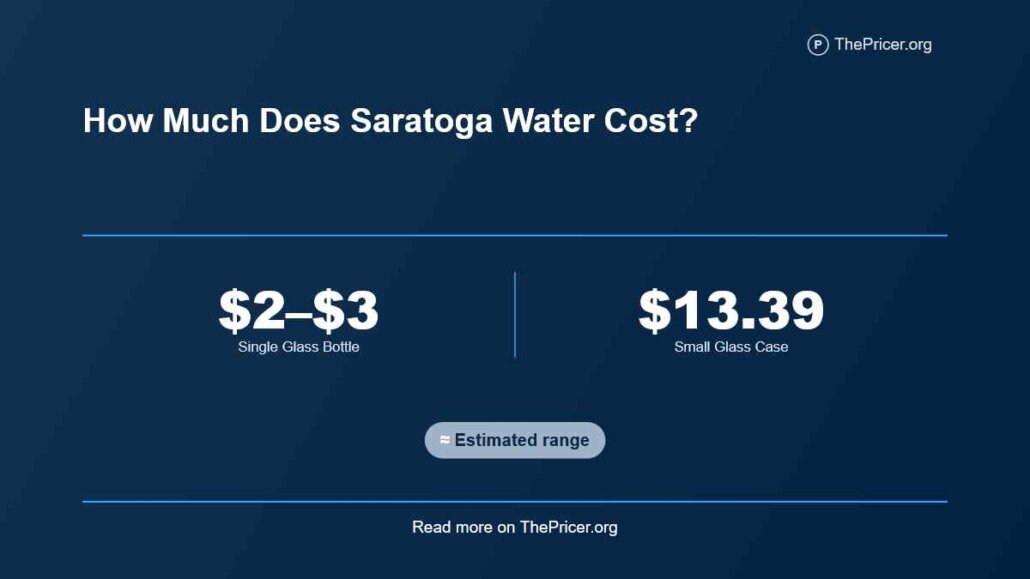
Saratoga Spring Water costs about $2 to $3 for a single 28-ounce glass bottle at U.S. grocery stores, while multipacks can bring the price below $1.50 per bottle for certain plastic formats. A 12-pack of 28-ounce glass bottles can cost around $25 to $31 at foodservice and delivery suppliers. Restaurants can charge considerably more for the same brand.
The biggest price differences come from bottle material, size, pack quantity, retailer and purchasing channel. Saratoga’s recognizable cobalt-blue bottles are sold in still and sparkling versions, but a case of plastic bottles and a case of glass bottles should not be compared solely by their sticker prices. This U.S. pricing analysis uses published offers checked in October 2026. Actual prices, availability, taxes and delivery charges vary by location.
Article Highlights
Jump to sections
- A 28-ounce glass bottle commonly sells for about $2 to $3 in the grocery listings reviewed.
- Target lists 12 sparkling 12-ounce glass bottles at $13.39.
- A 12-pack of 28-ounce still water in plastic bottles is listed at $16.49 at Target.
- ReadyRefresh lists twelve 28-ounce glass bottles at $30.59 before any applicable delivery-related charges.
- An illustrative 672-ounce purchase costs $32.98 in Target plastic cases versus $61.18 in ReadyRefresh glass cases, excluding delivery and taxes.
- Saratoga is spring water with relatively low dissolved-mineral content, not an unusually mineral-rich bottled water.
How Much Does Saratoga Water Cost?
The following published U.S. listings provide usable reference points. They are individual retailer offers, not a calculated national average. An online order may have different delivery charges, geographic restrictions or promotional pricing.
| Product and retailer | Published price | Approximate cost per bottle |
|---|---|---|
| Target, sparkling glass, 12 × 12 oz | $13.39 | $1.12 |
| Target, still glass, one 28 oz | $2.69 | $2.69 |
| Target, still plastic, 12 × 28 oz | $16.49 | $1.37 |
| Kroger, still 28 oz plastic bottle | $1.99 | $1.99 |
| ReadyRefresh, still glass, 12 × 28 oz | $30.59 | $2.55 |
| Restaurant Depot, sparkling glass, 12 × 28 oz | $29.23 | $2.44 |
Target’s current Saratoga product listings establish the first three examples. Kroger publishes its 28-ounce still-water offer at $1.99, although that listing is for a recycled-plastic bottle, not the signature glass version.
The ReadyRefresh glass case and Restaurant Depot sparkling case provide two distinct distribution-channel examples. They should not be treated as guaranteed wholesale prices available to every buyer.
The table also reveals why the original broad range of $2 to $5 per bottle was insufficient. Some individual glass bottles fit that range, yet multipacks of smaller glass bottles and larger plastic bottles can have much lower per-bottle prices. Container size and the amount of water purchased matter more than a generic bottle count.
What You Are Buying
Saratoga is an American spring-water brand associated with Saratoga Springs, New York, where bottling began in 1872. Its signature product is the cobalt-blue bottle, which makes the water recognizable in grocery stores, hotels and restaurants. The brand sells still and sparkling water in glass and recycled-PET plastic.
The branding reflects its history, but a Saratoga label does not mean every bottle contains water drawn inside Saratoga Springs. The company’s current product and source guidance explains that water comes from Northeastern spring sources and advises customers to check individual labels. The company also identifies 12- and 28-ounce glass formats and 16- and 28-ounce recycled-PET formats.
A Times Union investigation documented the distinction between the historic Saratoga source and water bottled from springs elsewhere in the Northeast. A buyer paying extra because the product supposedly comes exclusively from one famous New York spring should examine the source printed on the bottle.
These products also should not be confused with heavily mineralized natural mineral waters. Saratoga reports total dissolved solids below 150 parts per million. Its relatively light mineral profile helps explain the mild taste, while its premium retail positioning comes substantially from branding, packaging and distribution.
Glass Bottles vs Plastic
The signature glass bottle is an important part of Saratoga’s presentation, particularly on restaurant tables. Plastic bottles are lighter and appear frequently in multipack grocery listings. Both formats carry the Saratoga name, but they serve somewhat different buying purposes.
A useful comparison is Target’s $16.49 case containing twelve 28-ounce plastic bottles against ReadyRefresh’s $30.59 case containing twelve 28-ounce glass bottles. Each case supplies 336 fluid ounces.
The plastic offer costs approximately 4.91 cents per fluid ounce. The glass offer costs approximately 9.10 cents per fluid ounce. On those two published offers, the plastic format costs about 46% less per ounce.
That comparison isolates the amount of water, but the purchase channels differ. ReadyRefresh delivery charges, local retailer promotions and availability can widen or narrow the total difference. Glass is valuable for presentation, while plastic is more economical for stocking water where bottle appearance is secondary.
Woodman’s offers another glass reference, publishing $2.69 for a single sparkling 28-ounce bottle. That equates to about 9.61 cents per ounce, close to the per-ounce rate of ReadyRefresh’s glass case.
Glass is recyclable, but it is incorrect to assume that the bottle is intended for indefinite household refilling. Saratoga’s packaging and handling guidance recommends recycling its bottles rather than reusing them. Recycling access and local collection rules still determine what happens after consumption.
Still and Sparkling Costs
Saratoga sells both uncarbonated still water and carbonated sparkling water. The sparkling product adds carbonation during production. Flavor and texture differ, but the distinction does not automatically establish a consistent price premium.
In the inspected offers, Target’s 12-ounce glass sparkling case costs $13.39, while Restaurant Depot’s 28-ounce sparkling glass case costs $29.23. Both contain 12 bottles, but the second supplies considerably more water. Comparing their per-bottle prices alone exaggerates the difference.
For events and hospitality, small 12-ounce bottles are suitable for individual servings. A 28-ounce bottle contains enough water for multiple glasses and may work better for shared table service. Still water suits customers who dislike carbonation, while sparkling water provides the effervescence associated with traditional restaurant bottled-water service.
The appropriate purchasing unit is the number of servings required. A reception offering each guest a sealed bottle has different needs from a restaurant pouring a larger bottle between two diners. Buying by the case can reduce cost per serving, but only if the chosen size matches how the water will be used.
Restaurant and Hospitality Prices
Restaurant pricing reflects table service, staffing, glassware, dining-room overhead and the establishment’s positioning. A bottle bought at a grocery store is not economically equivalent to the same water served at a high-end restaurant.
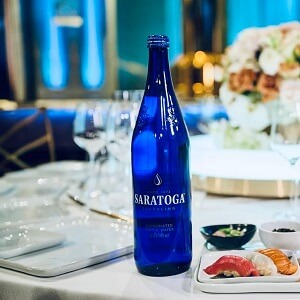
Published examples show how large that difference can become. A Wall Street Journal report described an $11 bottle of Saratoga at a fine-dining restaurant in Los Angeles. That is a documented restaurant example, not the normal price of every Saratoga bottle.
Compare that restaurant charge with ReadyRefresh’s $2.55 per bottle case equivalent. The restaurant sale is about 4.3 times the case’s per-bottle purchase figure. This is a retail-price comparison, not a calculation of the restaurant’s profit. Actual restaurant acquisition costs, service expenses and taxes have not been established by those figures.
Businesses stocking Saratoga can also obtain cases through restaurant-oriented suppliers. Gordon Food Service publishes a 28-ounce glass case offer at approximately $24.99, or $2.08 per bottle, at the listing checked. Membership rules, store location and business ordering arrangements can affect the accessible price.
Restaurants considering Saratoga should compare not only purchase prices but also storage space, glass handling, breakage, disposal and how the water is offered on the menu. A sealed premium bottle can support a higher selling price. It can also create customer dissatisfaction if a server presents an optional paid bottle as though it were complimentary water.
A Saratoga Case
The case sticker is not necessarily the delivered total. Shipping charges, service fees, sales tax where applicable, local delivery minimums and packaging requirements can all affect the final amount. No universal Saratoga delivery surcharge was verified, so such fees should be checked against the actual seller rather than added as an invented average.
Costco Business Delivery lists a 12-count glass-water product, but the usable price depends on the customer’s ordering location and account access. A warehouse or business-delivery listing without a visible payable amount should not be used to claim a national low price.
There is also a quantity trap. A shopper seeing a cheap 12-pack may overlook that each bottle holds 12 ounces, while another 12-pack holds 28 ounces. Both are cases of twelve, but the second contains 2.33 times as much water.
For a household that simply needs hydration, compare Saratoga with five-gallon water delivery or ordinary grocery water. For workplaces wanting drinks without disposable bottles, a Bevi dispensing system offers a completely different fixed-cost arrangement. Neither is a direct substitute for Saratoga’s dining-table presentation.
A 24-Bottle Purchase Example
Consider a family or office buying 24 Saratoga bottles, each containing 28 fluid ounces. The required quantity is 672 ounces, or 5.25 U.S. gallons. The following example uses the published Target plastic-case price and ReadyRefresh glass-case price already discussed.
Illustrative plastic purchase
- Two 12-packs at $16.49 each
- Water subtotal of $32.98
- Quantity of 672 fluid ounces
- Effective price of approximately 4.91 cents per ounce
Illustrative glass purchase
- Two 12-packs at $30.59 each
- Water subtotal of $61.18
- Quantity of 672 fluid ounces
- Effective price of approximately 9.10 cents per ounce
Choosing the published plastic offer saves $28.20 on the same volume of Saratoga water, before applicable taxes and delivery charges. For four such purchases, the arithmetic difference would be $112.80. That result is a comparison of these two offers, not a claim that every plastic Saratoga bottle is 46% cheaper than every glass one.
For a dinner party where guests notice the bottles, the added glass cost may be acceptable. For a workplace refrigerator or daily household use, the lower per-ounce plastic price can be more consequential than the appearance of the container.
Other Premium Water Brands
Comparing Saratoga with other premium waters requires matching both container size and material. The taste of spring water, artesian water and natural mineral water can differ because their mineral profiles and treatment methods differ.
At Target, S.Pellegrino sparkling mineral water has been listed at $2.99 for 33.8 ounces, or roughly 8.85 cents per ounce. A six-pack of 16.9-ounce S.Pellegrino bottles was also advertised at $6.99 during the reviewed offer. These are retailer-specific competing prices, and the material of the chosen bottle matters to a precise comparison.
A separate independent bottled-water tasting purchased a 28-ounce Saratoga bottle for $3.59. The review provides a documented higher individual-bottle observation, but its subjective flavor rankings should not be presented as a scientific measure of water quality.
Someone buying water mainly for hydration may reasonably choose less expensive spring or purified water. Buyers seeking a particular carbonation level, mild mineral profile or attractive glass bottle may place a greater value on Saratoga. The product’s higher price does not independently prove superior health effects.
The cost of producing bottled water also differs from its retail selling price. Packaging, distribution, retailer costs and branding contribute to what the customer pays. The manufacturer’s cost cannot be inferred simply by subtracting the price of tap water from the shelf price.
Water Quality and Shelf Life
Saratoga’s low mineral content and advertised taste profile should not be turned into unsupported claims of medical benefits. Water hydrates the body, but the bottle’s color and price are not indicators of additional therapeutic effects.
The FDA’s bottled-water definitions distinguish spring water from natural mineral water and describe the production and safety standards that apply. Saratoga is sold as spring water. It does not need a very high dissolved-mineral concentration to meet that identity.
Shelf life also depends on packaging. The manufacturer’s published guidance gives glass Saratoga products a two-year shelf life and recycled-PET products a nine-month shelf life. Store unopened bottles as directed, away from excessive heat and conditions that might damage seals or packaging.
Glass and PET each involve environmental tradeoffs in manufacture, transportation and disposal. Without a product-specific life-cycle assessment, a claim that Saratoga glass always has a smaller environmental impact than plastic is unsupported. Recycling the container through an accepted local collection system is more defensible advice than assuming the premium price automatically pays for environmental superiority.
When Saratoga Makes Financial Sense
The strongest reason to choose Saratoga is that the buyer values the specific presentation or taste enough to pay its price. Someone who needs inexpensive drinking water for daily volume consumption has a different objective from a restaurant purchasing bottled water for table service.
Makes sense if
- You want recognizable cobalt-blue glass bottles for a dinner, wedding or hospitality setting.
- You enjoy the low-mineral taste or the brand’s sparkling-water carbonation.
- You can buy an appropriately sized case at a verified local price.
- You are comparing prices by fluid ounce and understand the premium attached to glass.
Does not make sense if
- Your primary goal is the lowest possible cost per gallon of drinking water.
- You assume Saratoga provides special medical benefits because of its price.
- You are paying a substantial glass-bottle premium for water that will be poured into an ordinary dispenser.
- You expect every bottle to originate from one spring inside Saratoga Springs.
For customers buying repeatedly, the most reliable way to control cost is to establish the required volume and obtain local quotes in comparable units. Check the source label, packaging type, case quantity and total delivered price. That approach removes most of the misleading differences between advertised Saratoga offers.
Answers to Common Questions
How much is one blue glass bottle of Saratoga water?
A single 28-ounce blue glass bottle is listed at about $2 to $3 in the grocery examples reviewed. Restaurant prices can be considerably higher.
Is Saratoga cheaper by the case?
It can be. A 12-bottle glass case priced at $30.59 works out to approximately $2.55 per bottle. Compare bottle sizes and shipping costs before assuming a case is the better deal.
Does Saratoga water come only from New York?
No. Saratoga uses spring sources in the Northeast. The company directs buyers to the individual product label for source identification.
How long does Saratoga bottled water last?
Saratoga lists a two-year shelf life for its glass collection and nine months for its recycled-PET collection. Follow the labeled date and storage directions.
Is Saratoga water naturally sparkling?
No. The manufacturer explains that carbonation is added to its sparkling spring water during production. The still product is uncarbonated.
Disclosure: Educational content, not financial advice. Prices reflect public information as of the dates cited and can change. Confirm current rates, fees, taxes, and terms with official sources before purchasing. See our methodology and corrections policy.