
How Much Does Security Plus Certification Cost?
Updated on | Researched and reviewed by Alec Pow, Founder & Pricing Investigator
Prices, claims, and calculations checked against 6 cited sources. See our research methodology and corrections policy.
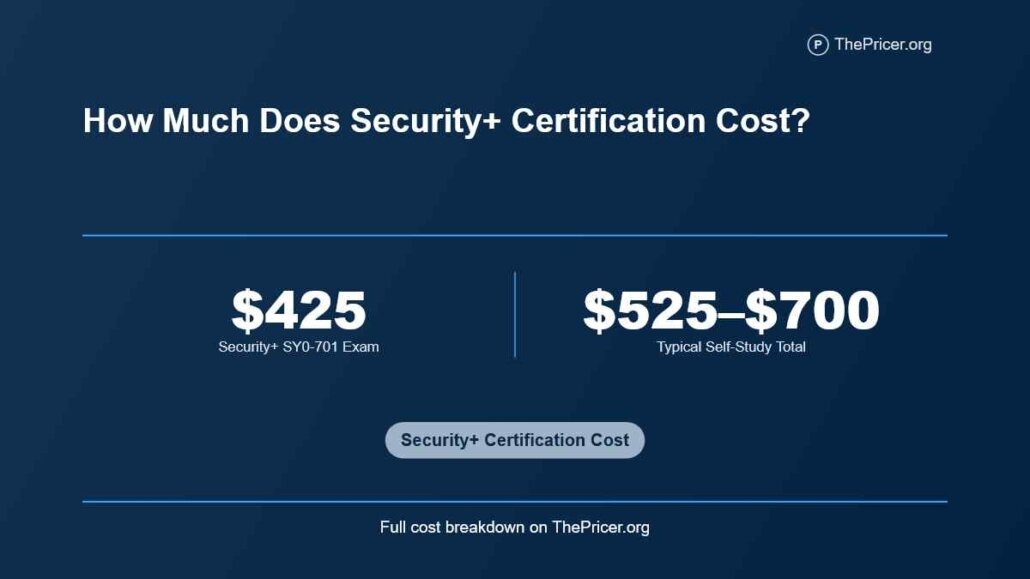
CompTIA Security+ certification currently costs $425 for the SY0-701 exam voucher, making that the minimum direct cost if you self-study and pass on the first attempt. A realistic self-study budget is closer to $525 to $700 once a current study guide, practice exams, or labs are added.
Instructor-led training costs much more. Current five-day Security+ classes commonly run around $2,495, often including structured courseware and, depending on the provider, an exam voucher. Over a full three-year certification cycle, renewal can add another $150 in Continuing Education fees if you use the standard CEU route.
Article Highlights
Jump to sections
- The current Security+ SY0-701 exam voucher costs $425.
- A lean self-study path usually lands around $525–$700.
- A live five-day training course commonly costs around $2,495.
- Some self-paced commercial courses with a voucher cost about $1,295.
- Security+ remains valid for three years.
- Standard renewal requires 50 CEUs and a $150 Continuing Education fee.
- A no-show or very late schedule change can cost the entire exam voucher.
- Security+ remains relevant to DoD 8140, but current DoD qualification is based on specific work roles and proficiency levels rather than the old 8570 IAT/IAM shorthand alone.
How Much Does Security+ Certification Cost?
The current CompTIA Security+ exam is SY0-701. The standard U.S. voucher price is $425.
| Security+ Path | Typical Cost |
|---|---|
| Exam only | $425 |
| Lean self-study | $525–$700 |
| Self-paced commercial course | $1,000–$1,300+ |
| Live instructor-led training | $2,400–$2,500+ |
| Three-year renewal via CEUs | $150 |
The exam fee is the only unavoidable certification charge. Training, books, practice exams, labs, and retake protection are optional.
Self-Study Cost
Self-study remains the cheapest realistic path.
A candidate might combine:
- Security+ exam voucher: $425
- Current study guide: roughly $40–$60
- Practice exam bank: roughly $80–$150
- Free video training: $0
That produces an approximate total of:
$425 + $50 + $100 = $575.
This is why a useful planning figure for a self-funded candidate is about $525 to $700, not merely the $425 voucher.
Someone who already has strong networking and security fundamentals may spend even less by using the published exam objectives, free videos, and one paid practice resource.
Live Training
Commercial instructor-led programs cost several times more than the exam itself.
ONLC currently lists five-day Security+ instructor-led classes at $2,495. Its course includes preparation aligned to SY0-701 and lists an exam voucher as part of the training package.
ONLC also offers a self-paced, on-demand Security+ course for $1,295, including digital course material and an exam voucher.
New Horizons currently prices its five-day Security+ class at $2,495, with an exam voucher offered separately for about $404 on its current course page.
That creates an important distinction: two providers can advertise nearly identical $2,495 training prices while including different exam components.
Always check whether the voucher is actually included before comparing course prices.
Exam Format
Security+ SY0-701 is designed to test practical baseline cybersecurity knowledge rather than only memorized definitions.
The exam covers general security concepts, threats and vulnerabilities, security architecture, security operations, and security program management and oversight.
Current SY0-701 specifications allow up to 90 questions, including multiple-choice and performance-based questions, with a testing time of 90 minutes.
The passing score is 750 on a 100–900 scale.
Because performance-based questions can require hands-on reasoning, candidates who have little practical exposure may get more value from labs than from buying several overlapping study books.
Retake Cost
Failing Security+ can significantly raise the total because another exam normally requires another voucher.
At the current $425 price:
Two full-priced attempts = $850.
CompTIA’s retake policy allows a candidate who fails the first attempt to retake the exam without a mandatory waiting period.
After a second failed attempt, CompTIA requires a waiting period of at least 14 calendar days before the third attempt.
Each attempt requires a valid paid voucher unless a bundle or reseller product includes retake protection.
This is why a discounted voucher-plus-retake package can make financial sense for someone who is uncertain about passing first time.
Scheduling Risk
Exam scheduling can create a hidden cost even when the candidate never fails.
Security+ can be taken through Pearson VUE at a test center or through online proctoring.
The exam price itself is generally the same either way.
However, CompTIA requires candidates to follow the cancellation and rescheduling rules associated with the booked appointment. Missing the permitted window or failing to appear can result in the voucher being forfeited.
At $425, one missed appointment can therefore cost more than an entire self-study library.
Online vs Test Center
Remote testing does not normally save money on the exam voucher itself, but it can eliminate travel, parking, fuel, and hotel costs.
A home candidate may instead need:
- a compatible computer;
- a reliable internet connection;
- a webcam and microphone;
- a clear desk and compliant private room.
Most candidates already own the necessary equipment, so it would be misleading to automatically add a $50 or $100 “remote exam technology fee” to every Security+ budget.
For someone who would otherwise drive several hours or book a hotel, online testing may nevertheless reduce the real cost meaningfully.
DoD 8140 Value

Security+ remains particularly relevant to people pursuing U.S. defense cybersecurity work, but the terminology has changed.
The Department of Defense’s current DoD 8140 framework replaced DoD 8570.01-M and moved away from treating cybersecurity qualifications as a simple universal certification list.
DoD 8140 now uses specific cyber work roles, qualification options, and proficiency levels. The framework covers cyber IT, cybersecurity, cyber effects, intelligence, cyber enablers, data/AI, and software engineering work.
Security+ can still satisfy qualification requirements for certain positions, but candidates should verify the exact work role and proficiency requirement rather than assuming that the old “IAT Level II” label tells the whole story.
The DoD 8140.03 manual explicitly allows multiple foundational qualification pathways, including education, training, certification, and experience depending on the role.
Renewal Cost
Security+ is valid for three years.
A common renewal route requires 50 Continuing Education Units during that cycle plus the Security+ Continuing Education fee.
The standard CE fee is $150 across the three-year cycle.
That works out to:
$150 ÷ 3 = $50 per year.
The CEUs themselves can be earned through qualifying training, webinars, conferences, higher certifications, publishing, work experience, or other activities permitted under current CompTIA rules.
The cash cost of those activities can be anywhere from zero to thousands of dollars.
Three-Year Cost
Consider a lean self-study candidate:
- Exam voucher: $425
- Study guide: $50
- Practice tests: $100
- Three-year CE fee: $150
- Total three-year cash cost: $725
That assumes the candidate passes on the first attempt and earns all 50 CEUs through free or employer-funded activities.
A candidate paying $2,495 for live training plus $150 for eventual renewal would already be at $2,645 before considering extra practice products or retakes.
Employer Funding
Before spending personal money, check whether your employer has a certification budget.
Security+ is common enough in IT support, cybersecurity, government contracting, and managed-services environments that employers may already have volume voucher agreements, approved training vendors, or reimbursement policies.
A $425 exam becomes effectively $0 out of pocket if the employer reimburses it after a passing result.
Some employers also pay for instructor-led training because the employee’s absence for several workdays can be a larger economic cost than the certification fee itself.
Student Discounts
CompTIA offers academic pricing through eligible education channels, and some schools purchase Security+ vouchers in volume at lower rates.
Those prices are not available to every retail buyer and can depend on school eligibility, location, and verification.
Similarly, partner and corporate voucher programs sometimes sell below public retail price.
A discounted voucher is useful, but candidates should verify the region and exam code. Many CompTIA vouchers are restricted to a particular country or currency region.
Other Security Certifications
Security+ is not always the best credential for every candidate.
The ISC2 SSCP exam currently costs $249 in the United States and other listed Americas markets.
SSCP is aimed more heavily at hands-on security administration and operations and carries professional-experience requirements for full certification.
The AWS Certified Security – Specialty exam costs $300. It is much more cloud-specific and assumes substantial AWS security knowledge.
| Certification | Current Exam Price | Main Focus |
|---|---|---|
| CompTIA Security+ | $425 | Vendor-neutral baseline cybersecurity |
| ISC2 SSCP | $249 | Security operations and administration |
| AWS Security – Specialty | $300 | AWS cloud security |
The cheapest exam is not automatically the best value. Security+ is broader and is often used earlier in a cybersecurity career, while the alternatives serve more specific purposes.
Worked Examples
Budget self-study
- Exam: $425
- Study guide: $50
- Practice exams: $100
- Total: $575
Self-paced commercial training
- ONLC on-demand training with voucher: $1,295
- Extra premium practice bank: $100
- Total: about $1,395
Live instructor-led path
- ONLC five-day course with voucher: $2,495
- Extra travel: $0 if attended remotely
- Total: $2,495
Failed first attempt
- Original voucher: $425
- Second full-price voucher: $425
- Total exam spend: $850
Hidden Costs
Retakes are the largest obvious extra. One second full-price attempt doubles the exam spend to $850.
Missed appointments can consume a voucher entirely.
Boot-camp time can create an opportunity cost if you use vacation days or unpaid leave for a five-day course.
Renewal training can become expensive if you earn CEUs through paid conferences instead of free webinars or employer-sponsored education.
Voucher expiration matters. Buying too early can create pressure to test before you are ready.
Duplicate study materials are another common waste. One current book, one strong practice bank, and targeted labs can be more useful than buying four overlapping courses.
You might also like our guides to PHR certification, PMP certification, and Epic certification training.
Is Security+ Worth It?
Security+ makes the most financial sense for someone who needs a recognized baseline cybersecurity credential rather than a highly specialized certification.
It can fit help-desk professionals moving toward security, junior administrators, SOC candidates, government contractors, and early-career security analysts.
A $575 self-study investment is modest compared with a major degree or boot camp.
If the credential contributes to obtaining a role that pays even $3,000 more per year, the simplified gross-pay break-even point is:
$575 ÷ $3,000 × 12 = about 2.3 months.
That calculation does not prove Security+ itself caused a raise. Experience, practical skills, location, clearance eligibility, employer requirements, and other certifications can matter just as much.
The value is weakest when someone buys Security+ without a target role or expects the certificate alone to replace hands-on IT experience.
What We Verified
We checked current Security+ SY0-701 pricing and certification structure, current commercial training prices, current three-year renewal requirements, retake timing rules, exam-delivery options, DoD 8140 workforce guidance, and competing cybersecurity exam prices.
Current retail Security+ exam pricing remains $425. Current commercial training examples include ONLC at $2,495 for live instructor-led training and $1,295 for its on-demand option, while New Horizons also lists a five-day Security+ course at $2,495.
We verified that Security+ remains a three-year credential requiring 50 CEUs under the standard continuing-education route and that the standard CE fee is $150 for the cycle.
We also verified that DoD 8140 replaced the old 8570.01-M framework and now uses work-role-specific qualification rules rather than treating one certification as universally sufficient for broad IAT or IAM categories.
Answers to Common Questions
How much does CompTIA Security+ cost?
The Security+ SY0-701 exam voucher currently costs $425.
How much should I budget with study materials?
A realistic self-study budget is around $525 to $700, depending on the study guide, practice exams, and labs you choose.
How much does Security+ training cost?
Commercial self-paced courses can cost around $1,000 to $1,300, while current five-day instructor-led programs commonly cost around $2,495.
How much does a Security+ retake cost?
Without prepaid retake coverage, another attempt generally requires another exam voucher. At the current retail price, two attempts can therefore cost $850.
How long does Security+ last?
The certification remains valid for three years.
How much does Security+ renewal cost?
The standard Continuing Education route requires 50 CEUs and a $150 CE fee across the three-year renewal cycle.
Does Security+ satisfy DoD 8140?
Security+ can qualify for certain DoD cyber workforce roles, but DoD 8140 is now role- and proficiency-based. Candidates should verify the specific qualification matrix for the position rather than relying only on older DoD 8570 IAT/IAM terminology.
Disclosure: Educational content, not financial advice. Prices reflect public information as of the dates cited and can change. Confirm current rates, fees, taxes, and terms with official sources before purchasing. See our methodology and corrections policy.