
How Much Does Sinkhole Repair Cost?
Published on | Written by Alec Pow
This article was researched using 14 sources. See our methodology and corrections policy.
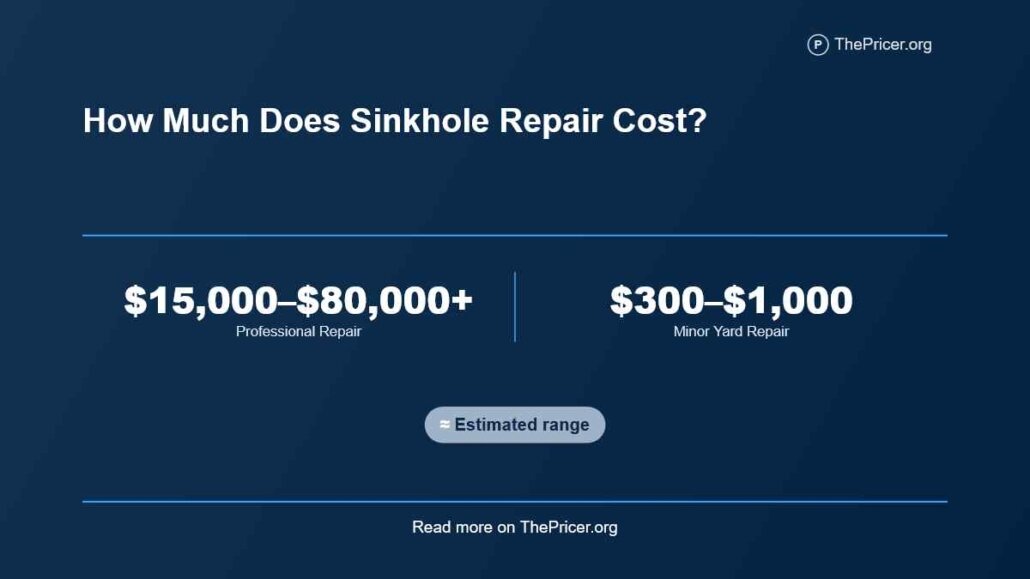
Professional sinkhole repair typically costs $15,000 to $80,000 or more when a property needs soil stabilization, pressure grouting, or foundation support. A small, stable yard depression that has been confirmed as nonstructural may cost only $300 to $1,000 to fill and restore. Severe sinkholes affecting buildings, roads, or extensive underground areas can exceed $100,000.
These are planning ranges, not a single national average. A shallow depression caused by buried debris is a different repair from a geological sinkhole beneath a house. The cause, depth, soil conditions, and structural damage determine which price applies.
For a home with suspected sinkhole activity, investigation should come before filling, leveling, or foundation work. Covering the visible hole without addressing the unsupported ground beneath it can leave the property exposed to further movement.
Article Highlights
Jump to sections
- Professional residential sinkhole remediation commonly falls in a published contractor planning range of $15,000 to $80,000+.
- Small, confirmed nonstructural depressions can sometimes be filled for several hundred dollars, but not every depression is safe to approach or repair.
- Geotechnical reports commonly cost $1,000 to $5,000, with specialized sinkhole investigations potentially costing more.
- Grouting treats unstable soil or underground voids. Underpinning transfers foundation loads to deeper, more competent ground.
- A hypothetical repair involving eight grout injection points and six foundation piers could cost approximately $16,800 to $38,800 before restoration and other project charges.
- Homeowners insurance may cover certain sinkhole losses, but ordinary sinkhole damage and catastrophic ground cover collapse are not treated identically under Florida law.
How Much Does Sinkhole Repair Cost?
Florida foundation contractors publish sinkhole remediation ranges around $15,000 to $75,000+ and $15,000 to $80,000+, depending on the stabilization work required. Those figures describe substantial professional remediation, not the price of putting soil into a shallow hole.
One Orlando foundation cost guide puts confirmed sinkhole remediation at $15,000 to $75,000+. Another Florida contractor estimate places comparable work at $15,000 to $80,000+. These are contractor-advertised ranges, not audited averages of completed insurance claims.
| Repair situation | Indicative cost | What the price covers |
|---|---|---|
| Small, stable yard depression | $300–$1,000+ | Limited fill, delivery, compaction, and surface restoration after the cause is identified |
| Geotechnical investigation | $1,000–$5,000+ | Professional soil assessment and reporting, with advanced testing priced separately when required |
| Localized foundation stabilization | $5,000–$15,000+ | Limited settlement work, which may not involve a true geological sinkhole |
| Confirmed residential sinkhole remediation | $15,000–$80,000+ | Engineered grouting, foundation support, or a combination of methods |
| Extensive structural or commercial damage | $100,000+ | Large-scale stabilization, excavation, structural repairs, and restoration |
Commercial projects can cost considerably more than residential work. A commercial sinkhole contractor publishes a broad $20,000 to $300,000+ range for business and municipal remediation. That range should not be used to estimate a typical backyard repair.
The most useful starting point is a written diagnosis explaining whether the property has a true sinkhole, an isolated underground void, a broken utility, or ordinary soil settlement.
The Price Difference
A visible opening does not reveal the full extent of underground instability. A six-foot depression above a shallow buried stump can require less work than a two-foot opening connected to a deeper cavity beneath a foundation.
The Florida Geological Survey warns that depressions can also come from decomposing buried materials, drainage problems, and other causes unrelated to a natural geological sinkhole. The agency recommends treating serious structural symptoms and unsafe openings as professional safety concerns.
Five conditions have the greatest influence on repair cost.
- Depth and underground extent. A larger unsupported area usually requires more investigation, material, and equipment.
- Proximity to a building. Stabilizing soil below a driveway is different from protecting an occupied house with a moving foundation.
- Soil and groundwater. Loose soil, flowing water, and difficult geology can complicate stabilization.
- Access. Crews may need to reach the affected ground beneath patios, landscaping, walls, or confined spaces.
- Existing damage. Cracked slabs, displaced utilities, damaged foundations, and surface restoration may require separate trades.
A sinking concrete surface does not automatically prove a sinkhole. Our guide to polyurethane foam injection costs explains the difference between lifting a settled slab and performing deeper soil stabilization. Applying a routine slab-lifting price to an active sinkhole can seriously underestimate the job.
Inspection and Engineering
Before choosing a repair method, an engineer or geologist may review the property history, inspect cracks and settlement, evaluate drainage, and recommend subsurface testing. The testing scope depends on the suspected cause and the risk to nearby structures.
Published geotechnical report pricing commonly falls between $1,000 and $5,000, with an average around $2,700. A separate geotechnical cost survey reports a similar $1,000 to $5,000 range.
Those prices cover ordinary geotechnical work across different construction projects. A suspected sinkhole that requires multiple borings, specialized geophysical testing, laboratory analysis, monitoring, or a detailed remediation design may cost more. Ask the engineer which tests are included and whether additional investigation could be recommended.
The resulting report should identify the likely cause of movement, the area requiring treatment, and the proposed stabilization method. Without that information, bids from different contractors may not describe the same repair.
Florida’s sinkhole reporting statute also establishes requirements for professional reports in applicable insurance investigations. The documentation matters because an insurer’s determination and a contractor’s proposed repairs may depend on the findings.
Sinkhole Repair Methods
Compaction grouting pumps a cement-based material into the ground to densify loose soil or treat certain underground voids. Contractors plan the number, depth, and location of injection points based on the subsurface conditions. The Orlando contractor guide publishes indicative injection-point prices of $1,000 to $2,500, although a complete grouting project is not necessarily billed as a simple point count.
Underpinning uses engineered supports, such as steel piers, to transfer building loads to deeper competent material. This method supports a structure but does not automatically eliminate all unstable soil on the property. Angi’s underpinning research places substantial foundation underpinning work around $15,000 to $50,000. Those figures concern underpinning generally, rather than confirmed sinkhole projects alone.
The Florida insurer Citizens explains the different functions of grouting and underpinning. A property may require one technique, both techniques, or a different engineered solution.
Excavation and engineered backfill may be considered when the unstable area is accessible and its full extent can be safely exposed. The material must suit the ground conditions and engineering design. A pile of loose fill is not a substitute for controlled placement and compaction.
Drainage or pipe repair becomes relevant when a failed underground line or ongoing water erosion caused the depression. The repair must address the source of the washout. Our sewer line replacement cost guide covers the separate expenses that can arise when buried piping is damaged.
A Complete Repair Budget
Consider a hypothetical house for which an engineer recommends eight grout injection points and six foundation piers. The figures below illustrate how published unit prices can build into a project total. They are not a quote for an actual property.
| Budget item | Calculation | Estimated cost |
|---|---|---|
| Geotechnical assessment | Published report range | $1,000–$5,000 |
| Compaction grouting | 8 points × $1,000–$2,500 | $8,000–$20,000 |
| Foundation piers | 6 piers × $1,300–$2,300 | $7,800–$13,800 |
| Illustrative subtotal | Combined items | $16,800–$38,800 |
At illustrative middle prices, the same calculation is eight grout points at $1,750 each, six piers at $1,800 each, and a $2,700 assessment. The subtotal is $27,500.
The span between the low and high calculations is $22,000, before changing the number of injection points or piers. That shows why two apparently similar sinkhole repairs can receive very different estimates.
Real proposals may use package pricing, different pier designs, additional stabilization, and engineering-specific quantities. Permit charges, monitoring, utility repairs, damaged concrete, and landscaping are not included in this example. Buyers should ask whether site preparation and restoration are already part of the contractor’s price to avoid counting them twice.
What About Small Yard Sinkholes?
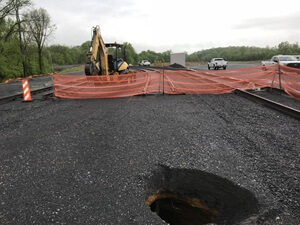 If an inspection establishes that a small depression is shallow, stable, away from structures, and caused by something such as decomposed buried material, surface filling may be an appropriate remedy. The Fairfax County conservation office describes several nongeological causes and provides guidance for limited, safe soil repairs.
The raw material may be inexpensive. HomeGuide’s fill dirt prices put ordinary fill around $5 to $25 per cubic yard, delivery commonly around $50 to $150, and spreading or installation around $200 to $400.
For a confirmed shallow depression requiring four cubic yards, the material alone would cost about $20 to $100. Adding those published delivery and installation allowances produces an illustrative $270 to $650 subtotal. Site minimums, grading, removal of unsuitable material, and professional assessment could push the complete bill higher.
This calculation applies only to a suitable surface-filling project. It does not price a true underground sinkhole or make it safe for a homeowner to enter, excavate, or approach an unstable opening.
If the depression is part of a broader surface problem, yard leveling costs may be relevant after the underlying condition is resolved. Correcting recurring runoff can also lead to a separate drainage or waterproofing project.
Hidden Costs and Insurance
The contractor’s stabilization price may not be the final bill. Repairing an affected driveway, replacing a damaged sewer line, restoring a patio, obtaining specialized testing, or fixing drainage can add substantial expenses.
Excavation is another variable. Published excavation rates place an excavator with an operator around $100 to $300 per hour. A contractor’s full excavation quote may already include machinery, labor, hauling, and backfilling, so equipment-hour estimates should not automatically be added to a completed-work bid.
Insurance can change the homeowner’s out-of-pocket cost, but coverage must be established from the policy and the cause of loss. Florida distinguishes ordinary sinkhole coverage from coverage for catastrophic ground cover collapse. The latter has a narrower legal definition, and not every depression or foundation crack qualifies. The state’s insurance coverage statute explains that distinction.
Florida’s Department of Financial Services also describes a sinkhole claims procedure for certain disputed claims. If an insurer denies a sinkhole claim without conducting testing, the policyholder may request testing within the specified period and face a limited initial share of testing costs. That share is subject to statutory conditions and can be reimbursed if the testing confirms covered sinkhole loss.
Do not assume insurance pays the whole contractor bill. Deductibles, exclusions, coverage limits, approved remediation methods, and separate cosmetic damage can affect the payout. Contact the insurer promptly if the property shows movement or damage that may trigger a claim, and preserve photographs, reports, correspondence, and written estimates.
Choosing a Repair Contractor
A useful quote explains the proposed method, treatment area, quantities, engineering basis, warranty, testing, and final restoration. It should distinguish soil stabilization from structural repairs rather than hiding both inside a vague foundation-repair allowance.
Makes sense if
- An engineer or qualified geologist identifies a condition that requires stabilization.
- The proposed method addresses the source of movement and protects the affected structure.
- The contractor provides a written scope tied to the investigation findings.
- The bid states which testing, permits, drainage repairs, and surface restoration are included.
Does not make sense if
- A contractor proposes filling a deep or active opening without establishing its extent.
- A slab-lifting quote is presented as a complete cure for serious subsurface instability.
- The proposal includes expensive piers without explaining why the foundation needs them.
- The contractor guarantees that a treated property can never experience future sinkhole activity.
Answers to Common Questions
What is the average cost to repair a sinkhole?
There is no reliable single national average covering everything called a sinkhole. Published Florida contractor ranges for substantial residential remediation run roughly $15,000 to $80,000+. Minor, nonstructural depressions can cost much less, while major structural losses can cost more.
Can you fill a sinkhole with dirt?
Only in suitable cases after the cause and safety of the depression have been established. A small, stable hole caused by buried material may be repaired with appropriately placed soil. Filling an active or deep geological sinkhole from the surface can conceal an unresolved hazard.
Does homeowners insurance cover sinkhole repair?
Sometimes. Coverage depends on the state, the policy, any sinkhole endorsement, the type of ground movement, and the resulting damage. Florida law distinguishes optional sinkhole-loss coverage from catastrophic ground cover collapse coverage.
How long does professional sinkhole repair take?
A limited repair may require only a short site visit after assessment, while subsurface investigations, engineering design, grouting, underpinning, and restoration can extend a project across weeks or longer. The actual schedule depends on access, testing, equipment, inspections, and repair scope.
Can a sinkhole reopen after repair?
Yes. Stabilization can address identified weak ground, but it cannot guarantee that all future movement or nearby sinkhole activity is impossible. Ask what the contractor will monitor, what the warranty covers, and whether drainage or other contributing conditions still need attention.
Disclosure: Educational content, not financial advice. Prices reflect public information as of the dates cited and can change. Confirm current rates, fees, taxes, and terms with official sources before purchasing. See our methodology and corrections policy.