
How Much Does Skin Tag Removal Cost?
Updated on | Written by Alec Pow
This article was researched using 14 sources. See our methodology and corrections policy.
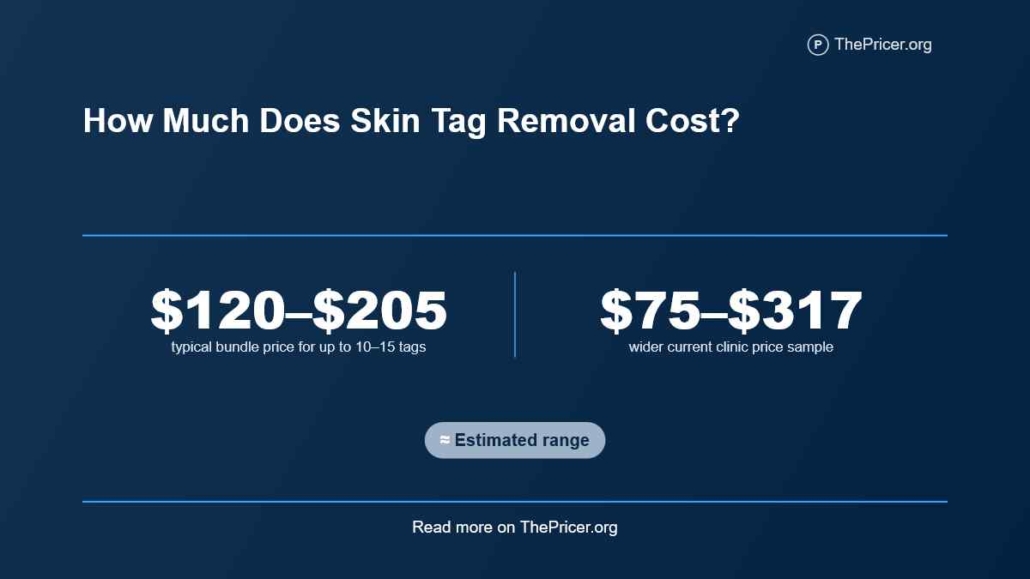
A practical procedure-price budget for professional skin tag removal is about $120 to $205 for a small bundle of up to 10 or 15 tags based on current U.S. clinic menus. A September 2026 review of nine U.S. clinic pages with explicit public skin-tag prices found a wider procedure-price span, from $75 for one to five simple tags to $317 for up to 15.
This is a transparent-price sample, not a representative national survey. The biggest cost drivers are lesion count, office-visit rules, size and location, and whether a growth needs diagnostic evaluation instead of cosmetic removal.
Removing one tag may cost close to the full session price, while treating 10 or 15 in the same priced block can push the effective cost per tag into the low teens.
Article Highlights
Jump to sections
- Five current clinic examples reviewed charge $120 to $205 (at $30 per hour, earning that amount would take about 4 to 6.8 hours of work, before taxes) for bundle-style removal of up to 10 or 15 skin tags.
- The sample runs from $75 for one to five simple tags to $317 for up to 15.
- A $120 price for up to 10 tags equals $120 per tag if only one is removed but $12 per tag if all 10 are treated.
- A separate new-patient consultation can add $150 to $200 at practices that do not include evaluation in the procedure price.
- Cosmetic removal is usually self-pay. Medicare may cover removal when a benign lesion is medically necessary and the reason is documented.
- FDA and dermatology guidance advise against products sold for at-home skin tag removal.
How Much Does Skin Tag Removal Cost?
Current clinic menus show that a straightforward cosmetic visit usually is not priced by cryotherapy, cautery, or snipping alone. Clinics often quote a single amount for a block of lesions. Tullahoma Dermatology lists skin tag removal pricing at $120 (about 4 hours of work at $30 per hour) per 10 tags and $110 for each additional set of 10. Dermatology Partners lists up to 15 tags at $205. Bluebird Dermatology posts one to 15 tags at $150 and more than 15 at $175.
Other current cash menus sit in the same broad neighborhood. Neoderma in Anaheim charges $195 for treatment covering up to 10 small tags, five medium tags, or one large tag. DermDirect lists up to 15 tags at $317 and another 10 at $169.
| Published clinic price | Included quantity | Effective price at full allowance |
|---|---|---|
| Tullahoma Dermatology | $120 for up to 10 | $12.00 per tag at 10 |
| Bluebird Dermatology | $150 for 1 to 15 | $10.00 per tag at 15 |
| Neoderma | $195 for up to 10 small tags | $19.50 per tag at 10 small tags |
| Dermatology Partners | $205 for up to 15 | $13.67 per tag at 15 |
The table uses posted prices from a small set of practices with transparent menus. It does not measure a national average and does not imply that every lesion qualifies for the listed bundle.
Why More Tags Can Cost Less Each
Skin tag pricing often behaves like a visit minimum rather than a strict per-lesion meter. At Tullahoma, the same $120 (about 4 hours of work at $30 per hour) buys removal of one tag or as many as 10 within the listed block. That makes the effective price $120 per tag for one, $24 per tag for five, and $12 per tag for 10. Adding a second block of up to 10 for $110 brings a 20-tag scenario to $230, or $11.50 per tag if all 20 qualify for that pricing.
This quantity effect is more useful than a generic claim that one removal method is always cheaper than another. A practice may choose snipping, electrodesiccation, cryosurgery, or another office technique after examining the lesion, while the patient still pays the clinic’s lesion-block price. The American Academy of Dermatology describes three office removal methods, including cryosurgery, electrodesiccation, and snipping. The method is selected based on tag size, location, and other clinical details.
Size can also change what fits inside a package. Neoderma’s $195 price covers up to 10 small tags, only five medium tags, or one large tag. A consumer comparing clinics should ask how the practice defines a small, medium, or extensive case before comparing the sticker price. One clinic’s “10 tags” offer may not buy the same amount of work as another clinic’s “10 tags” offer.
The Removal Method
The old idea that cryotherapy has one national price, cautery another, and excision a third is too neat. Current price menus show that many practices charge primarily by lesion count or treatment time, then let the clinician choose the method. That does not mean technique never changes the bill. It means the patient needs to know whether the clinic’s posted fee covers the chosen technique or whether a more involved procedure moves the case into a different billing category.
Pure Dermatology illustrates that distinction on one current menu. It lists simple skin tag removal at $75 for one to five lesions and $15 for each additional lesion, capped at $300. Larger tags or growths that need shave removal are listed separately at $125 per lesion. This is one clinic’s structure, but it shows why a very large or broad-based growth can cost more than a cluster of tiny stalked tags.
The same principle applies to delicate locations. Eyelid tags, lesions close to the eye, and growths with unusual appearance may need a different clinician or a diagnostic path before cosmetic treatment. The price should follow the service actually performed, not an assumed method chosen from an online chart. Readers comparing nearby procedures can see how milia removal costs use a different pricing structure even though both services may happen in a dermatology office.
Visit, Biopsy, and Pathology
The removal fee is not always the whole bill. True Dermatology lists a $150 self-pay visit that does not include procedures, plus $150 for fewer than 15 warts, skin tags, or keratoses. If both charges apply to a new self-pay patient, an illustrative visit becomes $300. That is a scenario based on two prices posted on the same page, not a promise that every skin-tag patient is billed both charges.
Liu Dermatology provides another useful cost model. Its surgical pricing page requires a new-patient surgical consultation of $200 before a procedure and lists skin tag removal up to 15 at $200. A new patient using that route would face $400 before any separate outside-lab charge. Liu also lists a self-pay pathology rate of $75 per specimen when pathology is needed. Routine skin tags do not automatically require pathology.
This is the hidden-price question worth asking before booking. Find out whether the evaluation fee is separate, whether it is credited toward treatment, whether removal can happen at the same appointment, and whether any specimen is expected to go to pathology. A tag that looks routine may stay inside the cosmetic price. A growth with diagnostic uncertainty can move into a medical evaluation, biopsy, or lesion-removal pathway with a different total. That distinction also matters when comparing the price with mole removal, where diagnostic testing is more likely to affect the bill.
When Insurance May Pay
Cosmetic skin tag removal is commonly self-pay. Medicare coverage guidance states that removal of benign skin lesions for appearance alone is cosmetic and not covered. The same guidance allows coverage when the removal is medically necessary and the condition is documented. Qualifying circumstances can include bleeding, pain, intense itching, inflammation, obstruction, restriction of vision, diagnostic uncertainty, or recurrent physical trauma. The exact criteria depend on the applicable coverage policy and the patient’s plan.
The practical difference is documentation. A tag that catches repeatedly on clothing and has documented trauma may be handled differently from an asymptomatic tag removed only because the patient dislikes its appearance. Medicare’s benign lesion coverage policy makes that distinction explicit. Private insurance rules vary, so a patient should ask the clinic which diagnosis and procedure codes it expects to submit and then verify benefits with the insurer before assuming the visit will be covered.
Coverage also does not mean a $0 patient bill. Deductibles, copays, coinsurance, network rules, and allowed amounts can still leave out-of-pocket costs. A cosmetic cash quote can sometimes be easier to predict than an insured medical claim. The useful comparison is the expected patient responsibility under the actual plan versus the clinic’s complete self-pay price.
Bad Price Comparison
At-home products can look cheaper because the purchase price may be small, but FDA guidance changes the comparison. The agency states that no OTC drugs are legally sold for mole or skin tag removal and has raised safety concerns about products marketed directly to consumers for those uses. The concern is not limited to whether a cream works. Products can injure skin, scar it, and delay proper evaluation of a growth that was mistaken for a harmless tag.
Home cutting, burning, freezing, or tying also creates a poor financial comparison because the buyer is taking on diagnostic and complication risk that is built into a professional visit. A dermatologist can confirm whether the growth is actually a skin tag before removing it. That matters because a wart, mole, or skin cancer can be mistaken for a benign tag.

The safe cost comparison is professional cosmetic removal versus professional medical evaluation when the lesion is symptomatic or uncertain. The current evidence does not support presenting an acid serum, freezing spray, or homeopathic cream as a normal lower-cost substitute for office treatment.
Skin Tags vs Other Skin Lesions
A true skin tag, or acrochordon, is a benign growth, often soft and attached by a stalk. The problem for a consumer is that visual self-diagnosis can be wrong. AAD guidance notes that people may mistake other growths, including skin cancer, for a skin tag. A changing, painful, bleeding, inflamed, or unusual lesion belongs in a diagnostic visit rather than a price-shopping exercise for cosmetic tag removal.
That distinction can change both the service and the bill. A cosmetic package priced for 10 or 15 tags assumes the lesions are suitable for that service. A clinician who is uncertain about one growth may recommend biopsy or another form of removal. That can introduce a procedure fee and pathology charge that were not part of the cosmetic bundle. The added cost is not a hidden markup if the service itself has changed.
Readers should also avoid transferring prices between different skin conditions. Milia extraction, mole removal, wart destruction, and skin tag removal can happen in the same specialty office but use different coding and treatment rules. A low skin-tag bundle does not establish the price of removing a pigmented mole or another lesion that needs pathology. The central money question is what the clinician believes the growth is and what service is required to deal with it safely.
When a Quote Makes Sense
A strong quote states the lesion allowance, charges above it, whether the office visit is separate, and whether pathology could add another bill. It should identify whether the price is cosmetic self-pay or an estimate of insured patient responsibility. Similar prices can cover different amounts of work.
Quantity creates the biggest savings opportunity when several small tags are suitable for treatment together. Separate visits can mean paying the clinic minimum again. A large package has little value when only a few lesions need removal. Compare the actual number, size, location, and diagnostic status of the lesions.
Makes sense if
- The clinic states the lesion allowance and total cash price in writing.
- The provider confirms the growths are suitable for routine skin tag removal.
- You know whether a separate consultation or pathology charge can apply.
- The multi-tag bundle matches the number you actually want removed.
Does not make sense if
- The growth is changing, bleeding unexpectedly, painful, or difficult to identify.
- The quote does not state how many lesions it covers.
- You are comparing a cosmetic bundle with a diagnostic biopsy or mole-removal service.
- The main reason for choosing a home product is a lower sticker price.
Answers to Common Questions
How much does it cost to remove one skin tag?
One tag can cost nearly the same as a small bundle. Current examples include $75 for one to five simple tags and $120 for up to 10.
How much does it cost to remove 10 skin tags?
Current examples include $120 for up to 10 tags and $195 for up to 10 small tags.
Does insurance cover skin tag removal?
Cosmetic removal is commonly self-pay. Coverage may apply when medically necessary symptoms or functional problems are documented.
Can skin tags be removed at home?
FDA and dermatology guidance advise against products marketed for at-home removal because of injury and diagnostic risks.
Can a consultation cost extra?
Yes. Some clinics price evaluation separately from removal, so a new-patient visit can add to the procedure fee.
Disclosure: Educational content, not medical advice. Pricing varies by provider, location, and insurance. Confirm eligibility, coverage, and out-of-pocket costs with a licensed clinician and your insurer. See our methodology and corrections policy.