
How Much Does Slack Subscription Cost?
Updated on | Written by Alec Pow
This article was researched using 12 sources. See our methodology and corrections policy.
Slack costs $0 on its Free plan, $7.25 per active user per month for Pro, and $15 per active user per month for Business+ when billed annually. Monthly billing increases those rates to $8.75 and $18, respectively. Slack Enterprise+ requires a custom quote based on the organization’s requirements and contract.
For a company with ten active employees, Pro costs $870 annually and Business+ costs $1,800 annually at standard annual rates, before taxes and separately purchased integrations. Slack’s Fair Billing Policy can reduce the effective expense when employees become inactive, making the number of billable members especially important.
The other purchasing decision is how long the company needs to retain conversations. Free workspaces can access only 90 days of history, and older information is eventually deleted. Teams depending on Slack as a searchable knowledge archive may therefore need a paid subscription.
Article Highlights
Jump to sections
- Slack Pro costs $7.25 per user/month annually or $8.75 with monthly billing.
- Slack Business+ costs $15 per user/month annually or $18 with monthly billing.
- A ten-person Pro subscription costs $870 annually at normal rates.
- Free workspaces provide 90-day history access and delete messages and files older than one year.
- Pro includes basic AI features, while Business+ adds advanced AI search and recaps.
- Eligible nonprofits can receive free Pro access or discounts as high as 85%.
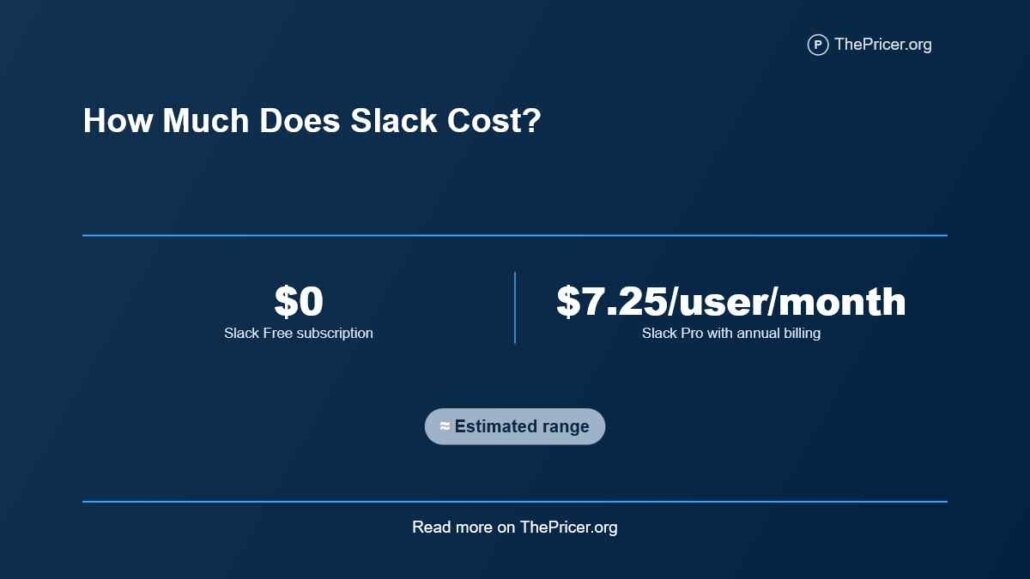
How Much Does Slack Cost?
Slack’s official U.S. pricing page currently lists Free, Pro, Business+, and Enterprise+. The figures below are standard published prices rather than temporary promotional discounts.
| Plan | Annual billing, per active user/month | Monthly billing, per active user/month | Yearly cost for 10 active users |
|---|---|---|---|
| Free | $0 | $0 | $0 |
| Pro | $7.25 | $8.75 | $870 |
| Business+ | $15 | $18 | $1,800 |
| Enterprise+ | Custom quote | Custom terms | Custom quote |
The annual totals assume ten continuously active, billable members. Actual invoices can differ because of prorated additions, inactive-member credits, promotions, taxes, and contracted enterprise terms.
Slack’s June 2025 pricing update increased Business+ from $12.50 to $15 per user monthly with annual billing, while Pro remained unchanged. The company also replaced its previous Enterprise Grid positioning with a newer Enterprise+ offering for new purchases.
These changes are described in Slack’s pricing and feature update announcement. Older comparisons that still list Business+ at $12.50 are not describing the current standard offer.
What Slack Free Includes
Slack Free supports team messaging, public and private channels, direct messages, file sharing, and integrations. There is no general ten-person membership ceiling, unlike the older article’s description.
However, the free edition imposes important functional restrictions. Slack’s free workspace limits explain that users can see and search only the most recent 90 days of messages and files. Content older than one year is permanently deleted on a rolling basis.
This replaced the historical 10,000-message search threshold. A very active workspace might reach 10,000 messages in a few days, while a quiet team might produce fewer than that in several months. The current time-based restriction affects those teams differently.
Free workspaces can install up to ten third-party or custom applications. They also have limited collaboration features, including one-to-one huddles rather than large group calls.
For a temporary project or a small team that keeps essential records elsewhere, Free may be sufficient. It is a poor choice when Slack conversations contain decisions, instructions, or customer correspondence that must remain accessible for years.
Slack Pro Features
Slack Pro costs $7.25 per active member monthly under annual billing. It provides access to the full available conversation history, unlimited app integrations, group huddles, workflow automation, and additional collaboration tools.
Its official Pro plan description confirms support for group calls with up to 50 participants, file and message search, canvases, lists, and Slack Connect collaboration with external organizations.
Pro also includes AI-generated conversation summaries and huddle notes. These capabilities can help employees catch up on discussions without reviewing every message manually.
The value of Pro depends on the organization’s actual workflow. A team using Slack as a daily archive for decisions and customer information may justify its cost through better access to historical conversations.
By comparison, an organization that communicates occasionally and stores all permanent project records in another system may not need to pay for full history and additional workflow features.
Business+ and Enterprise+
Business+ costs $15 per active user monthly with annual billing. It adds advanced AI functionality, identity management, and administrative controls intended for organizations with more complex operations.
The Business+ plan specification identifies features such as SAML single sign-on, user provisioning, AI-powered search, and daily AI recaps. The plan also includes around-the-clock support with a specified four-hour response commitment.
Business+ costs $7.75 more per user monthly than Pro on annual billing. For 20 active members, the additional expense is $1,860 annually.
That premium should be justified by the need for additional security, automation, AI, or administration. Businesses that only require unlimited history and ordinary messaging may find Pro more economical.
Enterprise+ is sold through customized agreements. Slack’s plan feature comparison lists enterprise-level security, governance, and administrative capabilities.
The original article’s $8 to $15 per user/month estimate for Enterprise Grid is not a current verified Enterprise+ rate. Contract prices depend on the organization’s size, requirements, services, and negotiated terms.
Annual vs. Monthly Billing
Annual billing provides a lower per-user price in exchange for committing to a longer billing arrangement. The savings can be calculated directly from Slack’s standard published rates.
For ten Pro members, annual billing costs $870. Twelve months of monthly billing at $8.75 per member costs $1,050. The annual option saves $180, or approximately 17.1% compared with monthly billing.
Business+ costs $1,800 annually for ten members, compared with $2,160 over twelve standard monthly payments. The savings are $360, or 16.7%.
These comparisons assume a stable team for the entire year. In practice, Slack’s active-member billing adjustments can change the effective annual expense.
The Slack subscription management instructions explain how eligible workspace administrators can change plans, select billing cycles, and manage downgrades.
The Hidden Cost of Guest Accounts
 Slack’s billing is not determined solely by a company’s employee count. Outside contractors and guests can become billable members depending on the type of access they receive.
Slack distinguishes single-channel guests from multi-channel guests. The former are generally free within the permitted allocation, while multi-channel guests are billed like full members.
The company’s workspace billing guidance explains that customers can add up to five free single-channel guests per paid active member, subject to Slack’s eligibility rules.
Consider a ten-person Pro workspace that adds three consultants as multi-channel guests. If all are active, the billable total rises to thirteen users.
At the annual-commitment rate of $7.25 per member monthly, the annualized cost increases from $870 to $1,131. The three consultants therefore add $261 per year, assuming they remain active for the full year.
If those consultants need access to only one channel each and qualify as free single-channel guests, the company may avoid that additional seat expense.
Guest configuration should follow genuine access requirements. Giving a contractor broader visibility simply to make administration convenient can increase costs and expose unnecessary information.
Fair Billing and Inactive Users
Slack’s Fair Billing Policy is unusual among business subscriptions because qualifying self-service customers receive credits when paid members stop using the service.
The official Fair Billing Policy applies to qualifying plans purchased through Slack’s website using eligible payment methods. When a member becomes inactive, Slack provides a prorated account credit for unused time.
Slack automatically identifies certain users as inactive after more than 28 days without usage. Workspace administrators can also deactivate accounts. Credits are generally applied to future Slack charges rather than refunded as cash.
For example, Slack’s own billing illustration uses a Pro member charged $8.75 monthly who is deactivated halfway through a 30-day billing period. The resulting credit is approximately $4.38.
Those credits have no cash value, cannot be transferred, and can expire when the paid subscription ends. Contracted enterprise arrangements may have different billing provisions.
The practical implication is that deactivating unused accounts can reduce future charges without requiring every employee to remain active for an entire subscription year.
A Complete Slack Team Budget
Consider an illustrative company with fifteen full-time employees, two external consultants requiring multi-channel access, and several connected business applications.
The business purchases Slack Pro at the annual billing rate and expects all seventeen billable accounts to remain active throughout the year.
- Fifteen employee accounts at $7.25 monthly: $1,305 annually
- Two multi-channel guest accounts at the same rate: $174 annually
- Illustrative paid integration subscription: $240 annually
- Illustrative one-time onboarding assistance: $350
The modeled first-year total is $2,069, before taxes and any other separately purchased services.
The Slack subscription component is $1,479 annually. The remaining $590 represents explicitly assumed integration and onboarding expenses rather than official Slack charges.
If onboarding does not recur, the modeled second-year cost falls to $1,719, assuming unchanged user counts and integration spending.
This example highlights two budgeting issues. Contractors may be billed like employees, while third-party applications can introduce costs even when Slack itself permits unlimited app integrations on a paid plan.
AI Features and Add-Ons
Slack’s 2025 pricing changes included additional AI features in paid subscriptions. Pro gained basic AI functionality, while Business+ and Enterprise+ incorporated more advanced AI capabilities.
Slack’s AI and pricing announcement also explains that its former Slack AI add-on is no longer sold separately through the Slack website. Customers who purchased the old add-on were subject to specific transition rules.
This matters when comparing a previous contract with current prices. A higher Business+ subscription charge may also include features that formerly required another purchase.
Some connected applications impose their own subscription charges. An integration might be free inside Slack but require an eligible paid account with Salesforce, Asana, or another provider.
For organizations using Slack alongside a CRM, the Salesforce subscription cost remains a separate line item unless explicitly included in a negotiated package.
Slack vs. Microsoft Teams
Microsoft Teams and Google Chat are relevant alternatives, particularly when a company already purchases Microsoft 365 or Google Workspace for email and document management.
Microsoft’s U.S. Teams pricing information lists Teams Essentials at $4 per user monthly with annual billing. Microsoft 365 Business Basic costs $7 per user monthly and includes business email, cloud storage, and other applications.
For ten users, Teams Essentials costs $480 annually, compared with $870 for Slack Pro under their standard annual rates.
However, this difference does not prove that Teams is always the less expensive business solution. Existing Microsoft licenses, application integrations, migration work, compliance needs, and employee workflows can change the effective comparison.
Google Chat is included with eligible Google Workspace subscriptions. Google’s current Business Starter standard price is $7 per user monthly with an annual commitment, but that price pays for an entire productivity suite rather than chat alone.
A company’s best option may therefore be the collaboration tool already included in software it uses daily.
Nonprofit and Education Discounts
Slack offers substantial assistance to eligible nonprofit organizations and educational institutions. Its nonprofit discount policy grants qualifying workspaces with 250 or fewer members access to Pro without subscription charges.
Eligible nonprofit workspaces with more than 250 members can receive an 85% Pro discount. Qualifying nonprofit organizations of any size may receive an 85% discount on Business+.
Slack’s education program separately provides an 85% discount on eligible Pro and Business+ subscriptions.
Approval is not automatic, and program restrictions apply. Organizations must verify their eligibility and complete the relevant application process.
A qualifying ten-user nonprofit receiving an 85% Business+ discount would reduce the modeled standard annual price from $1,800 to $270, assuming the discount applies to the whole annual license charge.
When Slack Is Worth Paying For
Slack Pro is most useful when the organization needs searchable historical conversations, numerous application integrations, and group collaboration tools. Business+ is more appropriate when advanced AI, administrative controls, and enterprise identity management have operational value.
Makes sense if
- Employees need long-term access to decisions and shared files.
- The company collaborates extensively with external partners.
- Group huddles and workflow automation replace separate tools or manual work.
- The selected plan provides security and management features the organization actually requires.
Does not make sense if
- Free Slack’s history limitations are acceptable for the intended use.
- An existing Microsoft 365 or Google Workspace subscription already meets communication needs.
- The organization is paying for Business+ without using its advanced features.
- Unnecessary guest accounts or connected services increase recurring costs.
Slack can also complement dedicated project tools. Its messaging features are different from the broader workload and portfolio capabilities described in the Asana pricing guide.
Answers to Common Questions
How much does Slack cost for ten users?
Slack Pro costs $870 annually and Business+ costs $1,800 annually for ten continuously active members at standard annual billing rates.
Can Slack be used for free indefinitely?
Yes. Free workspaces can continue operating, but only the latest 90 days of messages and files are accessible, and content older than one year is permanently deleted.
Does Slack charge for inactive employees?
Qualifying self-service paid subscriptions provide prorated credits when employees become inactive. The credits apply toward future charges and generally are not cash refunds.
Is Slack Business+ worth the upgrade?
It may be worth the premium for organizations using advanced AI search, identity management, enhanced administration, and higher-level support. Teams requiring only searchable history and group collaboration may prefer Pro.
Is Slack cheaper than Microsoft Teams?
At current standard list prices, Microsoft Teams Essentials starts at $4 per user monthly with annual billing, compared with $7.25 for Slack Pro. The better overall value depends on the features, existing subscriptions, and integrations required.
Disclosure: Educational content, not financial advice. Prices reflect public information as of the dates cited and can change. Confirm current rates, fees, taxes, and terms with official sources before purchasing. See our methodology and corrections policy.