
How Much Does Snow Plowing Cost Per Season?
Published on | Written by Alec Pow
This article was researched using 14 sources. See our methodology and corrections policy.
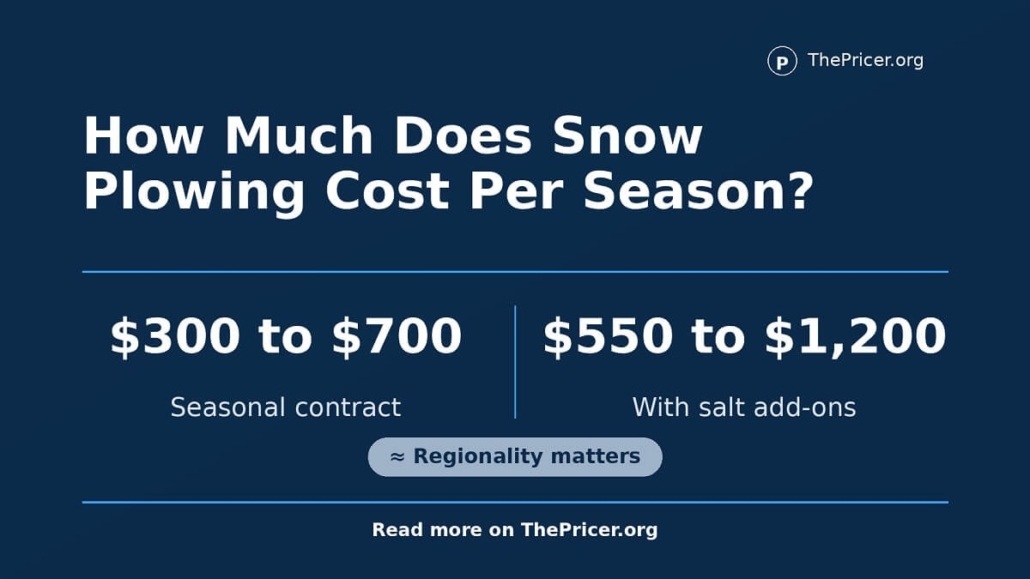
A seasonal residential plowing contract turns repeated driveway clearing into recurring winter service with a defined service area and dispatch rule. As of April 2026, Angi places seasonal residential contracts at $300 to $700, with per-visit snow removal at $51 to $203, and identifies driveway size and snowfall frequency as major drivers of the bill.
The seasonal quote is not simply a truck fee. It can combine plow labor, travel between accounts, equipment time, hand clearing, de-icing, and extra passes after deeper storms. Exact bids may stay private because driveway geometry, route placement, snowfall trigger, included surfaces, and visit limits are property-specific.
Homeowners, snow-removal contractors, plow trucks, driveway surfaces, sidewalks, snow blowers, de-icing materials, municipal street plows, and snow-storage areas all affect how the service is scoped. A contract can use per-push, seasonal, hourly, or depth-tier billing, and the practical comparison is made per season or per dispatch rather than as a one-time project. Trigger depth and add-on labor can change how often work is performed and what sits outside the base agreement.
How Much Does Snow Plowing Cost Per Season?
Jump to sections
- Current per-visit reference is $51 to $203 (at $30 per hour, earning that amount would take about 1.7 to 6.8 hours of work, before taxes) in the June 2026 residential cost data.
- St. Louis seasonal contracts for 2026 run $290 to $670 in published local seasonal contract data.
- Mid-range homeowner snow blower purchase: $500 to $1,500 in the snow blower ownership data.
A worked seasonal snow-plowing total
A useful seasonal estimate separates the base contract from services that may be billed outside it. Using the March 2026 two-car residential contract benchmarks, a homeowner whose agreement carries a $400 to $800 (about 1.7 to 3.3 full-time workdays at $30 per hour) seasonal charge and bills two $75 to $200 salt applications separately would land at $550 on the low side because $400 + 2 × $75 = $550, or $1,200 on the high side because $800 + 2 × $200 = $1,200.
The arithmetic is a budgeting model rather than a quote for a specific address. It shows why two agreements with similar base fees can produce different winter totals once de-icing moves outside the seasonal package.
The contract should make that separation visible before the first storm. A lower headline figure carries less value if every icy visit, walkway pass, or deeper snowfall creates another line on the invoice.
What you’re actually buying
Seasonal snow plowing is recurring clearing of driveable surfaces after snowfall meets the contractor’s service condition. The plow pushes accumulation to an available storage area on the property. Full snow removal can mean loading and hauling piles elsewhere, which is a different job. Hand work covers areas a truck blade cannot reach.
Service scope can extend beyond the driveway. Plowing, salt or sand application, edge marking, visit logging, snow hauling, walkway work, and garage-apron clearing are separate tasks that may or may not sit inside one agreement. A seasonal agreement is different from buying equipment because the contractor also takes responsibility for dispatching a truck when the contract conditions are met. The contractor also needs a workable place to stack snow without blocking garage access, visibility, drainage, or the next plow pass.
Seasonal contracts, per-push rates
Seasonal and per-push agreements divide weather risk differently. A seasonal flat rate fixes the contract charge for a defined set of winter services. Per-push billing creates a charge each time the property is serviced. Per-event language needs close reading because one long storm can require more than one pass, and a depth-based schedule can increase charges as accumulation rises. An August 2026 contract review distinguishes per-push, per-event, and seasonal billing and calls for the agreement to define the event and service record.
| Contract structure | Billing basis | Main contract check |
|---|---|---|
| Seasonal flat rate | Set winter charge | Included services and any visit cap |
| Per push | Each clearing pass | Trigger depth and repeat passes |
| Per event or depth tier | Storm or accumulation band | Definition of an event and deeper-snow treatment |
The contract language matters. A low trigger can create more dispatches than a higher trigger, and a visit cap can turn a flat winter fee into a base amount plus overage charges. The treatment of an ongoing storm matters too because several truck passes may be counted differently from one completed snow event.
Driveway size and service scope
Driveway footprint provides a useful starting point because a larger paved area takes more truck time and offers more places where snow must be stacked. One August 2026 residential pricing reference lists a single-car seasonal band of $300 to $450 (about 1.3 to 1.9 full-time workdays at $30 per hour), a two-car band of $500 to $700, and larger residential properties at $700 to $1,000. Those figures are budgeting references rather than nationwide quotes, and local snowfall patterns can move a bid outside them.
Square footage is only part of the workload. A short two-car driveway with open snow-storage space gives the operator a different task from an equally sized driveway bordered by walls, parked vehicles, steps, or a tight garage apron.
Adding sidewalks also shifts work from the truck to hand labor or smaller equipment. Full-property service can include front walks, steps, parking pads, and ice control, so two properties with similar driveways may receive different seasonal bids because the contracted clearing area is different.
What a real snow-plowing quote contains
A contractor’s number has to cover labor, truck and plow time, fuel, equipment wear, travel between accounts, materials, and business overhead. An August 23, 2026 contractor pricing worksheet builds quotes from operating inputs including loaded labor, equipment and fuel, overhead burden, drive time, expected events, trigger depth, response timing, and salt. For a homeowner, that means a seasonal figure should be read beside the service description rather than as a standalone number.
Three buyer cases
 A published Minnesota rate card supplies three distinct buyer cases in one market. For the 2025-2026 season, a Circle Pines driveway rate card lists driveway-only service at $1,150 with a 2-inch trigger, $1,350 with limited shoveling at the same trigger, $1,800 with a one-half-inch trigger, and $70 per basic pay-as-you-go plow, so $1,150 ÷ $70 = 16.4 and the seventeenth basic visit would pass the prepaid base before any depth surcharge.
These are not national buyer anecdotes. They are rate-card cases showing three separate drivers. The first buys driveway coverage, the second adds hand work, and the third pays for a lower dispatch threshold. That distinction is useful when comparing bids because a higher quote may represent a larger service promise rather than a higher charge for the same job.
Regional snowfall, route density
Contractors also price the route, not only the driveway. A Lakeville, Minnesota service page says coverage is accepted as its nearby route fills and that clusters of neighboring accounts make service easier to commit to. Snowfall frequency adds another layer because a seasonal contractor must plan truck capacity across every account during the same storm rather than treating each property as an isolated job.
A long private drive with a steep grade, a tight turn near the garage, limited snow-storage space, and no easy truck turnaround consumes more route time than a short straight driveway even before another storm pass is needed. Gravel and paved surfaces can also require different blade handling. Homeowners comparing a plow agreement with future paving work can use current asphalt driveway installation data as separate ownership context. The useful quote comparison is the same defined driveway, trigger, walks, ice treatment, and storm procedure across every bidder.
Who this cost makes sense for
A seasonal contract fits households that want recurring storm response without calculating a new bill after every qualifying snowfall. Per-push service can fit a property where plowable events are less frequent or where the owner wants to retain more weather risk. Buying equipment shifts the dispatch work back to the homeowner, and a built-in snow-melting system changes the decision again because it replaces contractor visits with installed equipment and energy use. Current heated driveway ownership costs give that alternative a separate capital-cost frame.
Makes sense if
- The driveway must be open after repeated qualifying storms.
- The household does not want to operate and store plowing or blowing equipment.
- The written agreement defines the trigger, service area, and extra-visit treatment.
- Hand clearing or de-icing can be added under a defined scope.
Doesn’t make sense if
- The property receives few plowable events and per-push billing fits better.
- The driveway is small enough for equipment already owned.
- The contractor cannot service the driveway’s slope, access, or surface safely.
- An installed snow-melting system already handles the main driveable area.
Answers to Common Questions
How much should I budget for seasonal residential snow plowing?
Current U.S. pricing references place many residential seasonal contracts in the mid-hundreds. Local posted rates can move below or above that band because snowfall trigger, driveway size, hand clearing, salt, and visit limits change the contracted workload.
Is seasonal snow plowing cheaper than paying per visit?
It can be during a winter with enough qualifying visits. A light winter can favor per-push billing. The useful comparison divides the seasonal quote by the local per-push charge and then checks whether both options use the same trigger and service scope.
Does a seasonal contract include salting?
Not automatically. Some contractors include ice treatment, and others list it as a separate application charge. The agreement should name the surfaces treated, the material, and the billing method.
Why does a steep or long driveway cost more?
It can require more truck time, slower maneuvering, greater travel within the property, and more planning for where snow can be stacked. Gravel, tight turns, parked vehicles, and limited turnaround space can add to the work.
Disclosure: Educational content, not financial advice. Prices reflect public information as of the dates cited and can change. Confirm current rates, fees, taxes, and terms with official sources before purchasing. See our methodology and corrections policy.