
How Much Does SpaceX AI GPU Infrastructure Cost?
Published on | Written by Alec Pow
This article was researched using 11 sources. See our methodology and corrections policy.
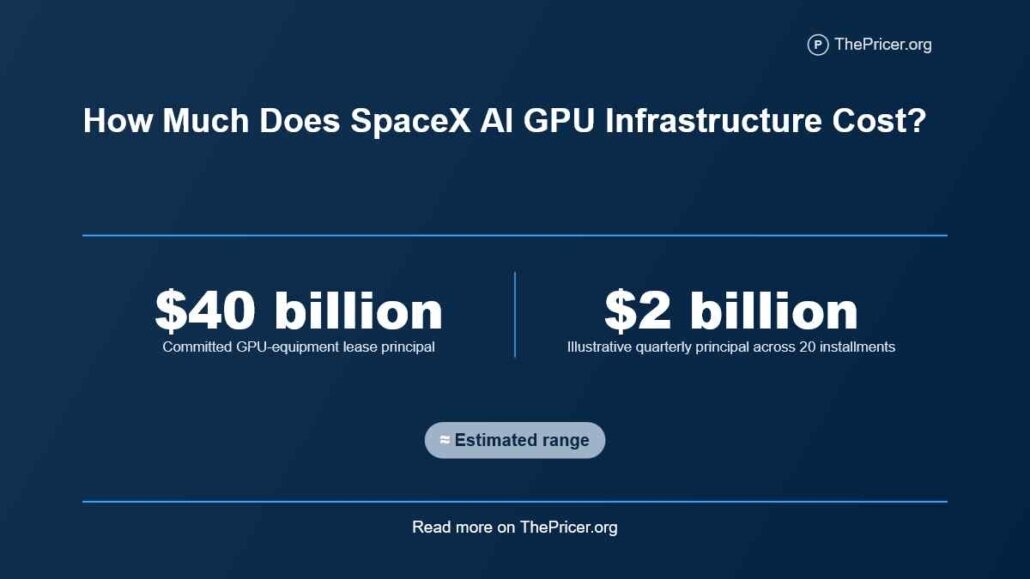
SpaceX has committed to approximately $40 billion in financing for NVIDIA AI GPUs and related equipment through a proposed lease with an Apollo Global Management-managed entity, announced October 26, 2026. That amount represents expected equipment-lease principal, not the entire cost of SpaceX’s data centers. Interest, electricity, cooling, construction, maintenance and other expenses can increase the total substantially.
The company expects the financing to close before the end of 2026, with GPU deliveries and individual leases beginning in the first half of 2027. The agreement covers NVIDIA’s next-generation Vera Rubin processors for terrestrial artificial intelligence infrastructure. It does not disclose the number of GPUs purchased or the final interest rate.
SpaceX already operates substantial AI computing infrastructure following its acquisition of xAI. Its September 2026 financial disclosures report 1.7 gigawatts of nameplate computing capacity and tens of billions of dollars in capital spending.
Article Highlights
Jump to sections
- SpaceX announced approximately $40 billion in committed GPU-equipment financing on October 26, 2026.
- The equipment will be leased for roughly five to five-and-a-quarter years, with interest and other expenses added to principal.
- The implied average principal repayment is $2 billion per quarter across 20 equal principal installments once the full amount is financed, excluding interest.
- SpaceX recorded approximately $48.1 billion in company-wide capital expenditure during the first nine months of 2026.
- Its disclosed AI nameplate compute capacity reached 1.7 gigawatts by September 30, 2026.
- SpaceX’s compute customers include Anthropic, Google and Reflection AI, under separate service contracts.
- The precise GPU count, equipment-by-equipment prices, financing interest rate and final all-in project cost have not been published.
How Much Is SpaceX Spending on AI GPUs?
The clearest new spending figure is the $40 billion financing commitment.
In its October 26 SEC filing, SpaceX disclosed a binding commitment letter signed October 24 with an Apollo-managed equipment lessor.
The lessor will acquire GPU pods and associated equipment and lease them to SpaceX for data centers selected by the company.
Under the proposed agreement, each equipment tranche receives its own lease schedule. Expected aggregate principal payments across those schedules total approximately $40 billion.
A separate SpaceX financing announcement identifies NVIDIA Vera Rubin chips as the principal next-generation hardware.
The agreement is subject to closing conditions. SpaceX expects closing before year-end 2026 and the first equipment deliveries in 2027.
The announced amount should not be described as an immediate cash purchase, a completed loan drawdown or the cost of constructing an entire AI campus.
What the $40 Billion Covers
The financing covers GPU pods and related equipment. A GPU pod is more than an individual accelerator.
Large AI computing installations require processors, server boards, high-speed interconnects, memory, networking equipment and associated systems that allow thousands of chips to work together.
The company’s joint financing details identify Apollo as the manager of the lessor, Goldman Sachs as sole structuring agent, and additional commitments from investment entities associated with BlackRock, Goldman Sachs Asset Management and KKR.
The arrangement does not publish itemized purchase prices for processors, server racks, networking hardware or storage.
It also does not establish how much of the $40 billion will be spent on GPUs alone.
GPU prices vary by generation, memory configuration, system architecture, purchase quantity and supplier contracts. Assigning an arbitrary processor price would produce a misleading estimate of SpaceX’s GPU count.
A fully installed AI data center requires many additional investments beyond the financed computing equipment.
How the GPU Lease Payments Work
SpaceX’s filing describes equipment leases lasting approximately five to five-and-a-quarter years from their individual commencement dates.
Rent is payable quarterly in advance. Each scheduled payment generally includes one-twentieth of the financed tranche cost, plus a fixed-rate charge on the remaining balance and certain ongoing expenses.
The interest rate will be established when the financing is priced, before the definitive lease is executed.
That payment structure creates an important difference between the announced principal and the amount SpaceX will eventually pay.
| Financing component | Published figure or treatment | What it means |
|---|---|---|
| Expected financed principal | About $40 billion | Aggregate equipment principal |
| Principal installments | Generally 20 per equipment tranche | Quarterly repayment structure |
| Implied full-program quarterly principal | About $2 billion | Calculated average, not one simultaneous invoice |
| Financing interest | Rate not yet disclosed | Additional lease cost |
| Additional expenses | Amount not disclosed | Other contractual and operating charges |
| Lease commencement | Expected first half of 2027 | Begins as equipment arrives |
The average principal calculation is $40 billion ÷ 20 = $2 billion.
It is not a forecast of actual quarterly cash flow. Equipment will arrive in tranches, and each tranche begins its own repayment schedule.
The interest and other expenses mean the total lease payments should ultimately exceed principal alone, assuming the agreement closes and is performed under the described terms.
Financing Interest
Because the fixed annual interest rate has not been disclosed, there is no verified final repayment total.
An illustration shows the sensitivity without pretending to know SpaceX’s negotiated rate.
Suppose the entire $40 billion were financed at once, principal were repaid evenly over 20 quarters, and the annual interest rate were hypothetically 6%.
The outstanding principal would decline by $2 billion each quarter. Using a simple annual-rate-divided-by-four calculation, the opening quarterly interest expense would be $600 million, falling as the balance declines.
Over 20 quarters, modeled interest would total approximately $6.3 billion. Principal plus interest would therefore be approximately $46.3 billion, excluding fees and other expenses.
At a hypothetical 8% rate using the same assumptions, interest would be approximately $8.4 billion, bringing principal plus interest to $48.4 billion.
These are financing illustrations, not SpaceX projections. Actual lease schedules may begin at different times, run longer than five years, and include other cost components. The final contracted rate remains unknown.
The useful finding is that even a small difference in financing rates produces billions of dollars of potential additional payments at this scale.
SpaceX’s Existing AI Infrastructure
 The new financing expands a computing operation that already has substantial physical capacity.
SpaceX’s third-quarter 2026 results reported 1.7 gigawatts of nameplate computing capacity as of September 30.
That is a measure of the scale of its AI computing infrastructure, not the electrical consumption of every server at every hour.
The company reported $7.56 billion of third-quarter revenue in its Super Intelligence segment, compared with approximately $813 million one year earlier.
Super Intelligence includes AI infrastructure services as well as AI software and related businesses, so its total revenue should not be interpreted as GPU rental income alone.
SpaceX’s September quarterly financial report shows approximately $48.1 billion in total capital spending during the first nine months of 2026.
The spending includes data centers and other infrastructure, alongside SpaceX’s rocket, satellite and other business investments.
The $40 billion proposed lease concerns future equipment deliveries and must not simply be added to historical expenditure to calculate an all-in AI infrastructure budget. Spending recognition, lease accounting and project scope are different.
Data Center Construction and Cooling
AI GPU equipment requires substantial supporting infrastructure.
A large computing campus needs a reliable power supply, electrical substations, distribution equipment, high-speed networking, high-density racks, liquid cooling and buildings capable of supporting the installation.
SpaceX’s prospectus discusses how the economics of AI infrastructure are driven by processors and critical IT equipment alongside data center construction and utility connections.
The company’s infrastructure cost discussion cites industry estimates that processors and critical IT hardware can represent around 70% of the capital cost of conventional AI computing facilities, with construction and related infrastructure around 30%.
That split is a broad industry reference, not a verified budget breakdown for the new SpaceX lease.
Cooling alone can become a major construction project. The cost to cool an AI data center explains why a 100-megawatt installation may need $100 million to $150 million of cooling infrastructure, followed by substantial annual electricity and maintenance spending.
Those ranges should not be automatically multiplied by SpaceX’s disclosed 1.7-gigawatt nameplate capacity. Campus equipment, existing investments and cooling technologies differ.
The October lease announcement does not identify a separate building budget or specify how much new electrical capacity its equipment will require.
Electricity Costs at AI Scale
Electricity is a continuous expense after a GPU installation enters service.
For perspective, consider a hypothetical 100-megawatt computing installation operating at full load for a year.
At an illustrative electricity price of 8 cents per kilowatt-hour, the servers alone would use approximately 876 million kilowatt-hours annually, representing $70.08 million in electricity.
Cooling, pumps and power-distribution losses would add further consumption.
A 1-gigawatt installation operating at the same assumed rate and utilization would consume ten times as much electricity, producing a modeled $700.8 million annual server-power bill before facility overhead.
Neither number is SpaceX’s published utility expenditure.
The actual cost depends on negotiated industrial power rates, utilization, power usage effectiveness, generation arrangements and the site’s physical infrastructure.
Electricity supply can also require substations, transmission capacity or dedicated generation equipment.
SpaceX’s investment strategy emphasizes integrating power access, AI processors and data center design, but the new $40 billion lease does not disclose a fixed per-megawatt electricity price.
Who Pays SpaceX for AI Compute?
SpaceX is not building infrastructure exclusively for its own Grok models. It also sells access to computing capacity to other AI companies.
In June 2026, the company disclosed a Google cloud computing agreement covering approximately 110,000 NVIDIA GPUs and associated systems.
The agreement specifies $920 million per month beginning in October 2026 after an earlier reduced-fee capacity ramp.
Either party can terminate under specified conditions, and the contract includes remedies if the required computing capacity is not delivered.
Anthropic separately announced a SpaceX compute partnership involving more than 220,000 GPUs and over 300 megawatts of capacity at Colossus 1.
SpaceX filings also describe contracts with Anthropic covering approximately 325,000 GPUs and substantial dedicated compute resources.
TechCrunch reported another SpaceX computing services contract with Reflection AI priced at $150 million per month for access to hardware at Colossus 2.
These are customer payments for computing services, not SpaceX’s cost of buying those GPUs. They cannot be added to the financing principal as though they were infrastructure expenses.
Can SpaceX Recover the Investment?
SpaceX says some of its new AI compute deployments are achieving payback periods of less than a year, although individual customer contracts and infrastructure accounting can differ.
The financing announcement presents that as management’s assessment, rather than a guaranteed return on every new GPU installation.
An illustrative calculation helps distinguish revenue from recovery of capital.
At $920 million per month, Google’s disclosed payment rate corresponds to $11.04 billion over 12 months if the full rate remains in effect throughout that period.
That is gross contractual revenue at the specified rate, not operating profit. It does not deduct electricity, depreciation, networking, financing or maintenance.
Nor is the Google agreement necessarily tied to the hardware being financed under the October 2026 lease.
Several of SpaceX’s cloud agreements permit early termination under defined conditions. Their published maximum durations should therefore not be treated as guaranteed future cash collections.
A defensible assessment of infrastructure payback requires actual equipment costs, customer usage, operating expenses, contract enforceability and the timing of GPU deployment.
GPU Ownership vs Leasing
Large AI developers have several ways to obtain computing capacity.
They can buy accelerator hardware outright, finance purchases, lease equipment, or rent complete systems from a cloud provider.
SpaceX’s October 2026 transaction uses equipment lease financing. Apollo’s managed entity is expected to acquire the hardware, while SpaceX uses it and makes scheduled payments.
The arrangement reduces the need to pay the full equipment price immediately but adds financing costs and contractual commitments over several years.
TechCrunch’s financing structure analysis confirms the lease approach and the planned timing of deliveries.
The risks differ from a conventional short-term cloud rental. SpaceX may remain responsible for financing payments even if chip efficiency, customer demand or computing prices change.
The processors also face technological obsolescence. A newer GPU generation can offer better performance per watt, making older installations less competitive before their financing commitments have expired.
The precise maintenance obligations, insurance costs, equipment residual values and end-of-lease disposition terms have not been disclosed publicly.
Orbital AI Infrastructure
SpaceX’s long-term AI ambitions also include putting computing hardware into orbit.
That is a separate proposed infrastructure category from the NVIDIA equipment financed under the new terrestrial lease.
A Reuters report on orbital computing said SpaceX was targeting initial demonstrations by late 2027, with broader deployment ambitions extending beyond that.
Orbital systems could benefit from solar power and the company’s launch capability, but hardware still requires manufacturing, launch, radiation protection, thermal control, communications and eventual replacement.
SpaceX has not provided a reliable full cost per operational orbital AI GPU, including deployment and lifetime expenses.
Its proposed orbital projects also face technical and regulatory uncertainty. They should not be included in the $40 billion terrestrial financing figure unless a disclosure explicitly connects the expenses.
Similarly, plans to manufacture proprietary AI processors through the Terafab initiative are distinct from the committed NVIDIA equipment lease.
What the New Financing Means
The October 2026 deal demonstrates how AI computing infrastructure increasingly requires financing arrangements previously associated with other capital-intensive industries.
Large installations combine expensive equipment with electricity, construction, cooling, networking and maintenance obligations.
The cost question is therefore not simply how many GPUs a company can buy. It is the amount invested to bring usable compute online and maintain it over time.
The financing makes sense if
- Equipment deliveries can be matched to contracted or strongly supported compute demand.
- Operating margins cover financing, utilities and maintenance.
- Customer contracts remain valuable as processor technology changes.
- Power and data center capacity are available when the GPUs arrive.
The investment becomes more difficult if
- GPU deliveries are delayed while other infrastructure stands ready.
- Financing costs or electricity expenses exceed expectations.
- Compute service prices fall faster than anticipated.
- Customer contracts terminate or hardware becomes less competitive before lease maturity.
Answers to Common Questions
How much is SpaceX spending on AI GPU infrastructure?
SpaceX announced approximately $40 billion in committed GPU-equipment lease financing on October 26, 2026. The final cost will also include financing interest and other infrastructure and operating expenses.
Did SpaceX already spend $40 billion on GPUs?
No. The disclosure describes a financing commitment, subject to closing conditions, with GPUs expected to arrive beginning in 2027.
How much will SpaceX pay in interest?
The final fixed financing rate has not been disclosed. Interest is additional to the approximately $40 billion expected principal repayments.
How many NVIDIA GPUs will SpaceX receive?
The October lease announcement does not give a GPU count. Other SpaceX agreements disclose numbers of GPUs serving existing customers, but those are not the number purchased through this transaction.
Does the $40 billion include orbital AI data centers?
No. The financing announcement identifies NVIDIA Vera Rubin equipment for terrestrial computing infrastructure. SpaceX’s proposed orbital AI systems are a separate project.
Disclosure: Educational content, not financial advice. Prices reflect public information as of the dates cited and can change. Confirm current rates, fees, taxes, and terms with official sources before purchasing. See our methodology and corrections policy.